

CD8+ and Regulatory T cells Differentiate Tumor Immune Phenotypes and Predict Survival in Locally Advanced Head and Neck Cancer
Open accessThe DOI matches its Crossref record; 39 of the 40 references it cites were found in a registry or an index.
Abstract
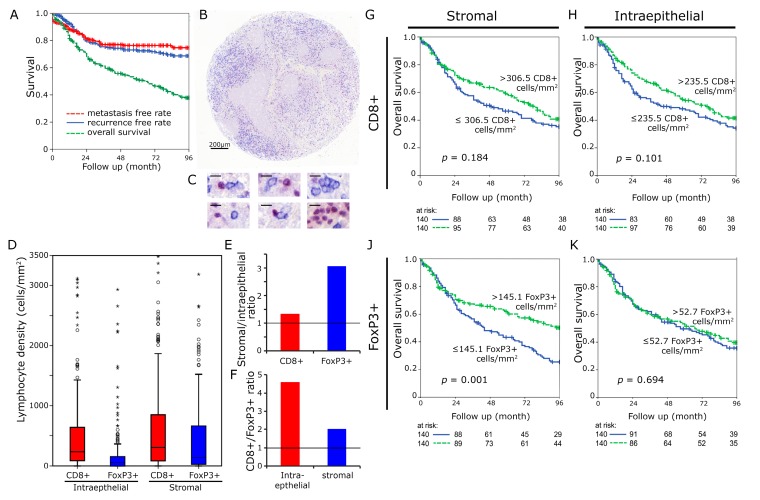
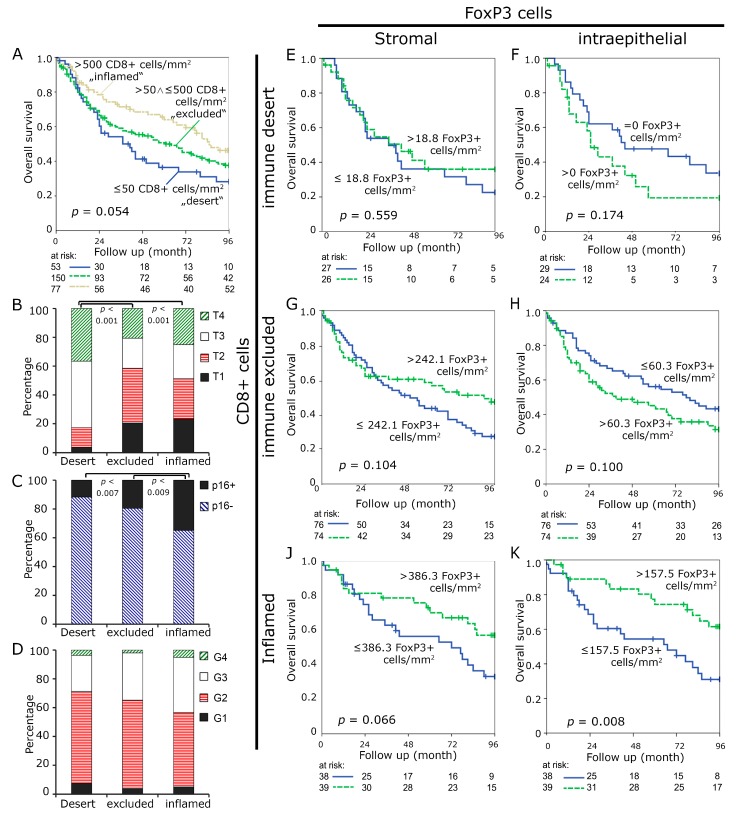
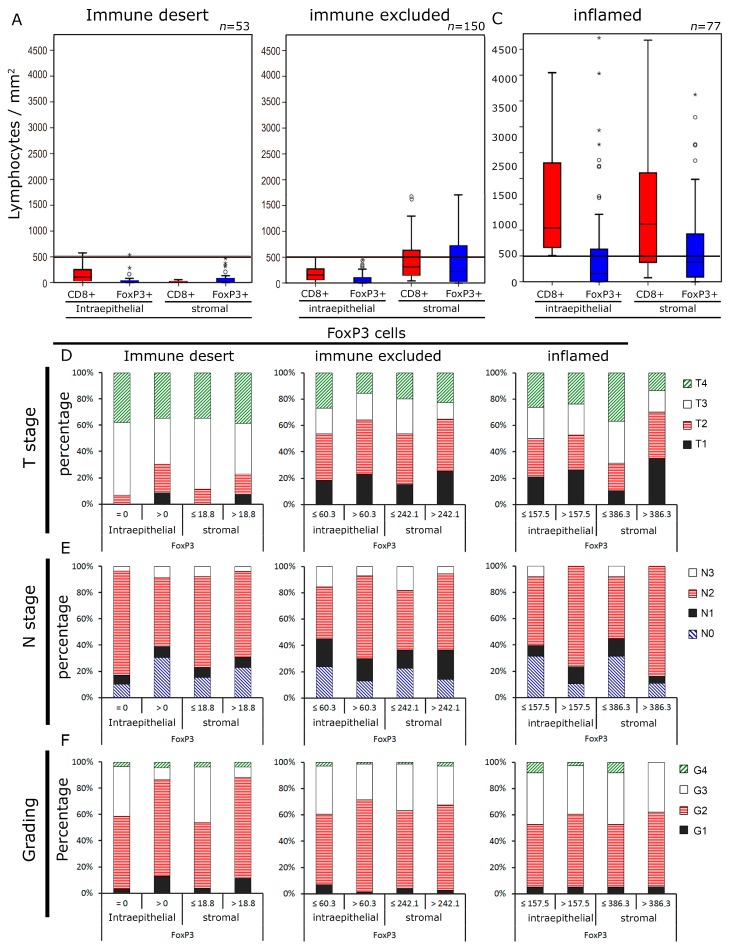
Background: The tumor immune status “inflamed”, “immune excluded”, and “desert” might serve as a predictive parameter. We studied these three cancer immune phenotypes while using a simple immunohistochemical algorithm. Methods: Pre-treatment tissue samples of 280 patients with locally advanced HNSCC treated with radiochemotherapy were analyzed. A double staining of CD8+ cytotoxic T cells (CTL) and FoxP3+ (Treg) was performed and the cell density was evaluated in the intraepithelial and stromal compartment of the tumor. Results: The classification of tumors as “immune desert” when stromal CTL were ≤ 50 cells/mm2, “inflamed” when intraepithelial CTL were > 500 cells/mm2, and as “excluded” when neither of these definitions met these cut off values allowed the best discrimination regarding overall survival. These groups had median OS periods of 37, 61, and 85 months, respectively. In “immune desert” and “immune excluded” tumors high Treg tended to worsen OS, but in “inflamed” tumors high Treg clearly improved OS. Conclusions: We propose that, in locally advanced HNSCC, the tumor immune state “inflamed”, “immune excluded”, and “immune desert” can be defined by intraepithelial and stromal CTL. Tregs can further subdivide these groups. The opposing effects of Tregs in the different groups might be the reason for the inconsistency of Tregs prognostic values published earlier.
Overview
The claims and statistics of this paper haven’t been checked yet.
Free: it reads the open-access text and checks the first 5 claims that cite a source we can check. Create a free account to check every claim.
Integrity signals
Registry
Cites
Statistics
Figures
Verification
Claims the paper makes
The claims and statistics of this paper haven’t been checked yet.
Free: it reads the open-access text and checks the first 5 claims that cite a source we can check. Create a free account to check every claim.
Claims other papers make about this one
Each is checked against this paper’s own text: does it say what the citing paper says it does?
The source backs part of the claim, not all of it — or backs it for a different population, condition or comparison.
In the citing paper
“Conversely, higher Tregs counts were associated with more undifferentiated tumors (p < 0.001) and more lymph node metastases (p = 0.039) in the “immune desert” group.”
From Potential anti-tumor effects of regulatory T cells in the tumor microenvironment: a review (2024) · cites this paper as [140]
Experimental — accuracy not yet measuredThe cited source says what the claim attributes to it.
In the citing paper
“In the “inflammatory” group of HNC, low stromal Tregs counts were correlated with larger tumor size (p < 0.001) and more lymph node metastases (p = 0.039).”
From Potential anti-tumor effects of regulatory T cells in the tumor microenvironment: a review (2024) · cites this paper as [140]
The cited source says what the claim attributes to it.
In the citing paper
“Additionally, Tregs counts in the “immune desert” group were linked to more undifferentiated cancers, including tumor grade (p = 0.018) [140].”
From Potential anti-tumor effects of regulatory T cells in the tumor microenvironment: a review (2024) · cites this paper as [140]
Self-check
Percentages, sums and reported differences re-computed from the paper’s own numbers.
The self-check needs the paper’s full text.
Citations
Cites
PD-1 blockade induces responses by inhibiting adaptive immune resistance
Tumeh, P. C., Harview, C. L., Yearley, J. H., Shintaku, I. P., Taylor, E. J. M., Robert, L., Chmielowski, B., Spasic, M., Henry, G., Ciobanu, V., et al. (2014) · Nature · doi:10.1038/nature13954 · Cited by 6,609 · cited 2×
“Checkpoint inhibitors activate cytotoxic immune cells, including CD8+ T cells, which, accordingly, are potential predictors of tumor response [5].”
BackgroundElements of cancer immunity and the cancer–immune set point
Chen, D. S., & Mellman, I. (2017) · Nature · doi:10.1038/nature21349 · Cited by 5,352 · cited 8×
“Besides immune cells, cell surface structures, cytokines, and tumor genetics or the microbiome may be used [6].”
BackgroundInfluentialCuriel, T. J., Coukos, G., Zou, L., Alvarez, X., Cheng, P., Mottram, P., Evdemon-Hogan, M., Conejo-Garcia, J. R., Zhang, L., Burow, M., et al. (2004) · Nature Medicine · doi:10.1038/nm1093 · Cited by 5,151 · cited 1×
“This is in accordance with the classical assumption that immunosuppressive Treg are associated with a worse prognosis of patients by suppressing anti-tumoural immunity [32].”
ResultNivolumab for Recurrent Squamous-Cell Carcinoma of the Head and Neck
Ferris, R. L., Blumenschein, G., Fayette, J., Guigay, J., Colevas, A. D., Licitra, L., Harrington, K., Kasper, S., Vokes, E. E., Even, C., et al. (2016) · New England Journal of Medicine · doi:10.1056/nejmoa1602252 · Cited by 5,101 · cited 1×
“In recurrent and/or metastatic head and neck squamous cell cancer (HNSCC) PD-1 inhibitors have response rates of around 13% in unselected patients [3] and also only 19% after PD-L1 based patient selection (CPS score ≥ 1) [4].”
BackgroundSakaguchi, S. (2005) · Nature Immunology · doi:10.1038/ni1178 · Cited by 2,669 · cited 1×
“However, FoxP3 appears to be the best single marker for Treg [31].”
BackgroundFOXP3+ regulatory T cells in the human immune system
Sakaguchi, S., Miyara, M., Costantino, C. M., & Hafler, D. A. (2010) · Nature Reviews Immunology · doi:10.1038/nri2785 · Cited by 2,439
Mechanisms of resistance to immune checkpoint inhibitors
Jenkins, R. W., Barbie, D. A., & Flaherty, K. T. (2018) · British Journal of Cancer · doi:10.1038/bjc.2017.434 · Cited by 1,383 · cited 1×
“Immune checkpoint inhibitors have exceptional anti-tumor activity in numerous cancer types [1] and they play a central role in the quickly changing therapeutic landscape of medical oncology [2].”
BackgroundSalama, P., Phillips, M., Grieu, F., Morris, M., Zeps, N., Joseph, D., Platell, C., & Iacopetta, B. (2009) · Journal of Clinical Oncology · doi:10.1200/jco.2008.18.7229 · Cited by 991
Shang, B., Liu, Y., Jiang, S.-J., & Liu, Y. (2015) · Scientific Reports · doi:10.1038/srep15179 · Cited by 985 · cited 3×
“This positive impact of FoxP3+ Tregs might be partially attributed to the down-regulation of a persistent inflammatory process, which could promote inflammation-driven tumor progression [13].”
BackgroundResultInfluentialPrognostic Value of Tumor-Infiltrating CD4+ T-Cell Subpopulations in Head and Neck Cancers
Badoual, C., Hans, S., Rodriguez, J., Peyrard, S., Klein, C., Agueznay, N. E. H., Mosseri, V., Laccourreye, O., Bruneval, P., Fridman, W. H., et al. (2006) · Clinical Cancer Research · doi:10.1158/1078-0432.ccr-05-1886 · Cited by 598 · cited 3×
“In contrast, in “inflamed” tumors, high Tregs were associated with significantly better overall survival, probably due to the down-regulation of harmful inflammatory reaction, which could favor tumor progression, as inflammation can induce tumorigenesis [9].”
BackgroundResult
Cited by
FoxP3+ T regulatory cells in cancer: Prognostic biomarkers and therapeutic targets
Saleh, R., & Elkord, E. (2020) · Cancer Letters · doi:10.1016/j.canlet.2020.07.022 · Cited by 352
Hydrogel drug delivery systems for minimally invasive local immunotherapy of cancer
Mikhail, A. S., Morhard, R., Mauda-Havakuk, M., Kassin, M., Arrichiello, A., & Wood, B. J. (2023) · Advanced Drug Delivery Reviews · doi:10.1016/j.addr.2023.115083 · Cited by 207
CD4+ T cells in antitumor immunity
Montauti, E. I., Oh, D. Y., & Fong, L. H. (2024) · Trends in cancer · doi:10.1016/j.trecan.2024.07.009 · Cited by 190
Tumor immune microenvironment in head and neck cancers
Chen, S. M. Y., Krinsky, A. L., Woolaver, R. A., Wang, X., Chen, Z., & Wang, J. H. (2020) · Molecular Carcinogenesis · doi:10.1002/mc.23162 · Cited by 179
“immunity; however, this function also limits the immune system to target neoplastic cells.(43,44) Moreover, peripheral Tregs can be recruited into the TME, where transforming growth factor (TGF‐β)”
BackgroundTowards a consensus definition of immune exclusion in cancer
Tiwari, A., Oravecz, T., Dillon, L. A. L., Italiano, A., Audoly, L., Fridman, W. H., & Clifton, G. T. (2023) · Frontiers in Immunology · doi:10.3389/fimmu.2023.1084887 · Cited by 129
“(52) looked at pre-treatment tissue samples of 280 patients with locally advanced head and neck squamous cell carcinomas (HNSCC).”
Background
Metadata
- Authors
- Echarti, A., Hecht, M., Büttner-Herold, M., Haderlein, M., Hartmann, A., Fietkau, R., & Distel, L.
- Affiliations
- Friedrich-Alexander-Universität Erlangen-Nürnberg (DE)
- Corresponding author
- Distel, Luitpold
- ORCID
- Venue
- Cancers
- Publisher
- MDPI AG
- Published
- 2019-09-19
- Volume
- 11
- Issue
- 9
- Pages
- 1398
- ISSN
- 2072-6694 (ISSN-L)
- PMC
- PMC6769847
- OpenAlex
- W2973362987
- Semantic Scholar
- b7ba5286cecc1321e90ef686f16b02346e360021
- Cited by
- 87
- References
- 40
- Citations by year
- 2026: 1 · 2025: 9 · 2024: 18 · 2023: 12 · 2022: 21 · 2021: 12 · 2020: 13
- FWCI
- 4.81
- Type
- journal article
- Language
- en
- Open access
- gold
- dx.doi.org
- Licence
- Locations
- Cancers (publishedVersion, cc-by)
- Europe PMC (PubMed Central) (publishedVersion, cc-by)
- PubMed Central (publishedVersion, cc-by)
- PubMed (publishedVersion)
- OPUS FAU (Kooperativer Bibliotheksverbund Berlin-Brandenburg (KOBV), on behalf of the Universitätsbibliothek Erlangen-Nürnberg) (submittedVersion, cc-by)
- DOAJ (DOAJ: Directory of Open Access Journals) (submittedVersion, cc-by-sa)
- Topics
- Health Sciences › Medicine › Oncology › Cancer Immunotherapy and Biomarkers
- Health Sciences › Medicine › Otorhinolaryngology › Head and Neck Cancer Studies
- Life Sciences › Immunology and Microbiology › Immunology › T-cell and B-cell Immunology
- Keywords
- head and neck squamous cell carcinoma, locally advanced cancer, tumor immune microenvironment, CD8+ cytotoxic T lymphocytes, regulatory T cells, Foxp3, tumor immune phenotype, immune desert, tumor-infiltrating lymphocytes, prognostic factors, overall survival, chemoradiotherapy
About these checks
Registry, retraction, Cites and statistics results are computed, not judged, with one exception: a printed reference that no index lists is read once by a model before it counts as a citation error. Claims are extracted by a model and kept only when their quote appears verbatim in the text; each cited source is then checked, with a model’s help, for whether it says what the claim relies on. Those verdicts can be wrong — read the claim’s quote and the cited source before relying on one.
Statistics and arithmetic are recomputed, not judged.
Confidence bands are shown only for fields calibrated on our annotated test set. None is calibrated yet, so no band is shown.
What counts as a claim ›How we measure confidence ›How we check this ›
Are you an author, or do you see a problem with this page? Request a review
How to cite
Cite CoChat for the checks on this page, and the paper for its own findings.
- This page
- CoChat. (2026). Citation check: CD8+ and Regulatory T cells Differentiate Tumor Immune Phenotypes and Predict Survival in Locally Advanced Head and Neck Cancer. https://app.cochat.ai/papers/10.3390/cancers11091398
- The paper
- Echarti, A., Hecht, M., Büttner-Herold, M., Haderlein, M., Hartmann, A., Fietkau, R., & Distel, L. (2019). CD8+ and Regulatory T cells Differentiate Tumor Immune Phenotypes and Predict Survival in Locally Advanced Head and Neck Cancer. Cancers. https://doi.org/10.3390/cancers11091398
Data sources
Bibliographic data: Semantic Scholar, OpenAlex, Crossref.
Contains information from the Semantic Scholar Academic Graph Datasets, made available under the ODC Attribution License (ODC-BY 1.0).
Semantic Scholar’s data is described in: Kinney, R., et al. (2023). The Semantic Scholar Open Data Platform. arXiv:2301.10140.
