

Should All Patients With HR-Positive HER2-Negative Metastatic Breast Cancer Receive CDK 4/6 Inhibitor As First-Line Based Therapy? A Network Meta-Analysis of Data from the PALOMA 2, MONALEESA 2, MONALEESA 7, MONARCH 3, FALCON, SWOG and FACT Trials
Open accessThe DOI matches its Crossref record; 37 of the 37 references it cites were found in a registry or an index.
Abstract
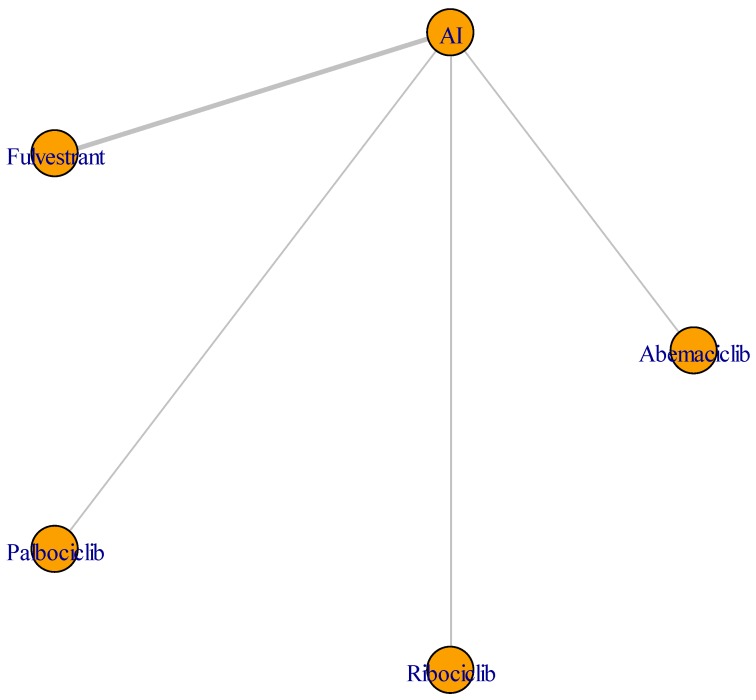
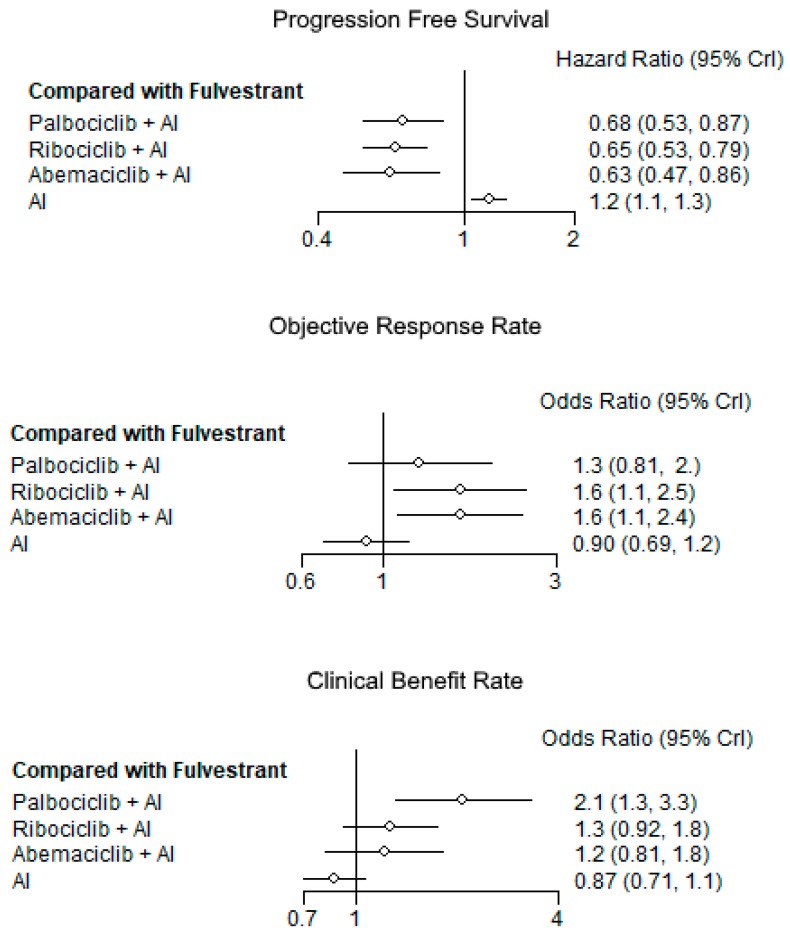
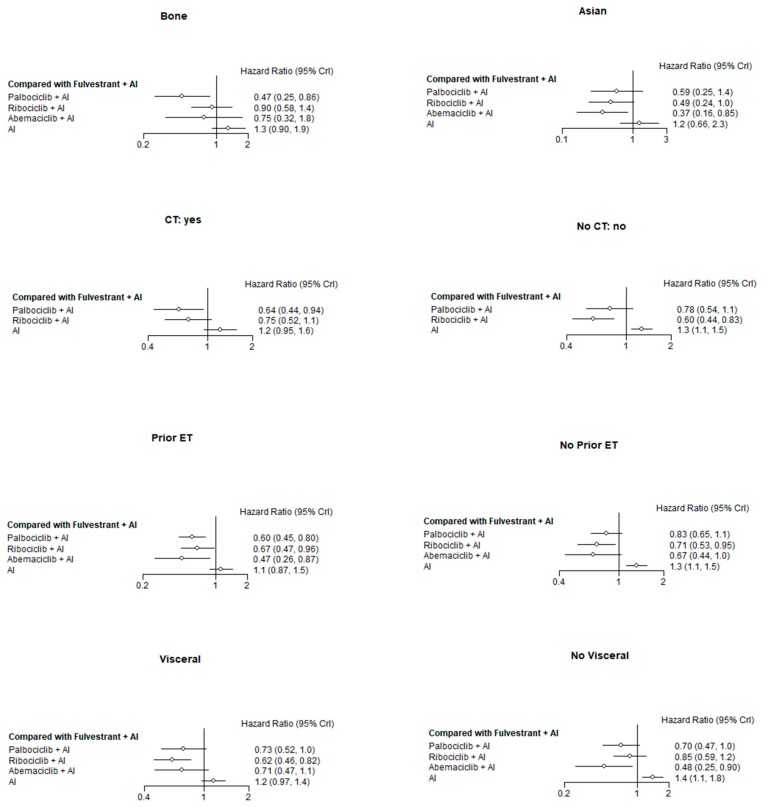
Background: We aim to understand whether all patients with hormonal receptor (HR)-positive (+)/human epidermal growth factor receptor-2 (HER2)-negative (−) metastatic breast cancer (MBC) should receive cyclin D-dependent kinase (CDK) 4/6 inhibitor-based therapy as a first-line approach. Methods: A network meta-analysis (NMA) using the Bayesian hierarchical arm-based model, which provides the estimates for various effect sizes, were computed. Results: First-line treatment options in HR+/HER2− MBC, including CDK 4/6 inhibitors combined with aromatase inhibitors (AIs) or fulvestrant (F), showed a significantly longer progression-free survival (PFS) in comparison with AI monotherapy, with a total of 26% progression risk reduction. In the indirect comparison across the three classes of CDK 4/6 inhibitors and F endocrine-based therapies, the first strategy resulted in longer PFS, regardless of specific CDK 4/6 inhibitor (HR: 0.68; 95% CrI: 0.53–0.87 for palbociclib + AI, HR: 0.65; 95% CrI: 0.53–0.79 for ribociclib + AI, HR: 0.63; 95% CrI: 0.47–0.86 for abemaciclib + AI) and patient’s characteristics. Longer PFS was also found in patients with bone-only and soft tissues limited disease treated with CDK 4/6 inhibitors. Conclusions: CDK 4/6 inhibitors have similar efficacy when associated with an AI in the first-line treatment of HR+ MBC, and are superior to either F or AI monotherapy, regardless of any other patients or tumor characteristics.
Overview
The claims and statistics of this paper haven’t been checked yet.
Free: it reads the open-access text and checks the first 5 claims that cite a source we can check. Create a free account to check every claim.
Integrity signals
Registry
Cites
Statistics
Figures
Verification
Claims the paper makes
The claims and statistics of this paper haven’t been checked yet.
Free: it reads the open-access text and checks the first 5 claims that cite a source we can check. Create a free account to check every claim.
Claims other papers make about this one
Each is checked against this paper’s own text: does it say what the citing paper says it does?
The source backs part of the claim, not all of it — or backs it for a different population, condition or comparison.
In the citing paper
“In recent years, a number of agents that improve patient outcomes have been approved by regulatory agencies in this setting, including those targeting the mammalian target of rapamycin, phosphatidylinositide 3-kinase, and cyclin-dependent kinase (CDK) pathways.3-5”
From E2112: Randomized Phase III Trial of Endocrine Therapy Plus Entinostat or Placebo in Hormone Receptor–Positive Advanced Breast Cancer. A Trial of the ECOG-ACRIN Cancer Research Group (2021) · cites this paper as [5]
Experimental — accuracy not yet measured
Self-check
Percentages, sums and reported differences re-computed from the paper’s own numbers.
The self-check needs the paper’s full text.
Citations
Cites
Sørlie, T., Perou, C. M., Tibshirani, R., Aas, T., Geisler, S., Johnsen, H., Hastie, T., Eisen, M. B., van de Rijn, M., Jeffrey, S. S., et al. (2001) · Proceedings of the National Academy of Sciences · doi:10.1073/pnas.191367098 · Cited by 10,938 · cited 2×
“Hormone receptor (HR)-positive (+) and human epidermal growth factor receptor type (HER2)-negative (−) metastatic breast cancer (MBC) represents the most common invasive cancer subtype in women [1].”
BackgroundPalbociclib and letrozole in advanced breast cancer
Finn, R. S., Martin, M., Rugo, H. S., Jones, S., Im, S.-A., Gelmon, K., Harbeck, N., Lipatov, O. N., Walshe, J. M., Moulder, S., et al. (2016) · New England Journal of Medicine · doi:10.1056/nejmoa1607303 · Cited by 3,007 · cited 5×
“PALOMA-2 Finn [12] 2016 III First-line therapy for MBC in patients not treated before for their metastatic disease.”
BackgroundMethodInfluentialAlpelisib for PIK3CA -Mutated, Hormone Receptor–Positive Advanced Breast Cancer
André, F., Ciruelos, E., Rubovszky, G., Campone, M., Loibl, S., Rugo, H. S., Iwata, H., Conte, P., Mayer, I. A., Kaufman, B., et al. (2019) · New England Journal of Medicine · doi:10.1056/nejmoa1813904 · Cited by 2,622 · cited 2×
“explored the safety and efficacy of only two CDK 4/6 inhibitors (palbociclib and ribociclib) in postmenopausal women after progression on a non-steroidal AI [35].”
BackgroundCristofanilli, M., Turner, N. C., Bondarenko, I., Ro, J., Im, S.-A., Masuda, N., Colleoni, M., DeMichele, A., Loi, S., Verma, S., et al. (2016) · The Lancet Oncology · doi:10.1016/s1470-2045(15)00613-0 · Cited by 1,827 · cited 1×
“In particular, palbociclib, ribociclib, and abemaciclib, the three available CDK 4/6 inhibitors, in combination with standard ET, showed progression-free survival (PFS) improvement in phase III trials, and have been approved for use in first and in later lines of therapy in women with HR+HER2− MBC, regardless of menop…”
BackgroundMONARCH 3: Abemaciclib As Initial Therapy for Advanced Breast Cancer
Goetz, M. P., Toi, M., Campone, M., Sohn, J., Paluch-Shimon, S., Huober, J., Park, I. H., Trédan, O., Chen, S.-C., Manso, L., et al. (2017) · Journal of Clinical Oncology · doi:10.1200/jco.2017.75.6155 · Cited by 1,744
Overall Survival with Palbociclib and Fulvestrant in Advanced Breast Cancer
Turner, N. C., Slamon, D. J., Ro, J., Bondarenko, I., Im, S.-A., Masuda, N., Colleoni, M., DeMichele, A., Loi, S., Verma, S., et al. (2018) · New England Journal of Medicine · doi:10.1056/nejmoa1810527 · Cited by 1,276 · cited 1×
“9) in the ET alone arm [18,19] In addition, also the SWOG trial has recently shown the median OS of 49.”
BackgroundTripathy, D., Im, S.-A., Colleoni, M., Franke, F., Bardia, A., Harbeck, N., Hurvitz, S. A., Chow, L., Sohn, J., Lee, K. S., et al. (2018) · The Lancet Oncology · doi:10.1016/s1470-2045(18)30292-4 · Cited by 1,025 · cited 4×
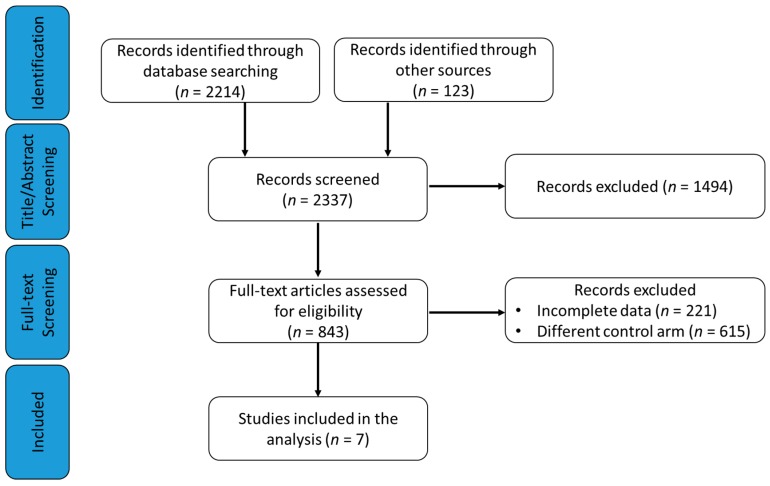
“ro g the search strategy, we identified four phase III trials comparing 1441 patients treated with CDK 4/6 inhibitors (palbociclib, ribociclibor, abemaciclib) in combination with an AI (1106 patients) [12–14], an AI plus ovarian fu ction suppression (OFS; 248 premenopausal patients), or tamoxifen plus OFS (87 premenop…”
MethodInfluentialOverall survival with ribociclib plus endocrine therapy in breast cancer
Im, S.-A., Lu, Y.-S., Bardia, A., Harbeck, N., Colleoni, M., Franke, F., Chow, L., Sohn, J., Lee, K.-S., Campos-Gomez, S., et al. (2019) · New England Journal of Medicine · doi:10.1056/nejmoa1903765 · Cited by 1,001
Overview of resistance to systemic therapy in patients with breast cancer
Gonzalez-Angulo, A. M., Morales-Vasquez, F., & Hortobagyi, G. N. (2007) · Advances in Experimental Medicine and Biology · doi:10.1007/978-0-387-74039-3_1 · Cited by 904 · cited 1×
“Almost two-thirds of women with newly diagnosed MBC have HR+ tumors, and approximately 25% of women with an early HR+ breast cancer diagnosis eventually relapse after adjuvant treatments [2].”
BackgroundHortobagyi, G. N., Stemmer, S. M., Burris, H. A., Yap, Y. S., Sonke, G. S., Paluch-Shimon, S., Campone, M., Petrakova, K., Blackwell, K. L., Winer, E. P., et al. (2018) · Annals of Oncology · doi:10.1093/annonc/mdy155 · Cited by 876 · cited 4×
“PALOMA-2 Palbociclib–letrozole Any AEs 62.2% 13.5% Neutropenia 56.1% 10.4% Leukopenia 24.1% 0.7% Placebo–letrozole Any AEs 22.1% 2.3% Neutropenia 0.9% 0.5% MONALEESA-2 Ribociclib–letrozole Neutropenia 52.4% 9.6% Abnormal LFT 8.4% 1.8% Leukopenia 20.1% 1.2% Placebo–letrozole Abnormal LFT 2.4% – Neutropenia, anemia, art…”
BackgroundMethodInfluential
Cited by
Recent progress of CDK4/6 inhibitors’ current practice in breast cancer
Wang, X., Zhao, S., Xin, Q., Zhang, Y., Wang, K., & Li, M. (2024) · Cancer Gene Therapy · doi:10.1038/s41417-024-00747-x · Cited by 163
“The fi ndings indicated a signi fi cant enhancement in both PFS and ORR when CDK4/6i were administered to patients with BM [55].”
MethodResistance and Overcoming Resistance in Breast Cancer
Luque-Bolivar, A., Pérez-Mora, E., Villegas, V. E., & Rondón‐Lagos, M. (2020) · Breast Cancer Targets and Therapy · doi:10.2147/bctt.s270799 · Cited by 163
Connolly, R. M., Zhao, F., Miller, K. D., Lee, M.-J., Piekarz, R. L., Smith, K. L., Brown-Glaberman, U. A., Winn, J. S., Faller, B. A., Onitilo, A. A., et al. (2021) · Journal of Clinical Oncology · doi:10.1200/jco.21.00944 · Cited by 125
A unique CDK4/6 inhibitor: Current and future therapeutic strategies of abemaciclib
Chong, Q.-Y., Kok, Z. H., Bui, N.-L.-C., Xiang, X., Wong, A. L., Yong, W. P., Sethi, G., Lobie, P. E., Wang, L., & Goh, B.-C. (2020) · Pharmacological Research · doi:10.1016/j.phrs.2020.104686 · Cited by 116
Roberto, M., Astone, A., Botticelli, A., Carbognin, L., Cassano, A., D’Auria, G., Fabbri, A., Fabi, A., Gamucci, T., Krasniqi, E., et al. (2021) · Cancers · doi:10.3390/cancers13020332 · Cited by 72
“A network meta-analysis, including patients treated with CDK4/6 inhibitors combined with aromatase inhibitors (AIs) or fulvestrant in comparison with AI or fulvestrant monotherapy, confirmed CDK4/6 inhibitors had similar efficacy when associated with an AI in the first-line treatment of HR+ ABC, and were superior to e…”
ResultSelf-citationO'Sullivan, C. C., Clarke, R. C., Goetz, M. P., & Robertson, J. F. R. (2023) · JAMA Oncology · doi:10.1001/jamaoncol.2023.2000 · Cited by 75
Abdelmalak, M., Singh, R., Anwer, M. I., Ivanchenko, P., Randhawa, A., Ahmed, M., Ashton, A. W., Du, Y., Jiao, X., & Pestell, R. G. (2022) · Cancers · doi:10.3390/cancers14215388 · Cited by 50
Munzone, E., Pagan, E., Bagnardi, V., Montagna, E., Cancello, G., Dellapasqua, S., Iorfida, M., Mazza, M., & Colleoni, M. A. (2021) · ESMO Open · doi:10.1016/j.esmoop.2021.100332 · Cited by 48
“These results, taken together, provide additional strength to the individual RCTs, supporting the use of CDK4/6 inhibitors in combination with ET as standard treatment of most HRþ MBC patients.(17,18) The results of the present meta-analysis point in the same direction, supporting the role of this treatment strategy i…”
ResultCDK4, CDK6/cyclin-D1 Complex Inhibition and Radiotherapy for Cancer Control: A Role for Autophagy
Nardone, V., Barbarino, M., Angrisani, A., Correale, P., Pastina, P., Cappabianca, S., Reginelli, A., Mutti, L., Miracco, C., Giannicola, R., et al. (2021) · International Journal of Molecular Sciences · doi:10.3390/ijms22168391 · Cited by 49
“Differently from the cytostatic effect alpociclib and ribociclib, abemaciclib achieved a durable cytotoxic effect in Rb-negative cells [70].”
BackgroundTreatment Strategies and Survival Outcomes in Breast Cancer
Cheung, K. (2020) · Cancers · doi:10.3390/cancers12030735 · Cited by 33
“carried out a network meta-analysis comparing the combination use of individual CDK4/6 inhibitors with fulvestrant or an aromatase inhibitor [13].”
MethodZhang, H., Wang, J., Li, J., Zhou, X., Yin, L., Wang, Y., Gu, Y., Niu, X., Yang, Y., Ji, H., et al. (2021) · Cancer Science · doi:10.1111/cas.14813 · Cited by 28
Elfgen, C., & Bjelic‐Radisic, V. (2021) · Cancers · doi:10.3390/cancers13235994 · Cited by 28
“However, an improved PFS was also observed in clinical trials with firstline CDK4/6 inhibitor therapy [24].”
Background‘Breast Cancer Resistance Likelihood and Personalized Treatment Through Integrated Multiomics’
Mehmood, S., Faheem, M. Q., Ismail, H., Farhat, S. M., Ali, M., Younis, S., & Asghar, M. N. (2022) · Frontiers in Molecular Biosciences · doi:10.3389/fmolb.2022.783494 · Cited by 28
Anti-Hormonal Therapy in Breast Cancer and Its Effect on the Blood-Brain Barrier
Curtaz, C. J., Kiesel, L., Meybohm, P., Wöckel, A., & Burek, M. (2022) · Cancers · doi:10.3390/cancers14205132 · Cited by 27
Im, Y., Karabulut, B., Lee, K. S., Park, B., Adhav, A. S., Çınkır, H. Y., Abdel‐Razeq, H., Chang, Y., Aksoy, S., Im, S., et al. (2021) · Breast Cancer Research and Treatment · doi:10.1007/s10549-021-06173-z · Cited by 21
Oligometastatic Breast Cancer: How to Manage It?
Barberi, V., Pietragalla, A., Franceschini, G., Marazzi, F., Paris, I., Cognetti, F., Masetti, R., Scambia, G., & Fabi, A. (2021) · Journal of Personalized Medicine · doi:10.3390/jpm11060532 · Cited by 18
“The pooled results of the metaanalysis showed no heterogeneity for all these subgroups, with a statistically significant improvement in PFS with a similar hazard ratio [60].”
BackgroundSelf-citationShao, H., Zhao, M., Guan, A., Shao, T., Zhou, D., Yu, G., & Tang, W. (2024) · BMC Medicine · doi:10.1186/s12916-023-03238-2 · Cited by 21
“All showing that the addition of CDK4/6i to endocrine therapy improves patient prognosis [9, 10, 13, 100–103].”
BackgroundApostolidou, K., Zografos, E., Papatheodoridi, A. M., Fiste, O., Dimopoulos, M. A., & Zagouri, F. (2024) · The Breast · doi:10.1016/j.breast.2024.103729 · Cited by 20
Palmieri, C., Musson, A., Harper-Wynne, C. L., Wheatley, D. A., Bertelli, G., Macpherson, I. R., Nathan, M., McDowall, E., Bhojwani, A. A., Verrill, M. W., et al. (2023) · British Journal of Cancer · doi:10.1038/s41416-023-02352-5 · Cited by 19
“The addition of a cyclindependent kinase 4/6 inhibitor (CDK4/6i) to an AI in the first-line setting for HR-positive, human epidermal growth factor 2-negative (HR-positive/HER2-negative) locally advanced or MBC has been shown to improve progression-free survival (PFS) [5, 6] and overall survival (OS) [7] compared to AI…”
Li, C., & Li, X. (2021) · OncoTargets and Therapy · doi:10.2147/ott.s298720 · Cited by 16
Cicini, M. P., Ferretti, G., Morace, N., Nisticò, C., Cognetti, F., & Rulli, F. (2021) · Breast Care · doi:10.1159/000519728 · Cited by 14
Self-citationDeClue, R. W., Fisher, M. D., Gooden, K., Walker, M. S., & Le, T. K. (2023) · Future Oncology · doi:10.2217/fon-2022-0894 · Cited by 13
Sim, S. H., Yang, H. N., Jeon, S. Y., Lee, K. S., & Park, I. H. (2021) · Scientific Reports · doi:10.1038/s41598-021-84999-9 · Cited by 15
Optimizing CDK4/6 inhibitors in advanced HR+/HER2- breast cancer: A personalized approach
Fontanella, C., Giorgi, C. A., Russo, S., Angelini, S., Nicolardi, L., Giarratano, T., Frezzini, S., Pestrin, M., Palleschi, D., Bolzonello, S., et al. (2022) · Critical Reviews in Oncology/Hematology · doi:10.1016/j.critrevonc.2022.103848 · Cited by 15
Therapy Algorithms for the Diagnosis and Treatment of Patients with Early and Advanced Breast Cancer
Schneeweiß, A., Bauerfeind, I., Fehm, T. N., Janni, W., Thomssen, C., Witzel, I., Wöckel, A., Müller, V., & on behalf of the Commission Breast of the Working Group Gynecologic Oncology (AGO) (2020) · Breast Care · doi:10.1159/000511925 · Cited by 13
Güren, A. K., Guliyev, M., Alan, Ö., Çadırci, K., Belevi, İ. N., Gültürk, İ., Özge, E., Kocaaslan, E., Ağyol, Y., Erel, P., et al. (2025) · Journal of Clinical Medicine · doi:10.3390/jcm14041071 · Cited by 13
“Clinical trials and real-world data investigations of ribociclib and palbociclib have revealed a heightened incidence of dose reductions among patients aged over 65 years [19–21].”
Sobrini-Morillo, P., Ravot, C., Herledan, C., Sánchez-Castellano, C., Cruz-Jentoft, A. J., & Falandry, C. (2024) · Seminars in Oncology · doi:10.1053/j.seminoncol.2024.01.003 · Cited by 10
In vitro anticancer effects of frankincense and its nanoemulsions for enhanced cancer cell targeting
Al-Balushi, R. A., Chaudhuri, A., Kandimalla, R., Haque, A., Alenezi, K. M., Saeed, M., Changez, M., Harthy, T. A., Al‐Hinaai, M. M., Siddiqui, S., et al. (2025) · Frontiers in Pharmacology · doi:10.3389/fphar.2025.1403780 · Cited by 11
Dawood, S. S., Konstantionva, M., Dent, R. A., Perazzo, F., Kim, S., Villarreal-Garza, C. M., Franco, S., Dai, M., & Simon, S. D. (2021) · BMC Proceedings · doi:10.1186/s12919-021-00224-5 · Cited by 10
Khanyile, R., Chipiti, T., Hull, R., & Dlamini, Z. (2025) · Cancers · doi:10.3390/cancers17050808 · Cited by 9
“As the understanding of the genomic landscape of breast cancer evolves, integrating genomic data with imaging findings will be crucial for optimizing treat-ment strategies and improving patient outcomes [80,81].”
Choi, Y., Park, S., Lee, S., Shin, H.-E., Kwon, S., Choi, J.-K., Lee, M.-H., Seo, S., & Lee, Y. (2023) · Biomolecules & Therapeutics · doi:10.4062/biomolther.2023.057 · Cited by 7
“For the treatment of hormone receptor-positive breast cancers, aromatase inhibitors, such as anastrozole and letrozole, in combination with cyclin-dependent kinase (CDK) 4/6 inhibitors are considered for the first-line therapy (Rossi et al., 2019; Waks and Winer, 2019).”
Chemotherapy for the Management of Cerebral Metastases
Foster, C. H., Dave, P., & Sherman, J. H. (2020) · Neurosurgery Clinics of North America · doi:10.1016/j.nec.2020.06.009 · Cited by 7
Geisler, J., Karihtala, P., Tuxen, M. K., Valachis, A., Delphi Panellist Group, Holm, B., Ahlin, C., Fosskaug, C. B., Bergqvist, J., Campos, A. B., et al. (2023) · Acta Oncologica · doi:10.1080/0284186x.2023.2254475 · Cited by 8
Minati, R., Cahuzac, M., Perrault, J., Lullier, V., Apavaloaei, A., Bonneil, É., Courcelles, M., Lanoix, J., Kina, E., Perreault, C., et al. (2025) · Cell Reports · doi:10.1016/j.celrep.2025.116676 · Cited by 5
Caputo, R., Fabi, A., Romagnoli, E., Baldini, E., Grasso, D., Fenderico, N., & Michelotti, A. (2022) · Breast Cancer Targets and Therapy · doi:10.2147/bctt.s376902 · Cited by 5
Self-citationFutamura, M., Nakayama, T., Yoshinami, T., Oshiro, C., Ishihara, M., Morita, M., Watanabe, A., Tanigichi, A., Tsukabe, M., Shimoda, M., et al. (2023) · Breast Cancer · doi:10.1007/s12282-023-01485-y · Cited by 4
Keskinkılıç, M., Semiz, H. S., Yavuzşen, T., & Öztop, İ. (2024) · Frontiers in Oncology · doi:10.3389/fonc.2024.1378563 · Cited by 6
Liu, S., Sun, X., Xu, X., & Lin, F. (2020) · Journal of Breast Cancer · doi:10.4048/jbc.2020.23.e55 · Cited by 5
González-Conde, M., Yáñez-Gómez, C., López‐López, R., & Costa, C. (2021) · Journal of Personalized Medicine · doi:10.3390/jpm11050407 · Cited by 4
“increase in the PFS, independent of the patients’ features [23].”
BackgroundHu, Q., Kang, W., Wang, Q., & Luo, T. (2022) · BMJ Open · doi:10.1136/bmjopen-2021-056374 · Cited by 4
Research advances in treatment strategies for breast cancer liver metastases: A comprehensive review
Yan, L., & Tao, P. (2025) · iLiver · doi:10.1016/j.iliver.2025.100186 · Cited by 6
Chen, Z.-L., Fu, Z., Zhang, N., Zou, W., & Chen, W. (2025) · BMC Pharmacology and Toxicology · doi:10.1186/s40360-025-00862-x · Cited by 4
Kolyadina, I. V. (2021) · Tumors of female reproductive system · doi:10.17650/1994-4098-2021-17-2-58-67 · Cited by 3
Galactionova, K., Loibl, S., Salari, P., Marmé, F., Martín, M., Untch, M., Bonnefoi, H. R., Kim, S., Bear, H. D., McCarthy, N., et al. (2022) · Frontiers in Oncology · doi:10.3389/fonc.2022.886831 · Cited by 3
Martin, S., Pflumio, C., Trensz, P., Schaff-Wendling, F., Kalish‐Weindling, M., Fischbach, C., Pierard, L., Limacher, J., Nader, R., Velten, M., et al. (2022) · Clinical Breast Cancer · doi:10.1016/j.clbc.2022.10.006 · Cited by 3
Pan, B., Hao, Z., Xu, Y., Wang, Z., Yao, R., Wang, X., Ren, C., Zhou, Y., Sun, Q., & Huo, L. (2022) · Frontiers in Oncology · doi:10.3389/fonc.2022.1095779 · Cited by 4
Насретдинов, А. Ф., Султанбаева, Н. И., Мусин, Ш. И., Lipatov, O. N., Измайлов, А. А., Ayupov, R. Т., Меньшиков, К. В., Пушкарев, А. В., & Султанбаев, А. В. (2020) · Meditsinskiy sovet = Medical Council · doi:10.21518/2079-701x-2020-20-40-46 · Cited by 3
Huang, H.-Y., Lin, L. Z. Y., Lu, X., & Jiang, Y. (2025) · Discover Oncology · doi:10.1007/s12672-025-02545-9 · Cited by 2
“In recent years, the research of fluorine chemistry in the field of medicine has been deepening, and a number of fluo-rine-containing medicines have been introduced, such as fulvestrant, Enhertu, abemaciclib, etc. [15–17].”
Pérez, A. R., Felip, E., Chicas-Sett, R., Montero-Luis, Á., Arias, L. D. P., del Alba, A. G., López‐Campos, F., López, C., Hernando, O., Conde-Moreno, A. J., et al. (2022) · Clinical & Translational Oncology · doi:10.1007/s12094-022-03011-6 · Cited by 3
Liang, H., Yin, G., Shi, G., Liu, X., Liu, Z., & Li, J. (2023) · Current Computer - Aided Drug Design · doi:10.2174/0115734099269728231115060827 · Cited by 1
Luan, D., Zhang, X., Zhang, Z. Y., Man, X., & Hai, B. (2026) · Journal of Orthopaedic Surgery and Research · doi:10.1186/s13018-026-07042-5 · Cited by 1
Fabi, A., Buono, G., Bria, E., Bianchini, G., Curigliano, G., Laurentiis, M. D., Placido, S. D., Mastro, L. D., Guarneri, V., Generali, D., et al. (2022) · Frontiers in Oncology · doi:10.3389/fonc.2022.950861 · Cited by 1
Self-citationСултанбаев, А. В., Насретдинов, А. Ф., Султанбаева, Н. И., Меньшиков, К. В., Мусин, Ш. И., Измайлов, А. А., Lipatov, O. N., Пушкарев, В. А., Валиахмедов, Р. Б., Пушкарев, А. В., et al. (2021) · Malignant tumours · doi:10.18027/2224-5057-2020-10-3 · Cited by 1
Liquid Biopsy: New Tool to Overcome CDKi Resistance Mechanism in Luminal Metastatic Breast CancerPreprint
González-Conde, M., Yáñez-Gómez, C., López‐López, R., & Costa, C. (2021) · Preprints.org · doi:10.20944/preprints202103.0063.v1
“A more profound understanding of molecular differences is necessary for the precise use of this drugs in the clinic setting, although it was confirmed the comparable efficacy of these inhibitors by increasing Progression Free Survival (PFS) independently of patients features [24].”
BackgroundRyspayeva, D. (2021) · Practical oncology · doi:10.22141/2663-3272.4.1.2021.229867
The effects of anticancer therapies on bone metastases in breast cancer
Arias-Pinilla, G. A., & Brown, J. (2021) · Elsevier eBooks · doi:10.1016/b978-0-12-821666-8.00069-4
Therapiealgorithmen für das Mammakarzinom
Blohmer, J., Schneeweiß, A., Bauerfeind, I., Fehm, T. N., Müller, V., Thomssen, C., Witzel, I., Wöckel, A., & Janni, W. (2021) · Der Onkologe · doi:10.1007/s00761-021-01060-0
Choi, K. H., Park, C. S., Kim, S. H., Kim, N. W., Lee, J. H., Kim, J. Y., Park, I., Seong, M. K., Kim, H., & Noh, W. C. (2021) · Journal of Breast Disease · doi:10.14449/jbd.2021.9.2.65
“The PALOMA-2, a phase III clinical trial, showed that the combination of palbociclib and letrozole as first-line therapy significantly improved the disease-free survival in patients with advanced HR-positive/HER2-negative breast cancer [7-9].”
BackgroundEditorial Board (2021) · Journal of Modern Oncology · doi:10.26442/18151434.2021.1.200764
The Combination Therapy in Breast Cancer Treatment
Liu, Q., Mei, Y., Zhang, W., & Zhang, Y. (2022) · Highlights in Science Engineering and Technology · doi:10.54097/hset.v8i.1219
“To reduce the drug resistance in HR+ breast cancer, adding CDK4/6 inhibitors in endocrine therapy is recommend and have been made with some success [18].”
BackgroundZiobro, M., & Grela-Wojewoda, A. (2023) · Biomedicines · doi:10.3390/biomedicines11020510 · Cited by 3
“randomized clinical trials comparing these three drugs, meta-analyses and attempts at direct comparisons have shown that they have similar efficacy [13,14].”
BackgroundShao, H., Zhao, M., Guan, A.-J., Shao, T., Zhou, D., Yu, G., & Tang, W. (2024) · Figshare · doi:10.6084/m9.figshare.24987711
Shao, H., Zhao, M., Guan, A.-J., Shao, T., Zhou, D., Yu, G., & Tang, W. (2024) · Figshare · doi:10.6084/m9.figshare.24987922
Müller, L., Schmidt, K., & Meier, P. (2021) · Asian journal of Current Research in Clinical Cancer · doi:10.51847/1bjvmejvrj
Brufsky, A., Layman, R. M., Liu, X., Li, B., McRoy, L., Cohen, A., Estévez, M., Cottu, P. H., Curigliano, G., & Rugo, H. S. (2026) · The Breast · doi:10.1016/j.breast.2026.104744
Tan, Y., Ye, Y., Zhao, W., 江杭舫, Wang, J., Zhao, J., & Ma, F. (2026) · Cancer Biology & Therapy · doi:10.1080/15384047.2026.2683159
“7,8 9-12 To date, no studies have evaluated the efficacy and safety profiles of CDK4/6 inhibitors in patients residing in plains versus high-altitude regions.”
Guan, M., & Hao, H. (2026) · Cancers · doi:10.3390/cancers18152376
“Subgroup analyses showed benefits in older patients (>70 years; pooled median PFS 18.6 vs. 10.9 months; hazard ratio, 0.56) and patients with visceral metastases, although the presence of liver metastases was associated with poorer outcomes [32,33].”
InfluentialDrug resistance in breast cancer brain metastasis: mechanisms and therapeutic strategies
Sarker, P., & Rao, S. S. (2026) · Biochimica et Biophysica Acta (BBA) - Reviews on Cancer · doi:10.1016/j.bbcan.2026.189684 · Cited by 1
Karatlı, S., Yazılıtaş, D., & Altınbaş, M. (2026) · Expert Review of Anticancer Therapy · doi:10.1080/14737140.2026.2733826
Metadata
- Authors
- Rossi, V., Berchialla, P., Giannarelli, D., Nisticò, C., Ferretti, G., Gasparro, S., Russillo, M., Catania, G., Vigna, L., Mancusi, R. L., Bria, E., Montemurro, F., Cognetti, F., & Fabi, A.
- Affiliations
- Azienda Ospedaliera San Camillo-Forlanini (IT)
- University of Turin (IT)
- Instituto Nazionale Tumori Regina Elena (IT)
- University of Rome Tor Vergata (IT)
- Università Cattolica del Sacro Cuore (IT)
- Candiolo Cancer Institute (IT)
- Sapienza University of Rome (IT)
- Corresponding author
- Fabi, Alessandra
- ORCID
- Venue
- Cancers
- Publisher
- MDPI AG
- Published
- 2019-10-26
- Volume
- 11
- Issue
- 11
- Pages
- 1661
- ISSN
- 2072-6694 (ISSN-L)
- PMC
- PMC6896062
- OpenAlex
- W2981795130
- Cited by
- 70
- References
- 37
- Citations by year
- 2026: 6 · 2025: 7 · 2024: 7 · 2023: 8 · 2022: 12 · 2021: 23 · 2020: 7
- FWCI
- 1.77
- Type
- journal article
- Language
- en
- Open access
- gold
- dx.doi.org
- Licence
- Locations
- Cancers (publishedVersion, cc-by)
- Europe PMC (PubMed Central) (publishedVersion, cc-by)
- PubMed Central (publishedVersion, cc-by)
- PubMed (publishedVersion)
- Institutional Research Information System University of Turin (University of Turin) (submittedVersion, other-oa)
- DOAJ (DOAJ: Directory of Open Access Journals) (submittedVersion, cc-by-sa)
- Funders
- Pfizer
- Celgene
- Helsinn
- Topics
- Health Sciences › Medicine › Oncology › Advanced Breast Cancer Therapies
- Life Sciences › Biochemistry, Genetics and Molecular Biology › Cancer Research › Breast Cancer Treatment Studies
- Health Sciences › Medicine › Oncology › PARP inhibition in cancer therapy
- Keywords
- HR-positive HER2-negative metastatic breast cancer, CDK4/6 inhibitors, first-line therapy, aromatase inhibitors, fulvestrant, palbociclib, ribociclib, abemaciclib, progression-free survival, endocrine therapy, soft tissue disorders
About these checks
Registry, retraction, Cites and statistics results are computed, not judged, with one exception: a printed reference that no index lists is read once by a model before it counts as a citation error. Claims are extracted by a model and kept only when their quote appears verbatim in the text; each cited source is then checked, with a model’s help, for whether it says what the claim relies on. Those verdicts can be wrong — read the claim’s quote and the cited source before relying on one.
Statistics and arithmetic are recomputed, not judged.
Confidence bands are shown only for fields calibrated on our annotated test set. None is calibrated yet, so no band is shown.
What counts as a claim ›How we measure confidence ›How we check this ›
Are you an author, or do you see a problem with this page? Request a review
Data sources
Bibliographic data: Semantic Scholar, OpenAlex, Crossref.
Contains information from the Semantic Scholar Academic Graph Datasets, made available under the ODC Attribution License (ODC-BY 1.0).
Semantic Scholar’s data is described in: Kinney, R., et al. (2023). The Semantic Scholar Open Data Platform. arXiv:2301.10140.
