

HER3 Alterations in Cancer and Potential Clinical Implications
Open accessThe DOI matches its Crossref record; 152 of the 155 references it cites were found in a registry or an index.
Abstract
In recent years, the third member of the HER family, kinase impaired HER3, has become a target of interest in cancer as there is accumulating evidence that HER3 plays a role in tumor growth and progression. This review focuses on HER3 activation in bladder, breast, colorectal, and lung cancer disease progression. HER3 mutations occur at a rate up to ~10% of tumors dependent on the tumor type. With patient tumors routinely sequenced for gene alterations in recent years, we have focused on HER3 mutations in bladder, breast, colon, and lung cancers particularly in response to targeted therapies and the potential to become a resistance mechanism. There are currently several HER3 targeting drugs in the pipeline, possibly improving outcomes for cancer patients with tumors containing HER3 activation and/or alterations.
Overview
The claims and statistics of this paper haven’t been checked yet.
Free: it reads the open-access text and checks the first 5 claims that cite a source we can check. Create a free account to check every claim.
Integrity signals
Registry
Cites
Statistics
Figures




Verification
Claims the paper makes
The claims and statistics of this paper haven’t been checked yet.
Free: it reads the open-access text and checks the first 5 claims that cite a source we can check. Create a free account to check every claim.
Claims other papers make about this one
Each is checked against this paper’s own text: does it say what the citing paper says it does?
In the citing paper
“HER3 displays intrinsically low kinase activity and must dimerize with either another EGFR-family member, including HER2 and EGFR, or a non-EGFR receptor tyrosine kinase (RTKs), including fibroblast growth factor receptor (FGFR), MET, or Axl to stimulate cell survival and proliferation signaling [38].”
From Recent Advances in Therapeutic Strategies to Improve Colorectal Cancer Treatment (2024) · cites this paper as [38]
Self-check
Percentages, sums and reported differences re-computed from the paper’s own numbers.
The self-check needs the paper’s full text.
Citations
Cites
PD-1 and PD-L1 Immune Checkpoint Blockade to Treat Breast Cancer
Hartkopf, A. D., Taran, F.-A., Wallwiener, M., Walter, C. B., Krämer, B., Grischke, E.-M., & Brucker, S. Y. (2016) · Breast Care · doi:10.1159/000453569 · Cited by 30,845
Cerami, E., Gao, J., Dogrusoz, U., Gross, B. E., Sumer, S. O., Aksoy, B. A., Jacobsen, A., Byrne, C. J., Heuer, M. L., Larsson, E., et al. (2012) · Cancer Discovery · doi:10.1158/2159-8290.cd-12-0095 · Cited by 17,455
Siegel, R. L., Miller, K. D., Fuchs, H. E., & Jemal, A. (2022) · CA: A Cancer Journal for Clinicians · doi:10.3322/caac.21708 · Cited by 17,196 · cited 3×
“Slightly more common in men and older populations, the overall 5-year survival rate for colon cancer is 63% [87].”
BackgroundInfluentialIntegrative Analysis of Complex Cancer Genomics and Clinical Profiles Using the cBioPortal
Gao, J., Aksoy, B. A., Dogrusoz, U., Dresdner, G., Gross, B., Sumer, S. O., Sun, Y., Jacobsen, A., Sinha, R., Larsson, E., et al. (2013) · Science Signaling · doi:10.1126/scisignal.2004088 · Cited by 15,160 · cited 9×
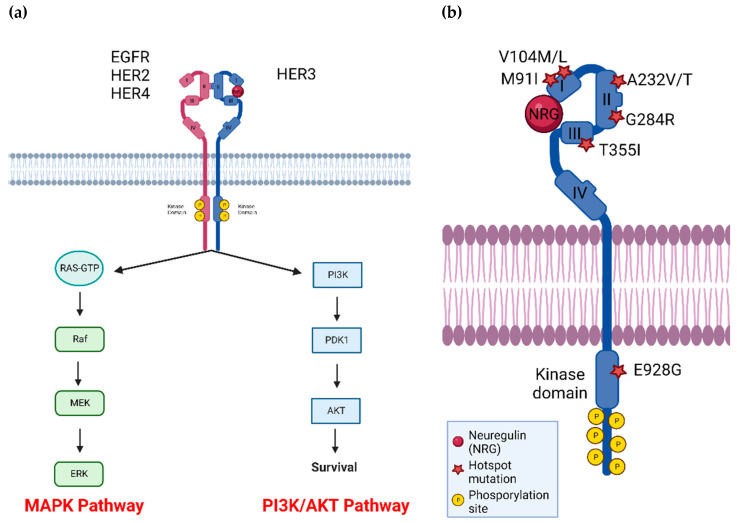
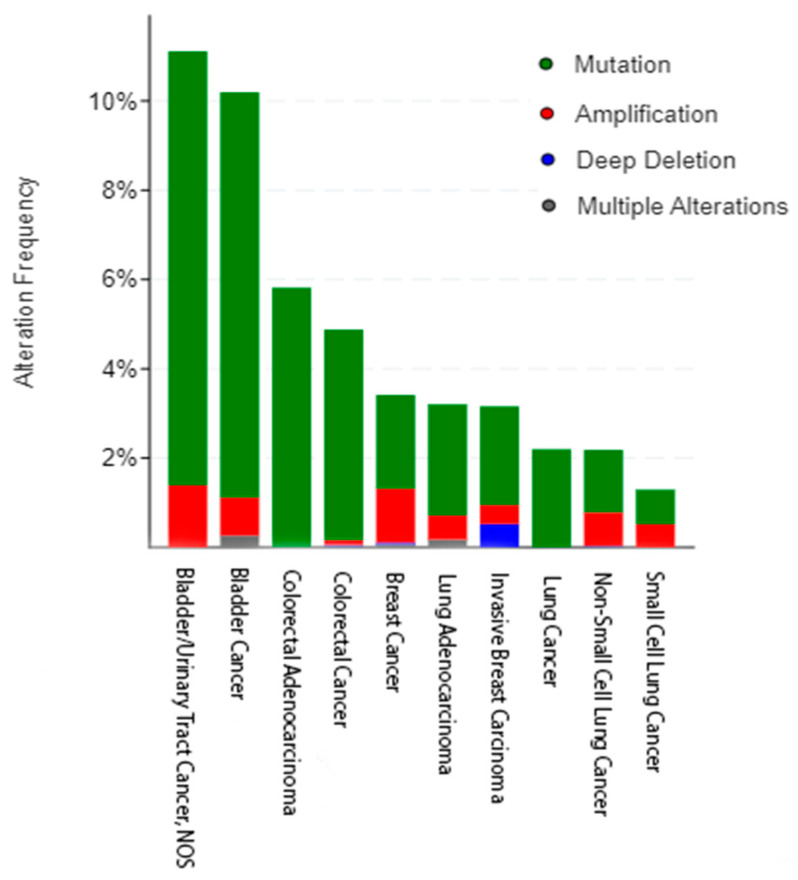
“This review will focus on the role of HER3 in bladder, breast, colorectal, and lung cancers including HER3 alterations, as HER3 alterations are frequently found in these subsets (Figure 2), and discuss the top HER3 mutations seen across each tumor type (Figure 1b) [27,28].”
BackgroundInfluentialMET Amplification Leads to Gefitinib Resistance in Lung Cancer by Activating ERBB3 Signaling
Engelman, J. A., Zejnullahu, K., Mitsudomi, T., Song, Y., Hyland, C., Park, J. O., Lindeman, N., Gale, C.-M., Zhao, X., Christensen, J., et al. (2007) · Science · doi:10.1126/science.1141478 · Cited by 4,496
Genotypic and Histological Evolution of Lung Cancers Acquiring Resistance to EGFR Inhibitors
Sequist, L. V., Waltman, B. A., Dias-Santagata, D., Digumarthy, S., Turke, A. B., Fidias, P., Bergethon, K., Shaw, A. T., Gettinger, S., Cosper, A. K., et al. (2011) · Science Translational Medicine · doi:10.1126/scitranslmed.3002003 · Cited by 3,499
Zehir, A., Benayed, R., Shah, R. H., Syed, A., Middha, S., Kim, H. R., Srinivasan, P., Gao, J., Chakravarty, D., Devlin, S. M., et al. (2017) · Nature Medicine · doi:10.1038/nm.4333 · Cited by 3,380 · cited 4×
“Later studies showed that certain HER3 mutations were found to be oncogenic, and in recent years, further papers have focused on the role mutant HER3 and other HER3 alterations play in different types of cancers [26,29,30].”
BackgroundInfluentialTriple-negative breast cancer: challenges and opportunities of a heterogeneous disease
Bianchini, G., Balko, J. M., Mayer, I. A., Sanders, M. E., & Gianni, L. (2016) · Nature Reviews Clinical Oncology · doi:10.1038/nrclinonc.2016.66 · Cited by 3,079
Harbeck, N., Penault-Llorca, F., Cortes, J., Gnant, M., Houssami, N., Poortmans, P., Ruddy, K., Tsang, J., & Cardoso, F. (2019) · Nature Reviews Disease Primers · doi:10.1038/s41572-019-0111-2 · Cited by 3,024
Olayioye, M. A. (2000) · The EMBO Journal · doi:10.1093/emboj/19.13.3159 · Cited by 2,434
Cited by
HER2/PI3K/AKT pathway in HER2-positive breast cancer: A review
Pan, L., Li, J., Xu, Q., Gao, Z., Yang, M., Wu, X., & Li, X. (2024) · Medicine · doi:10.1097/md.0000000000038508 · Cited by 175
Recent Advances in Therapeutic Strategies to Improve Colorectal Cancer Treatment
Gmeiner, W. H. (2024) · Cancers · doi:10.3390/cancers16051029 · Cited by 78
“…displays intrinsically low kinase activity and must dimerize with either another EGFR-family member, including HER2 and EGFR, or a non-EGFR receptor tyrosine kinase (RTKs), including fibroblast growth factor receptor (FGFR), MET, or Axl to stimulate cell survival and proliferation signaling [38].”
BackgroundEmerging importance of HER3 in tumorigenesis and cancer therapy
Garrett, J. T., Tendler, S., Feroz, W., Kilroy, M. K., & Yu, H. A. (2025) · Nature Reviews Clinical Oncology · doi:10.1038/s41571-025-01008-y · Cited by 46
Self-citationTargeting HER3 to overcome EGFR TKI resistance in NSCLC
Chen, Q., Jia, G., Zhang, X., & Ma, W. (2024) · Frontiers in Immunology · doi:10.3389/fimmu.2023.1332057 · Cited by 40
Triple-negative breast cancer: from none to multiple therapeutic targets in two decades
Carvalho, F. M. (2023) · Frontiers in Oncology · doi:10.3389/fonc.2023.1244781 · Cited by 34
Alonso-Valenteen, F., Mikhael, S., Wang, H., Sims, J. D., Taguiam, M., Teh, J., Sances, S., Wong, M., Miao, T., Srinivas, D., et al. (2025) · Nature Nanotechnology · doi:10.1038/s41565-025-01867-7 · Cited by 29
Antibody-drug conjugates as game changers in bladder cancer: current progress and future directions
Zhang, F., & Li, S. (2025) · Frontiers in Immunology · doi:10.3389/fimmu.2025.1591191 · Cited by 21
HER3: Updates and current biology function, targeted therapy and pathologic detecting methods
Gao, L., Zhang, Y., Feng, M., Shen, M., Yang, L., Wei, B., Zhou, Y., & Zhang, Z. (2024) · Life Sciences · doi:10.1016/j.lfs.2024.123087 · Cited by 19
Long road towards effective HER3 targeting in breast cancer
Papa, F., Grinda, T., Rassy, E., Cheikh-Hussin, R., Ribeiro, J. M., Antonuzzo, L., & Pistilli, B. (2024) · Cancer Treatment Reviews · doi:10.1016/j.ctrv.2024.102786 · Cited by 18
Colorectal Cancer: Risk Factors, Novel Approaches in Molecular Screening and Treatment.
Anbari, K., & Ghanadi, K. (2025) · PubMed Central · doi:10.22088/ijmcm.bums.14.1.576 · Cited by 17
Desai, O., Rathore, M. G., Boutros, C. S., Wright, M., Bryson, E., Curry, K., & Wang, R. (2024) · Genes & Diseases · doi:10.1016/j.gendis.2024.101354 · Cited by 12
Li, W., Xie, C., Zhu, X., Tang, J., Wang, L., & Lou, L. (2024) · Acta Pharmacologica Sinica · doi:10.1038/s41401-023-01221-4 · Cited by 11
The Therapeutic Significance of HER3 in Non-small Cell Lung Cancer (NSCLC): A Review Study
Trinder, A., Ding, K., & Zhang, J. (2024) · Current Medicinal Chemistry · doi:10.2174/0109298673269305231115102542 · Cited by 9
Antibody-drug conjugates in the treatment of advanced triple-negative breast cancer
Kubiatowski, T., & Kalinka‐Warzocha, E. (2025) · Menopause Review/Przegląd Menopauzalny · doi:10.5114/pm.2025.154681 · Cited by 6
Urano, T., Yokota, E., Iwai, M., Yukawa, T., Naomoto, Y., Takigawa, N., Fujiwara, H., Akiyama, T., Haisa, M., Fukazawa, T., et al. (2025) · Human Cell · doi:10.1007/s13577-025-01206-x · Cited by 4
HER3 V104 mutations regulate cell signaling, growth, and drug sensitivity in cancer
Mishra, R., Kilroy, M. K., Feroz, W., Patel, H. M., & Garrett, J. T. (2024) · Molecular Carcinogenesis · doi:10.1002/mc.23743 · Cited by 3
Self-citationHao, S., Yan, J.-H., Wang, R., Ge, G., Si, M.-C., Niu, Y.-F., Cai, Z.-H., Zheng, W., Zhao, C.-G., Li, X., et al. (2026) · Bioorganic & Medicinal Chemistry · doi:10.1016/j.bmc.2026.118637 · Cited by 1
Pérez, C. G., Aras, E. L., Saiz-López, P., García-Toro, E., Abad, C. B., Ledesma, I. R., González, M. P., Domínguez, M. V., Cabria, N. E., & Herrero, G. C. (2024) · Clinical & Translational Oncology · doi:10.1007/s12094-024-03651-w · Cited by 1
Gulyaeva, L. F., Филипенко, М. Л., & Кушлинский, Н. Е. (2025) · Advances in molecular oncology · doi:10.17650/2313-805x-2025-12-1-8-13
MelCher5k/BRAF+ subcutaneous human melanoma xenograft with CD20 expression
Mikhaylova, I. N., Treshalina, H. M., Karshieva, S. S., Khochenkov, D. A., Андронова, Н. В., Shubina, I. Z., & Kiselevskiy, M. V. (2025) · Advances in molecular oncology · doi:10.17650/2313-805x-2025-12-2-68-76
Reprogramming viral entry for precision therapeutics
Medina‐Kauwe, L. K. (2026) · Open Access Government · doi:10.56367/oag-050-12372
Chan, J. K., Rothe, M., Garrett-Mayer, E. S., Pisick, E. P., Ghatalia, P., Gregory, A., deShazo, M., Mileham, K. F., Murphy, M. C., Alese, O. B., et al. (2026) · JCO Precision Oncology · doi:10.1200/po-25-01250
Tracking Bone Loss in GLP-1RA Therapy: The Potential of the Deoxypyridinoline Urine Test
Margoni, A., Basdra, E. K., & Papavassiliou, A. G. (2026) · Diagnostics · doi:10.3390/diagnostics16132128
New and Novel Agents for Advanced Bladder Cancer
Superdock, M., Iyer, G., & Milowsky, M. I. (2026) · Urologic Clinics of North America · doi:10.1016/j.ucl.2026.06.010
Metadata
- Authors
- Kilroy, M. K., Park, S., Feroz, W., Patel, H., Mishra, R., Alanazi, S., & Garrett, J. T.
- Affiliations
- University of Cincinnati (US)
- Department of Pharmaceutical Sciences, James L. Winkle College of Pharmacy, University of Cincinnati, Cincinnati, OH 45267, USA
- Harold C. Simmons Comprehensive Cancer Center (US)
- Corresponding author
- Garrett, Joan T.
- ORCID
- Venue
- Cancers
- Publisher
- MDPI AG
- Published
- 2022-12-14
- Volume
- 14
- Issue
- 24
- Pages
- 6174
- ISSN
- 2072-6694 (ISSN-L)
- PMC
- PMC9776947
- OpenAlex
- W4311793976
- Cited by
- 21
- References
- 155
- Citations by year
- 2026: 4 · 2025: 6 · 2024: 10 · 2023: 1
- FWCI
- 0.52
- Type
- journal article
- Language
- en
- Open access
- gold
- doi.org
- Licence
- Locations
- Cancers (publishedVersion, cc-by)
- PubMed Central (publishedVersion, cc-by)
- PubMed (publishedVersion)
- DOAJ (DOAJ: Directory of Open Access Journals) (submittedVersion, cc-by-sa)
- Funders
- American Cancer Society (RSG-20-071-01-TBG)
- Topics
- Health Sciences › Medicine › Oncology › HER2/EGFR in Cancer Research
- Health Sciences › Medicine › Pulmonary and Respiratory Medicine › Lung Cancer Treatments and Mutations
- Life Sciences › Biochemistry, Genetics and Molecular Biology › Cancer Research › Cancer Mechanisms and Therapy
- Keywords
- HER3, ErbB receptors, bladder cancer, breast cancer, colorectal cancer, lung cancer, tumor progression, targeted therapy resistance, genetic alterations
About these checks
Registry, retraction, Cites and statistics results are computed, not judged, with one exception: a printed reference that no index lists is read once by a model before it counts as a citation error. Claims are extracted by a model and kept only when their quote appears verbatim in the text; each cited source is then checked, with a model’s help, for whether it says what the claim relies on. Those verdicts can be wrong — read the claim’s quote and the cited source before relying on one.
Statistics and arithmetic are recomputed, not judged.
Confidence bands are shown only for fields calibrated on our annotated test set. None is calibrated yet, so no band is shown.
What counts as a claim ›How we measure confidence ›How we check this ›
Are you an author, or do you see a problem with this page? Request a review
Data sources
Bibliographic data: Semantic Scholar, OpenAlex, Crossref.
Contains information from the Semantic Scholar Academic Graph Datasets, made available under the ODC Attribution License (ODC-BY 1.0).
Semantic Scholar’s data is described in: Kinney, R., et al. (2023). The Semantic Scholar Open Data Platform. arXiv:2301.10140.
