

The DOI matches its Crossref record; 171 of the 174 references it cites were found in a registry or an index.
Current State and Future Challenges for PI3K Inhibitors in Cancer Therapy
Open accessAbstract
The phosphoinositide 3 kinase (PI3K)-protein kinase B (PKB/AKT)-mammalian target of the rapamycin (mTOR) axis is a key signal transduction system that links oncogenes and multiple receptor classes which are involved in many essential cellular functions. Aberrant PI3K signalling is one of the most commonly mutated pathways in cancer. Consequently, more than 40 compounds targeting key components of this signalling network have been tested in clinical trials among various types of cancer. As the oncogenic activation of the PI3K/AKT/mTOR pathway often occurs alongside mutations in other signalling networks, combination therapy should be considered. In this review, we highlight recent advances in the knowledge of the PI3K pathway and discuss the current state and future challenges of targeting this pathway in clinical practice.
Overview
The claims and statistics of this paper haven’t been checked yet.
Run the check — free, no account needed. It reads the open-access text and checks the sources it cites.
Integrity signals
Registry
Cites
Statistics
Figures
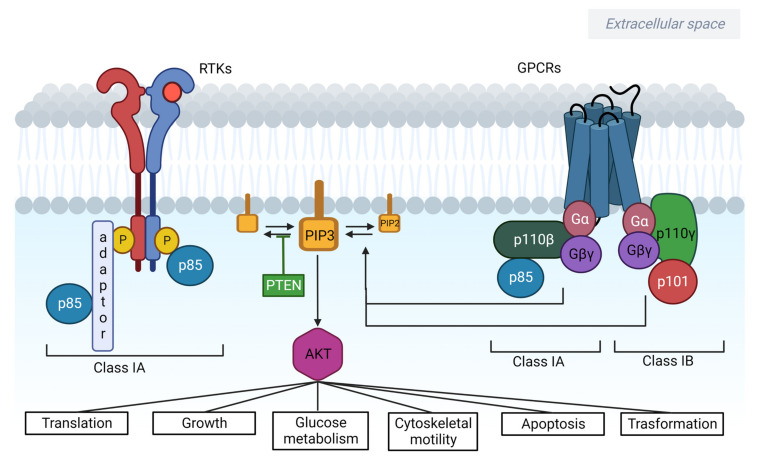
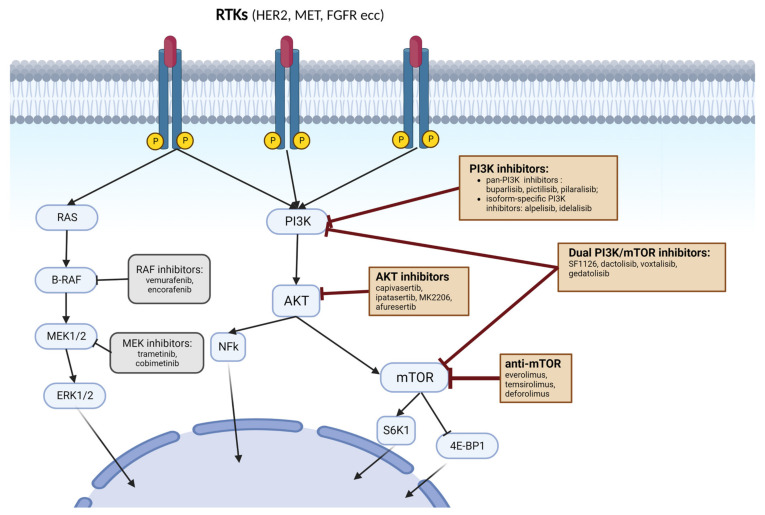
Verification
Claims the paper makes
The claims and statistics of this paper haven’t been checked yet.
Run the check — free, no account needed. It reads the open-access text and checks the sources it cites.
Claims other papers make about this one
Each is checked against this paper’s own text: does it say what the citing paper says it does?
The source backs part of the claim, not all of it — or backs it for a different population, condition or comparison.
In the citing paper
“The phosphoinositide 3-kinase (PI3K)/AKT/mTOR pathway is a major downstream signaling cascade of EGFR and represents an important bypass mechanism contributing to resistance to cetuximab and panitumumab [40,41,42,43,44].”
From Overcoming Resistance to Anti-EGFR Therapies: Mechanisms of Cetuximab and Panitumumab Resistance and Emerging Combination Strategies (2026) · cites this paper as [44]
Experimental — accuracy not yet measured
Self-check
Percentages, sums and reported differences re-computed from the paper’s own numbers.
The self-check needs the paper’s full text.
Citations
Cites
mTOR Signaling in Growth, Metabolism, and Disease
Saxton, R. A., & Sabatini, D. M. (2017) · Cell · doi:10.1016/j.cell.2017.02.004 · Cited by 7,555
Oncology meets immunology: the cancer-immunity cycle.
Chen, D. S., & Mellman, I. (2013) · Immunity · doi:10.1016/j.immuni.2013.07.012 · Cited by 6,929
Comprehensive molecular profiling of lung adenocarcinoma
The Cancer Genome Atlas Research Network (2014) · Nature · doi:10.1038/nature13385 · Cited by 5,732
Discovery and saturation analysis of cancer genes across 21 tumour types
Lawrence, M. S., Stojanov, P., Mermel, C. H., Robinson, J. T., Garraway, L. A., Golub, T. R., Meyerson, M., Gabriel, S. B., Lander, E. S., & Getz, G. (2014) · Nature · doi:10.1038/nature12912 · Cited by 3,096 · cited 1×
“Discovered in the late 1980s, the family of lipid kinases named phosphoinositide 3-kinase (PI3K) and the correlated PI3K/AKT signalling pathway have been shown to play a pivotal role in different oncogenic processes including cell survival, metabolism and metastasis [1].”
BackgroundAlpelisib for PIK3CA -Mutated, Hormone Receptor–Positive Advanced Breast Cancer
André, F., Ciruelos, E., Rubovszky, G., Campone, M., Loibl, S., Rugo, H. S., Iwata, H., Conte, P., Mayer, I. A., Kaufman, B., et al. (2019) · New England Journal of Medicine · doi:10.1056/nejmoa1813904 · Cited by 2,622
Targeting PI3K signalling in cancer: opportunities, challenges and limitations
Engelman, J. A. (2009) · Nature Reviews Cancer · doi:10.1038/nrc2664 · Cited by 2,445
Exploiting the PI3K/AKT Pathway for Cancer Drug Discovery
Hennessy, B. T., Smith, D. L., Ram, P. T., Lu, Y., & Mills, G. B. (2005) · Nature Reviews Drug Discovery · doi:10.1038/nrd1902 · Cited by 2,214
The PI3K–AKT network at the interface of oncogenic signalling and cancer metabolism
Hoxhaj, G., & Manning, B. D. (2020) · Nature Reviews Cancer · doi:10.1038/s41568-019-0216-7 · Cited by 2,137
Targeting PI3K/Akt signal transduction for cancer therapy
He, Y., Sun, M., Zhang, G. G., Yang, J., Chen, K. S., Xu, W. W., & Li, B. (2021) · Signal Transduction and Targeted Therapy · doi:10.1038/s41392-021-00828-5 · Cited by 2,045
Oncogenic Kras maintains pancreatic tumors through regulation of anabolic glucose metabolism
Ying, H., Kimmelman, A. C., Lyssiotis, C. A., Hua, S., Chu, G. C., Fletcher-Sananikone, E., Locasale, J. W., Son, J., Zhang, H., Coloff, J. L., et al. (2012) · Cell · doi:10.1016/j.cell.2012.01.058 · Cited by 2,043
Research works printed but not linked: 2
- (2022, December 08). Capivasertib Plus Faslodex Reduced the Risk of Disease Progression or Death by 40% versus Faslodex in Advanced HR-Positive Breast Cancer. Available online: https://www.astrazeneca.com/media-centre/press-releases/2022/capivasertib-pfs-in-hr-positive-breast-cancer.html.
- (2023, January 01). MTOR Inhibition Induces Upstream Receptor Tyrosine Kinase Signaling and Activates Akt—PubMed, Available online: https://pubmed.ncbi.nlm.nih.gov/16452206/.
Cited by
Sorted by citations
Items 101–122 of 122
ENANTIOSELECTIVE CATALYSIS FOR THE SYNTHESIS OF 1-SUBSTITUTED-2,2,2-TRIFLUOROETHYLAMINES
Wzorek, A., Ono, T., Baecker, D., Zhang, W., & Soloshonok, V. A. (2026) · Ukrainian Chemistry Journal · doi:10.33609/2708-129x.91.12.2025.33-72
Abedi, A., Moghaddam, M. M., Kachuei, R., & Fooladi, A. A. I. (2026) · Journal of Physiology and Biochemistry · doi:10.1007/s13105-026-01171-5
Hernowo, B. S., Ilanur, A., Agustina, H., Oehadian, A., Dewayani, B. M., Yantisetiasti, A., Usman, H. A., Primastari, E., Husain, O., Nuraeni, N., et al. (2026) · Blood Research · doi:10.1007/s44313-026-00129-2
Backlund, A., Samaniego, C. H., Rangaraj, V. R., Campbell, C., Cocito, C., Souweidane, M. M., Dahmane, N., & Greenfield, J. P. (2026) · Cancer Research · doi:10.1158/0008-5472.can-25-5402
Wang, F., Altelaar, M. A. F., & Stecker, K. E. (2026) · Journal of Proteome Research · doi:10.1021/acs.jproteome.5c00907
Li, L., Guo, X., Wang, G., Zhang, J., Wang, J., Miao, S., Sun, Y., Ma, S., & Shi, X. (2026) · Journal of Cellular and Molecular Medicine · doi:10.1111/jcmm.71180
Tsuchiya, H., Sugimori, M., Kaneko, T., Ishino, Y., Tsunoda, S., Funaoka, A., Endo, K., Oishi, R., Suzuki, Y., Kanemaru, Y., et al. (2026) · Research Square · doi:10.21203/rs.3.rs-9508063/v1
Hofmann, E., Abu-Sirhan, S., Elsholtz, F. H. J., Piwonski, I., Kreutzer, K., Doll, C., Joosten, M., Möbs, M., Busch, C., Fenske, B., et al. (2026) · npj Precision Oncology · doi:10.1038/s41698-026-01527-6
The Rise of Oncoendocrinology: How Modern Cancer Therapies Are Reshaping Endocrine Practice
Shapoo, N., Boma, N., Gotlieb, V., Mattana, J., Belokovskaya, R., & Franco, A. (2026) · Medical Sciences · doi:10.3390/medsci14030347
Dixit, A., & Das, A. (2026) · Drug Research · doi:10.1055/a-2901-3150
Zhou, X., Liu, Y., Zhang, J., Ren, M., Ji, G., Cai, X., & Bi, R. (2026) · Archives of Gynecology and Obstetrics · doi:10.1007/s00404-026-08525-w
Che, J., Han, X., & Li, X. (2026) · Pharmacognosy Magazine · doi:10.1177/09731296261471009
Dutta, P., Patel, D. D., Shukla, H., Limaye, D., Jothiswaran, V. V., Banerjee, J., Gandhi, S., & Banerjee, S. (2026) · ACS Applied Nano Materials · doi:10.1021/acsanm.6c02918
PDK1 signaling in cancer: Current status and future perspectives
Honnasiddappa, D. B., Ramar, M., Biju, T., Sajjan, M., Venkatesh, C., Mahadeva, N. K., Kunjiappan, S., Ammunje, D. N., & Pavadai, P. (2026) · International Journal of Biological Macromolecules · doi:10.1016/j.ijbiomac.2026.154405
Chen, C., Holmes, R., Carter, J., Maity, S., Pawley, S. B., Stahl, N., Crossan, A., Rager, J. D., Juvekar, A., Wang, M., et al. (2026) · Journal of Medicinal Chemistry · doi:10.1021/acs.jmedchem.6c00269
Mohiuddin, M. (2026) · Health Science Reports · doi:10.1002/hsr2.73275
Exploiting an epigenetic resistance mechanism to PI3-kinase inhibition in leukemic stem cells
Glushakow-Smith, S. G., Kaur, I., Sidoli, S., Hemmati, S., Angeles, E., Sinclair, T., Chakraborty, S., Battle, A., Ames, K., Narayanagari, S.-R., et al. (2026) · Leukemia · doi:10.1038/s41375-026-03145-4
Ren, H., Wang, Y., Ma, W., Ogaji, O. D., Chen, S., Du, K., Zhang, X., Xu, B., Zhai, S., Fang, S., et al. (2026) · Phytotherapy Research · doi:10.1002/ptr.70454
The Risk of Hyperglycemia with PI3K Inhibitors in Cancer Patients-A Meta-Analysis
Rong, Z., & Wu, S. (2026) · Cancer Investigation · doi:10.1080/07357907.2026.2721528
Komisarof, J., Zhang, S., Rimawi, M. F., & Huang, Q. (2026) · Next research. · doi:10.1016/j.nexres.2026.102608
Heterogeneity and drug resistance in breast cancer
Chakrabarty, S., Dash, B., -, D. P., & Swain, S. S. (2026) · Elsevier eBooks · doi:10.1016/b978-0-443-49074-3.00004-2
Therapeutic potential of natural products targeting the PI3K/Akt signaling axis in cancer
Kataria, A., Thakur, M., & Bansal, S. (2026) · Elsevier eBooks · doi:10.1016/b978-0-443-27544-9.00007-6
Metadata
- Authors
- Sirico, M., D’Angelo, A., Gianni, C., Casadei, C., Merloni, F., & De Giorgi, U.
- Affiliations
- Istituto Scientifico Romagnolo per lo Studio e la Cura dei Tumori (IT)
- Royal United Hospital (GB)
- Department of Medical Oncology, IRCCS Istituto Romagnolo per lo Studio dei Tumori (IRST) “Dino Amadori”, 47014 Meldola, Italy
- Corresponding author
- Sirico, Marianna
- Venue
- Cancers
- Publisher
- MDPI AG
- Published
- 2023-01-23
- Volume
- 15
- Issue
- 3
- Pages
- 703
- ISSN
- 2072-6694 (ISSN-L)
- PMC
- PMC9913212
- OpenAlex
- W4317907174
- Cited by
- 121
- References
- 174
- Citations by year
- 2026: 31 · 2025: 47 · 2024: 33 · 2023: 10
- FWCI
- 3.20
- Type
- journal article
- Language
- en
- Open access
- gold
- doi.org
- Licence
- Locations
- Cancers (publishedVersion, cc-by)
- PubMed Central (publishedVersion, cc-by)
- PubMed (publishedVersion)
- Archivio istituzionale della ricerca (Alma Mater Studiorum Università di Bologna) (submittedVersion, other-oa)
- AIRUS (submittedVersion)
- Funders
- Ministero della Salute
- Topics
- Life Sciences › Biochemistry, Genetics and Molecular Biology › Molecular Biology › PI3K/AKT/mTOR signaling in cancer
- Life Sciences › Biochemistry, Genetics and Molecular Biology › Molecular Biology › Metabolism, Diabetes, and Cancer
- Health Sciences › Medicine › Oncology › Advanced Breast Cancer Therapies
- Keywords
- PI3K inhibitors, PI3K/AKT/mTOR pathway, cancer therapy, PI3K signaling, Akt, mTOR, combination therapy, clinical trials
About these checks
Registry, retraction, Cites and statistics results are computed, not judged, with one exception: a printed reference that no index lists is read once by a model before it counts as a citation error. Claims are extracted by a model and kept only when their quote appears verbatim in the text; each cited source is then checked, with a model’s help, for whether it says what the claim relies on. Those verdicts can be wrong — read the claim’s quote and the cited source before relying on one.
Statistics and arithmetic are recomputed, not judged.
Confidence bands are shown only for fields calibrated on our annotated test set. None is calibrated yet, so no band is shown.
What counts as a claim ›How we measure confidence ›How we check this ›
Are you an author, or do you see a problem with this page? Request a review
