

BRAF Inhibitors in Metastatic Colorectal Cancer and Mechanisms of Resistance: A Review of the Literature
Open accessThe DOI matches its Crossref record; 74 of the 74 references it cites were found in a registry or an index.
Abstract
Metastatic colorectal cancer (mCRC) with mutated BRAF exhibits distinct biological and molecular features that set it apart from other subtypes of CRC. Current standard treatment for these tumors involves a combination of chemotherapy (CT) and VEGF inhibitors. Recently, targeted therapy against BRAF and immunotherapy (IT) for cases with microsatellite instability (MSI) have been integrated into clinical practice. While targeted therapy has shown promising results, resistance to treatment eventually develops in a significant portion of responsive patients. This article aims to review the available literature on mechanisms of resistance to BRAF inhibitors (BRAFis) and potential therapeutic strategies to overcome them.
Overview
The claims and statistics of this paper haven’t been checked yet.
Free: it reads the open-access text and checks the first 5 claims that cite a source we can check. Create a free account to check every claim.
Integrity signals
Registry
Cites
Statistics
Figures
Verification
Claims the paper makes
The claims and statistics of this paper haven’t been checked yet.
Free: it reads the open-access text and checks the first 5 claims that cite a source we can check. Create a free account to check every claim.
Claims other papers make about this one
Each is checked against this paper’s own text: does it say what the citing paper says it does?
The source backs part of the claim, not all of it — or backs it for a different population, condition or comparison.
In the citing paper
“In addition, the epidermal growth factor receptor (EGFR)/RAS/MAPK signaling pathway is often constitutively activated, either through activation of signaling proteins RAS (KRAS mutated in ~40% of CRCs) or RAF (BRAF mutated in 10–15% of CRCs), which stimulates cell proliferation [13,14,15].”
From Mechanisms and Strategies to Overcome Drug Resistance in Colorectal Cancer (2025) · cites this paper as [14]
Experimental — accuracy not yet measuredThe source backs part of the claim, not all of it — or backs it for a different population, condition or comparison.
In the citing paper
“BRAF inhibitors have proven ineffective as single agents due to adaptive feedback re-activation of the MAPK and other signaling pathways [5–13, 38].”
From Co-targeting SRC overcomes resistance to BRAF inhibitors in colorectal cancer (2025) · cites this paper as [38]
Experimental — accuracy not yet measuredThe cited source says what the claim attributes to it.
In the citing paper
“For cancers with activating BRAF mutations, various BRAF inhibitors are now available, such as vemurafenib, dabrafenib, and encorafenib, that selectively and competitively inhibit mutant BRAF and interfere with downstream MAPK signaling [14].”
From Mechanisms and Strategies to Overcome Drug Resistance in Colorectal Cancer (2025) · cites this paper as [14]
Self-check
Percentages, sums and reported differences re-computed from the paper’s own numbers.
The self-check needs the paper’s full text.
Citations
Cites
The consensus molecular subtypes of colorectal cancer
Guinney, J., Dienstmann, R., Wang, X., de Reyniès, A., Schlicker, A., Soneson, C., Marisa, L., Roepman, P., Nyamundanda, G., Angelino, P., et al. (2015) · Nature Medicine · doi:10.1038/nm.3967 · Cited by 5,170 · cited 1×
“BRAF mutation in mCRC carries independent prognostic value and significant associations with clinical and biological disease characteristics [6].”
BackgroundOverman, M. J., McDermott, R., Leach, J. L., Lonardi, S., Lenz, H.-J., Morse, M. A., Desai, J., Hill, A., Axelson, M., Moss, R. A., et al. (2017) · The Lancet Oncology · doi:10.1016/s1470-2045(17)30422-9 · Cited by 2,836 · cited 1×
“Immunotherapy’s benefit in MSI tumors has been confirmed in other studies [34,35], making it the current first-line treatment for MSI-positive mCRC.”
BackgroundEpidemiology of colorectal cancer: incidence, mortality, survival, and risk factors
Rawla, P., Sunkara, T., & Barsouk, A. (2019) · Gastroenterology Review · doi:10.5114/pg.2018.81072 · Cited by 2,323 · cited 1×
“Globally, CRC accounts for 11% of all new cancer cases worldwide [3], with up to a quarter presenting distant metastases at diagnosis.”
BackgroundOverman, M. J., Lonardi, S., Wong, K. Y. M., Lenz, H.-J., Gelsomino, F., Aglietta, M., Morse, M. A., Van Cutsem, E., McDermott, R., Hill, A., et al. (2018) · Journal of Clinical Oncology · doi:10.1200/jco.2017.76.9901 · Cited by 2,079
Unresponsiveness of colon cancer to BRAF(V600E) inhibition through feedback activation of EGFR
Prahallad, A., Sun, C., Huang, S., Di Nicolantonio, F., Salazar, R., Zecchin, D., Beijersbergen, R. L., Bardelli, A., & Bernards, R. (2012) · Nature · doi:10.1038/nature10868 · Cited by 2,051
Weisenberger, D. J., Siegmund, K. D., Campan, M., Young, J., Long, T. I., Faasse, M. A., Kang, G. H., Widschwendter, M., Weener, D., Buchanan, D., et al. (2006) · Nature Genetics · doi:10.1038/ng1834 · Cited by 1,990 · cited 2×
“It is defined by the activation of the KRAS/AKT pathway, dysregulation of mTOR/4EBP, and increased immune infiltration [18].”
BackgroundCombined BRAF and MEK Inhibition versus BRAF Inhibition Alone in Melanoma
Long, G. V., Stroyakovskiy, D., Gogas, H., Levchenko, E., de Braud, F., Larkin, J., Garbe, C., Jouary, T., Hauschild, A., Grob, J. J., et al. (2014) · New England Journal of Medicine · doi:10.1056/nejmoa1406037 · Cited by 1,899 · cited 1×
“Inhibiting only a part of the MAPK pathway (BRAFi or MEKi in monotherapy) triggers a feedback loop that leads to EGFR hyperactivation and subsequent tumor growth [43–45].”
BackgroundCervantes, A., Adam, R., Roselló, S., Arnold, D., Normanno, N., Taïeb, J., Seligmann, J., De Baere, T., Osterlund, P., Yoshino, T., et al. (2023) · Annals of Oncology · doi:10.1016/j.annonc.2022.10.003 · Cited by 1,796 · cited 1×
“In the ESMO guidelines, this combination is also referenced as the first choice for fit patients [30].”
BackgroundTargeting RAS–ERK signalling in cancer: promises and challenges
Samatar, A. A., & Poulikakos, P. I. (2014) · Nature Reviews Drug Discovery · doi:10.1038/nrd4281 · Cited by 1,163 · cited 2×
“Both mechanisms could be involved in BRAFi resistance [51].”
BackgroundWidespread potential for growth-factor-driven resistance to anticancer kinase inhibitors
Wilson, T. R., Fridlyand, J., Yan, Y., Penuel, E., Burton, L., Chan, E., Peng, J., Lin, E., Wang, Y., Sosman, J., et al. (2012) · Nature · doi:10.1038/nature11249 · Cited by 1,134 · cited 1×
“In vitro, sensitivity to HGF or c-MET inhibition was observed, suggesting c-MET could be another therapeutic target [64].”
Background
Cited by
Mechanisms and Strategies to Overcome Drug Resistance in Colorectal Cancer
Haynes, J., & Manogaran, P. (2025) · International Journal of Molecular Sciences · doi:10.3390/ijms26051988 · Cited by 82
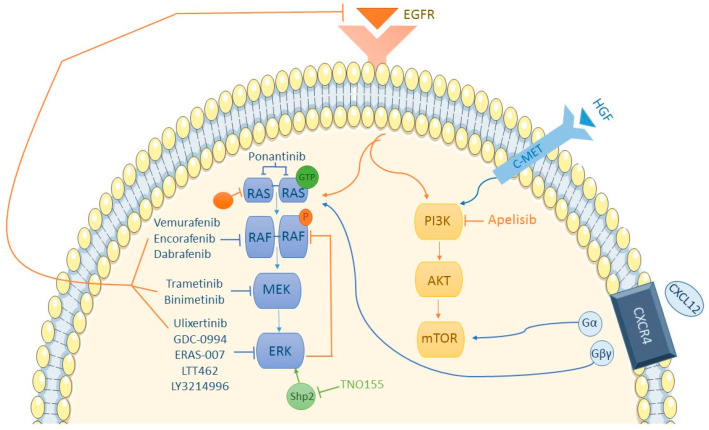
“This type of targeted therapy is only effective in the absence of mutations in , HER2-positive) ) for CRC with BRAF-V600E mutation, used in combination with EGFR inhibitor cetuximab (Figure 2) [14,34].”
Obesity-Associated Colorectal Cancer
Gonzalez-Gutierrez, L., Motiño, O., Barriuso, D., de la Puente-Aldea, J., Alvarez-Frutos, L., Kroemer, G., Palacios, R., & Senovilla, L. (2024) · International Journal of Molecular Sciences · doi:10.3390/ijms25168836 · Cited by 60
“The former has a dismal prognosis, a worse response to chemotherapy, as well as a higher incidence of peritoneal metastases [215].”
BackgroundUnraveling the complexities of colorectal cancer and its promising therapies – An updated review
Saha, S., Ghosh, S., Ghosh, S., Nandi, S., & Nayak, A. (2024) · International Immunopharmacology · doi:10.1016/j.intimp.2024.113325 · Cited by 30
Colorectal Cancer: Genetic Underpinning and Molecular Therapeutics for Precision Medicine
Dosunmu, G. T., & Shergill, A. P. (2024) · Genes · doi:10.3390/genes15050538 · Cited by 21
“…overcoming resistance necessitates innovative therapeutic strategies, such as combining BRAF inhibitors with agents targeting other pathways or receptors implicated in resistance; employing ERK inhibitors; and exploring novel agents such as pan-RAF inhibitors or BRAF paradox breakers [81].”
WHO Classification of Tumours: evolution of a global resource in the molecular era
Hodge, J. C., Netto, G. J., Rekhi, B., Cooper, W. A., Eden, M., Field, A. S., Goh, V., Kench, J. G., Khoury, J. D., Leite, K. R. M., et al. (2025) · The Lancet Oncology · doi:10.1016/s1470-2045(24)00709-5 · Cited by 16
Zheng, E., Włodarczyk, M., Węgiel, A., Osielczak, A., Możdżan, M., Biskup, L., Grochowska, A., Wołyniak, M., Gajewski, D., Porc, M., et al. (2024) · Frontiers in Surgery · doi:10.3389/fsurg.2024.1398289 · Cited by 12
Co-targeting SRC overcomes resistance to BRAF inhibitors in colorectal cancer
Rubio-Cuesta, B., Carretero-Puche, C., Llamas, P., Sarmentero, J., Gil-Calderon, B., Lens-Pardo, A., Antón-Pascual, B., Rubio-González, E., Cámara-Jurado, M., Salamanca, J., et al. (2025) · British Journal of Cancer · doi:10.1038/s41416-025-03058-6 · Cited by 7
Cai, A., Fu, Q., Sun, M., Chen, H. M., Wang, Y., & Ju, H. (2025) · Bioelectrochemistry · doi:10.1016/j.bioelechem.2025.109058 · Cited by 7
Pan-Cancer Molecular Biomarkers: Practical Considerations for the Surgical Pathologist
Jafari, P., Forrest, M. E., Segal, J. P., Wang, P., & Tjota, M. Y. (2025) · Modern Pathology · doi:10.1016/j.modpat.2025.100752 · Cited by 9
Yoshida, Y., Takahashi, M., Taniguchi, S. H., Numakura, R., Komine, K., & Ishioka, C. (2024) · Cancer Science · doi:10.1111/cas.16280 · Cited by 5
“48 The KEYNOTE-177 study demonstrated that a BRAF mutation was not significantly associated with the worse survival of patients with MSI-high CRC treated with pembroli-zumab.”
BackgroundTreatment sequencing in metastatic colorectal cancer
Torounidou, N., Yerolatsite, M., Zarkavelis, G., Amylidi, A.-L., Karafousia, V., Kampletsas, E. O., & Mauri, D. (2024) · Współczesna Onkologia · doi:10.5114/wo.2024.146982 · Cited by 5
“These findings offer a new therapeutic option for previously treated patients with KRAS G12C-mutated mCRC [25].”
Altaf, A., Kawashima, J., Khalil, M., Stecko, H., Rashid, Z., Kalady, M. F., & Pawlik, T. M. (2025) · European Journal of Surgical Oncology · doi:10.1016/j.ejso.2025.109718 · Cited by 3
Pastor, P. G., Gonzalez, N. S., Salvà, F., Ros, J., Baraibar, I., Rodríguez-Castells, M., de Torres, C. S., García, A., Alcaráz, A., Vaghi, C., et al. (2026) · Genes · doi:10.3390/genes17040460 · Cited by 4
Al‐Tamimi, A. O., Elemam, N. M., Hafezi, S., Saber-Ayad, M. M., & Talaat, I. M. (2026) · Frontiers in Pharmacology · doi:10.3389/fphar.2026.1807304 · Cited by 3
“BRAF mutation often accompanied by T-cell dysfunction rather than effective immune control (Guerrero et al., 2023).”
Xicheng, W., Deng, Y., Yanqiao, Z., Liu, T., Xianglin, Y., Jianwei, Y., Tao, Z., Zang, A., Yu, L., Li, H., et al. (2026) · Cancer Medicine · doi:10.1002/cam4.71697 · Cited by 2
“In mCRC, BRAF inhibitors alone are not effective due to the feedback activation of epidermal growth factor receptor (EGFR) in BRAF-mutant CRC, which leads to continued cell proliferation [12].”
Wei, N., Thielen, N., Mohammadi, M., Bhat, M. A., Li, T., Sun, Y., Kitamura, S., Chu, E., & Kuang, C. (2026) · Acta Pharmaceutica Sinica B · doi:10.1016/j.apsb.2026.05.008 · Cited by 2
“PI3K/AKT is usually much more activated in mCRC, as compared to melanoma 43 .”
Emerging treatment approaches for colorectal cancer treatment resistance
Mabonga, L., Fourie, R. L., Kappo, A. P., Lyantagaye, S., & Dlamini, Z. (2024) · Elsevier eBooks · doi:10.1016/b978-0-443-33475-7.00001-9 · Cited by 1
Solé-Blanch, C., España, S., de la Puente-Noël, A., Marín-Béjar, O., Manzano, J. L., & Martínez‐Cardús, A. (2025) · Biochimica et Biophysica Acta (BBA) - Reviews on Cancer · doi:10.1016/j.bbcan.2025.189503 · Cited by 1
Accessibility of Somatic Genetic Testing for Cancer Treatment Decisions
Klavans, M. R., Musa, F., & Huang, M. (2026) · Annual Review of Medicine · doi:10.1146/annurev-med-050124-082437 · Cited by 1
Geisen, M. E., Tessmann, J. W., Kelson, C. O., He, D., Wang, C., Faisal, A. S. M., Beswick, E. J., Baca, Y., Rock, S., Kolesar, J. M., et al. (2026) · Neoplasia · doi:10.1016/j.neo.2026.101283
“Development of resistance to approved BRAF-targeted therapy presents a clinical challenge and limits clinical benefits [18].”
Targeted therapies and precision medicine in colorectal cancer drug resistance
Bida, M., Mosoane, B., Mehrotra, R., & Dlamini, Z. (2024) · Elsevier eBooks · doi:10.1016/b978-0-443-33475-7.00017-2
Alzarkali, O., & Castria, T. B. D. (2025) · SSRN Electronic Journal · doi:10.2139/ssrn.5383532
범승훈 (2024) · Seoul National University Open Repository (Seoul National University)
Molecular imaging for nano-theranostics : Raman spectroscopy approach
Alaouta, C. (2024) · theses.fr (ABES) · doi:10.70675/90173e46zdf1dz4845z97f6z13cbe351311f
INVESTIGATING MONO-DRIVER VERSUS MULTI-DRIVER ONCOGENESIS VIA ALTERATIONS TO CELL SIGNALING PATHWAYS
Chapdelaine, A. G. (2025) · Digital Commons - URI (University of Rhode Island) · doi:10.23860/diss-4446
Dirven, I., Ang, C., Bertels, C., Kortbeek, K., de Haar-Holleman, A., Vollebergh, M. A., Poulikakos, P. I., & Neyns, B. (2026) · Cancer · doi:10.1002/cncr.70569
Metadata
- Authors
- Guerrero, P., Albarrán, V., San Román, M., González-Merino, C., García de Quevedo, C., Moreno, J., Calvo, J. C., González, G., Orejana, I., Chamorro, J., Martínez-Delfrade, Í., Morón, B., de Frutos, B., & Ferreiro, M. R.
- Affiliations
- Department of Medical Oncology, Ramon y Cajal University Hospital, 28034 Madrid, Spain
- Hospital Universitario Ramón y Cajal (ES)
- ORCID
- Venue
- Cancers
- Publisher
- MDPI AG
- Published
- 2023-10-31
- Volume
- 15
- Issue
- 21
- Pages
- 5243
- ISSN
- 2072-6694 (ISSN-L)
- PMC
- PMC10649848
- OpenAlex
- W4388041706
- Cited by
- 21
- References
- 74
- Citations by year
- 2026: 6 · 2025: 8 · 2024: 7
- FWCI
- 0.68
- Type
- journal article
- Language
- en
- Open access
- gold
- doi.org
- Licence
- Locations
- Cancers (publishedVersion, cc-by)
- PubMed Central (publishedVersion, cc-by)
- PubMed (publishedVersion)
- Digital Commons-TMC (Texas Medical Center) (submittedVersion)
- Topics
- Health Sciences › Medicine › Oncology › Colorectal Cancer Treatments and Studies
- Health Sciences › Medicine › Pulmonary and Respiratory Medicine › Lung Cancer Treatments and Mutations
- Life Sciences › Biochemistry, Genetics and Molecular Biology › Molecular Biology › Melanoma and MAPK Pathways
- Keywords
- BRAF inhibitors, metastatic colorectal cancer, BRAF mutation, drug resistance mechanisms, VEGF inhibitors, chemotherapy, immunotherapy, microsatellite instability, targeted therapy, resistance reversal strategies
About these checks
Registry, retraction, Cites and statistics results are computed, not judged, with one exception: a printed reference that no index lists is read once by a model before it counts as a citation error. Claims are extracted by a model and kept only when their quote appears verbatim in the text; each cited source is then checked, with a model’s help, for whether it says what the claim relies on. Those verdicts can be wrong — read the claim’s quote and the cited source before relying on one.
Statistics and arithmetic are recomputed, not judged.
Confidence bands are shown only for fields calibrated on our annotated test set. None is calibrated yet, so no band is shown.
What counts as a claim ›How we measure confidence ›How we check this ›
Are you an author, or do you see a problem with this page? Request a review
Data sources
Bibliographic data: Semantic Scholar, OpenAlex, Crossref.
Contains information from the Semantic Scholar Academic Graph Datasets, made available under the ODC Attribution License (ODC-BY 1.0).
Semantic Scholar’s data is described in: Kinney, R., et al. (2023). The Semantic Scholar Open Data Platform. arXiv:2301.10140.
