

Alternative Methods to Animal Testing for the Safety Evaluation of Cosmetic Ingredients: An Overview
Open accessThe DOI matches its Crossref record; 56 of the 56 references it cites were found in a registry or an index.
Abstract
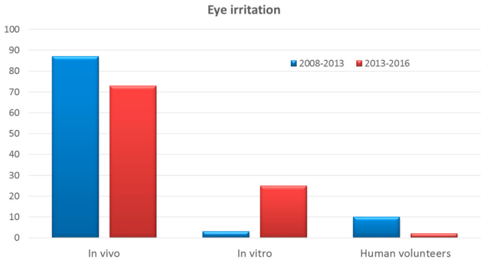
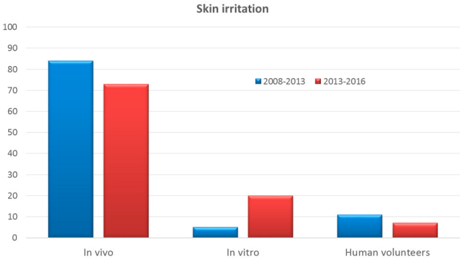
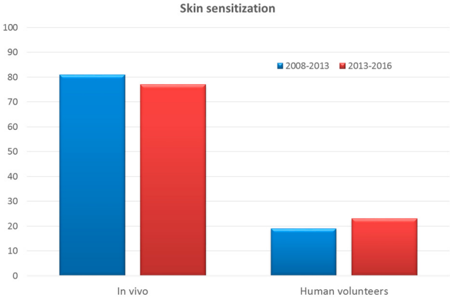
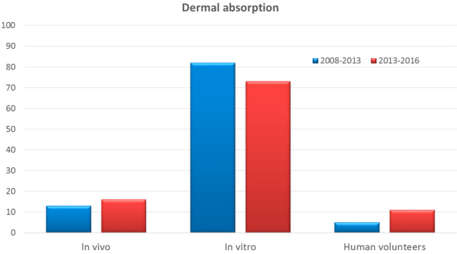
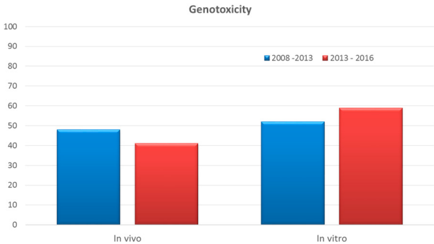
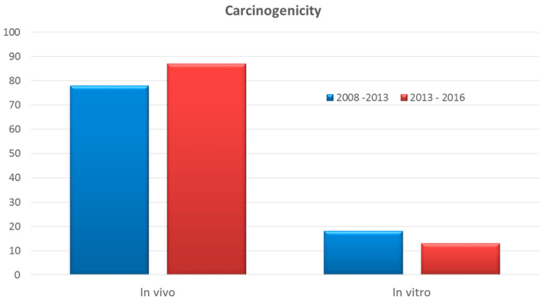
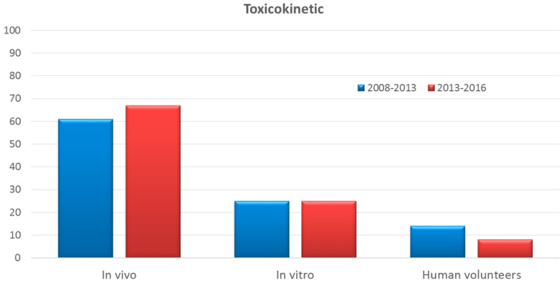
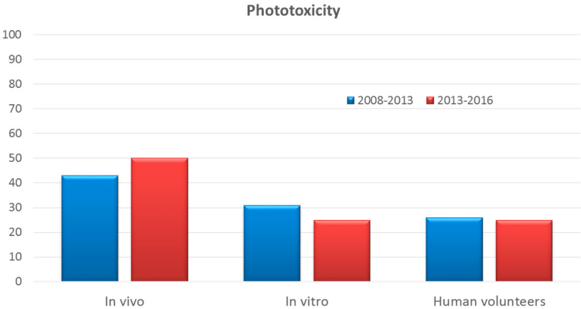
The safety of cosmetics sold in Europe is based on the safety evaluation of each individual ingredient conducted by those responsible for putting the product on the market. However, those substances for which some concern exists with respect to human health (e.g., colorants, preservatives, UV-filters, nanomaterials) are evaluated at the European Commission level by a scientific committee, currently called the Scientific Committee on Consumer Safety (SCCS). According to the Cosmetics Regulation (European Commission, 2009), it is prohibited in the European Union (EU) to market cosmetic products and ingredients that have been tested on animals. However, the results of studies performed before the ban continue to be accepted. In the current study, we evaluated the use of in vitro methods in the dossiers submitted to the SCCS in the period between 2013 and 2016 based on the published reports issued by the scientific committee, which provides a scientific opinion on these dossiers. The results of this evaluation were compared with those of an evaluation conducted four years previously. We found that, despite a slight increase in the number of studies performed in vitro, the majority of studies submitted to the SCCS is still done principally in vivo and correspond to studies performed before the ban.
Overview
The claims and statistics of this paper haven’t been checked yet.
Free: it reads the open-access text and checks the first 5 claims that cite a source we can check. Create a free account to check every claim.
Integrity signals
Registry
Cites
Statistics
Figures
Verification
Claims the paper makes
The claims and statistics of this paper haven’t been checked yet.
Free: it reads the open-access text and checks the first 5 claims that cite a source we can check. Create a free account to check every claim.
Claims other papers make about this one
Each is checked against this paper’s own text: does it say what the citing paper says it does?
The source backs part of the claim, not all of it — or backs it for a different population, condition or comparison.
In the citing paper
“Research has revealed that apart from men and women, children are also easily affected by lead poisoning, children can easily ingest and breathe lead-contaminated products (55).”
From The dark side of beauty: an in-depth analysis of the health hazards and toxicological impact of synthetic cosmetics and personal care products (2024) · cites this paper as [55]
Experimental — accuracy not yet measuredThe check wasn’t confident either way, so it gives no verdict — never disputed.
In the citing paper
“Lead poisoning also affects pregnant women, with elevated blood lead levels causing untimely birth of babies.”
From The dark side of beauty: an in-depth analysis of the health hazards and toxicological impact of synthetic cosmetics and personal care products (2024) · cites this paper as [55]
Experimental — accuracy not yet measured
Self-check
Percentages, sums and reported differences re-computed from the paper’s own numbers.
The self-check needs the paper’s full text.
Citations
Cites
DRAIZE, J. H., WOODARD, G., & CALVERY, H. O. (1944) · The Journal of Pharmacology and Experimental Therapeutics · doi:10.1016/s0022-3565(25)08751-8 · Cited by 2,602
Development of a Peptide Reactivity Assay for Screening Contact Allergens
Gerberick, G. F. (2004) · Toxicological Sciences · doi:10.1093/toxsci/kfh213 · Cited by 529
Gerberick, G. F., Vassallo, J. D., Foertsch, L. M., Price, B. B., Chaney, J. G., & Lepoittevin, J.-P. (2007) · Toxicological Sciences · doi:10.1093/toxsci/kfm064 · Cited by 400
Test No. 471: Bacterial Reverse Mutation Test
OECD (2020) · OECD Guidelines for the Testing of Chemicals, Section 4 · doi:10.1787/9789264071247-en · Cited by 394
Ashikaga, T., Yoshida, Y., Hirota, M., Yoneyama, K., Itagaki, H., Sakaguchi, H., Miyazawa, M., Ito, Y., Suzuki, H., & Toyoda, H. (2006) · Toxicology in Vitro · doi:10.1016/j.tiv.2005.10.012 · Cited by 342
Lilienblum, W., Dekant, W., Foth, H., Gebel, T., Hengstler, J. G., Kahl, R., Kramer, P.-J., Schweinfurth, H., & Wollin, K.-M. (2008) · Archives of Toxicology · doi:10.1007/s00204-008-0279-9 · Cited by 318
Test No. 487: In Vitro Mammalian Cell Micronucleus Test
OECD (2023) · OECD Guidelines for the Testing of Chemicals, Section 4 · doi:10.1787/9789264264861-en · Cited by 279
Drug-Permeability and Transporter Assays in Caco-2 and Mdck Cell Lines
Volpe, D. A. (2011) · Future Medicinal Chemistry · doi:10.4155/fmc.11.149 · Cited by 252
Alternative Methods for Eye and Skin Irritation Tests: An Overview
Vinardell, M. P., & Mitjans, M. (2008) · Journal of Pharmaceutical Sciences · doi:10.1002/jps.21088 · Cited by 194
Self-citationNatsch, A. (2010) · Toxicological Sciences · doi:10.1093/toxsci/kfp228 · Cited by 183
Cited by
A comprehensive review on nanoemulsion as an ophthalmic drug delivery system
Choradiya, B. R., & Patil, S. B. (2021) · Journal of Molecular Liquids · doi:10.1016/j.molliq.2021.116751 · Cited by 90
Alnuqaydan, A. M. (2024) · Frontiers in Public Health · doi:10.3389/fpubh.2024.1439027 · Cited by 84
“Research has revealed that apart from men and women, children are also easily affected by lead poisoning, children can easily ingest and breathe lead-contaminated products (55).”
BackgroundEspinosa-Leal, C. A., & García‐Lara, S. (2019) · Planta Medica · doi:10.1055/a-0857-6633 · Cited by 67
Banerjee, P., & Ülker, Ö. C. (2022) · Toxicology Mechanisms and Methods · doi:10.1080/15376516.2022.2053623 · Cited by 62
“A testing ban of using animal tests on finished cosmetic products has been in force in the EU since 2004, while in 2013 a marketing ban came into force for all kinds of animal toxicity tests including repeated-dose toxicity, reproductive toxicity and toxicokinetics (Vinardell and Mitjans 2017).”
MethodHalal Label vs Product Quality in Halal Cosmetic Purchasing Decisions
Anggadwita, G., Alamanda, D. T., & Ramadani, V. (2020) · IKONOMIKA · doi:10.24042/febi.v4i2.5897 · Cited by 31
“In 2014, the global Muslim cosmetics industry spent $ 54 billion, or around 7% of world spending, and will increase by 2020 by $ 80 billion (Yuswati, 2018).”
Background
Metadata
- Authors
- Vinardell, M., & Mitjans, M.
- Affiliations
- Departament of Biochemistry and Physiology, Faculty of Pharmacy and Food Sciences, Universitat de Barcelona, Av. Joan XXIII 27-31, Barcelona 08028, Spain
- Universitat de Barcelona (ES)
- Venue
- Cosmetics
- Publisher
- MDPI AG
- Published
- 2017-09-02
- Volume
- 4
- Issue
- 3
- Pages
- 30
- ISSN
- 2079-9284 (ISSN-L)
- OpenAlex
- W2752678264
- Cited by
- 37
- References
- 56
- Citations by year
- 2026: 1 · 2025: 5 · 2024: 4 · 2023: 7 · 2022: 6 · 2021: 7 · 2020: 3 · 2019: 2 · 2018: 2
- FWCI
- 3.03
- Type
- journal article
- Language
- en
- Open access
- gold
- doi.org
- Licence
- Locations
- Cosmetics (publishedVersion, cc-by)
- Dipòsit Digital de la Universitat de Barcelona (Universitat de Barcelona) (submittedVersion, cc-by)
- DOAJ (DOAJ: Directory of Open Access Journals) (submittedVersion)
- Topics
- Health Sciences › Veterinary › Small Animals › Animal testing and alternatives
- Health Sciences › Medicine › Dermatology › Contact Dermatitis and Allergies
- Life Sciences › Immunology and Microbiology › Immunology › Immunotoxicology and immune responses
- Keywords
- alternatives to animal testing, in vitro methods, cosmetic ingredients, safety assessment, cosmetic regulation, cosmetic colorants, preservatives, UV filters, nanomaterials, in vivo evaluation
About these checks
Registry, retraction, Cites and statistics results are computed, not judged, with one exception: a printed reference that no index lists is read once by a model before it counts as a citation error. Claims are extracted by a model and kept only when their quote appears verbatim in the text; each cited source is then checked, with a model’s help, for whether it says what the claim relies on. Those verdicts can be wrong — read the claim’s quote and the cited source before relying on one.
Statistics and arithmetic are recomputed, not judged.
Confidence bands are shown only for fields calibrated on our annotated test set. None is calibrated yet, so no band is shown.
What counts as a claim ›How we measure confidence ›How we check this ›
Are you an author, or do you see a problem with this page? Request a review
Data sources
Bibliographic data: Semantic Scholar, OpenAlex, Crossref.
Contains information from the Semantic Scholar Academic Graph Datasets, made available under the ODC Attribution License (ODC-BY 1.0).
Semantic Scholar’s data is described in: Kinney, R., et al. (2023). The Semantic Scholar Open Data Platform. arXiv:2301.10140.
