

From the Fibonacci Icosagrid to E8 (Part I): The Fibonacci Icosagrid, an H3 Quasicrystal
Open accessThe DOI matches its Crossref record; 36 of the 36 references it cites were found in a registry or an index; 4 of the 19 sources its claims cite were checked for support.
Abstract
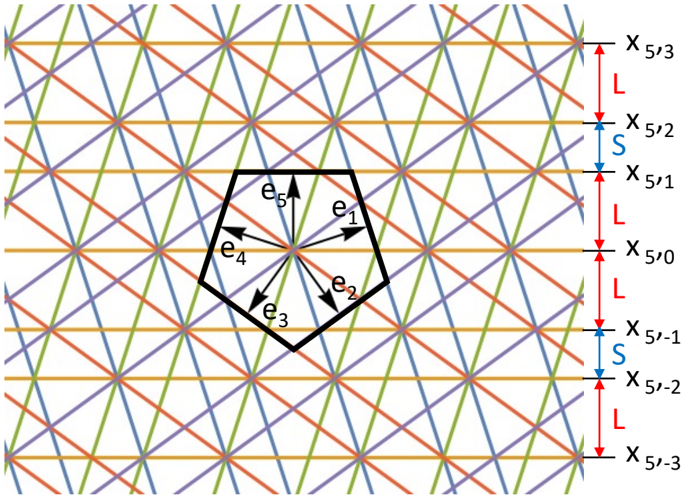
This paper introduces a new kind of quasicrystal by Fibonacci-spacing a multigrid of a certain symmetry, like H2, H3, T3, etc. Multigrids of a certain symmetry can be used to generate quasicrystals, but multigrid vertices are not a quasicrystal due to arbitrary closeness. By Fibonacci-spacing the grids, the structure transit into an aperiodic order becomes a quasicrystal itself. Unlike the quasicrystal generated by the dual-grid method, this kind of quasicrystal does not live in the dual space of the grid space. It is the grid space itself and possesses quasicrystal properties, except that its total number of vertex types are not finite and fixed for the infinite size of the quasicrystal but bounded by a slowly logarithmic growing number. A 2D example, the Fibonacci pentagrid, is given. A 3D example, the Fibonacci icosagrid (FIG), is also introduced, as well as its subsets, the Fibonacci tetragrid (FTG). The FIG can be thought of as a golden composition of five sets of FTGs. The golden composition procedure is another way to transit a random structure into aperiodic order, and the associated rotational angle is the same as the angle that resolves the geometric frustration for the H3 tetrahedral clusters. The FIG resembles another quasicrystal that is the same golden composition of five quasicrystals that are cut and projected and sliced from the E8 lattice. This leads to further exploration in mapping the FIG to the E8 lattice, and the results will be published following this paper.
Overview
CoChat Summary
## TL;DR
The paper proposes the Fibonacci multigrid method, in which periodic multigrids are turned into quasicrystals by replacing uniform spacing with Fibonacci spacing, so the grid space itself becomes quasiperiodic rather than its dual. It develops 2D and 3D examples, especially the Fibonacci icosagrid (FIG), and argues that FIG is closely related to an E8-derived 3D quasicrystal through golden composition and golden twisting.
## Key findings
- The authors state that applying Fibonacci spacing to a periodic multigrid removes the “arbitrary closeness” of vertices and yields a new quasicrystal type in the grid space itself, unlike the dual-grid method.
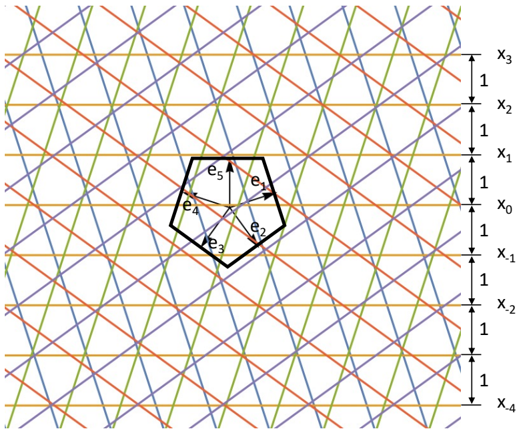
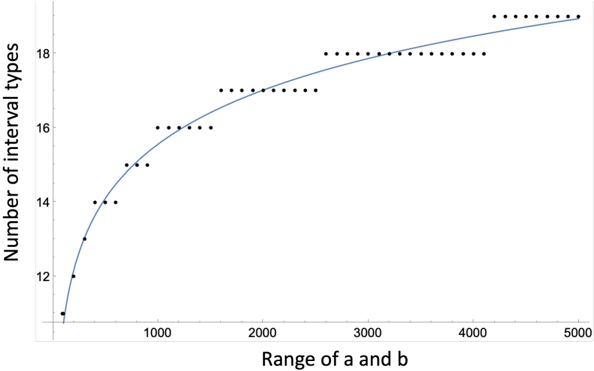
- For the 2D Fibonacci pentagrid (FPG), they report that the number of vertex/interval types is not fixed but grows slowly; the text says it appears “logarithmic” and “slowly subdividing” in a fractal-like way.
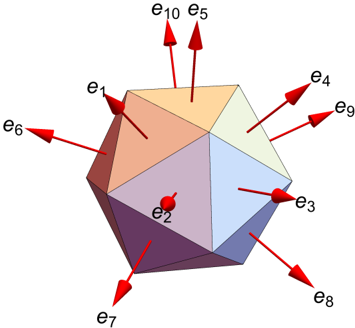
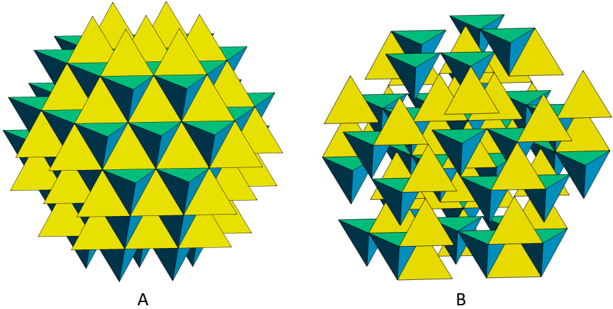
- In 3D, the Fibonacci icosagrid (FIG) is described as a “golden composition” of five Fibonacci tetragrids (FTGs), and the paper says the FIG contains 20Gs at various locations with “finite types of local clusters” but increasing vertex types as size grows.
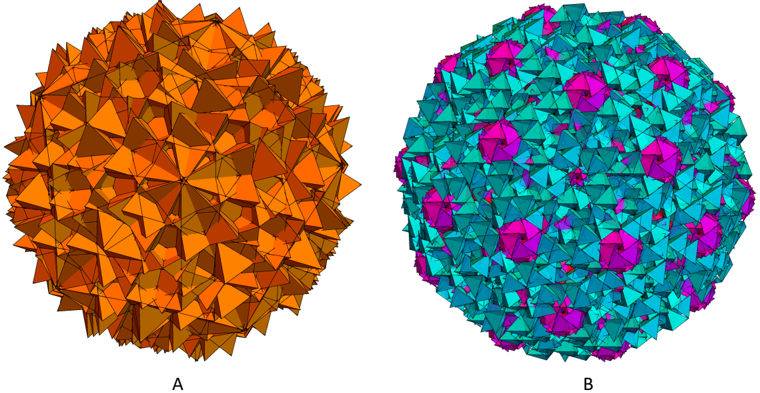
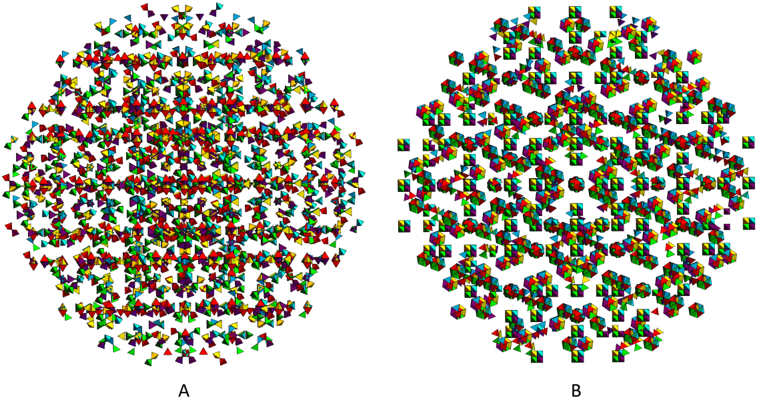
- The paper claims the FIG is very similar to a 3D quasicrystal made from five slices of the Elser-Sloane quasicrystal from the E8 lattice, and says “about 95%” of the 3D quasicrystal derived from E8 is a subset of the FIG.
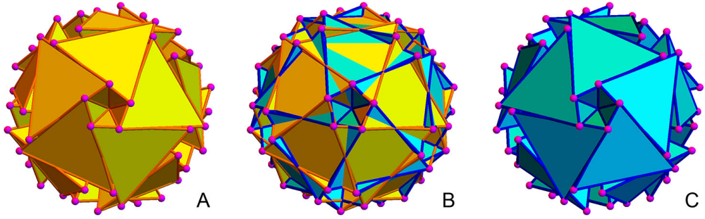
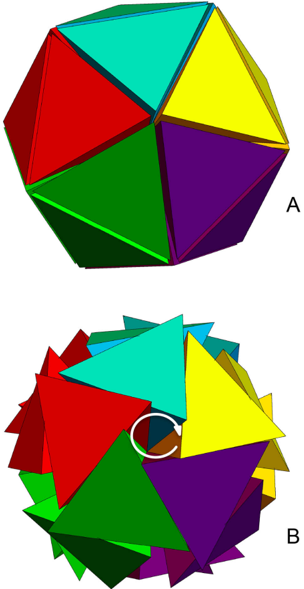
- For golden twisting of a 20-tetrahedron cluster, the paper says plane classes reduce from 70 in an evenly distributed vertex-sharing 20-tetrahedral cluster to 10 in the twisted 20G.
## Methods
- The study is conceptual and geometric: it extends the dual-grid idea by replacing periodic hyperplane spacing with a Fibonacci chain, especially the case with \u03c1 = \u03bc = \u03d5 and palindromic symmetry (\u03b1 = 0, \u03b2 = 1/2).
- It works through 2D and 3D constructions: the Fibonacci pentagrid, Fibonacci tetragrid, and Fibonacci icosagrid, using intersection vertices, tetrahedral clusters, and “golden composition” of five tetragrid sets.
- The main analysis is structural and descriptive, including counting interval/vertex types, comparing periodic vs Fibonacci spacing, and comparing the FIG to an E8-derived quasicrystal and to twisted tetrahedral clusters.
## Limitations
- The paper itself notes that the total number of vertex types in the Fibonacci multigrid is “not finite and fixed for the infinite size” of the quasicrystal, but only bounded by a slowly logarithmically growing number.
- It does not provide a formal proof or exhaustive classification of the proposed quasicrystal properties; the text is exploratory and repeatedly uses phrases like “we discovered,” “it seems,” and “possible mapping” — evident from the paper’s wording.
- The data availability statement says data are available on request due to privacy reasons, so the underlying data are not openly accessible as presented in the paper.
Model-written summary. Check it against the paper before relying on it.
Integrity signals
Registry
Cites
Statistics
Figures
Verification
Claims the paper makes
4 Valid · 20 Not valid · 8 Not checked · 58 Own results and interpretations
The cited sources support only part of this claim — read each source’s verdict below.
In the paper
“Notably, the FIG bears a striking resemblance to a 3D quasicrystal that composites five 3D slices of the Elser-Sloane quasicrystal found from the E 8 lattice via the cut-and-project method [29].”
§ From the Fibonacci Icosagrid to E 8 (Part I): The Fibonacci Icosagrid, an H 3 Quasicrystal > 1. Introduction
What the sources say
- Partly supportedcites [29] 29. Elser, V.; Sloane, N.J.A. A highly symmetric four-dimensional quasicrystal. J. Phys. A 1987, 20, 6161-6168. [CrossRef] sourceExperimental — accuracy not yet measured
The Introduction states that the authors constructed a four-dimensional quasicrystal by projecting the E8 lattice and that it has a three-dimensional quasicrystal as a cross section. The discussion of property (v) likewise identifies a three-dimensional cross section, but our copy does not describe a quasicrystal composed of five such slices. The claimed resemblance to the FIG is the citing authors’ observation, not a finding attributed to this source. (LLM, conf=0.86)
plainstates an association- Asserted: passes — The authors put it forward as true.
- Checkable: passes — It can be checked against evidence.
- Load-bearing: passes — The paper’s conclusions depend on it.
- Based: passes — The paper gives a reason why it holds.
- Partly supported
Every source the paper cites for this claim was checked and supports it.
In the paper
“As a matter of fact, we discovered that the FIG is very similar to a 3D quasicrystal that is a golden composition of a 5 or 20 3D tetrahedral (T 3 ) slice of the ESQC [29] (a 4D quasicrystal cut and projected from the E 8 lattice).”
§ From the Fibonacci Icosagrid to E 8 (Part I): The Fibonacci Icosagrid, an H 3 Quasicrystal > 3.3. The Possible Mapping of the FIG to the E 8 Lattice and the Golden Twisting
What the sources say
- Supportedcites [29] 29. Elser, V.; Sloane, N.J.A. A highly symmetric four-dimensional quasicrystal. J. Phys. A 1987, 20, 6161-6168. [CrossRef] source
The Introduction (page unavailable) describes the paper’s four-dimensional quasicrystal as a projection of the E8 lattice and says it has a three-dimensional quasicrystal as a cross section. The citation identifies the ESQC; the FIG comparison and proposed golden composition are framed as the citing authors’ discovery, not a finding attributed to this source. (LLM, conf=0.92)
plainstates an association- Asserted: passes — The authors put it forward as true.
- Checkable: passes — It can be checked against evidence.
- Load-bearing: passes — The paper’s conclusions depend on it.
- Based: passes — The paper gives a reason why it holds.
- Supported
The cited sources support only part of this claim — read each source’s verdict below.
In the paper
“The angle of twist to remove the gaps was shown to equal the angle of rotation into an extra dimension needed to remove the gaps as is typically performed with Regge calculus [32].”
§ From the Fibonacci Icosagrid to E 8 (Part I): The Fibonacci Icosagrid, an H 3 Quasicrystal > 3.3. The Possible Mapping of the FIG to the E 8 Lattice and the Golden Twisting
What the sources say
- Partly supportedcites [32] 32. Fang, F.; Clawson, R.; Irwin, K. Closing Gaps in Geometrically Frustrated Symmetric Clusters: Local Equivalence between Discrete Curvature and Twist Transformations. Mathematics 2018, 6, 89. [CrossRef sourceExperimental — accuracy not yet measured
Section 4.3 states that the twist and discrete-curvature transformations close the gaps at the same angle. Section 2.1 identifies the discrete-curvature angle as rotation into a fourth dimension. The paper does not identify that procedure as typical of Regge calculus, so that part of the attributed claim is unsupported. (LLM, conf=0.85)
boostedstates an association- Asserted: passes — The authors put it forward as true.
- Checkable: passes — It can be checked against evidence.
- Load-bearing: passes — The paper’s conclusions depend on it.
- Based: passes — The paper gives a reason why it holds.
- Partly supported
The paper states this without a source or data behind it here, so there is nothing to check it against. The quote shows it is in the paper.
In the paper
“It is the grid space itself and possesses quasicrystal properties, except that its total number of vertex types are not finite and fixed for the infinite size of the quasicrystal but bounded by a slowly logarithmic growing number.”
§ From the Fibonacci Icosagrid to E 8 (Part I): The Fibonacci Icosagrid, an H 3 Quasicrystal > Abstract
plainstates an association- Asserted: passes — The authors put it forward as true.
- Checkable: passes — It can be checked against evidence.
- Load-bearing: passes — The paper’s conclusions depend on it.
- Based: unclear — It is unclear why the paper says it holds.
A result the paper states — it cites no source for it, so there is none to check. The quote shows it is in the paper.
In the paper
“This paper introduces a new kind of quasicrystal by Fibonacci-spacing a multigrid of a certain symmetry, like H 2 , H 3 , T 3 , etc.”
§ From the Fibonacci Icosagrid to E 8 (Part I): The Fibonacci Icosagrid, an H 3 Quasicrystal > Abstract
plainstates a cause- Asserted: passes — The authors put it forward as true.
- Checkable: passes — It can be checked against evidence.
- Load-bearing: passes — The paper’s conclusions depend on it.
- Based: passes — The paper gives a reason why it holds.
44 more claims
Create a free account to see all 90 claims and to verify the 7 references still open.
- Probably not a substantial claim. 22
- It may state two separate claims as one. 23
- The quote only partly states this claim. 1
Citations
Cites
Metallic Phase with Long-Range Orientational Order and No Translational Symmetry
Shechtman, D., Blech, I., Gratias, D., & Cahn, J. W. (1984) · Physical Review Letters · doi:10.1103/physrevlett.53.1951 · Cited by 7,060
Connes, A. (1988) · NATO ASI Series · doi:10.1007/978-1-4613-0729-7_3 · Cited by 717
Quasicrystals. I. Definition and structure
Levine, D., & Steinhardt, P. J. (1986) · Physical Review B · doi:10.1103/physrevb.34.596 · Cited by 708
Phonons, phasons, and dislocations in quasicrystals
Socolar, J. E. S., Lubensky, T. C., & Steinhardt, P. J. (1986) · Physical Review B · doi:10.1103/physrevb.34.3345 · Cited by 450
Algebraic theory of Penrose's non-periodic tilings of the plane. I
de Bruijn, N. G. (1981) · Indagationes Mathematicae (Proceedings) · doi:10.1016/1385-7258(81)90016-0 · Cited by 445
Steinhardt, P. J., & Ostlund, S. (1987) · WORLD SCIENTIFIC eBooks · doi:10.1142/0391 · Cited by 442
Quasicrystals. II. Unit-cell configurations
Socolar, J. E. S., & Steinhardt, P. J. (1986) · Physical Review B · doi:10.1103/physrevb.34.617 · Cited by 392
Electronic properties of quasicrystals an experimental review
Poon, S. J. (1992) · Advances in Physics · doi:10.1080/00018739200101513 · Cited by 351
Baake, M., & Grimm, U. (2013) · Cambridge University Press eBooks · doi:10.1017/cbo9781139025256 · Cited by 303
Photonic band gap phenomenon and optical properties of artificial opals
Bogomolov, V. N., Gaponenko, S. V., Germanenko, I. N., Kapitonov, A. M., Petrov, E. P., Gaponenko, N. V., Prokofiev, A. V., Ponyavina, A. N., Silvanovich, N. I., & Samoilovich, S. M. (1997) · Physical Review E · doi:10.1103/physreve.55.7619 · Cited by 234
Research works printed but not linked: 1
- 5. Senechal, M.L. Quasicrystals and Geometry; Cambrige University Press: Cambridge, UK, 1995.
Cited by
From the Fibonacci Icosagrid to E8 (Part II): The Composite Mapping of the Cores
Clawson, R., Fang, F., & Irwin, K. (2024) · Crystals · doi:10.3390/cryst14020194 · Cited by 1
Self-citation
Metadata
- Authors
- Fang, F., & Irwin, K.
- Affiliations
- Quantum Gravity Research (US)
- Corresponding author
- Fang, Fang
- Venue
- Crystals
- Publisher
- MDPI AG
- Published
- 2024-01-31
- Volume
- 14
- Issue
- 2
- Pages
- 152
- ISSN
- 2073-4352 (ISSN-L)
- OpenAlex
- W4391386183
- Cited by
- 1
- References
- 34
- Citations by year
- 2024: 1
- FWCI
- 0.10
- Type
- journal article
- Language
- en
- Open access
- gold
- dx.doi.org
- Licence
- Locations
- Crystals (publishedVersion, cc-by)
- DOAJ (DOAJ: Directory of Open Access Journals) (submittedVersion, cc-by-sa)
- Topics
- Physical Sciences › Materials Science › Materials Chemistry › Quasicrystal Structures and Properties
- Physical Sciences › Physics and Astronomy › Statistical and Nonlinear Physics › Advanced Mathematical Theories and Applications
- Physical Sciences › Mathematics › Mathematical Physics › Mathematical Dynamics and Fractals
- Keywords
- quasicrystals, aperiodic order, multigrid methods, E8 lattice, cut-and-project, geometric frustration, tetrahedral clusters
About these checks
Registry, retraction, Cites and statistics results are computed, not judged, with one exception: a printed reference that no index lists is read once by a model before it counts as a citation error. Claims are extracted by a model and kept only when their quote appears verbatim in the text; each cited source is then checked, with a model’s help, for whether it says what the claim relies on. Those verdicts can be wrong — read the claim’s quote and the cited source before relying on one.
The claim verdicts this report counts are experimental: their accuracy is not yet measured.
A language model drew the claims from the paper on 2026-10-10, under version 3 of the claim definition (model deepseek-v4.1-flash, prompt extract-v3).
A second model labelled each claim on 2026-10-10 (model jev-1.13-20260917, definition revision gold-guideline-v0.2).
Cited sources are checked with a language model’s help (gpt-6-sol).
Statistics and arithmetic are recomputed, not judged.
Confidence bands are shown only for fields calibrated on our annotated test set. None is calibrated yet, so no band is shown.
What counts as a claim ›How we measure confidence ›How we check this ›
Are you an author, or do you see a problem with this page? Request a review
Data sources
Bibliographic data: Semantic Scholar, OpenAlex, Crossref.
Contains information from the Semantic Scholar Academic Graph Datasets, made available under the ODC Attribution License (ODC-BY 1.0).
Semantic Scholar’s data is described in: Kinney, R., et al. (2023). The Semantic Scholar Open Data Platform. arXiv:2301.10140.
