

Safety Concern and Regulatory Status of Chemicals Used in Cosmetics and Personal Care Products
Open accessThe DOI matches its Crossref record; 44 of the 45 references it cites were found in a registry or an index.
Abstract
Cosmetics and personal care products (PCPs) are a few of the most commonly used products across the globe with a whopping market share of approximately USD 500 billion. These products are used for cleansing purposes and for improving the quality and beauty of the face, hair, and skin. There are many chemical substances involved in the manufacturing of cosmetics and PCPs. These chemical substances incorporated in cosmetics or PCPs are crucial to develop high-quality products with superior appearance, applicability, and stability; however, excessive use of such chemicals in cosmetics and PCPs has become a safety concern as many of these are reported to cause severe health complications. Overuse of cosmetics and PCPs with hazardous material should be minimized, especially by pregnant women and children. Gynecologists advise pregnant women not to use cosmetics and PCPs with hazardous chemicals. The implementation of a lawful framework is crucial to establish the safety of cosmetics and PCPs. Cosmetic companies/industries must be strictly regulated and made compliant to the guidelines in order to protect human health and minimize safety concerns. In this review, hazardous chemicals incorporated in the personal care products/cosmetics and their related risk and health complications have been discussed in detail. Additionally, regulatory status and clinical trials of chemical substances that involve toxicity and causing severe complications have also been discussed.
Overview
The claims and statistics of this paper haven’t been checked yet.
Free: it reads the open-access text and checks the first 5 claims that cite a source we can check. Create a free account to check every claim.
Integrity signals
Registry
Cites
Statistics
Figures
Verification
Claims the paper makes
The claims and statistics of this paper haven’t been checked yet.
Free: it reads the open-access text and checks the first 5 claims that cite a source we can check. Create a free account to check every claim.
Claims other papers make about this one
Each is checked against this paper’s own text: does it say what the citing paper says it does?
The source backs part of the claim, not all of it — or backs it for a different population, condition or comparison.
In the citing paper
“Prolonged and repeated exposure, the synergistic effects of chemical combinations, and even possible nanoparticle penetration are all factors that can cause these hazardous effects (21).”
From The dark side of beauty: an in-depth analysis of the health hazards and toxicological impact of synthetic cosmetics and personal care products (2024) · cites this paper as [21]
Experimental — accuracy not yet measuredThe cited source says what the claim attributes to it.
In the citing paper
“It becomes clear that several chemicals, including parabens and phthalates, which are frequently found in these cosmetics, have been linked to negative health impacts.”
From The dark side of beauty: an in-depth analysis of the health hazards and toxicological impact of synthetic cosmetics and personal care products (2024) · cites this paper as [21]
Self-check
Percentages, sums and reported differences re-computed from the paper’s own numbers.
The self-check needs the paper’s full text.
Citations
Cites
Ashbolt, N. J., Amézquita, A., Backhaus, T., Borriello, P., Brandt, K. K., Collignon, P., Coors, A., Finley, R., Gaze, W. H., Heberer, T., et al. (2013) · Environmental Health Perspectives · doi:10.1289/ehp.1206316 · Cited by 660
Endocrine Disruptors and Asthma-Associated Chemicals in Consumer Products
Dodson, R. E., Nishioka, M., Standley, L. J., Perovich, L. J., Brody, J. G., & Rudel, R. A. (2012) · Environmental Health Perspectives · doi:10.1289/ehp.1104052 · Cited by 542 · cited 2×
“Allergic reactions could also be occurring by some chemicals that are common in cosmetics manufacturing, like alcohol (in shampoos, lotions), isothiazolinones (preservatives added in shampoos and body wash), butylated hydroxytoluene (preservative in hair products), and ether (as an impurity in hair products) [36].”
BackgroundSafety assessment of personal care products/cosmetics and their ingredients
Nohynek, G. J., Antignac, E., Re, T., & Toutain, H. (2010) · Toxicology and Applied Pharmacology · doi:10.1016/j.taap.2009.12.001 · Cited by 489 · cited 1×
“Clinical trials have four phases: Phase (1) when the trial is carried out on healthy volunteers; phase (2) when the trial is carried out on a small population of the diseased patient; in the third and fourth phases, the test is approved for human use on a large populationto check its effect on the human body in a long…”
BackgroundEffects of propyl paraben on the male reproductive system
Oishi, S. (2002) · Food and Chemical Toxicology · doi:10.1016/s0278-6915(02)00204-1 · Cited by 421 · cited 2×
“l i t t ight cause organ system toxicity [32].”
BackgroundNanotechnology in Cosmetics and Cosmeceuticals—A Review of Latest Advancements
Gupta, V., Mohapatra, S., Mishra, H., Farooq, U., Kumar, K., Ansari, M., Aldawsari, M., Alalaiwe, A., Mirza, M., & Iqbal, Z. (2022) · Gels · doi:10.3390/gels8030173 · Cited by 370
Self-citationToxic metals contained in cosmetics: A status report
Bocca, B., Pino, A., Alimonti, A., & Forte, G. (2014) · Regulatory Toxicology and Pharmacology · doi:10.1016/j.yrtph.2014.02.003 · Cited by 316 · cited 4×
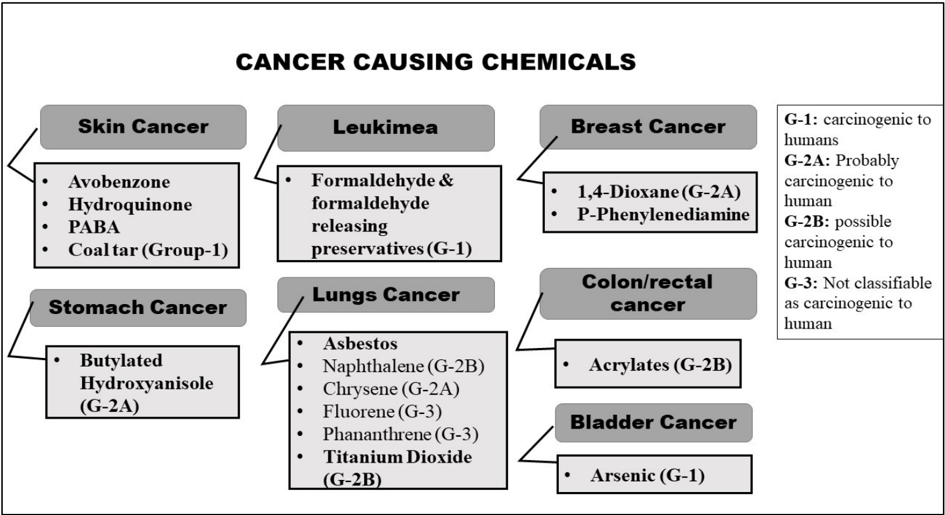
“Some chemicals such as avobenzone, hydroquinone, and PABA present in the sunscreens are not carcinogenic but can increase the risk of having skin cancer, while coal tar (group 1) is carcinogenic that can cause skin cancer as shown in Figure 3 [31].”
BackgroundInfluentialBraun, J. M., Just, A. C., Williams, P. L., Smith, K. W., Calafat, A. M., & Hauser, R. (2014) · Journal of Exposure Science & Environmental Epidemiology · doi:10.1038/jes.2013.69 · Cited by 289 · cited 1×
“Most of the cosmetic products are applied on the skin, which results in the toxic/harmful chemicals penetrating the stratum corneum barrier and reaching the dermis of the human skin, and may further reach the systemic circulation [26].”
BackgroundESTIMATED EXPOSURE TO PHTHALATES IN COSMETICS AND RISK ASSESSMENT
Koo, H. J., & Lee, B. M. (2004) · Journal of Toxicology and Environmental Health, Part A · doi:10.1080/15287390490513300 · Cited by 282
Jung, C., Son, A., Her, N., Zoh, K.-D., Cho, J., & Yoon, Y. (2015) · Journal of Industrial and Engineering Chemistry · doi:10.1016/j.jiec.2014.12.035 · Cited by 269 · cited 1×
“Generally, there are no metabolic disruptors present in any beauty care products [38].”
BackgroundLegal and practical challenges in classifying nanomaterials according to regulatory definitions
Miernicki, M., Hofmann, T., Eisenberger, I., von der Kammer, F., & Praetorius, A. (2019) · Nature Nanotechnology · doi:10.1038/s41565-019-0396-z · Cited by 206 · cited 1×
“In 2013, a subcommittee of workforce protection was referred by the secretary of health and human services [42,43].”
Background
Research works printed but not linked: 6
- Lintner, K. Global Regulatory Issues for the Cosmetics Industry; Elsevier: Amsterdam, The Netherlands, 2009.
- Chauhan, P.; Mendonica, M. Role of Regulatory Authorities on the Working of Contract Research Organization and Pharmaceutical Company's Clinical Trials in India: A Study of Strategic Alliances between Pharmaceutical Companies and Clinical Research Organisations in India. Asia Pac. J. Health Manag. 2021, 16, 87-91. [CrossRef]
- Kajapriya, R.; Surya, R. An Analysis on Insight of Women Consumer's towards Cosmetic Products. Int. J. Manag. Res. Rev. 2015, 5, 246.
- Hashim, P. and Hashim, D.. A review of cosmetic and personal care products: Halal perspective and detection of ingredient. Pertanika J. Sci. Technol. 2013, 21, 281-292.
- Harp, B.; Barrows, J. US Regulation of Color Additives in Foods. In Colour Additives for Foods and Beverages; Elsevier: Amsterdam, The Netherlands, 2015; pp. 75-88.
- Abellán, E.F.G.; Pérez, D.M. Quality Control of Cosmetic Products: Specific Legislation on Ingredients. In Analysis of Cosmetic Products; Elsevier: Amsterdam, The Netherlands, 2018; pp. 39-53.
Cited by
Alnuqaydan, A. M. (2024) · Frontiers in Public Health · doi:10.3389/fpubh.2024.1439027 · Cited by 84
“Prolonged and repeated exposure, the synergistic effects of chemical combinations, and even possible nanoparticle penetration are all factors that can cause these hazardous effects (21).”
BackgroundFast unmasking toxicity of safe personal care products
Morlock, G. E., & Zoller, L. (2025) · Journal of Chromatography A · doi:10.1016/j.chroma.2025.465886 · Cited by 21
Application of nanotechnology in anti-aging cosmetics: advantages, challenges, and prospects
Pan, X., Zhong, Z., Hu, X., Wu, J., Huang, W., Li, W., Zhao, Y., Xie, Y., Huang, Y., Liang, J., et al. (2025) · Polymer Bulletin · doi:10.1007/s00289-025-05903-3 · Cited by 16
Lapmanee, S., Bhubhanil, S., Khongkow, M., Namdee, K., Yingmema, W., Bhummaphan, N., Wongchitrat, P., Charoenphon, N., Hutchison, J. A., Talodthaisong, C., et al. (2025) · ACS Omega · doi:10.1021/acsomega.4c10648 · Cited by 12
“31 This study utilized rats and rabbits, both of which are relevant models for wound healing research due to skin structure and healing processes that resemble those of humans.”
Foam-Based Drug Delivery Systems for Skin Disorders: A Comprehensive Review
Myrzagulova, S., Zhexenova, A. N., Kumar, M., Kumar, D., & Kumar, A. (2025) · AAPS PharmSciTech · doi:10.1208/s12249-025-03098-4 · Cited by 13
“Primary safety issues related to foam-based formulations include possible skin irritation, allergic responses, systemic absorption of active pharmaceutical ingredients (APIs), and excipient toxicity, hence requiring thorough in vitro and in vivo toxicological assessments [178].”
The Hidden Dangers: How Synthetic Organic Compounds Impact Health and the Environment
Jha, A., & Jha, M. (2024) · International Journal of Nursing Information · doi:10.58418/ijni.v3i2.104 · Cited by 18
Zhong, Z., Chen, W., & Deng, J. (2024) · Microchemical Journal · doi:10.1016/j.microc.2024.110409 · Cited by 8
Prifti, E., & El-Osta, A. A. R. (2025) · BMJ Public Health · doi:10.1136/bmjph-2025-003564 · Cited by 3
Changing Skin: The Prevalence, Impact, and Risks of Skin Bleaching Among African Women
Tulashie, S. K., Ackom, V., Baidoo, E. B., Acquah, G., Fialor, B., & Alale, E. M. (2025) · Journal of Racial and Ethnic Health Disparities · doi:10.1007/s40615-025-02695-0 · Cited by 4
Shafique, I., Ahmad, R., Shin, K., Cho, Y., Oh, N., Hur, J., & Kim, S. (2025) · ACS ES&T Water · doi:10.1021/acsestwater.5c00947 · Cited by 2
Pandey, R., Singh, A., Singh, A. K., & Shukla, S. V. (2024) · Springer eBooks · doi:10.1007/978-981-97-6740-3_9 · Cited by 2
Suspect screening of plastic additives in baby skincare products
Liang, X., Cheng, Y., Tang, S., Liu, X., Li, J., Deng, Y., Tan, H., & Chen, D. (2026) · Environment International · doi:10.1016/j.envint.2026.110137 · Cited by 2
AlBlooshi, S., Ali, M. A., Abdelrahim, D. N., & Awadalla, S. (2026) · Frontiers in Toxicology · doi:10.3389/ftox.2026.1758512 · Cited by 1
Self-citationCOSMETOVIGILANCE: A REVIEW OF COSMETIC SAFETY, ADVERSE EFFECTS, AND REGULATORY PERSPECTIVES
KK, V., & B, M. (2026) · Asian Journal of Pharmaceutical and Clinical Research · doi:10.22159/ajpcr.2026v19i5.59089 · Cited by 2
Adsorption and filtration of organic pollutants using nanoferrites
Naagar, M., Wan, F., Chalia, S., Thakur, P., & Thakur, A. (2024) · Elsevier eBooks · doi:10.1016/b978-0-443-22232-0.00009-5 · Cited by 1
Biomass as Whitening Agents Derived from Plants
Ramadhan, R., Maharani, R., Devi, A. P., Warnida, H., & Fatrıasarı, W. (2024) · Springer eBooks · doi:10.1007/978-981-97-1908-2_17 · Cited by 5
Cosmeceutical Legislation: Global and Pakistan View
Liaqat, I., Jurrat, H., Ali, N. M., Aftab, M. N., Ali, S., Naseem, S., Arshad, M., & Yang, G. (2025) · Springer eBooks · doi:10.1007/978-3-031-86087-4_17 · Cited by 1
BIOLOGICAL AND PHYSIOCHEMICAL STUDIES OF OLEYL PALMITATE AS AN ACTIVE AGENT IN COSMETIC FORMULATION
Halim, N. F. A., Radzi, S. M., Rehan, M. M., Amin, N. A. M., & Rahman, N. J. A. (2025) · Chemical and Natural Resources Engineering Journal (Formally known as Biological and Natural Resources Engineering Journal) · doi:10.31436/cnrej.v9i1.120
Aringazina, A. M., Maharani, R. N., Sodiqah, Y., Akib, M. N. R., Aulia, N., & Hastiah, H. (2025) · Healthy Tadulako Journal (Jurnal Kesehatan Tadulako) · doi:10.22487/htj.v11i2.1596
Akram, A., Singh, I., & Chauhan, S. B. (2025) · Current Drug Research Reviews · doi:10.2174/0125899775377516250826002729 · Cited by 1
Exploring the Intersection of Cosmetic Chemical Exposure and Health Disparities in Breast Cancer
Kim, J., & Seo, S. (2025) · American journal of student research. · doi:10.70251/hyjr2348.35208217
Algarra, P. L., Ledesma, A. S.-T., Guillén‐Riquelme, A., González, J. J. A., & Aguilar-Elena, R. (2025) · International Journal of Occupational Safety and Ergonomics · doi:10.1080/10803548.2025.2575603
“This concern is particularly relevant for female assessors of reproductive age, who are commonly involved in the olfactory evaluation process [5,6].”
Wound healing potential of Canarium luzonicum in rats: Role of caspase-3 modulation
Asiri, Y., & Venkatesan, K. (2026) · Journal of Herbmed Pharmacology · doi:10.34172/jhp.2026.53430
“The animals were housed separately (15).”
Research on Cosmetic Safety Governance Strategies Based on Evolutionary Game Theory
杨, 国. (2026) · Advances in Applied Mathematics · doi:10.12677/aam.2026.154190
ANALYSIS OF INFORMATION ON COSMETICS RECALLS IN TÜRKİYE
Ercan, T. (2026) · Sabuncuoglu Serefeddin Health Sciences · doi:10.55895/sshs.1850392
Parabens and triclosan in personal care products: Hazards, and knowledge gaps
Aposu, L., Wuana, R. A., Itodo, A. U., & Ande, S. (2026) · Next research. · doi:10.1016/j.nexres.2026.101951
The Impact of Endocrine Disruptors in Cosmetic Products: A Systematic Review
Popa, F., Stanescu, C., Zavtoni, A.-M., & Zavtoni, M. (2026) · Cosmetics · doi:10.3390/cosmetics13030141
Eye Cosmetics and Ocular Surface Diseases: An Emerging Concern in Modern Aesthetic Practices
Bhujel, B., Eah, K. S., Kang, S. S., Chung, H. W., Lee, H., & Kim, J. Y. (2026) · Cosmetics · doi:10.3390/cosmetics13040181 · Cited by 1
Safety Oversight of Skincare Products Used by Young Adults in Urban Nigeria: A Systematic Review
Ndako, D. J. (2026) · INTERNATIONAL JOURNAL OF HEALTH AND PHARMACEUTICAL RESEARCH · doi:10.56201/ijhpr.vol.11.no5.2026.pg50.66
Chalaris, M., Anastasiou, S., & Stasinopoulos, N. (2026) · Elsevier eBooks · doi:10.1016/b978-0-443-27500-5.00005-8
Akpe, P. U., Oghenetekevwe, E., & Onosemuode, C. (2026) · European Journal of Applied Science Engineering and Technology · doi:10.59324/ejaset.2026.4(5).03
Samtio, S., Suheryani, I., Mughal, U. U. R., Ali, S., Mughal, S. A., Haider, S. S., Arbani, R. A., & Farooqui, M. U. (2026) · Genetics and Molecular Research · doi:10.4238/de7m2556
Misquith, G., Burke, I., & Chandler, J. L. (2026) · microPublication biology · doi:10.17912/micropub.biology.002208
Metadata
- Authors
- Kaushik, M., Farooq, U., Ali, M. S., Ansari, M. J., Iqbal, Z., & Mirza, M. A.
- Affiliations
- Jamia Hamdard (IN)
- Prince Sattam Bin Abdulaziz University (SA)
- Corresponding author
- Iqbal, Zeenat
- Mirza, Mohd Aamir
- Venue
- Dermato
- Publisher
- MDPI AG
- Published
- 2023-05-24
- Volume
- 3
- Issue
- 2
- Pages
- 131-157
- ISSN
- 2673-6179 (ISSN-L)
- OpenAlex
- W4378220736
- Cited by
- 28
- References
- 45
- Citations by year
- 2026: 10 · 2025: 11 · 2024: 6 · 2023: 1
- FWCI
- 7.76
- Type
- journal article
- Language
- en
- Open access
- gold
- doi.org
- Licence
- Locations
- Dermato (publishedVersion, cc-by)
- DOAJ (DOAJ: Directory of Open Access Journals) (submittedVersion, cc-by-sa)
- Topics
- Health Sciences › Medicine › Dermatology › Contact Dermatitis and Allergies
- Physical Sciences › Environmental Science › Health, Toxicology and Mutagenesis › Effects and risks of endocrine disrupting chemicals
- Physical Sciences › Chemical Engineering › Chemical Health and Safety › Chemical Safety and Risk Management
- Keywords
- cosmetics, personal care products, hazardous chemicals, cosmetic safety, medical complications, pregnancy, children, cosmetic regulation, toxicity, clinical trials
About these checks
Registry, retraction, Cites and statistics results are computed, not judged, with one exception: a printed reference that no index lists is read once by a model before it counts as a citation error. Claims are extracted by a model and kept only when their quote appears verbatim in the text; each cited source is then checked, with a model’s help, for whether it says what the claim relies on. Those verdicts can be wrong — read the claim’s quote and the cited source before relying on one.
Statistics and arithmetic are recomputed, not judged.
Confidence bands are shown only for fields calibrated on our annotated test set. None is calibrated yet, so no band is shown.
What counts as a claim ›How we measure confidence ›How we check this ›
Are you an author, or do you see a problem with this page? Request a review
Data sources
Bibliographic data: Semantic Scholar, OpenAlex, Crossref.
Contains information from the Semantic Scholar Academic Graph Datasets, made available under the ODC Attribution License (ODC-BY 1.0).
Semantic Scholar’s data is described in: Kinney, R., et al. (2023). The Semantic Scholar Open Data Platform. arXiv:2301.10140.
