

The DOI matches its Crossref record; its reference list is not available.
An Efficient Multi-Level Convolutional Neural Network Approach for White Blood Cells Classification
Open accessAbstract
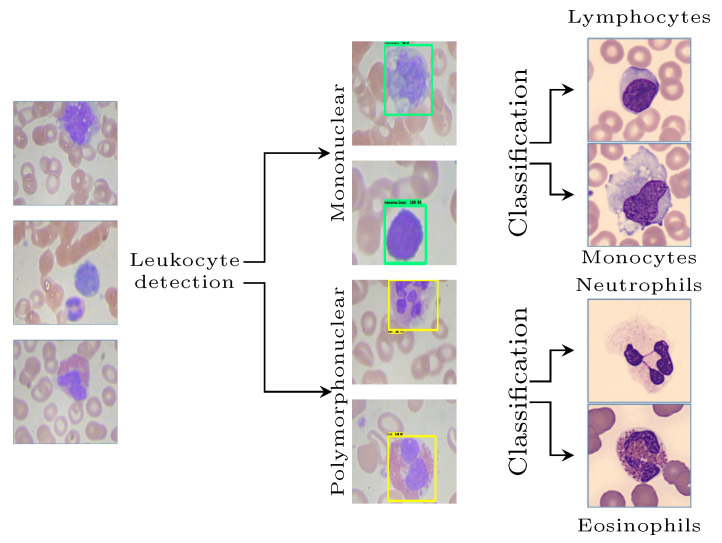
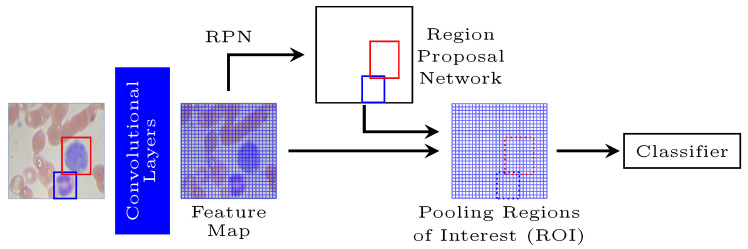
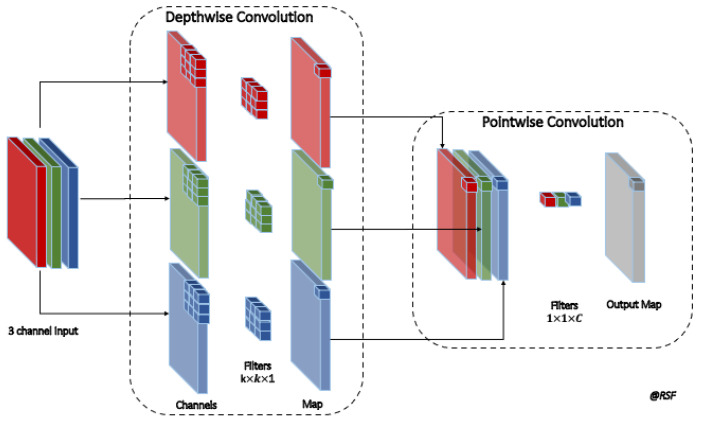
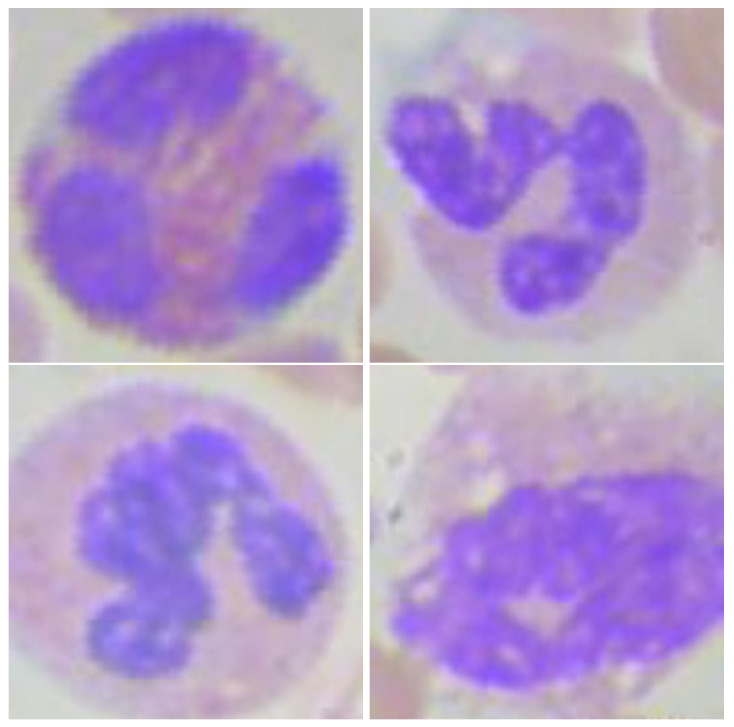
The evaluation of white blood cells is essential to assess the quality of the human immune system; however, the assessment of the blood smear depends on the pathologist’s expertise. Most machine learning tools make a one-level classification for white blood cell classification. This work presents a two-stage hybrid multi-level scheme that efficiently classifies four cell groups: lymphocytes and monocytes (mononuclear) and segmented neutrophils and eosinophils (polymorphonuclear). At the first level, a Faster R-CNN network is applied for the identification of the region of interest of white blood cells, together with the separation of mononuclear cells from polymorphonuclear cells. Once separated, two parallel convolutional neural networks with the MobileNet structure are used to recognize the subclasses in the second level. The results obtained using Monte Carlo cross-validation show that the proposed model has a performance metric of around 98.4% (accuracy, recall, precision, and F1-score). The proposed model represents a good alternative for computer-aided diagnosis (CAD) tools for supporting the pathologist in the clinical laboratory in assessing white blood cells from blood smear images.
Overview
The claims and statistics of this paper haven’t been checked yet.
Run the check — free, no account needed. It reads the open-access text and checks the sources it cites.
Integrity signals
Registry
Cites
Statistics
Figures
Verification
Claims the paper makes
The claims and statistics of this paper haven’t been checked yet.
Run the check — free, no account needed. It reads the open-access text and checks the sources it cites.
Claims other papers make about this one
Each is checked against this paper’s own text: does it say what the citing paper says it does?
The check wasn’t confident either way, so it gives no verdict — never disputed.
In the citing paper
“STR profiling remains the gold standard for cell line authentication.”
From The history, landscape, and outlook of human cell line authentication and security (2024) · cites this paper as [120]
Experimental — accuracy not yet measured
Self-check
Percentages, sums and reported differences re-computed from the paper’s own numbers.
The self-check needs the paper’s full text.
Citations
No citation lists for this paper
No citation lists for this paper yet — checked again daily.
References 57 · Cited by 116
Research works printed but not linked: 12
- Bonilla, M., and Menell, J. (2016). Chapter 13–Disorders of White Blood Cells. Lanzkowsky’s Manual of Pediatric Hematology and Oncology, Elsevier. · DOI
- Gautam, A., Singh, P., Raman, B., and Bhadauria, H. (2016, January 22–25). Automatic classification of leukocytes using morphological features and naïve Bayes classifier. Proceedings of the 2016 IEEE Region 10 Conference (TENCON), Singapore. · DOI
- Castro, 2019, Convolutional neural networks for detection intracranial hemorrhage in CT images, CRoNe, 2564, 37
- Gao, J., Yang, J., Zhang, J., and Li, M. (2015, January 2–5). Natural scene recognition based on convolutional neural networks and deep Boltzmannn machines. Proceedings of the 2015 IEEE International Conference on Mechatronics and Automation (ICMA), Beijing, China. · DOI
- Mellado, D., Saavedra, C., Chabert, S., and Salas, R. (2017, January 22–24). Pseudorehearsal approach for incremental learning of deep convolutional neural networks. Proceedings of the Computational Neuroscience: First Latin American Workshop, LAWCN 2017, Porto Alegre, Brazil. · DOI
- Honnalgere, A., and Nayak, G. (2019). Classification of normal versus malignant cells in B-ALL white blood cancer microscopic images. ISBI 2019 C-NMC Challenge: Classification in Cancer Cell Imaging, Springer. · DOI
- Howard, A.G., Zhu, M., Chen, B., Kalenichenko, D., Wang, W., Weyand, T., Andreetto, M., and Adam, H. (2017). MobileNets: Efficient Convolutional Neural Networks for Mobile Vision Applications. arXiv.
- Zhang, Y., Wu, H., Liu, H., Tong, L., and Wang, M.D. (2019). Improve Model Generalization and Robustness to Dataset Bias with Bias-regularized Learning and Domain-guided Augmentation. arXiv.
- Imran Razzak, M., and Naz, S. (2017, January 21–26). Microscopic blood smear segmentation and classification using deep contour aware CNN and extreme machine learning. Proceedings of the IEEE Conference on Computer Vision and Pattern Recognition Workshops, Honolulu, HI, USA. · DOI
- Tran, T., Kwon, O.H., Kwon, K.R., Lee, S.H., and Kang, K.W. (2018, January 10–12). Blood cell images segmentation using deep learning semantic segmentation. Proceedings of the 2018 IEEE International Conference on Electronics and Communication Engineering (ICECE), Xi’an, China. · DOI
- Yu, W., Chang, J., Yang, C., Zhang, L., Shen, H., Xia, Y., and Sha, J. (2017, January 25–28). Automatic classification of leukocytes using deep neural network. Proceedings of the 2017 IEEE 12th International Conference on ASIC (ASICON), Guiyang, China. · DOI
- Girshick, R. (2015). Fast r-cnn. arXiv. · DOI · Paper page
Metadata
- Authors
- Cheuque, C., Querales, M., León, R., Salas, R., & Torres, R.
- Affiliations
- Universidad Andrés Bello (CL)
- University of Valparaíso (CL)
- Centro de Investigación y Desarrollo en Ingeniería en Salud, Escuela de Ingeniería C. Biomédica, Universidad de Valparaíso, Valparaíso 2362905, Chile
- Corresponding author
- Torres, Romina
- Venue
- Diagnostics
- Publisher
- MDPI AG
- Published
- 2022-01-20
- Volume
- 12
- Issue
- 2
- Pages
- 248
- ISSN
- 2075-4418 (ISSN-L)
- PMC
- PMC8871319
- OpenAlex
- W4206685736
- Cited by
- 116
- References
- 57
- Citations by year
- 2026: 18 · 2025: 32 · 2024: 26 · 2023: 28 · 2022: 12
- FWCI
- 8.02
- Type
- journal article
- Language
- en
- Open access
- gold
- doi.org
- Licence
- Locations
- Diagnostics (publishedVersion, cc-by)
- PubMed Central (publishedVersion, cc-by)
- PubMed (publishedVersion)
- DOAJ (DOAJ: Directory of Open Access Journals) (submittedVersion, cc-by-sa)
- Repositorio Institucional Académico , Sistema de Bibliotecas Universidad Andrés Bello (UNAB) (Universidad Andrés Bello (UNAB)) (submittedVersion, other-oa)
- Funders
- Agencia Nacional de Investigación y Desarrollo (ICN2021- 381 004)
- Topics
- Physical Sciences › Computer Science › Computer Vision and Pattern Recognition › Digital Imaging for Blood Diseases
- Life Sciences › Biochemistry, Genetics and Molecular Biology › Biophysics › Cell Image Analysis Techniques
- Health Sciences › Health Professions › Health Information Management › Artificial Intelligence in Healthcare
- Keywords
- white blood cell classification, blood smear images, lymphocytes, monocytes, neutrophils, eosinophils, Faster R-CNN, MobileNet, two-stage classification, computer-aided diagnosis
About these checks
Registry, retraction, Cites and statistics results are computed, not judged, with one exception: a printed reference that no index lists is read once by a model before it counts as a citation error. Claims are extracted by a model and kept only when their quote appears verbatim in the text; each cited source is then checked, with a model’s help, for whether it says what the claim relies on. Those verdicts can be wrong — read the claim’s quote and the cited source before relying on one.
Statistics and arithmetic are recomputed, not judged.
Confidence bands are shown only for fields calibrated on our annotated test set. None is calibrated yet, so no band is shown.
What counts as a claim ›How we measure confidence ›How we check this ›
Are you an author, or do you see a problem with this page? Request a review
How to cite
Cite CoChat for the checks on this page, and the paper for its own findings.
- This page
- CoChat. (2026). Citation check: An Efficient Multi-Level Convolutional Neural Network Approach for White Blood Cells Classification. https://app.cochat.ai/papers/10.3390/diagnostics12020248
- The paper
- Cheuque, C., Querales, M., León, R., Salas, R., & Torres, R. (2022). An Efficient Multi-Level Convolutional Neural Network Approach for White Blood Cells Classification. Diagnostics. https://doi.org/10.3390/diagnostics12020248
