

NSX-Net: A Neurolinguistic and Acoustic Multimodal Deep Learning Framework for Speech Disorder Classification
Open accessThe DOI matches its Crossref record; 41 of the 41 references it cites were found in a registry or an index; 2 of the 5 sources its claims cite were checked for support.
Abstract
Background/Objectives: Speech disorders caused by neurological, articulatory, cognitive, and behavioral impairments require accurate multimodal analysis frameworks capable of jointly understanding acoustic abnormalities and neurolinguistic inconsistencies for reliable computer-assisted speech disorder assessment. Recent multimodal deep learning approaches have utilized speech signals, linguistic transcripts, attention mechanisms, and contextual fusion strategies to improve disordered speech analysis and intelligent disorder prediction. However, existing methods frequently suffer from insufficient temporal synchronization, ineffective local–global feature learning, multimodal redundancy, poor interpretability, and reduced robustness under heterogeneous speech disorders. To address these challenges, Methods: The proposes NSX-Net (NeuroSpeech Explainable Network), an intelligent multimodal deep learning framework for speech disorder classification using Acoustic Speech Signal Data and Neurolinguistic Text/Linguistic Data. Initially, the Adaptive Speech Refinement Module (ASRM) performs noise removal, silence elimination, signal normalization, spectrogram generation, MFCC extraction, and transcript preprocessing to improve multimodal speech consistency. Subsequently, the Hierarchical Multimodal Feature Learning Unit (HMFLU) extracts discriminative feature representations through the Cross-Domain Representation Encoder (CDRE), Fine-Grained Speech Pattern Analyzer (FGSPA), and Global Sequential Dependency Learner (GSDL) for capturing both local articulation abnormalities and long-range semantic dependencies. Furthermore, the Dual-Path Attention Enhancement Block (DPAEB) emphasizes clinically important disordered speech regions using adaptive local–global attention mechanisms, while the Temporal Resolution Synchronization Module (TRSM) aligns rhythm-level and beat-level multimodal contextual structures to improve temporal consistency and suppress noise disturbances. Results: Experimental evaluation across six publicly available multimodal speech disorder datasets demonstrated that NSX-Net achieved superior performance, with 99.27% Accuracy, 99.11% Precision, 98.97% Recall, 99.02% F1-Score, and 99.41% AUC, significantly outperforming existing state-of-the-art frameworks. Conclusions: Finally, optimized multimodal contextual representations are forwarded into a Softmax classification layer for intelligent multiclass speech disorder prediction with improved interpretability and potential clinical applicability.
Overview
CoChat Summary
## TL;DR
NSX-Net is a multimodal deep learning framework for speech disorder classification that combines acoustic speech signals and neurolinguistic text/language features with attention and temporal synchronization modules. The paper reports strong results across six public datasets, including 99.27% Accuracy and 99.41% AUC, while noting that broader real-world and multilingual validation is still needed.
## Key findings
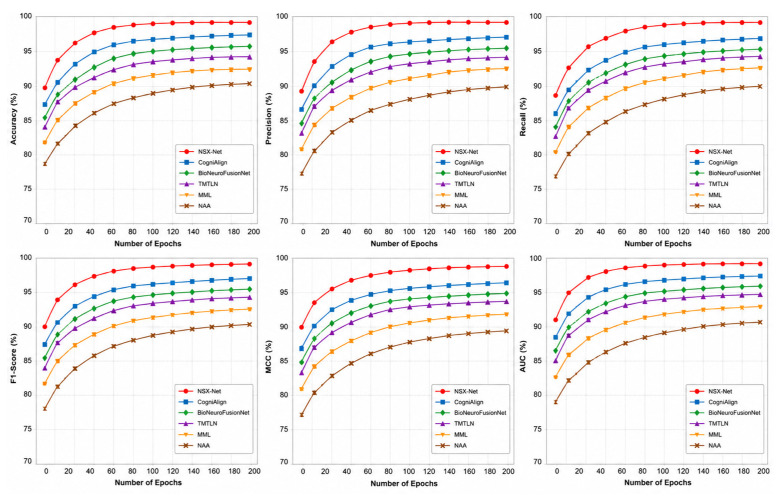
- Experimental evaluation across six publicly available multimodal speech disorder datasets showed NSX-Net achieved 99.27% Accuracy, 99.11% Precision, 98.97% Recall, 99.02% F1-Score, and 99.41% AUC.
- In one comparison, NSX-Net outperformed baselines including NAA (91.42%), MML (93.65%), BioNeuroFusionNet (96.21%), TMTLN (95.38%), and CogniAlign (96.87%) with 99.12% classification accuracy.
- The paper reports additional values of Recall (98.84%), Precision (98.91%), F1-Score (98.96%), MCC (98.41%), Specificity (99.02%), and AUC (99.31%) in another experimental summary.
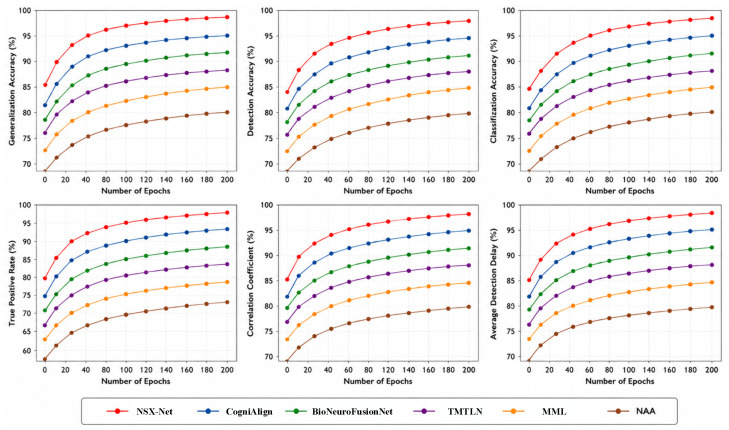
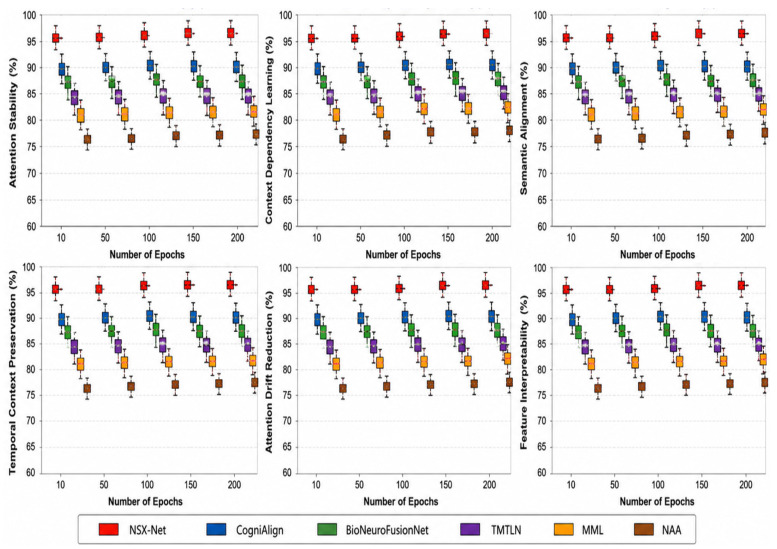
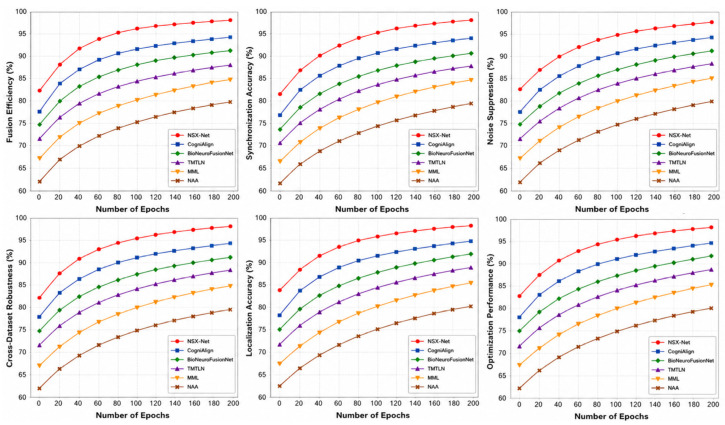
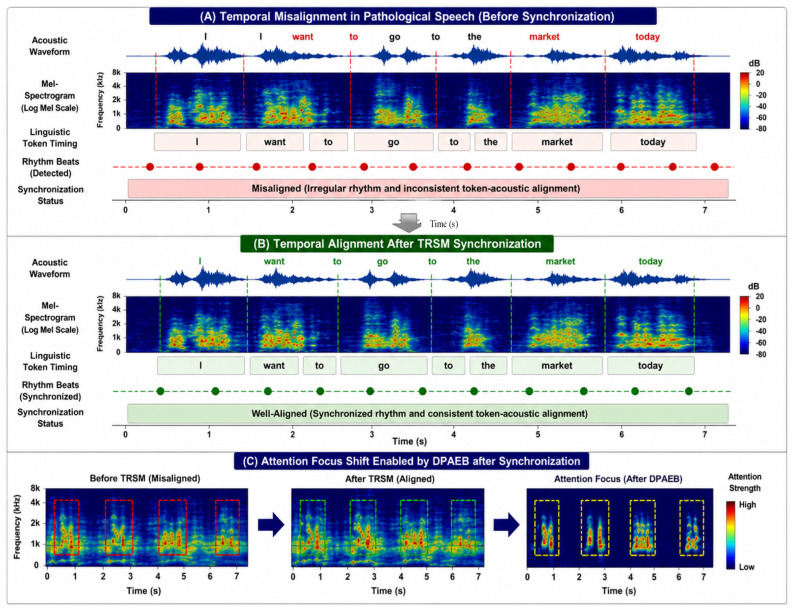
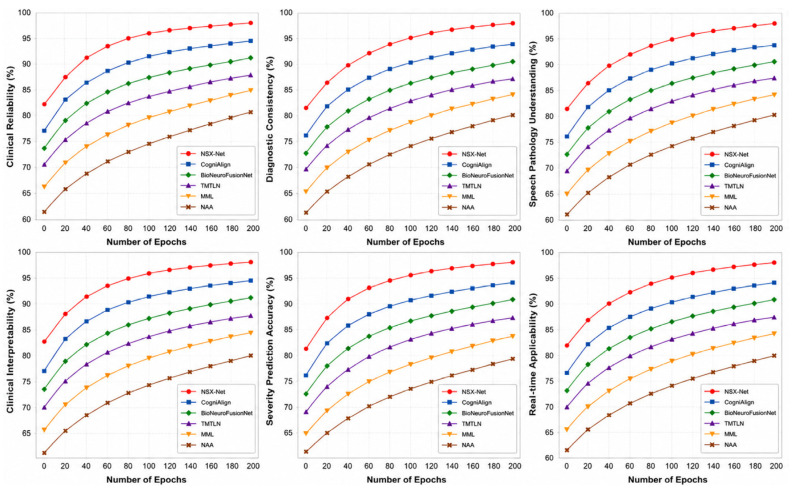
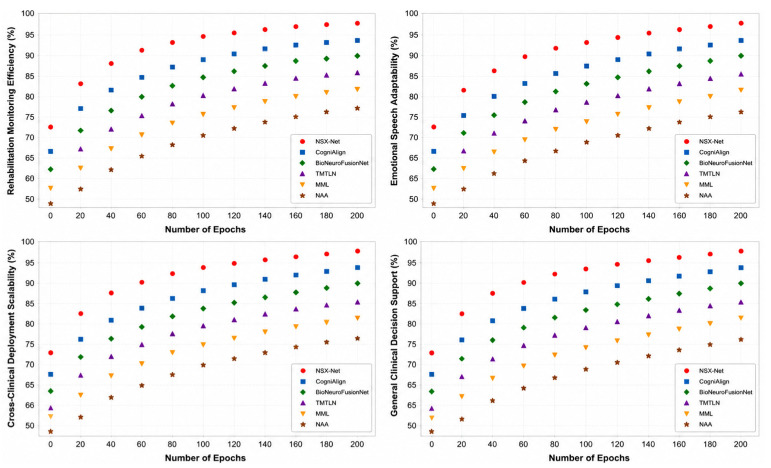
- The authors state that visualization and quantitative analyses showed improved context learning, temporal synchronization, attention optimization, noise robustness, cross-dataset generalization, and severe speech disorder detection.
## Methods
- The study proposes NSX-Net (NeuroSpeech Explainable Network), a multimodal deep learning framework that combines acoustic speech signal data and neurolinguistic text/linguistic data.
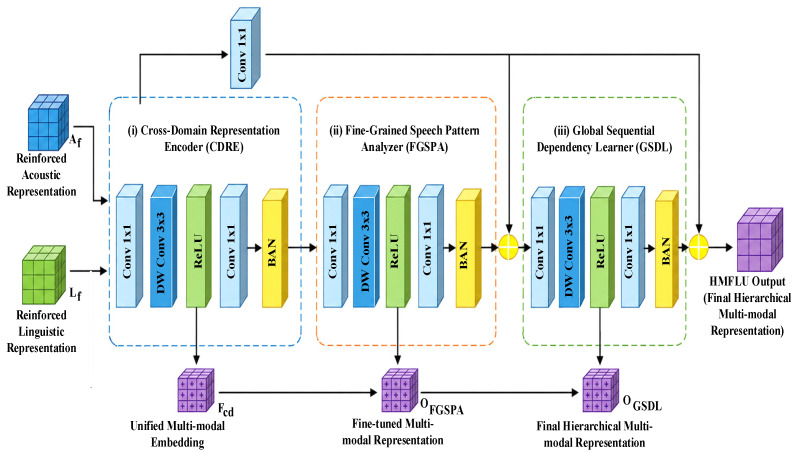
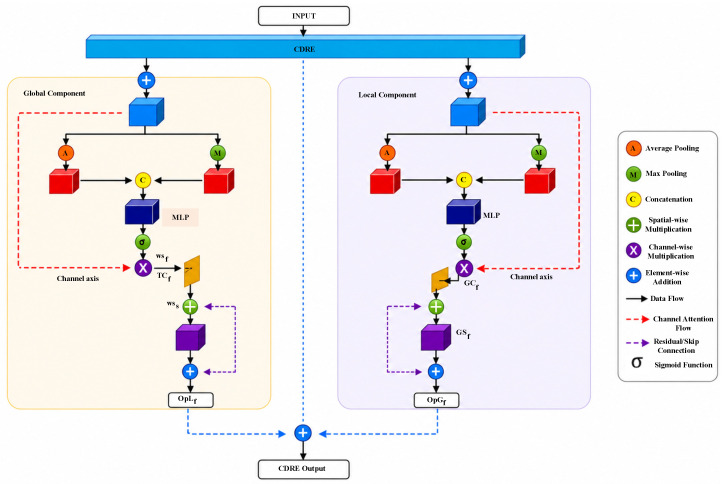
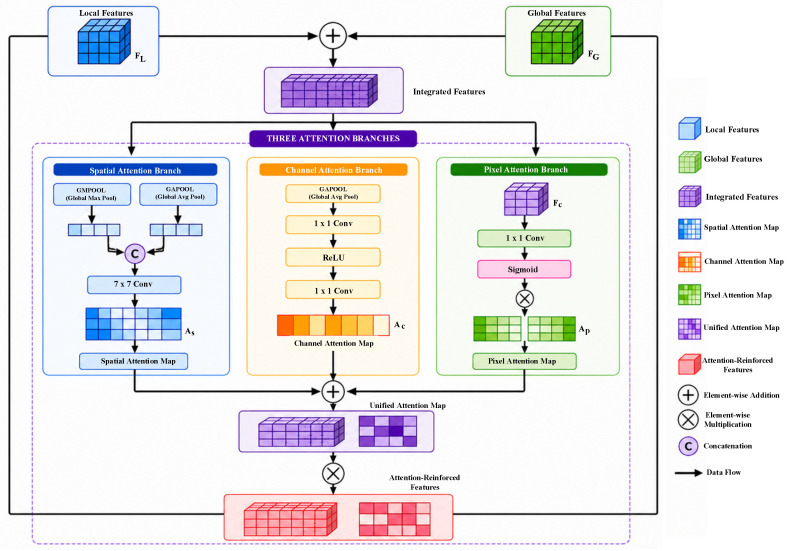
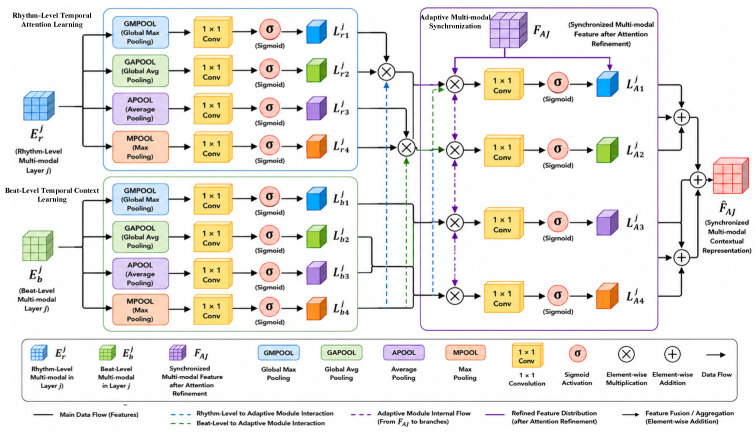
- The framework uses ASRM for preprocessing, HMFLU with CDRE, FGSPA, and GSDL for feature extraction, DPAEB for attention enhancement, TRSM for temporal synchronization, and a Softmax classification layer for multiclass prediction.
- Experiments were run in Python 3.11 with PyTorch; transcript analysis used HuggingFace Transformers API and NLTK, and acoustic preprocessing used LibROSA and Praat. Evaluation used five-fold cross-validation, early stopping, categorical cross-entropy loss, and Adam with learning rate 0.0001 and batch size 32.
## Limitations
- The paper states that NSX-Net was evaluated only on publicly available speech disorder datasets, and that robustness in real-world clinical environments, multilingual populations, and unseen recording conditions needs further validation.
- It also states that the current framework does not perform disorder severity estimation, progression monitoring, or longitudinal patient assessment.
- The paper notes that NSX-Net currently uses only acoustic speech signals and neurolinguistic textual information, and future work will explore additional modalities such as articulatory movement, facial expressions, EEG, or neuroimaging.
- Evident from the text: the evaluation is described as offline rather than real-time, so the paper does not demonstrate live clinical deployment.
Model-written summary. Check it against the paper before relying on it.
Integrity signals
Registry
Cites
Statistics
Figures
Verification
Claims the paper makes
1 Valid · 6 Not valid · 2 Not checked · 51 Own results and interpretations
The cited sources support only part of this claim — read each source’s verdict below.
In the paper
“The limitation of existing acoustic-based approaches such as NAA and TMTLN for simultaneously characterizing the issues related to articulation, cognition, and behavior associated with speech disorders is because of their focus on low-level speech abnormalities while failing to consider neurolinguistic inconsistency related to semantics.”
§ NSX-Net: A Neurolinguistic and Acoustic Multimodal Deep Learning Framework for Speech Disorder Classification > 4. Experimental Analysis
What the sources say
- Partly supportedcites [21] Algaraady J. Mahyoob M. Khan M.Z. Neurolinguistic and acoustic analysis of articulatory impairments in Arabic speech disorders Front. Hum. Neurosci. 2025 19 1638363 10.3389/fnhum.2025.1638363 41127411 PMC12537716 sourceExperimental — accuracy not yet measured
Split into 2 atoms — 0 confirmed, 2 partially supported, 0 disputed, 0 misattributed, 0 unverifiable. Expand the claim to see per-atom verdicts.
- Partly supportedcites [26] Zhao A. Wang N. Niu X. Chen M. Wu H. A triplet multimodel transfer learning network for speech disorder screening of Parkinson’s disease Int. J. Intell. Syst. 2024 2024 8890592 10.1155/2024/8890592 sourceExperimental — accuracy not yet measured
Split into 2 atoms — 0 confirmed, 2 partially supported, 0 disputed, 0 misattributed, 0 unverifiable. Expand the claim to see per-atom verdicts.
plainstates a cause- Asserted: passes — The authors put it forward as true.
- Checkable: passes — It can be checked against evidence.
- Load-bearing: passes — The paper’s conclusions depend on it.
- Based: passes — The paper gives a reason why it holds.
- Partly supported
A result the paper reports from its own data — it cites no other source for it, so there is none to check. The quote shows it is in the paper.
In the paper
“In comparison with the existing baseline frameworks, cross-dataset analysis further revealed that the proposed NSX-Net could consistently retain its feature stability and classification robustness in the face of unexpected abnormal distributions of speech.”
§ NSX-Net: A Neurolinguistic and Acoustic Multimodal Deep Learning Framework for Speech Disorder Classification > 4. Experimental Analysis
hedged- Asserted: passes — The authors put it forward as true.
- Checkable: passes — It can be checked against evidence.
- Load-bearing: passes — The paper’s conclusions depend on it.
- Based: passes — The paper gives a reason why it holds.
The paper states this without a source or data behind it here, so there is nothing to check it against. The quote shows it is in the paper.
In the paper
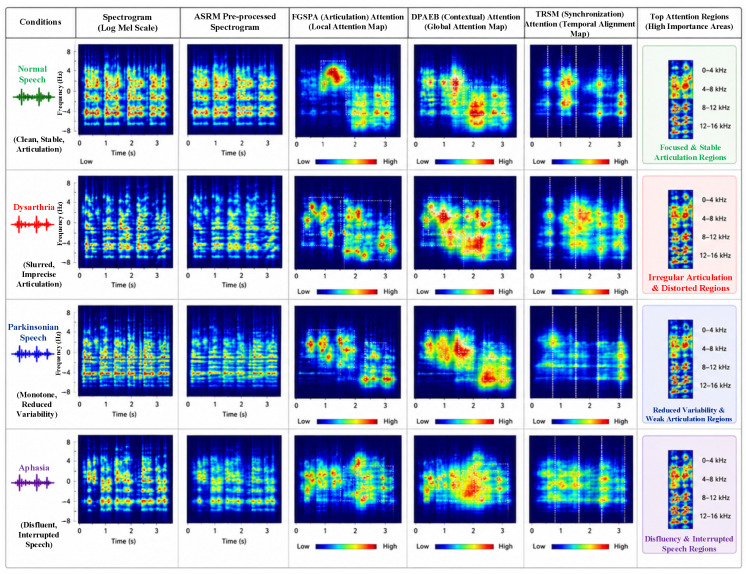
“Moreover, NSX-Net generated extremely focused activations in clinically important areas, such as articulation abnormalities, temporal rhythm disturbances, and cognitive linguistic degradations.”
§ NSX-Net: A Neurolinguistic and Acoustic Multimodal Deep Learning Framework for Speech Disorder Classification > 4. Experimental Analysis
boostedstates a cause- Asserted: passes — The authors put it forward as true.
- Checkable: passes — It can be checked against evidence.
- Load-bearing: passes — The paper’s conclusions depend on it.
- Based: unclear — It is unclear why the paper says it holds.
- Rests on an assumption not shown here.
A result the paper reports from its own data — it cites no other source for it, so there is none to check. The quote shows it is in the paper.
In the paper
“The extreme stability of feature learning and attention focusing enabled by the adaptive synchronization methods used by NSX-Net proved to be highly resilient even when faced with severe speech distortions and inconsistent languages, unlike conventional multimodal models.”
§ NSX-Net: A Neurolinguistic and Acoustic Multimodal Deep Learning Framework for Speech Disorder Classification > 4. Experimental Analysis
boostedstates a cause- Asserted: passes — The authors put it forward as true.
- Checkable: passes — It can be checked against evidence.
- Load-bearing: passes — The paper’s conclusions depend on it.
- Based: passes — The paper gives a reason why it holds.
A result the paper reports from its own data — it cites no other source for it, so there is none to check. The quote shows it is in the paper.
In the paper
“In contrast to conventional multimodal systems, NSX-Net yielded more specific and clinically relevant activations of attention mechanisms for articulatory disorders, cognitive speech abnormalities, and rhythmic disorders of speech, as illustrated by the results of interpretability analysis based on visualization techniques.”
§ NSX-Net: A Neurolinguistic and Acoustic Multimodal Deep Learning Framework for Speech Disorder Classification > 4. Experimental Analysis
plainstates a cause- Asserted: passes — The authors put it forward as true.
- Checkable: passes — It can be checked against evidence.
- Load-bearing: passes — The paper’s conclusions depend on it.
- Based: passes — The paper gives a reason why it holds.
- Rests on an assumption not shown here.
12 more claims
Create a free account to see all 60 claims and to verify the 3 references still open.
- It may state two separate claims as one. 26
- The quote only partly states this claim. 1
- Probably not a substantial claim. 20
Citations
Cites
Khoo, L. S., McNaney, R., Lim, M. K., & Chong, C. Y. (2024) · Sensors · doi:10.3390/s24020348 · Cited by 242
A Comprehensive Review on Synergy of Multi-Modal Data and AI Technologies in Medical Diagnosis
Xu, X., Li, J., Zhu, Z., Zhao, L., Wang, H., Song, C., Chen, Y., Zhao, Q., Yang, J., & Pei, Y. (2024) · Bioengineering · doi:10.3390/bioengineering11030219 · Cited by 242 · cited 1×
“Considering that speech abnormalities may affect both the voice and language simultaneously, the fusion of acoustic speech signals and neurolinguistic linguistic features yields more comprehensive insights into speech abnormalities [4,5].”
Kalateh, S., Estrada-Jimenez, L. A., Nikghadam-Hojjati, S., & Barata, J. (2024) · IEEE Access · doi:10.1109/access.2024.3430850 · Cited by 205 · cited 1×
“The existing models are further constrained in their ability to identify minor articulation errors and unique features associated with specific speech disorders without incorporating adaptive attention mechanisms and context-based alignment methodologies [18–20].”
Machine learning-assisted wearable sensing systems for speech recognition and interaction
Liu, T., Zhang, M., Li, Z., Dou, H., Zhang, W., Yang, J., Wu, P., Li, D., & Mu, X. (2025) · Nature Communications · doi:10.1038/s41467-025-57629-5 · Cited by 176 · cited 1×
“Liu et al. [43] introduced a wearable, wireless, flexible skin-attached acoustic sensor (SAAS) that captures vocal organ vibrations and skin movements to enable speech recognition and human–machine interaction in harsh acoustic environments.”
Shahriar, S., Lund, B. D., Mannuru, N. R., Arshad, M. A., Hayawi, K., Bevara, R. V. K., Mannuru, A., & Batool, L. (2024) · Applied Sciences · doi:10.3390/app14177782 · Cited by 156
DepMSTAT: Multimodal Spatio-Temporal Attentional Transformer for Depression Detection
Tao, Y., Yang, M., Li, H., Wu, Y., & Hu, B. (2024) · IEEE Transactions on Knowledge and Data Engineering · doi:10.1109/tkde.2024.3350071 · Cited by 154 · cited 1×
“Tao et al. [40] introduced DepMSTAT, a multimodal spatiotemporal attention-based transformer framework for depression detection using heterogeneous behavioral data.”
Multimodal Interaction, Interfaces, and Communication: A Survey
Dritsas, E., Τρίγκα, Μ., Troussas, C., & Mylonas, P. (2025) · Multimodal Technologies and Interaction · doi:10.3390/mti9010006 · Cited by 147 · cited 1×
“However, later on, deep learning approaches based on CNN, LSTM, and hybrid CNN-LSTM models achieved better results by automatically deriving hierarchical acoustic representations from spectrogram and temporal voice signals [11,12].”
A Survey of Cutting-edge Multimodal Sentiment Analysis
Singh, U., Abhishek, K., & Azad, H. K. (2024) · ACM Computing Surveys · doi:10.1145/3652149 · Cited by 136 · cited 1×
“Although RNNs, LSTMs, and BiLSTMs have been found to be effective in modeling temporal dependencies between speech signals, CNNs have become prevalent in spatial feature extraction from spectrograms with the emergence of deep learning [8].”
Odusami, M., Maskeliūnas, R., Damaševičius, R., & Misra, S. (2023) · Cognitive Neurodynamics · doi:10.1007/s11571-023-09993-5 · Cited by 115 · cited 1×
“The existing models are further constrained in their ability to identify minor articulation errors and unique features associated with specific speech disorders without incorporating adaptive attention mechanisms and context-based alignment methodologies [18–20].”
A survey of multimodal learning: Methods, applications, and future
Yuan, Y., Li, Z., & Zhao, B. (2025) · ACM Computing Surveys · doi:10.1145/3713070 · Cited by 90 · cited 1×
“Since early detection of any speech problems can improve the patient’s prognosis, speech disorder analysis has recently become an important field for health care professionals, neurologists, and linguists [1,2].”
Research works printed but not linked: 3
- Hu G. Xin Y. Lyu W. Huang H. Sun C. Zhu Z. Gui L. Cai R. Cambria E. Seifi H. Recent trends of multimodal affective computing: A survey from NLP perspective arXiv 2024 2409.07388
- Anuprabha M. Gurugubelli K. Kesavaraj V. Vuppala A.K. A multi-modal approach to dysarthria detection and severity assessment using speech and text information Proceedings of the ICASSP 2025—2025 IEEE International Conference on Acoustics, Speech and Signal Processing (ICASSP), Hyderabad, India, 6–11 April 2025 IEEE Piscataway, NJ, USA 2025 1 5
- Chhabra A. Vishwakarma D.K. Mhs-stma: Multimodal hate speech detection via scalable transformer-based multilevel attention framework arXiv 2024 2409.05136
Metadata
- Authors
- Nadeem, A., Khan, M. Z., Sirshar, M., & Thirunavukkarasu, U.
- Affiliations
- King Salman Center for Disability Research (SA)
- Saveetha University (IN)
- Corresponding author
- Khan, Mohammad Zubair
- Venue
- Diagnostics
- Publisher
- MDPI AG
- Published
- 2026-07-28
- Volume
- 16
- Issue
- 15
- Pages
- 2377
- ISSN
- 2075-4418 (ISSN-L)
- PMC
- PMC13465158
- OpenAlex
- W7171521658
- Semantic Scholar
- 4b97975c33d8b1e10d70dad6e3bdc72e8ad4d241
- Cited by
- 0
- References
- 38
- FWCI
- 0.00
- Type
- journal article
- Language
- en
- Open access
- gold
- doi.org
- Licence
- Locations
- Diagnostics (publishedVersion, cc-by)
- PubMed Central (publishedVersion, cc-by)
- PubMed (publishedVersion)
- DOAJ (DOAJ: Directory of Open Access Journals) (submittedVersion)
- Funders
- King Salman Center for Disability Research (KSRG-2026-341)
- Topics
- Health Sciences › Health Professions › Speech and Hearing › Voice and Speech Disorders
- Physical Sciences › Computer Science › Artificial Intelligence › Speech Recognition and Synthesis
- Physical Sciences › Computer Science › Signal Processing › Speech and Audio Processing
- Keywords
- multimodal deep learning, acoustic features, neurogenic speech disorders, global-local attention, temporal synchronization, explainable neural networks, speech preprocessing
About these checks
Registry, retraction, Cites and statistics results are computed, not judged, with one exception: a printed reference that no index lists is read once by a model before it counts as a citation error. Claims are extracted by a model and kept only when their quote appears verbatim in the text; each cited source is then checked, with a model’s help, for whether it says what the claim relies on. Those verdicts can be wrong — read the claim’s quote and the cited source before relying on one.
The claim verdicts this report counts are experimental: their accuracy is not yet measured.
A language model drew the claims from the paper on 2026-10-11, under version 3 of the claim definition (model deepseek-v4.1-flash, prompt extract-v3).
A second model labelled each claim on 2026-10-11 (model jev-1.13-20260917, definition revision gold-guideline-v0.2).
Cited sources are checked with a language model’s help (gpt-6-sol).
Statistics and arithmetic are recomputed, not judged.
Confidence bands are shown only for fields calibrated on our annotated test set. None is calibrated yet, so no band is shown.
What counts as a claim ›How we measure confidence ›How we check this ›
Are you an author, or do you see a problem with this page? Request a review
Data sources
Bibliographic data: Semantic Scholar, OpenAlex, Crossref.
Contains information from the Semantic Scholar Academic Graph Datasets, made available under the ODC Attribution License (ODC-BY 1.0).
Semantic Scholar’s data is described in: Kinney, R., et al. (2023). The Semantic Scholar Open Data Platform. arXiv:2301.10140.
