

FPGA Implementation for CNN-Based Optical Remote Sensing Object Detection
Open accessThe DOI matches its Crossref record; 49 of the 49 references it cites were found in a registry or an index.
Abstract
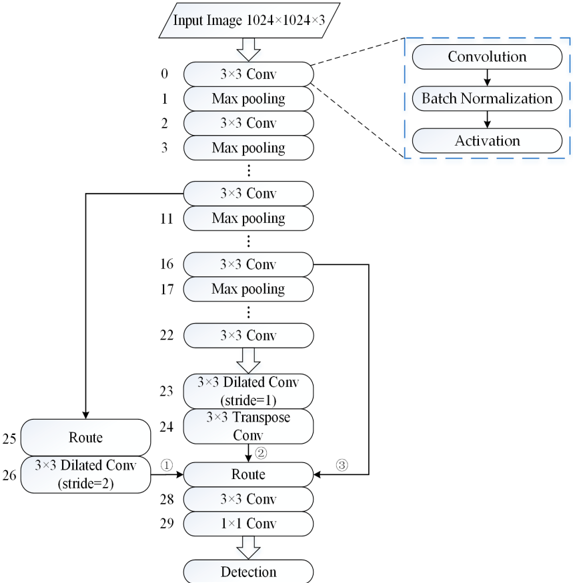
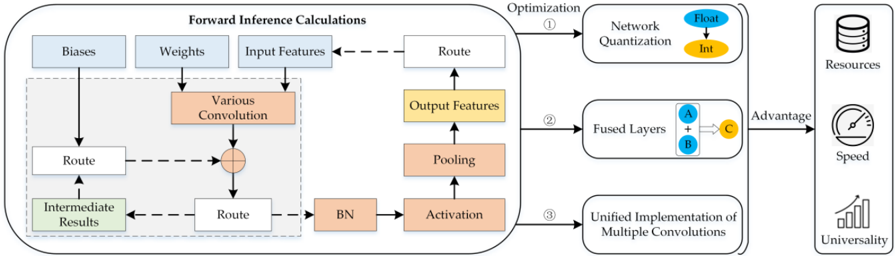
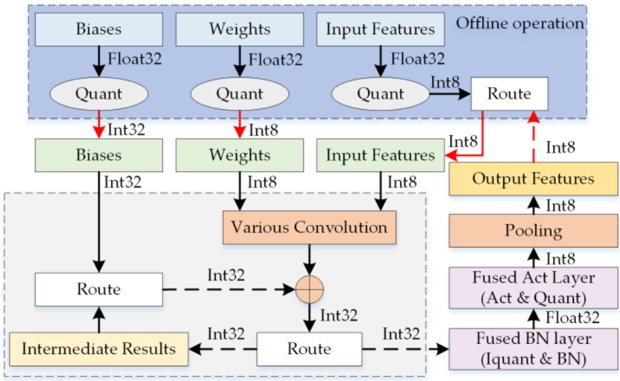
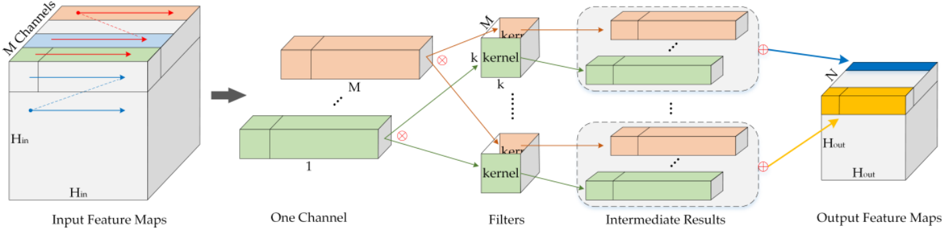
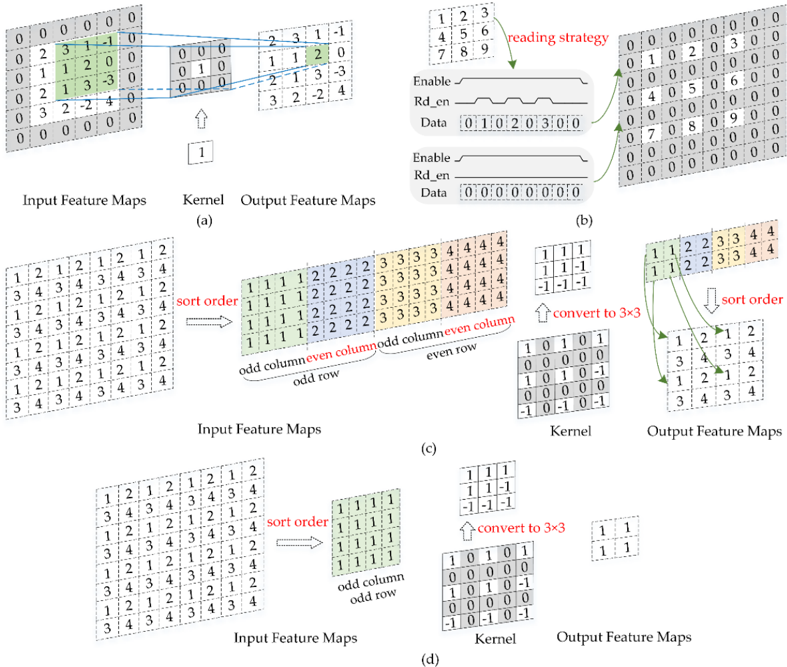
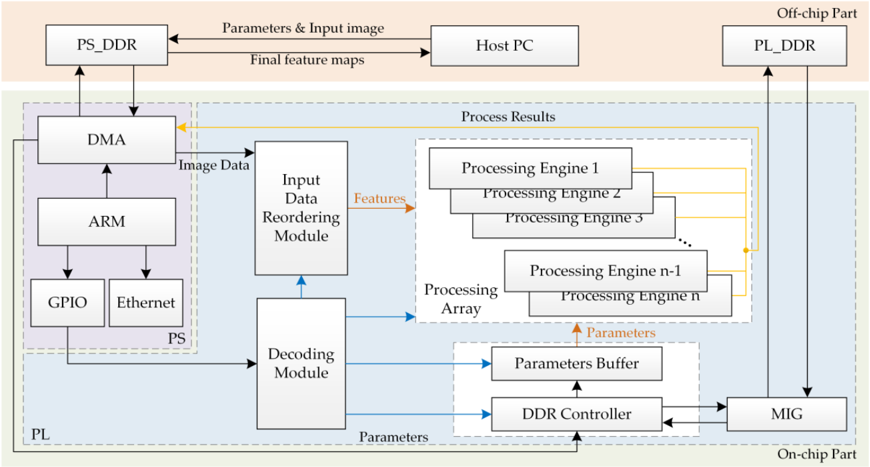
In recent years, convolutional neural network (CNN)-based methods have been widely used for optical remote sensing object detection and have shown excellent performance. Some aerospace systems, such as satellites or aircrafts, need to adopt these methods to observe objects on the ground. Due to the limited budget of the logical resources and power consumption in these systems, an embedded device is a good choice to implement the CNN-based methods. However, it is still a challenge to strike a balance between performance and power consumption. In this paper, we propose an efficient hardware-implementation method for optical remote sensing object detection. Firstly, we optimize the CNN-based model for hardware implementation, which establishes a foundation for efficiently mapping the network on a field-programmable gate array (FPGA). In addition, we propose a hardware architecture for the CNN-based remote sensing object detection model. In this architecture, a general processing engine (PE) is proposed to implement multiple types of convolutions in the network using the uniform module. An efficient data storage and access scheme is also proposed, and it achieves low-latency calculations and a high memory bandwidth utilization rate. Finally, we deployed the improved YOLOv2 network on a Xilinx ZYNQ xc7z035 FPGA to evaluate the performance of our design. The experimental results show that the performance of our implementation on an FPGA is only 0.18% lower than that on a graphics processing unit (GPU) in mean average precision (mAP). Under a 200 MHz working frequency, our design achieves a throughput of 111.5 giga-operations per second (GOP/s) with a 5.96 W on-chip power consumption. Comparison with the related works demonstrates that the proposed design has obvious advantages in terms of energy efficiency and that it is suitable for deployment on embedded devices.
Overview
The claims and statistics of this paper haven’t been checked yet.
Free: it reads the open-access text and checks the first 5 claims that cite a source we can check. Create a free account to check every claim.
Integrity signals
Registry
Cites
Statistics
Figures

Verification
Claims the paper makes
The claims and statistics of this paper haven’t been checked yet.
Free: it reads the open-access text and checks the first 5 claims that cite a source we can check. Create a free account to check every claim.
Claims other papers make about this one
Each is checked against this paper’s own text: does it say what the citing paper says it does?
The cited source says what the claim attributes to it.
In the citing paper
“FPGA is wildly utilized in various tasks including deep learning [199, 247, 331–334].”
From Review of deep learning: concepts, CNN architectures, challenges, applications, future directions (2021) · cites this paper as [332]
Self-check
Percentages, sums and reported differences re-computed from the paper’s own numbers.
The self-check needs the paper’s full text.
Citations
Cites
Rich Feature Hierarchies for Accurate Object Detection and Semantic Segmentation
Girshick, R., Donahue, J., Darrell, T., & Malik, J. (2014) · 2014 IEEE Conference on Computer Vision and Pattern Recognition · doi:10.1109/cvpr.2014.81 · Cited by 32,684
(2016) · Cited by 31,590
Self-citationBatch Normalization: Accelerating Deep Network Training by Reducing Internal Covariate Shift
Ioffe, S., & Szegedy, C. (2015) · arXiv · doi:10.48550/arxiv.1502.03167 · Cited by 27,818
SSD: Single Shot MultiBox Detector
Liu, W., Anguelov, D., Erhan, D., Szegedy, C., Reed, S., Fu, C.-Y., & Berg, A. C. (2016) · Lecture Notes in Computer Science · doi:10.1007/978-3-319-46448-0_2 · Cited by 22,128 · cited 4×
“Liu, W.; Anguelov, D.; Erhan, D.; Szegedy, C.; Reed, S.; Fu, C.Y.; Berg, A.C. SSD: Single shot multibox detector.”
MethodInfluentialSelf-citationYOLO9000: Better, Faster, Stronger
Redmon, J., & Farhadi, A. (2017) · 2017 IEEE Conference on Computer Vision and Pattern Recognition (CVPR) · doi:10.1109/cvpr.2017.690 · Cited by 19,892
DOTA: A Large-Scale Dataset for Object Detection in Aerial Images
Xia, G.-S., Bai, X., Ding, J., Zhu, Z., Belongie, S., Luo, J., Datcu, M., Pelillo, M., & Zhang, L. (2018) · 2018 IEEE/CVF Conference on Computer Vision and Pattern Recognition · doi:10.1109/cvpr.2018.00418 · Cited by 3,414
Optimizing FPGA-based Accelerator Design for Deep Convolutional Neural Networks
Zhang, C., Li, P., Sun, G., Guan, Y., Xiao, B., & Cong, J. (2015) · Proceedings of the 2015 ACM/SIGDA International Symposium on Field-Programmable Gate Arrays · doi:10.1145/2684746.2689060 · Cited by 2,158 · cited 8×
“FPGAs and ASICs have the advantages of high performance and energy efficiency [16,19].”
BackgroundInfluentialA survey on object detection in optical remote sensing images
Cheng, G., & Han, J. (2016) · ISPRS Journal of Photogrammetry and Remote Sensing · doi:10.1016/j.isprsjprs.2016.03.014 · Cited by 1,475
Joyce, K. E., Belliss, S. E., Samsonov, S. V., McNeill, S. J., & Glassey, P. J. (2009) · Progress in Physical Geography: Earth and Environment · doi:10.1177/0309133309339563 · Cited by 496 · cited 1×
“The increasing volume of image data puts high pressure on the data downlink [8,9].”
BackgroundYOLO9000: Better, Faster, Stronger
Redmon, J., & Farhadi, A. (2016) · arXiv · doi:10.48550/arxiv.1612.08242 · Cited by 488
Cited by
Review of deep learning: concepts, CNN architectures, challenges, applications, future directions
Alzubaidi, L., Zhang, J., Humaidi, A. J., Al-Dujaili, A., Duan, Y., Al-Shamma, O., Santamaría, J., Fadhel, M. A., Al-Amidie, M., & Farhan, L. (2021) · Journal of Big Data · doi:10.1186/s40537-021-00444-8 · Cited by 7,906
FlexCNN: An End-to-end Framework for Composing CNN Accelerators on FPGA
Basalama, S., Sohrabizadeh, A., Wang, J., Guo, L., & Cong, J. (2022) · ACM Transactions on Reconfigurable Technology and Systems · doi:10.1145/3570928 · Cited by 77
Deep Convolutional Neural Networks for Weeds and Crops Discrimination From UAS Imagery
Hashemi-Beni, L., Gebrehiwot, A. A., Karimoddini, A., Shahbazi, A., & Dorbu, F. E. (2022) · Frontiers in Remote Sensing · doi:10.3389/frsen.2022.755939 · Cited by 53
“In recent times, there has been considerable progress in the classi fi cation and segmentation of remote sensing data using deep learning for different applications (Chen et al., 2020 and Zhang et al., 2021).”
MethodA Systematic Literature Review on Binary Neural Networks
Sayed, R., Azmi, H., Shawkey, H., Khalil, A. H., & Refky, M. A. (2023) · IEEE Access · doi:10.1109/access.2023.3258360 · Cited by 61
“INTRODUCTION IN recent years, Convolutional Neural Network (CNN) achieved massive success in various aspects of image classification [1], [2], object recognition [3], [4], object detection [5], speech emotion recognition [6], [7], and classification of noisy non-stationary signals [8].”
BackgroundBrain-Inspired Remote Sensing Interpretation: A Comprehensive Survey
Jiao, L., Huang, Z., Liu, X., Yang, Y., Ma, M., Zhao, J., You, C., Hou, B., Yang, S., Liu, F., et al. (2023) · IEEE Journal of Selected Topics in Applied Earth Observations and Remote Sensing · doi:10.1109/jstars.2023.3247455 · Cited by 49
“Therefore, the authors in [314], [315], and [316] divided the filters into multiple groups for operation.”
Background
Metadata
- Authors
- Zhang, N., Wei, X., Chen, H., & Liu, W.
- Affiliations
- Beijing Institute of Technology (CN)
- Tsinghua University (CN)
- Corresponding author
- Liu, Wenchao
- Venue
- Electronics
- Publisher
- MDPI AG
- Published
- 2021-01-25
- Volume
- 10
- Issue
- 3
- Pages
- 282
- ISSN
- 2079-9292 (ISSN-L)
- OpenAlex
- W3121787284
- Cited by
- 85
- References
- 46
- Citations by year
- 2026: 5 · 2025: 21 · 2024: 15 · 2023: 18 · 2022: 21 · 2021: 5
- FWCI
- 5.31
- Type
- journal article
- Language
- en
- Open access
- gold
- doi.org
- Licence
- Locations
- Electronics (publishedVersion, cc-by)
- DOAJ (DOAJ: Directory of Open Access Journals) (submittedVersion, cc-by-sa)
- Funders
- National Key R & D Program of China (2017YFB0502800, 2017YFB0502804)
- the MYHT Program of China (B0201)
- Topics
- Physical Sciences › Computer Science › Computer Vision and Pattern Recognition › Advanced Neural Network Applications
- Physical Sciences › Computer Science › Hardware and Architecture › Embedded Systems Design Techniques
- Physical Sciences › Engineering › Electrical and Electronic Engineering › Embedded Systems and FPGA Applications
- Keywords
- FPGA implementation, convolutional neural networks, optical remote sensing, object detection, YOLOv2, hardware architecture, energy efficiency, embedded systems, Xilinx Zynq
About these checks
Registry, retraction, Cites and statistics results are computed, not judged, with one exception: a printed reference that no index lists is read once by a model before it counts as a citation error. Claims are extracted by a model and kept only when their quote appears verbatim in the text; each cited source is then checked, with a model’s help, for whether it says what the claim relies on. Those verdicts can be wrong — read the claim’s quote and the cited source before relying on one.
Statistics and arithmetic are recomputed, not judged.
Confidence bands are shown only for fields calibrated on our annotated test set. None is calibrated yet, so no band is shown.
What counts as a claim ›How we measure confidence ›How we check this ›
Are you an author, or do you see a problem with this page? Request a review
How to cite
Cite CoChat for the checks on this page, and the paper for its own findings.
- This page
- CoChat. (2026). Citation check: FPGA Implementation for CNN-Based Optical Remote Sensing Object Detection. https://app.cochat.ai/papers/10.3390/electronics10030282
- The paper
- Zhang, N., Wei, X., Chen, H., & Liu, W. (2021). FPGA Implementation for CNN-Based Optical Remote Sensing Object Detection. Electronics. https://doi.org/10.3390/electronics10030282
Data sources
Bibliographic data: Semantic Scholar, OpenAlex, Crossref.
Contains information from the Semantic Scholar Academic Graph Datasets, made available under the ODC Attribution License (ODC-BY 1.0).
Semantic Scholar’s data is described in: Kinney, R., et al. (2023). The Semantic Scholar Open Data Platform. arXiv:2301.10140.
