

Investigating the Operational Complexity of Digital Workflows Based on Human Cognitive Aspects
Open accessThe DOI matches its Crossref record; 30 of the 31 references it cites were found in a registry or an index.
Abstract
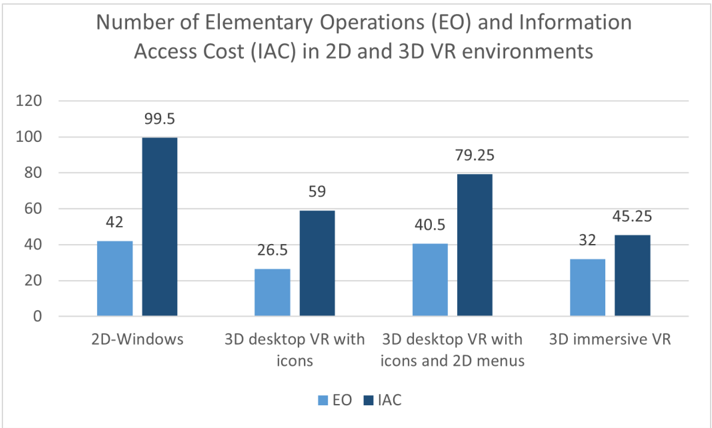
In recent decades, the everyday working environment has increasingly shifted into the digital realm. Accordingly, the assessment of human working performance has become strongly influenced by the level, frequency, and mode of interaction with the digital environment. This paper presents a system-level comparative analysis of human–computer interactions in 2D versus 3D digital environments, focusing on human behavior in different environments and interfaces. For the purposes of this analysis, a new methodology is proposed—inspired by a set of new concepts and metrics—that can be used to evaluate digital interfaces based on the number and complexity of user operations. Beyond the use of objective indicators, the study was supplemented by a user survey of 52 people to map the congruence of digital systems and user requirements. According to the research results, in 3D virtual work environments, users perform at least 30 percent fewer elementary operations. The Information Access Cost is 54 percent less in immersive VR than in classical 2D user interfaces. Based on these figures, we conclude that the development trends behind 3D VR-based working environments coincide with the intention to extend human cognitive capabilities.
Overview
The claims and statistics of this paper haven’t been checked yet.
Free: it reads the open-access text and checks the first 5 claims that cite a source we can check. Create a free account to check every claim.
Integrity signals
Registry
Cites
Statistics
Figures
Verification
Claims the paper makes
The claims and statistics of this paper haven’t been checked yet.
Free: it reads the open-access text and checks the first 5 claims that cite a source we can check. Create a free account to check every claim.
Claims other papers make about this one
Each is checked against this paper’s own text: does it say what the citing paper says it does?
The source backs part of the claim, not all of it — or backs it for a different population, condition or comparison.
In the citing paper
“In contrast, studies [6,8,16,28,29] address intermediate or non-specialized users, whether university students, mobile users or digital collaborators.”
From The Impact of User Interface and Experience (UI/UX) Design on Visual Ergonomics: A Technical Approach for Reducing Human Error in Industrial Settings (2026) · cites this paper as [28]
Experimental — accuracy not yet measuredThe source backs part of the claim, not all of it — or backs it for a different population, condition or comparison.
In the citing paper
“Even in systems with partially ergonomic designs [13,17,18,28], incomplete implementation translates into errors caused by visual ambiguity, redundant task execution, or misinterpretation.”
From The Impact of User Interface and Experience (UI/UX) Design on Visual Ergonomics: A Technical Approach for Reducing Human Error in Industrial Settings (2026) · cites this paper as [28]
Experimental — accuracy not yet measuredThe source backs part of the claim, not all of it — or backs it for a different population, condition or comparison.
In the citing paper
“In contrast, this review broadens the scope by demonstrating the effectiveness of specific visual factors across multiple domains like industrial, transportation, and virtual reality, particularly under high operational pressure [11,28].”
From The Impact of User Interface and Experience (UI/UX) Design on Visual Ergonomics: A Technical Approach for Reducing Human Error in Industrial Settings (2026) · cites this paper as [28]
Experimental — accuracy not yet measured
Self-check
Percentages, sums and reported differences re-computed from the paper’s own numbers.
The self-check needs the paper’s full text.
Citations
Cites
The Psychology of Human-Computer Interaction
Card, S. K., Moran, T. P., & Newell, A. (2018) · CRC Press eBooks · doi:10.1201/9780203736166 · Cited by 4,103
Rasmussen, J. (1983) · IEEE Transactions on Systems, Man, and Cybernetics · doi:10.1109/tsmc.1983.6313160 · Cited by 3,434
Definition and synergies of cognitive infocommunications
Bárányi, P., & Csapó, Á. (2012) · SZTAKI Publication Repository (Hungarian Academy of Sciences) · Cited by 748
Cognitive Infocommunications (CogInfoCom)
Baranyi, P., Csapo, A., & Sallai, G. (2015) · Springer eBooks · doi:10.1007/978-3-319-19608-4 · Cited by 584
Henderson, D. A., & Card, S. (1986) · ACM Transactions on Graphics · doi:10.1145/24054.24056 · Cited by 522
Wohlgenannt, I., Simons, A., & Stieglitz, S. (2020) · Business & Information Systems Engineering · doi:10.1007/s12599-020-00658-9 · Cited by 364
RTO: An overview and assessment of current practice
Darby, M. L., Nikolaou, M., Jones, J., & Nicholson, D. (2011) · Journal of Process Control · doi:10.1016/j.jprocont.2011.03.009 · Cited by 344
Homuncular Flexibility in Virtual Reality
Won, A. S., Bailenson, J., Lee, J., & Lanier, J. (2015) · Journal of Computer-Mediated Communication · doi:10.1111/jcc4.12107 · Cited by 258
The Present and Future of Positive Technologies
Botella, C., Riva, G., Gaggioli, A., Wiederhold, B. K., Alcaniz, M., & Baños, R. M. (2012) · Cyberpsychology, Behavior, and Social Networking · doi:10.1089/cyber.2011.0140 · Cited by 205
An Insider's View of the Future of Virtual Reality
Lanier, J., & Biocca, F. (1992) · Journal of Communication · doi:10.1111/j.1460-2466.1992.tb00816.x · Cited by 171
Research works printed but not linked: 2
- Fritzsche, L.; Jendrusch, R.; Leidholdt, W.; Bauer, S.; Jäckel, T.; Pirger, A. Introducing ema (Editor for Manual Work Activities)-A New Tool for Enhancing Accuracy and Efficiency of Human Simulations in Digital Production Planning. In Digital Human Modeling; Springer: Berlin/Heidelberg, Germany, 2011; pp. 272-281. [CrossRef]
- Shneiderman, B.; Plaisant, C.; Cohen, M.; Jacobs, S.; Elmqvist, N. Designing the User Interface Strategies for Effective Human-Computer Interaction; Pearson Higher Education & Professional Group: New York City, NY, USA, 2017; p. 624.
Cited by
Unlocking the Potential of Immersive VR Systems: The Role of Gesture and Natural Controls
Horváth, I., & Berki, B. (2023) · IEEE International Conference on Cognitive Aspects of Virtual Reality (CVR) · doi:10.1109/cvr58941.2023.10394795 · Cited by 10
Self-citationHorváth, I., & Csapó, Á. (2023) · IEEE International Conference on Cognitive Aspects of Virtual Reality (CVR) · doi:10.1109/cvr58941.2023.10395520 · Cited by 8
“Recent developments in VR have led to o g n t i v e s p e significantly new solutions that involve people, devices and digital content (see, e.g. [4, 5, 6]).”
BackgroundSelf-citationAspects of Dynamics in Dialogue Collaboration
Vogel, C. M., Koutsombogera, M., & Reverdy, J. (2023) · Electronics · doi:10.3390/electronics12102210 · Cited by 11
Design Suggestions for Digital Workflow Oriented Desktop VR Spaces
Sudár, A., & Horváth, I. (2024) · Híradástechnika/Infocommunications journal · doi:10.36244/icj.2024.5.14 · Cited by 6
Self-citationSomabut, A., Chaichuay, V., Chansanam, W., Detthamrong, U., Laochankham, S., Lowatcharin, G., Wannasen, T., & Li, C. (2026) · Social Sciences & Humanities Open · doi:10.1016/j.ssaho.2026.102832 · Cited by 5
Metadata
- Authors
- Horváth, I., & Berki, B.
- Affiliations
- Obuda University (HU)
- Corresponding author
- Horváth, Ildikó
- Venue
- Electronics
- Publisher
- MDPI AG
- Published
- 2023-01-19
- Volume
- 12
- Issue
- 3
- Pages
- 528
- ISSN
- 2079-9292 (ISSN-L)
- OpenAlex
- W4317608680
- Cited by
- 15
- References
- 30
- Citations by year
- 2026: 3 · 2025: 1 · 2024: 5 · 2023: 6
- FWCI
- 2.59
- Type
- journal article
- Language
- en
- Open access
- gold
- doi.org
- Licence
- Locations
- Electronics (publishedVersion, cc-by)
- Topics
- Physical Sciences › Computer Science › Human-Computer Interaction › Interactive and Immersive Displays
- Physical Sciences › Computer Science › Human-Computer Interaction › Usability and User Interface Design
- Physical Sciences › Computer Science › Human-Computer Interaction › Virtual Reality Applications and Impacts
- Keywords
- digital workflow, human-computer interaction, immersive virtual reality, information access costs, user requirements, user behavior
About these checks
Registry, retraction, Cites and statistics results are computed, not judged, with one exception: a printed reference that no index lists is read once by a model before it counts as a citation error. Claims are extracted by a model and kept only when their quote appears verbatim in the text; each cited source is then checked, with a model’s help, for whether it says what the claim relies on. Those verdicts can be wrong — read the claim’s quote and the cited source before relying on one.
Statistics and arithmetic are recomputed, not judged.
Confidence bands are shown only for fields calibrated on our annotated test set. None is calibrated yet, so no band is shown.
What counts as a claim ›How we measure confidence ›How we check this ›
Are you an author, or do you see a problem with this page? Request a review
Data sources
Bibliographic data: Semantic Scholar, OpenAlex, Crossref.
Contains information from the Semantic Scholar Academic Graph Datasets, made available under the ODC Attribution License (ODC-BY 1.0).
Semantic Scholar’s data is described in: Kinney, R., et al. (2023). The Semantic Scholar Open Data Platform. arXiv:2301.10140.
