

Profitable Decarbonization through E-Mobility
Open accessThe DOI matches its Crossref record; 18 of the 18 references it cites were found in a registry or an index.
Abstract
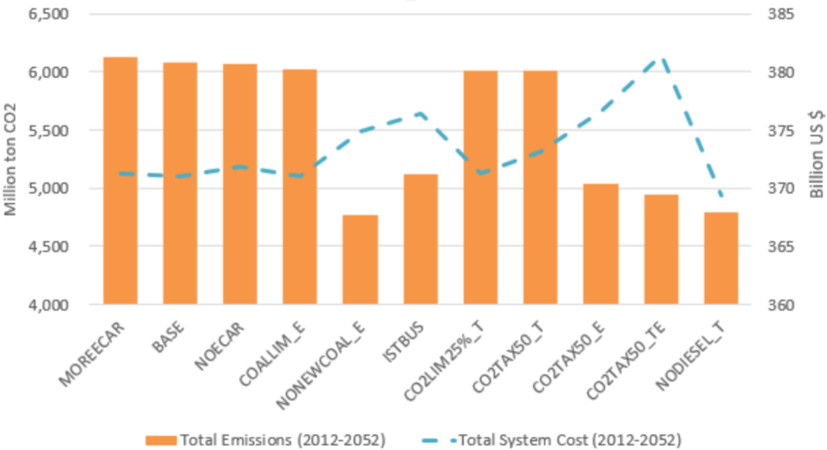
This paper focuses on the interdependent relationship of power generation, transportation and CO2 emissions to evaluate the impact of electric vehicle deployment on power generation and CO2 emissions. The value of this evaluation is in the employment of a large-scale, bottom-up, national energy modeling system that encompasses the complex relationships of producing, transforming, transmitting and supplying energy to meet the useful demand characteristics with great technological detail. One of such models employed in this analysis is the BUEMS model. The BUEMS model provides evidence of win-win policy options that lead to profitable decarbonization using Turkey’s data in BUEMS. Specifically, the result shows that a ban on diesel fueled vehicles reduces lifetime emissions as well as lifetime costs. Furthermore, model results highlight the cost-effective emission reduction potential of e-buses in urban transportation. More insights from the results indicate that the marginal cost of emission reduction through e-bus transportation is much lower than that through other policy measures such as carbon taxation in transport. This paper highlights the crucial role the electricity sector plays in the sustainability of e-mobility and the value of related policy prescriptions.
Overview
The claims and statistics of this paper haven’t been checked yet.
Free: it reads the open-access text and checks the first 5 claims that cite a source we can check. Create a free account to check every claim.
Integrity signals
Registry
Cites
Statistics
Figures
Verification
Claims the paper makes
The claims and statistics of this paper haven’t been checked yet.
Free: it reads the open-access text and checks the first 5 claims that cite a source we can check. Create a free account to check every claim.
Claims other papers make about this one
Each is checked against this paper’s own text: does it say what the citing paper says it does?
The source backs part of the claim, not all of it — or backs it for a different population, condition or comparison.
In the citing paper
“Further contributions like those from Kumbaroglu et al. [84] and Lebkowski [85] discuss the integration of EVs into public transport systems, pointing out the profitability and sustainability of such initiatives.”
From Electric Vehicle Adoption: A Comprehensive Systematic Review of Technological, Environmental, Organizational and Policy Impacts (2024) · cites this paper as [84]
Experimental — accuracy not yet measured
Self-check
Percentages, sums and reported differences re-computed from the paper’s own numbers.
The self-check needs the paper’s full text.
Citations
Cites
Climate change 2007 - mitigation of climate change
Metz, B., Davidson, O. R., Bösch, P., Dave, R., & Meyer, L. (2007) · Cited by 3,484
Climate Change 2014 : Synthesis Report
Pachauri, R. K., Allen, M. R. (. D. )., & Minx, J. C. (. D. ). (2015) · OPUS 4 (Zuse Institute Berlin) · Cited by 2,322
Global EV Outlook 2018: Towards cross-modal electrification
Bunsen, T., Cazzola, P., Gorner, M., Paoli, L., Scheffer, S., Schuitmaker, R., Tattini, J., & Teter, J. (2018) · Cited by 219
TIMES modelling of transport sector in China and USA: Comparisons from a decarbonization perspective
Zhang, H., Chen, W., & Huang, W. (2016) · Applied Energy · doi:10.1016/j.apenergy.2015.08.124 · Cited by 179
Changing patterns and determinants of transportation carbon emissions in Chinese cities
Li, F., Cai, B., Ye, Z., Wang, Z., Zhang, W., Zhou, P., & Chen, J. (2019) · Energy · doi:10.1016/j.energy.2019.02.179 · Cited by 122 · cited 1×
“For example, a study that examined transportation carbon emissions in 341 cities concludes that transport emissions were significantly lower in central and western cities than in eastern cities and the emissions per GDP contributed to policies aimed at reducing transport emissions [14].”
BackgroundA multi-model assessment of energy and emissions for India's transportation sector through 2050
Paladugula, A. L., Kholod, N., Chaturvedi, V., Ghosh, P. P., Pal, S., Clarke, L., Evans, M., Kyle, P. G., Koti, P. N., Parikh, K. S., et al. (2018) · Energy Policy · doi:10.1016/j.enpol.2018.01.037 · Cited by 109 · cited 1×
“In a recent study, five modeling teams converged to understand the impact of road transport in energy demand and emissions by developing baseline projections for India’s transportation sector [13].”
BackgroundPOLICY INSIGHTS FROM THE EMF 32 STUDY ON U.S. CARBON TAX SCENARIOS
BARRON, A. R., FAWCETT, A. A., HAFSTEAD, M. A. C., MCFARLAND, J. R., & MORRIS, A. C. (2018) · Climate Change Economics · doi:10.1142/s2010007818400031 · Cited by 70 · cited 1×
“For example, a fixed tax trajectory was set such that the tax begins in 2020 at either $25 or $50 and rises at either 1% or 5% per year [30].”
BackgroundDecarbonizing the Greek road transport sector using alternative technologies and fuels
Tsita, K. G., & Pilavachi, P. A. (2017) · Thermal Science and Engineering Progress · doi:10.1016/j.tsep.2017.02.003 · Cited by 34 · cited 1×
“In evaluating the decarbonization of the Greek road transport sector using alternative technologies and fuels, [12] uses the Long-range Energy Alternatives Planning (LEAP) model.”
MethodEnergy technology investments in competitive and regulatory environments
Shittu, E., PARKER, G. G., & Jiang, X. (2015) · Environment Systems & Decisions · doi:10.1007/s10669-015-9569-y · Cited by 31 · cited 1×
“The optimal configuration of the sources of electricity often result from the dynamics of the competition [4], state of technological progress [5] or responses to uncertainties in regulations [6] or reliability [7] of the technology portfolio.”
BackgroundSelf-citationKamdem, B., & Shittu, E. (2016) · Renewable and Sustainable Energy Reviews · doi:10.1016/j.rser.2016.12.062 · Cited by 30
Self-citation
Research works printed but not linked: 5
- Karali, N. (2012). Design and Development of a Large-Scale Energy Model. [Ph.D. Thesis, Bogazici University].
- Işık, M. (2016). Energy, Economy and Environment Integrated Large-Scale Modeling and Analysis of the Turkish Energy System. [Ph.D. Thesis, Bogazici University].
- Günel, G. (2018). Analysis of CO2 Emission Reduction, Energy and Economy Interactions in Turkey Using BUEMS-MACRO. [Master’s Thesis, Boğaziçi University].
- Yıldırım, I. (2019). Energy Policy Analysis with the Boğaziçi University Energy Modeling System BUEMS: Prospects for the Diffusion of Renewable Energy Tecnologies and Utilization of Domestic Coal Reserves in Turkey. [Master’s Thesis, Boğaziçi University].
- Canaz, C. (2019). Transport Sector Energy Use, Electric Vehicle Deployment and CO2 Emissions in Turkey: An Evaluation Using the Boğaziçi University Energy Modeling System. [Master’s Thesis, Boğaziçi University].
Cited by
Zaino, R., Ahmed, V., Alhammadi, A. M., & Alghoush, M. (2024) · World Electric Vehicle Journal · doi:10.3390/wevj15080375 · Cited by 211
Hofbauer, L., McDowall, W., & Pye, S. (2022) · Renewable and Sustainable Energy Reviews · doi:10.1016/j.rser.2022.112330 · Cited by 78
Onat, N. C., Abdella, G. M., Küçükvar, M., KUTTY, A. A. K. A., Al-Nuaimi, M. H. B., Kumbaroğlu, G., & Bulu, M. (2021) · Sustainable Development · doi:10.1002/sd.2186 · Cited by 63
Self-citationPan, W., & Shittu, E. (2024) · Applied Energy · doi:10.1016/j.apenergy.2024.124838 · Cited by 31
Self-citationDönmezçelik, O., Koçak, E., & Örkçü, H. H. (2022) · Energy · doi:10.2339/politeknik.1212520 · Cited by 31
Metadata
- Authors
- Kumbaroğlu, G., Canaz, C., Deason, J., & Shittu, E.
- Affiliations
- Boğaziçi University (TR)
- George Washington University (US)
- Corresponding author
- Kumbaroğlu, Gürkan
- Venue
- Energies
- Publisher
- MDPI AG
- Published
- 2020-08-05
- Volume
- 13
- Issue
- 16
- Pages
- 4042
- ISSN
- 1996-1073 (ISSN-L)
- OpenAlex
- W3047302094
- Cited by
- 17
- References
- 18
- Citations by year
- 2026: 1 · 2025: 3 · 2024: 3 · 2023: 3 · 2022: 4 · 2021: 3
- FWCI
- 0.86
- Type
- journal article
- Language
- en
- Open access
- gold
- doi.org
- Licence
- Locations
- Energies (publishedVersion, cc-by)
- RePEc: Research Papers in Economics (submittedVersion)
- DOAJ (DOAJ: Directory of Open Access Journals) (submittedVersion, cc-by-sa)
- Funders
- Fulbright Commission (FY-2019-TR-SS-17)
- Scientific & Technical Research Council of Turkey (104M348)
- Bogazici University Scientific Research Fund (BAP12281)
- Topics
- Physical Sciences › Engineering › Electrical and Electronic Engineering › Electric Vehicles and Infrastructure
- Physical Sciences › Energy › Renewable Energy, Sustainability and the Environment › Energy, Environment, and Transportation Policies
- Physical Sciences › Engineering › Electrical and Electronic Engineering › Integrated Energy Systems Optimization
- Keywords
- electric mobility, decarbonization, electric vehicles, CO2 emissions, diesel vehicle bans, electric buses, urban transport, carbon tax, emission reduction costs, electricity generation, energy policy, Turkey
About these checks
Registry, retraction, Cites and statistics results are computed, not judged, with one exception: a printed reference that no index lists is read once by a model before it counts as a citation error. Claims are extracted by a model and kept only when their quote appears verbatim in the text; each cited source is then checked, with a model’s help, for whether it says what the claim relies on. Those verdicts can be wrong — read the claim’s quote and the cited source before relying on one.
Statistics and arithmetic are recomputed, not judged.
Confidence bands are shown only for fields calibrated on our annotated test set. None is calibrated yet, so no band is shown.
What counts as a claim ›How we measure confidence ›How we check this ›
Are you an author, or do you see a problem with this page? Request a review
How to cite
Cite CoChat for the checks on this page, and the paper for its own findings.
- This page
- CoChat. (2026). Citation check: Profitable Decarbonization through E-Mobility. https://app.cochat.ai/papers/10.3390/en13164042
- The paper
- Kumbaroğlu, G., Canaz, C., Deason, J., & Shittu, E. (2020). Profitable Decarbonization through E-Mobility. Energies. https://doi.org/10.3390/en13164042
Data sources
Bibliographic data: Semantic Scholar, OpenAlex, Crossref.
Contains information from the Semantic Scholar Academic Graph Datasets, made available under the ODC Attribution License (ODC-BY 1.0).
Semantic Scholar’s data is described in: Kinney, R., et al. (2023). The Semantic Scholar Open Data Platform. arXiv:2301.10140.
