

A Prediction Model for Battery Electric Bus Energy Consumption in Transit
Open accessThe DOI matches its Crossref record; 63 of the 63 references it cites were found in a registry or an index.
Abstract
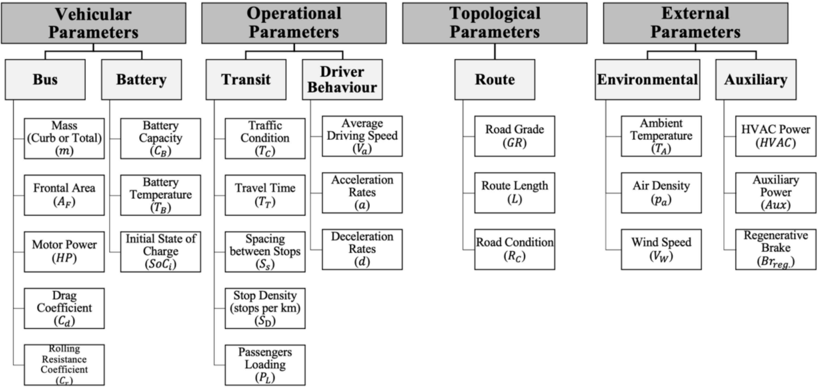
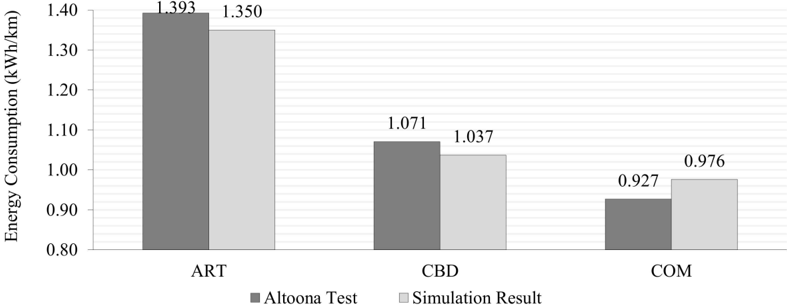
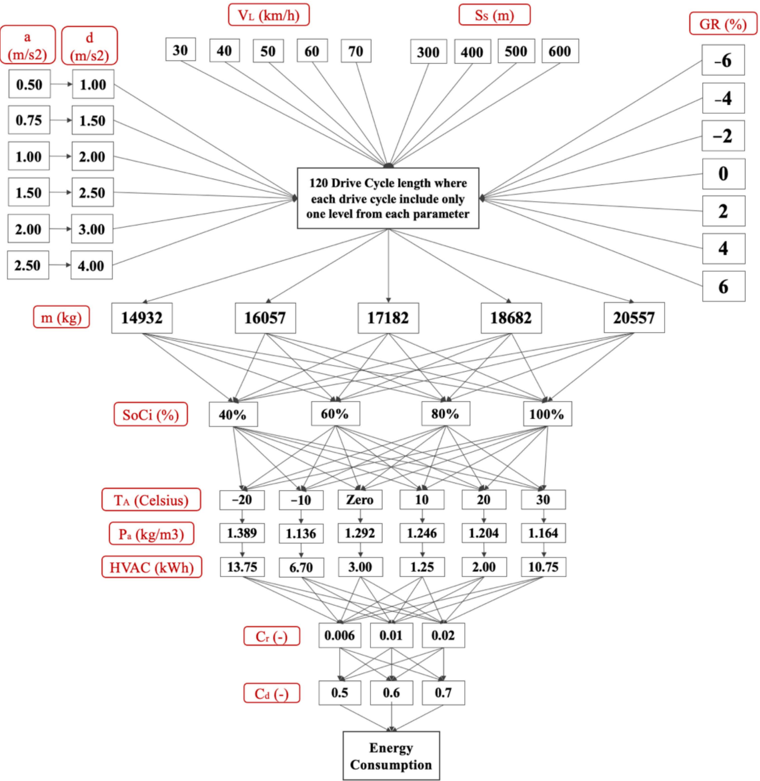
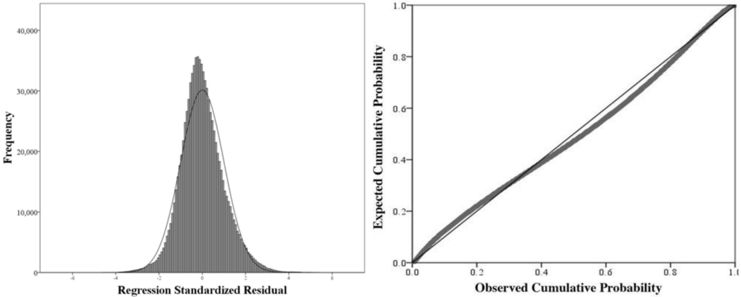
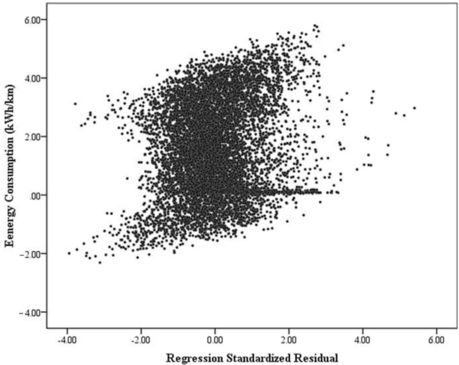
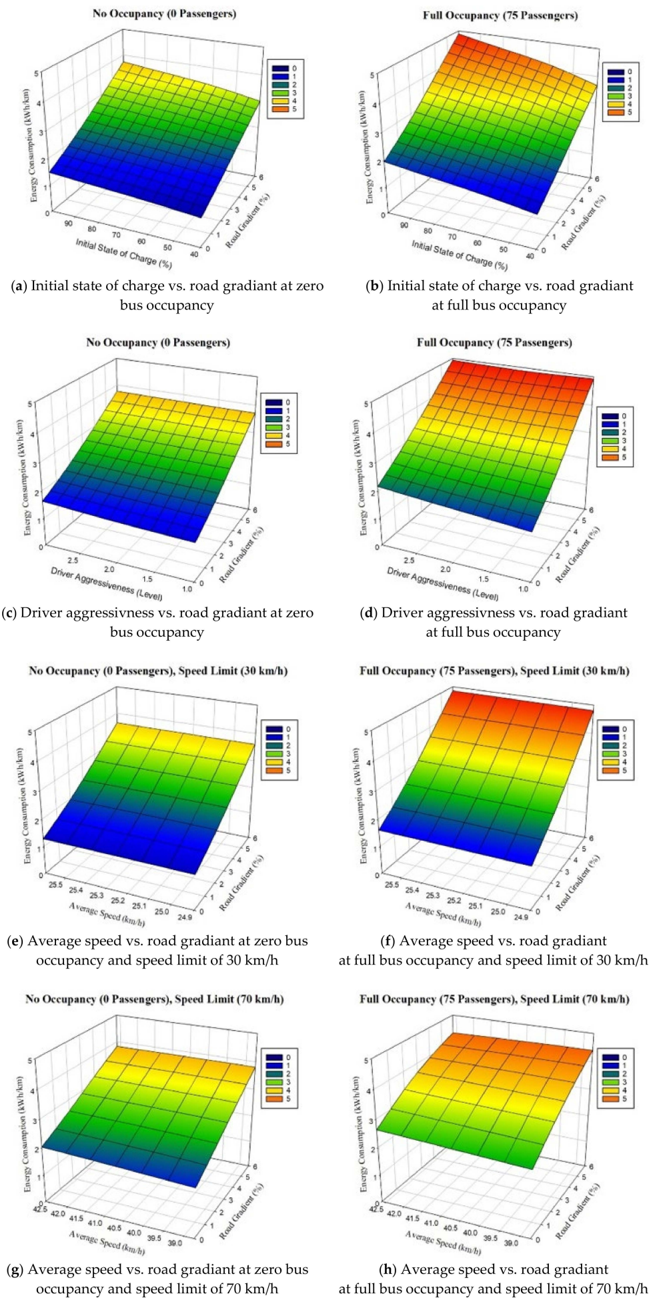
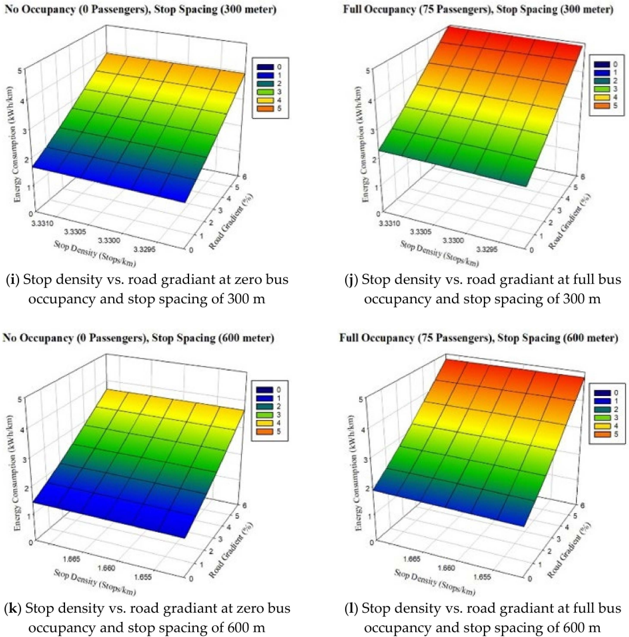
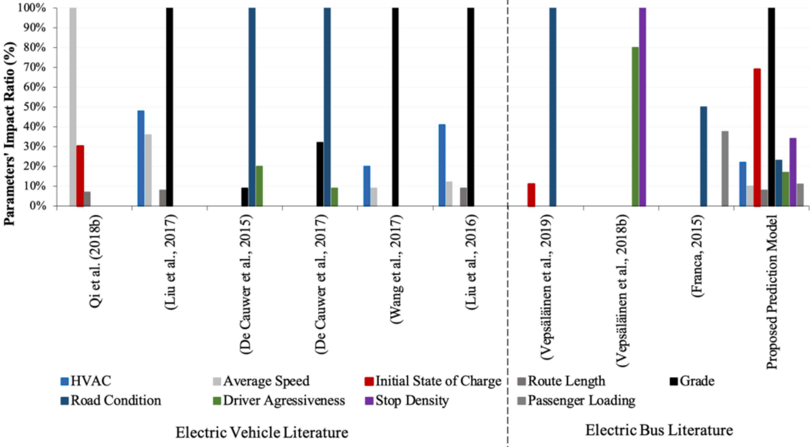
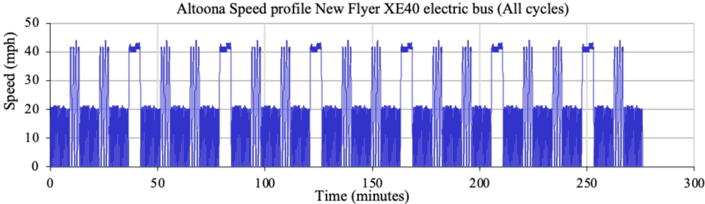
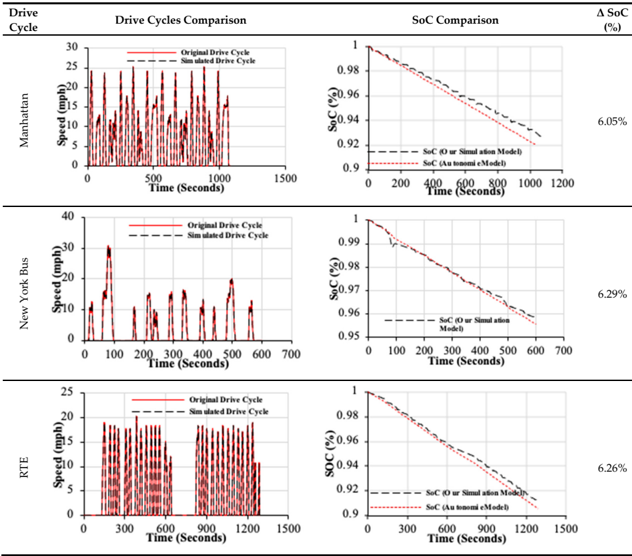
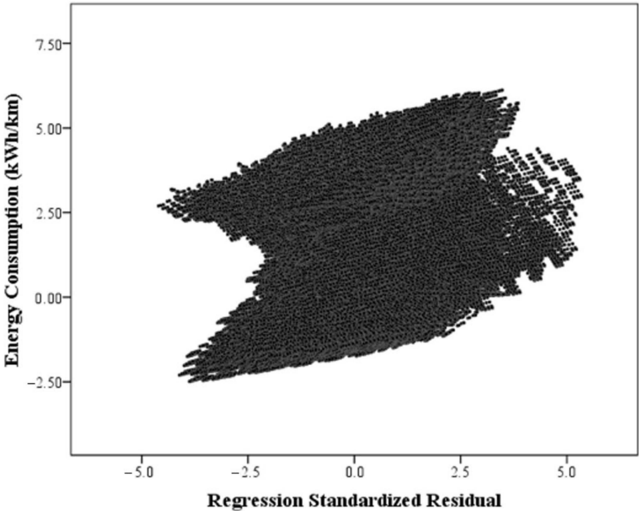
This study investigates the impacts of vehicular, operational, topological, and external parameters on the energy consumption (EC) of battery-electric buses (BEBs) in transit operation. Furthermore, the study develops a data-driven prediction model for BEB energy consumption in transit operation that considers these four parameters. A Simulink energy model is developed to estimate the EC rates and validated using the Altoona’s test real-world data. A full-factorial experiment is used to generate 907,199 scenarios for BEB operation informed by 120 real-world drive cycles. A multivariate multiple regression model was developed to predict BEB’s EC. The regression model explained more than 96% of the variation in the EC of the BEBs. The results show the significant impacts of road grade, the initial state of charge, road condition, passenger loading, driver aggressiveness, average speed, HVAC, and stop density on BEB’s energy consumption, each with a different magnitude. The study concluded that the optimal transit profile for BEB operation is associated with rolling grade and relatively lower stop density (one to two stops/km).
Overview
The claims and statistics of this paper haven’t been checked yet.
Free: it reads the open-access text and checks the first 5 claims that cite a source we can check. Create a free account to check every claim.
Integrity signals
Registry
Cites
Statistics
Figures


Verification
Claims the paper makes
The claims and statistics of this paper haven’t been checked yet.
Free: it reads the open-access text and checks the first 5 claims that cite a source we can check. Create a free account to check every claim.
Claims other papers make about this one
Each is checked against this paper’s own text: does it say what the citing paper says it does?
The source backs part of the claim, not all of it — or backs it for a different population, condition or comparison.
In the citing paper
“Similarly, the predictive model presented in Abdelaty and Mohamed's study [124] for the energy needs of battery electric buses incorporates environmental and operational variables to optimize routing and charging strategies, thereby supporting fleet managers in achieving more sustainable urban mobility.”
From Electric Vehicle Adoption: A Comprehensive Systematic Review of Technological, Environmental, Organizational and Policy Impacts (2024) · cites this paper as [124]
Experimental — accuracy not yet measured
Self-check
Percentages, sums and reported differences re-computed from the paper’s own numbers.
The self-check needs the paper’s full text.
Citations
Cites
An Introduction to Statistical Learning
James, G., Witten, D., Hastie, T., & Tibshirani, R. (2013) · Springer Texts in Statistics · doi:10.1007/978-1-4614-7138-7 · Cited by 12,106
SPSS for Windows Step by Step: A Simple Guide and Reference
Mallery, P., & George, D. (1998) · Cited by 10,394
Identification and Review of Sensitivity Analysis Methods
Christopher Frey, H., & Patil, S. R. (2002) · Risk Analysis · doi:10.1111/0272-4332.00039 · Cited by 1,036
ADVISOR: a systems analysis tool for advanced vehicle modeling
Markel, T., Brooker, A., Hendricks, T., Johnson, V, Kelly, K., Kramer, B., O’Keefe, M., Sprik, S., & Wipke, K. (2002) · Journal of Power Sources · doi:10.1016/s0378-7753(02)00189-1 · Cited by 849 · cited 4×
“The transportation system has been contributing to a high share of greenhouse gas (GHG) emissions over the past two decades [1,2] Currently, transportation contributes to approximately 20% of global GHG emissions.”
BackgroundMethodInfluentialElectric buses: A review of alternative powertrains
Mahmoud, M., Garnett, R., Ferguson, M., & Kanaroglou, P. (2016) · Renewable and Sustainable Energy Reviews · doi:10.1016/j.rser.2016.05.019 · Cited by 418 · cited 3×
“In general, e-buses are classified into two main types: fuel cell e-bus (FCEB), which uses hydrogen fuel cells to generate energy on board for the electric motor; and battery e-bus (BEB), which stores the energy on an onboard battery that supplies the electric motor with the required energy [6].”
BackgroundEnergy consumption and cost-benefit analysis of hybrid and electric city buses
Lajunen, A. (2014) · Transportation Research Part C: Emerging Technologies · doi:10.1016/j.trc.2013.10.008 · Cited by 357 · cited 4×
“The power required for bus movements (Pout) is estimated in Equation (16) while taking into consideration the efficiency of the inverter and the motor [2,33,35,64].”
BackgroundMethodInfluentialEnergy Consumption Prediction for Electric Vehicles Based on Real-World Data
De Cauwer, C., Van Mierlo, J., & Coosemans, T. (2015) · Energies · doi:10.3390/en8088573 · Cited by 304
Battery capacity and recharging needs for electric buses in city transit service
Gao, Z., Lin, Z., LaClair, T. J., Liu, C., Li, J.-M., Birky, A. K., & Ward, J. (2017) · Energy · doi:10.1016/j.energy.2017.01.101 · Cited by 304 · cited 2×
“The battery capacity (Q(I)) gives the amount of the current (electric charge) that the battery can deliver during the discharge state at the rated voltage (Equation (8)) [38]; where Wdischarge is the battery discharge power and Wcharge is the battery charge power from regenerated kinetic energy.”
BackgroundMethodEnergy consumption estimation integrated into the Electric Vehicle Routing Problem
Basso, R., Kulcsár, B., Egardt, B., Lindroth, P., & Sanchez-Diaz, I. (2019) · Transportation Research Part D: Transport and Environment · doi:10.1016/j.trd.2019.01.006 · Cited by 290
Zhou, B., Wu, Y., Zhou, B., Wang, R., Ke, W., Zhang, S., & Hao, J. (2016) · Energy · doi:10.1016/j.energy.2015.12.041 · Cited by 287
Research works printed but not linked: 5
- Abdelaty, H.; Elsayed, M.; Mohamed, M. Assessing the feasibility of energy storage system for electric bus transit planning. In Proceedings of the 55th Annual Canadian Transportation Research Forum, Montreal, QC, Canada, 24-27 May 2020; pp. 1-21.
- Abdelaty, H.; Mohamed, M. Uncertainty in Electric Bus Energy Consumption: The Impacts of Grade and Driving Behaviour. In Proceedings of the 55th Annual Canadian Transportation Research Forum, Montreal, QC, Canada, 24-27 May 2020.
- Barolli, L., Amato, F., Moscato, F., Enokido, T., Takizawa, M., Eds.; Springer International Publishing: Cham, Switzerland, 2020; pp. 393-404.
- Joseph, F.; Hair, J.; Black, W.C.; Babin, B.J.; Anderson, R.E. Multivariate Data Analysis, 7th ed.; Pearson Education Limited: Harlow, UK, 2009.
- Hair, J.; Black, W.; Babin, B.; Anderson, R. Multivariate Data Analysis; Pearson Prentice Hall: Upper Saddle River, NJ, USA, 2010.
Cited by
Zaino, R., Ahmed, V., Alhammadi, A. M., & Alghoush, M. (2024) · World Electric Vehicle Journal · doi:10.3390/wevj15080375 · Cited by 211
“[124] Predictive model for battery electric bus energy consumption; vehicular, operational, topological, and external parameters.”
BackgroundMethodTrip energy consumption estimation for electric buses
Ji, J., Bie, Y., Zeng, Z., & Wang, L. (2022) · Communications in Transportation Research · doi:10.1016/j.commtr.2022.100069 · Cited by 168
“Abdelaty and Mohamed (2021) developed a multivariate multiple linear regression model for EB energy consumption considering the impacts of vehicular, operational, topological, and external parameters.”
BackgroundMethodMachine learning prediction models for battery-electric bus energy consumption in transit
Abdelaty, H., Al-Obaidi, A., Mohamed, M., & Farag, H. E. Z. (2021) · Transportation Research Part D Transport and Environment · doi:10.1016/j.trd.2021.102868 · Cited by 146
Self-citationReview of the energy forecasting and scheduling model for electric buses
Lim, L. K., Muis, Z. A., Ho, W. S., Hashim, H. B., & Bong, C. P. C. (2022) · Energy · doi:10.1016/j.energy.2022.125773 · Cited by 72
Foda, A., Abdelaty, H., Mohamed, M., & El-Saadany, E. F. (2023) · Energy · doi:10.1016/j.energy.2023.127592 · Cited by 57
Self-citationA feature prediction-based method for energy consumption prediction of electric buses
Zhang, Z., Wang, S., Ye, B., & Ma, Y. (2024) · Energy · doi:10.1016/j.energy.2024.134345 · Cited by 53
Soukhov, A., & Mohamed, M. (2021) · Transportation Research Part D Transport and Environment · doi:10.1016/j.trd.2021.103127 · Cited by 42
Self-citationOptimization of single-line electric bus scheduling with skip-stop operation
Tang, C., Shi, H., & Liu, T. (2023) · Transportation Research Part D Transport and Environment · doi:10.1016/j.trd.2023.103652 · Cited by 36
Ekici, Y. E., Akdağ, O., Aydın, A. A., & Karadağ, T. (2023) · IEEE Access · doi:10.1109/access.2023.3316362 · Cited by 33
Towards Efficient Battery Electric Bus Operations: A Novel Energy Forecasting Framework
Würtz, S., Bogenberger, K., Göhner, U., & Rupp, A. (2024) · World Electric Vehicle Journal · doi:10.3390/wevj15010027 · Cited by 36
“In the article [53], the authors developed a simulation method to generate bus trips from existing data but used constant values for auxiliary power demand, which makes up a significant portion of the overall demand.”
A framework for BEB energy prediction using low-resolution open-source data-driven model
Abdelaty, H., & Mohamed, M. (2022) · Transportation Research Part D Transport and Environment · doi:10.1016/j.trd.2022.103170 · Cited by 29
Self-citationSun, S., Batista, S., Menéndez, M., Wang, Y., & Zhang, S. (2023) · Sustainable Cities and Society · doi:10.1016/j.scs.2023.105086 · Cited by 25
Transit electrification state of the art: A machine-learning based text mining approach
Eldeeb, G., & Mohamed, M. (2022) · Transportation Research Part D Transport and Environment · doi:10.1016/j.trd.2022.103446 · Cited by 21
Self-citationEnergy Consumption Prediction of Electric City Buses Using Multiple Linear Regression
Sennefelder, R. M., Martín-Clemente, R., & Carvajal, R. G. (2023) · Energies · doi:10.3390/en16114365 · Cited by 25
A Trip-Based Data-Driven Model for Predicting Battery Energy Consumption of Electric City Buses
Dabčević, Z., Škugor, B., Cvok, I., & Deur, J. (2024) · Energies · doi:10.3390/en17040911 · Cited by 24
Electric Buses in Hot Climates: Challenges, Technologies, and the Road Ahead
Alarrouqi, R. A., Ahmad, F., Bayhan, S., & Al‐Fagih, L. (2024) · IEEE Access · doi:10.1109/access.2024.3387542 · Cited by 26
Interpretable bus energy consumption model with minimal input variables considering powertrain types
Xu, H., Tu, R., Li, T., & Chen, H. (2023) · Transportation Research Part D Transport and Environment · doi:10.1016/j.trd.2023.103742 · Cited by 21
Dynamic Surrogate Trip-Level Energy Model for Electric Bus Transit System Optimization
Foda, A., Mohamed, M., & Bakr, M. H. (2022) · Transportation Research Record Journal of the Transportation Research Board · doi:10.1177/03611981221100242 · Cited by 20
“First, ADVISOR MATLAB/Simulink environment is considered an accurate tool for simulating BEB conduct (25, 26).”
BackgroundMethodSelf-citationBroatch, A., Olmeda, P., Bares, P., & Aceros, S. (2022) · Energies · doi:10.3390/en16010168 · Cited by 20
Jahic, A., Eskander, M., Avdevičius, E., & Schulz, D. (2023) · B&H eletrical engineering · doi:10.2478/bhee-2023-0007 · Cited by 29
Othman, K., Silva, D. D., Shalaby, A. S., & Abdulhai, B. (2025) · Green Energy and Intelligent Transportation · doi:10.1016/j.geits.2024.100250 · Cited by 14
Energy Consumption Prediction for Electric Buses Based on Traction Modeling and LightGBM
Zhao, J. B., He, J., Wang, J., & Liu, K. (2025) · World Electric Vehicle Journal · doi:10.3390/wevj16030159 · Cited by 15
The impacts of optimization approaches on BEB system configuration in transit
Foda, A., & Mohamed, M. (2024) · Transport Policy · doi:10.1016/j.tranpol.2024.03.015 · Cited by 16
Self-citationPoskart, B., Iskierka, G., Krot, K., Burduk, R., Gwizdal, P., & Gola, A. (2022) · Sensors · doi:10.3390/s22249861 · Cited by 14
Abdelouahed, A., Berrada, A., & Mrabet, R. E. (2023) · Environmental Progress & Sustainable Energy · doi:10.1002/ep.14278 · Cited by 14
Szumska, E., Pawlik, Ł., Frej, D. P., & Wilk-Jakubowski, J. Ł. (2025) · Energies · doi:10.3390/en18205420 · Cited by 13
Temporal robustness assessment framework for city-scale bus transit networks
Abdelaty, H., Mohamed, M., Ezzeldin, M., & El-Dakhakhni, W. W. (2022) · Physica A Statistical Mechanics and its Applications · doi:10.1016/j.physa.2022.128077 · Cited by 14
Self-citationAn integrated model of electric bus energy consumption and optimised depot charging
Hendriks, J., & Sturmberg, B. C. P. (2024) · npj Sustainable Mobility and Transport · doi:10.1038/s44333-024-00008-2 · Cited by 13
“These include linear regression 22,23 and regression tree models 24 .”
Deniz, R. M., & Aydın, N. (2024) · Neural Computing and Applications · doi:10.1007/s00521-024-09788-7 · Cited by 18
“…fossil fuel-powered vehicles for transportation, which are responsible for almost 25% of worldwide CO 2 emissions and 20% of greenhouse gas (GHG) releases, contributes significantly to the increase in environmental issues involving air pollution, noise concerns and traffic congestion [1, 2].”
Transformation of an existing urban bus line: Milan Full Electric project
Borghetti, F., Longo, M., Mazzoncini, R., Panarese, A., & Somaschini, C. (2022) · Transportation research procedia · doi:10.1016/j.trpro.2021.12.012 · Cited by 11
“Several studies in the literature have addressed the issue of energy consumption by highlighting the importance of how electricity is produced (Abdelaty and Mohamed, 2021; Pietrzak and Pietrzak, 2021).”
BackgroundA Quantitative Method to Assess the Vehicle-To-Grid Feasibility of a Local Public Transport Company
Borghetti, F., Longo, M., Miraftabzadeh, S. M., Mizzoni, G., & Giudici, G. (2023) · IEEE Access · doi:10.1109/access.2023.3279713 · Cited by 12
“usually consume just 10 % of their energy reserve [22], [23].”
BackgroundBie, Y., Zhou, H., & Yang, M. (2025) · Energy · doi:10.1016/j.energy.2025.135097 · Cited by 9
Data Driven Energy Economy Prediction for Electric City Buses Using Machine Learning
Sennefelder, R. M., Martín-Clemente, R., Carvajal, R. G., & Trifonov, D. (2023) · IEEE Access · doi:10.1109/access.2023.3311895 · Cited by 10
“Data-driven approaches, which use machine-learning or deep learning algorithms and real-world driving data, or even mixed data-driven and physics-based approaches, can be found in [22], [23], [24], [25], [26], [27], [28], [29], [30], [31], [32], [33], [34], and [35].”
BackgroundMethodInfluentialEnergy consumption model with real-time data for driving range extension of electric buses
Ekici, Y. E., Aydın, A. A., Karadağ, T., Akdağ, O., & Ateş, A. (2025) · Sustainable Futures · doi:10.1016/j.sftr.2025.100603 · Cited by 8
Klaproth, T., Berendes, E., Lehmann, T., Kratzing, R., & Ufert, M. (2025) · World Electric Vehicle Journal · doi:10.3390/wevj16080419 · Cited by 10
Vehicle-To-Grid: a Case Study of ATM E-Bus Depots in the City of Milan in Italy
Borghetti, F., Colombo, C. G., Longo, M., Mazzoncini, R., Panarese, A., & Somaschini, C. (2021) · AEIT International Annual Conference · doi:10.23919/aeit53387.2021.9626953 · Cited by 7
Ekici, Y. E., Karadağ, T., Akdağ, O., Aydın, A. A., & Tekin, H. O. (2025) · IEEE Transactions on Intelligent Transportation Systems · doi:10.1109/tits.2025.3558147 · Cited by 8
Compliance indicator determination method to match electric buses with bus lines
Szilassy, P. Á., & Földes, D. (2024) · Heliyon · doi:10.1016/j.heliyon.2024.e38321 · Cited by 6
Expressing the energy consumption of electric buses with mesoscopic traffic variables
Mamarikas, S., Doulgeris, S., Αλετράς, Ν., Wong, C. K.-L., Samaras, Z. C., & Ntziachristos, L. D. (2025) · Atmospheric Environment X · doi:10.1016/j.aeaoa.2025.100367 · Cited by 8
Adedeji, B. P., & Zaidi, A. (2025) · Next research. · doi:10.1016/j.nexres.2025.101006 · Cited by 6
Ekici, Y. E., Karadağ, T., Akdağ, O., Aydın, A. A., & Tekin, H. O. (2025) · ICT Express · doi:10.1016/j.icte.2025.03.009 · Cited by 5
IGLESIA, C. D. S. D. L., Fernández‐Arias, P., Antón‐Sancho, Á., & Vergara, D. (2022) · Sustainability · doi:10.3390/su14095641 · Cited by 5
Cost analysis of different vehicle technologies for semi-flexible transit operations
Mishra, S., & Mehran, B. (2024) · Transportation Research Part D Transport and Environment · doi:10.1016/j.trd.2024.104159 · Cited by 6
Andrusenko, S., Будниченко, В. Б., & Podpisnov, V. (2022) · Vehicle and Electronics Innovative Technologies · doi:10.30977/veit.2022.22.0.8 · Cited by 6
Kozłowski, E., Zimakowska-Laskowska, M., Wiśniowski, P. K., Šnauko, B., Laskowski, P. P., Laskowski, J. F., Matijošius, J., Świderski, A., & Török, Á. (2025) · Energies · doi:10.3390/en18195107 · Cited by 7
Electric bus energy prediction and factors interactions using explainable machine learning models
Wang, W., Mohamed, M., Zhang, B., Zhang, Q., & Abdelaty, H. (2025) · Engineering Applications of Artificial Intelligence · doi:10.1016/j.engappai.2025.112877 · Cited by 4
Self-citationMathematical modeling using real driving data for decision making in city buses electrification
Skarlis, S. A., Nikiforiadis, A., Kortsari, A., Grau, J. M. S., & Ayfantopoulou, G. (2025) · Case Studies on Transport Policy · doi:10.1016/j.cstp.2025.101633 · Cited by 4
A transformer-enhanced causal analysis framework for inter-stop energy consumption of electric bus
He, Y., Huang, Z., Zhan, J., Zhong, L., & Pei, M. (2026) · Transportation Research Part D Transport and Environment · doi:10.1016/j.trd.2026.105221 · Cited by 7
Li, X., Horváth, B., & Winkler, Á. (2025) · Energies · doi:10.3390/en18061545 · Cited by 4
Optimizing the Location of On-Route Fast-Charging Stations in a Battery Electric Bus System
Hosseini, A., Amani, A. M., Keshavarzain, K., & Jalili, M. (2023) · International Conference Power and Energy Systems Engineering · doi:10.1109/cpese59653.2023.10303159 · Cited by 5
“The optimization problem is formulated to obtain the optimum location of fast chargers and minimize the charging cost considering the worst case scenario of full on board passenger capacity (75 passengers) [29] and HVAC load (3KWh/km) [27].”
BackgroundMethodErgül, H., & Tuydes-Yaman, H. (2026) · Annals of Operations Research · doi:10.1007/s10479-026-07104-1 · Cited by 5
Śmieszek, M., Mateichyk, V., & Mościszewski, J. (2024) · Energies · doi:10.3390/en17164179 · Cited by 3
Petrunić, J. G. (2024) · Springer eBooks · doi:10.1007/978-3-031-69051-8_2 · Cited by 3
Evaluation of Electric Bus Operations in Hilly Terrain—A Case Study of Leh
Sharma, A., Das, S., Nasar, A., Gairola, P., Gandhi, S., & Nezamuddin, N. (2025) · Lecture notes in civil engineering · doi:10.1007/978-981-97-9943-5_2 · Cited by 4
Voytkiv, S. (2021) · Vehicle and Electronics Innovative Technologies · doi:10.30977/veit.2021.20.0.01 · Cited by 3
Assessment of transit bus electricity consumption using a random parameters approach
Li, Q., Leng, Y., Yao, H., & Pei, M. (2024) · Energy · doi:10.1016/j.energy.2024.132811 · Cited by 3
Shiledar, A., Shanker, A., Pulvirenti, L., Luca, G. D., Akintade, R., & Rizzoni, G. (2025) · SAE International journal of commercial vehicles · doi:10.4271/02-19-02-0007 · Cited by 3
Kumari, A., Rather, Z. H., & Dahiwale, P. V. (2023) · IEEE India Conference · doi:10.1109/indicon59947.2023.10440896 · Cited by 2
“The mathematical model to compute the energy consumption is presented in [15] and [16].”
MethodCompliance Indicator Determination Method to Match Electric Buses with RoutesPreprint
Szilassy, P. Á., & Földes, D. (2023) · SSRN Electronic Journal · doi:10.2139/ssrn.4594506 · Cited by 2
Bendigiri, P., & Rao, P. (2024) · International Journal of Energy Sector Management · doi:10.1108/ijesm-07-2024-0047 · Cited by 1
Optimizing Electric Bus Efficiency: Evaluating Seasonal Performance in a Southern USA Transit System
Hossain, M. R., Babuji, A., Hasan, M. H., Yu, H., Oloufa, A. A., & Abou-Senna, H. (2025) · Future Transportation · doi:10.3390/futuretransp5030092 · Cited by 2
Development of a battery capacity prediction model for electric vehicles
Borgohain, A., Choudhury, P. K., & Dutta, P. P. (2025) · Journal of Energy Storage · doi:10.1016/j.est.2025.119632 · Cited by 1
Energy consumption prediction for Dual-Powered trolley bus based on a SE-TCN hybrid network
Wu, J., Huang, Z., & Zhou, W. G. (2025) · Measurement · doi:10.1016/j.measurement.2025.119978 · Cited by 5
Feasibility assessment of zero-emission medium and heavy-duty vehicles in fleet operations
Yang, Q., Huang, K., & Mohamed, M. (2026) · Transportation Research Part D Transport and Environment · doi:10.1016/j.trd.2026.105243 · Cited by 1
Self-citationAnalysis and development of criteria for the operational efficiency of urban electric buses
Voytkiv, S. (2024) · Vehicle and Electronics Innovative Technologies · doi:10.30977/veit.2024.25.0.2 · Cited by 1
Eggleton, E., Carlin, R., Goldwyn, H. J., Truong, L., Ilioiu, D., & Schwartz, D. T. (2022) · SSRN Electronic Journal · doi:10.2139/ssrn.4158241 · Cited by 1
Research on Energy Consumption Model of Campus Micro-cycle Bus System
Zhang, O., Tan, J., Gong, B., Hua, Q., Wang, Q., & Li, H. (2022) · IEEE Vehicular Technology Conference · doi:10.1109/vtc2022-fall57202.2022.10012779
Electric City Buses Enhanced Energy Consumption Model Using Real-Time Big-DataPreprint
Karadağ, T., Ekici, Y. E., Akdağ, O., & Aydın, A. A. (2023) · SSRN Electronic Journal · doi:10.2139/ssrn.4613853
БУДНИЧЕНКО, І., & ХАРЛАМОВ, С. (2024) · СУЧАСНІ ТЕХНОЛОГІЇ В МАШИНОБУДУВАННІ ТА ТРАНСПОРТІ · doi:10.36910/automash.v1i22.1350 · Cited by 1
An integrated model of electric bus energy consumption and optimised depot chargingPreprint
Sturmberg, B. C. P., & Hendriks, J. (2024) · Research Square · doi:10.21203/rs.3.rs-4566629/v1
Placement of Battery Electric Bus Charging Points Considering Urban Land Prices
Szilassy, P. Á., Joós, A., & Ágoston, G. (2025) · Smart City Symposium Prague (SCSP) · doi:10.1109/scsp65598.2025.11037692
Dynamic holding and speed guidance of electric buses with at-stop wireless chargers
Yuan, Y. L., Zhang, X., Li, X., & Qiu, B. (2025) · Engineering Optimization · doi:10.1080/0305215x.2025.2535526
“The initial SOC of EBs significantly influences both the charging performance and operational dynamics (Abdelaty and Mohamed 2021).”
Development of a central fleet monitoring system
Elgouhary, N. H., Ali, A. H., & Asfoor, M. S. (2025) · Journal of Physics Conference Series · doi:10.1088/1742-6596/3058/1/012021
“Abdelaty et al. developed a simulation energy model to estimate energy consumption rates and used real Altoona test data [2].”
Shan, X., Li, Q., Wan, C., Ouyang, M., Peng, H., Wu, G., & Barth, M. (2025) · Energy · doi:10.1016/j.energy.2025.138726
Keler, A., Nakao, S., & Schmöcker, J. (2025) · Research Square · doi:10.21203/rs.3.rs-7872908/v1
Abdelaty, H., & Mohamed, M. (2025) · Scientific Reports · doi:10.1038/s41598-025-30585-2 · Cited by 1
Self-citationJena, S. P., Goyal, P., Sairam, K., Nagappan, B., Shipra, K., & Sivachidambaranathan, V. (2025) · Multidisciplinary Reviews · doi:10.31893/multirev.2025ss0126
Kizilarslan, Y., Arı, O., & Kaçar, S. (2025) · Cukurova University Journal of Natural and Applied Sciences · doi:10.70395/cunas.1821869
Duarte, A., da Cruz, J. P. G., & Yoshizaki, H. T. Y. (2025) · Transportes · doi:10.58922/transportes.v33.e3067 · Cited by 2
Ahmed, M. A., Saeed, M. M. A., Ibrahim, Y., Abas, M. M., IDRIS, E., & Mohammed, R. H. (2026) · Signals and communication technology · doi:10.1007/978-3-032-02705-4_3
A Time-Partitioned Dual-Layer LSTM Based on Route Spatiotemporal for Electric Bus Energy Prediction
Wang, Y., Wang, Y., Liu, S., Zhu, Y., Wang, B., Li, Y., Yao, G., & Zhong, W. (2026) · World Electric Vehicle Journal · doi:10.3390/wevj17040210
“Specifically, physical route features—including intersection geometry, signalized corridors, and varying bus-stop spacing—create highly localized peaks in power demand [14].”
Experimental Designs for Electric Bus Routes
Rios, N., Xu, J., & Xu, Z. (2026) · Technometrics · doi:10.1080/00401706.2026.2670598
“…have identified that either the density of stops in a route (e.g., number of stops per mile) or the distance between consecutive stops is a significant factor for predicting the energy consumption of electric buses (Vepsäläinen et al. 2018; Abdelaty and Mohamed 2021; Pamuła and Pamuła 2022).”
Kizilarslan, Y., & Arı, O. (2026) · Cukurova University Journal of Natural and Applied Sciences · doi:10.70395/cunas.1895778
Wang, Z., Zheng, F., & Liu, M. (2026) · Systems · doi:10.3390/systems14070770
Dembitskyi, V., САМОСТЯН, В., Mocanu, G., & Ion, I. V. (2026) · World Electric Vehicle Journal · doi:10.3390/wevj17080387
“At higher stop densities, the coefficient increases; however, its values should be adjusted with consideration of partial energy recovery through regenerative braking (Table 6) [29,34,37].”
InfluentialChoi, M., & Song, J. (2026) · International Journal of Automotive Technology · doi:10.1007/s12239-026-00541-8
Stoicescu, V., Manea, D., Răcănel, C., Ellemer, D. O. B. O., & Oţoiu, A. (2026) · Future Transportation · doi:10.3390/futuretransp6050205
Arı, O., & Kizilarslan, Y. (2026) · Bitlis Eren Üniversitesi Fen Bilimleri Dergisi · doi:10.17798/bitlisfen.1886365
A Virtual System-Level Platform for Fault Analysis of Lithium-Ion Battery SystemsPreprint
Gravante, E., Clifford, T., & D’Arpino, M. (2026) · SSRN Electronic Journal · doi:10.2139/ssrn.7576328
Yang, J., Zhou, H., Wu, X., Zheng, P., Dai, F., Fu, L., Li, Q., Deng, P., Peng, Y., Haifeng, H., et al. (2026) · Renewable Energy · doi:10.1016/j.renene.2026.126577
Metadata
- Authors
- Abdelaty, H., & Mohamed, M.
- Affiliations
- McMaster University (CA)
- Corresponding author
- Mohamed, Moataz
- Venue
- Energies
- Publisher
- MDPI AG
- Published
- 2021-05-14
- Volume
- 14
- Issue
- 10
- Pages
- 2824
- ISSN
- 1996-1073 (ISSN-L)
- OpenAlex
- W3163798297
- Cited by
- 90
- References
- 63
- Citations by year
- 2026: 14 · 2025: 28 · 2024: 17 · 2023: 14 · 2022: 13 · 2021: 4
- FWCI
- 3.90
- Type
- journal article
- Language
- en
- Open access
- gold
- doi.org
- Licence
- Locations
- Energies (publishedVersion, cc-by)
- RePEc: Research Papers in Economics (submittedVersion)
- DOAJ (DOAJ: Directory of Open Access Journals) (submittedVersion, cc-by-sa)
- Funders
- Natural Sciences and Engineering Research Council of Canada (RGPIN-2018-05994)
- Topics
- Physical Sciences › Engineering › Automotive Engineering › Electric and Hybrid Vehicle Technologies
- Physical Sciences › Engineering › Electrical and Electronic Engineering › Electric Vehicles and Infrastructure
- Physical Sciences › Engineering › Automotive Engineering › Vehicle emissions and performance
- Keywords
- battery electric buses, load forecasting, road slope, state of charge, passenger load, driver aggressiveness, HVAC energy consumption, multivariate multiple regression
About these checks
Registry, retraction, Cites and statistics results are computed, not judged, with one exception: a printed reference that no index lists is read once by a model before it counts as a citation error. Claims are extracted by a model and kept only when their quote appears verbatim in the text; each cited source is then checked, with a model’s help, for whether it says what the claim relies on. Those verdicts can be wrong — read the claim’s quote and the cited source before relying on one.
Statistics and arithmetic are recomputed, not judged.
Confidence bands are shown only for fields calibrated on our annotated test set. None is calibrated yet, so no band is shown.
What counts as a claim ›How we measure confidence ›How we check this ›
Are you an author, or do you see a problem with this page? Request a review
Data sources
Bibliographic data: Semantic Scholar, OpenAlex, Crossref.
Contains information from the Semantic Scholar Academic Graph Datasets, made available under the ODC Attribution License (ODC-BY 1.0).
Semantic Scholar’s data is described in: Kinney, R., et al. (2023). The Semantic Scholar Open Data Platform. arXiv:2301.10140.
