

Optimal Distribution Network Reconfiguration with Renewable Generation Using a Hybrid Quantum–Classical QAOA for Power Loss Minimization
Open accessThe DOI matches its Crossref record; 38 of the 39 references it cites were found in a registry or an index; none of the 17 sources its claims cite is checked for support yet.
Abstract
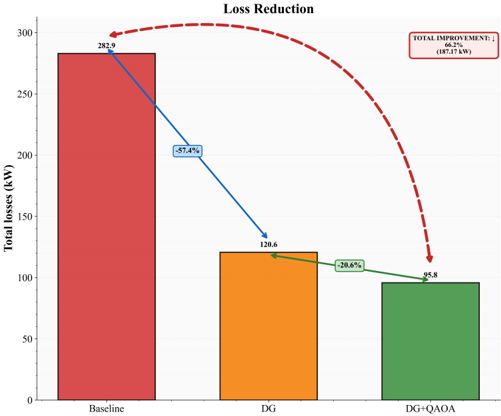
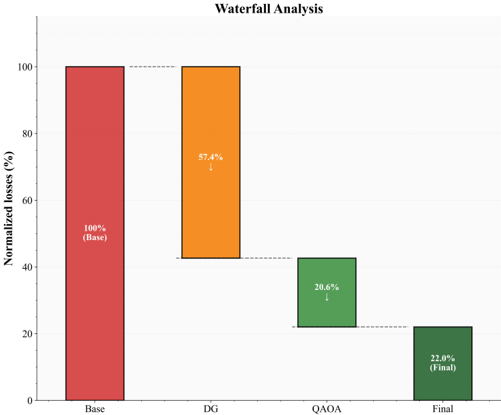
This paper proposes a hybrid quantum–classical framework for distribution network reconfiguration (DNR) under high distributed generation (DG) penetration, integrating nonlinear AC power-flow validation with the Quantum Approximate Optimization Algorithm (QAOA). Unlike prior quantum-assisted studies that rely on simplified DC or surrogate models, the proposed approach embeds AC-feasible loss evaluation directly within the combinatorial optimization loop. The methodology first evaluates all admissible switching configurations of the IEEE 33-bus system under DG integration using full AC power flow. The resulting loss landscape is compressed into a Quadratic Unconstrained Binary Optimization (QUBO) representation and mapped to an Ising Hamiltonian, enabling variational optimization via QAOA. The dominant configuration suggested by the quantum layer is subsequently validated through AC feasibility analysis. Simulation results show that the coordinated DG + QAOA strategy reduces active power losses from 282.938 kW (baseline) to 95.773 kW, corresponding to a 66.15% reduction relative to the original topology and an additional 20.62% improvement beyond DG-only operation. The minimum bus voltage increases from 0.8828 p.u. to 0.9531 p.u., satisfying IEEE 1547 limits, while requiring only two switching operations. These results demonstrate that embedding AC-consistent validation within a hybrid QAOA framework enhances physical realism, scalability, and solution quality for combinatorial optimization in active distribution networks.
Overview
CoChat Summary
TL;DR
The paper proposes a hybrid quantum-classical QAOA framework that embeds AC power-flow validation in distribution network reconfiguration with DG. On the IEEE 33-bus system, it reports reducing active losses from 282.938 kW to 95.773 kW (66.15%) and raising minimum voltage from 0.8828 to 0.9531 p.u.
Key findings
- DG+QAOA reduces active losses to 95.773 kW, a 66.15% reduction vs baseline 282.938 kW and an additional 20.62% beyond DG-only 120.649 kW; annual energy saving is approximately 1638 MWh.
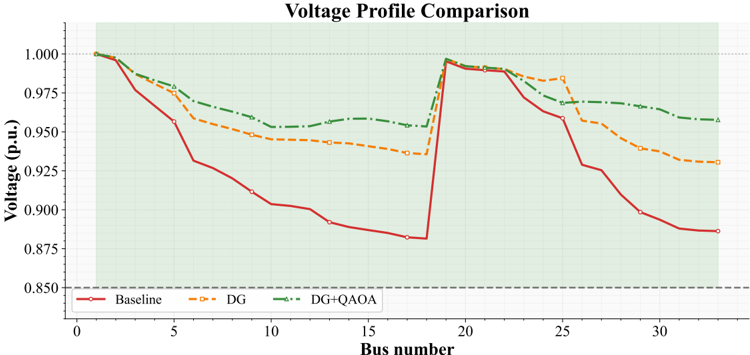
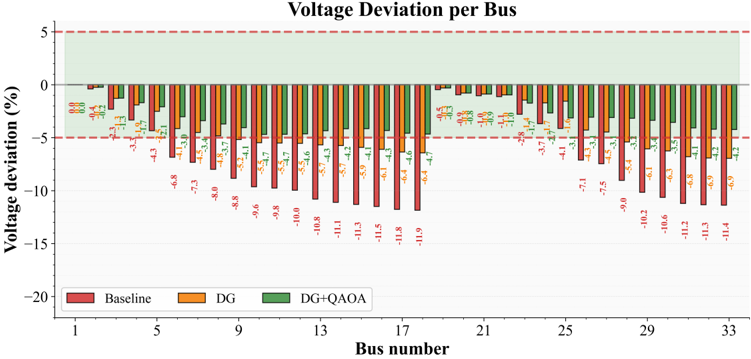
- Minimum bus voltage rises from 0.8828 p.u. (bus 18) to 0.9531 p.u. (bus 10); maximum voltage deviation improves from -11.72% to -4.69%, satisfying IEEE 1547 ±5%; average voltage increases from 0.9378 to 0.9701 p.u.
- The QAOA-selected configuration has 95.773 kW, a 9.98% gap vs the global optimum 87.083 kW, requires two switching operations (SW34 and SW37) vs three for the optimum, and total computational time is 1.36 s.
- QUBO compresses 32 AC-evaluated configurations into a 5×5 matrix with 15 independent parameters; depth p=1 QAOA uses γ*=1.234 rad, β*=0.678 rad, with selected configuration probability P=0.387.
Methods
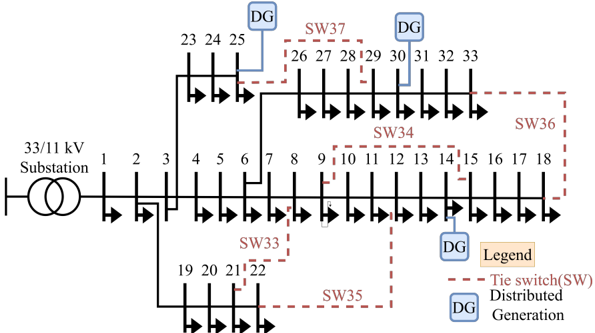
- IEEE 33-bus distribution system with five tie-switches (n_s=5, 32 configurations) and 1.9 MW DG at buses 14 (500 kW), 25 (800 kW), and 30 (600 kW), representing 51.1% of total demand.
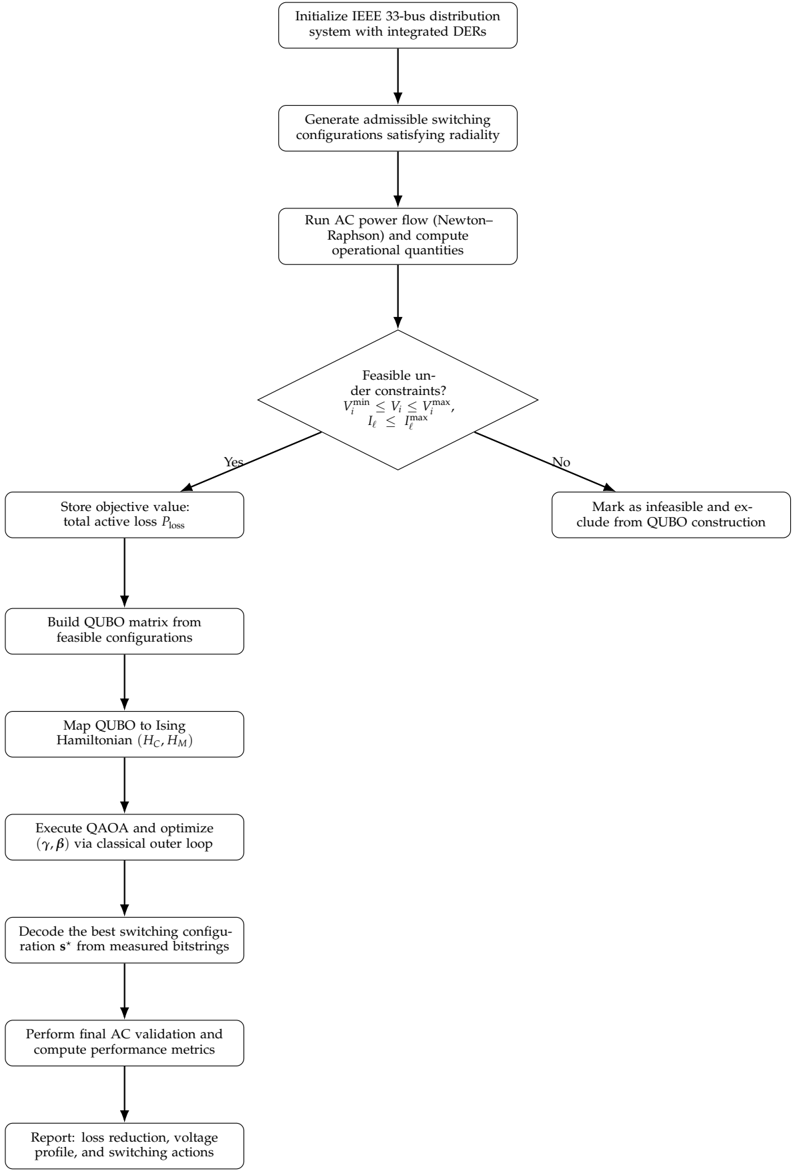
- Exhaustive AC power-flow evaluation via Newton-Raphson for all configurations under radiality, voltage (0.95–1.05 p.u.), and thermal constraints; losses normalized and compressed into QUBO, mapped to Ising Hamiltonian, optimized with QAOA using COBYLA, Qiskit Aer statevector noiseless simulation, then final AC validation.
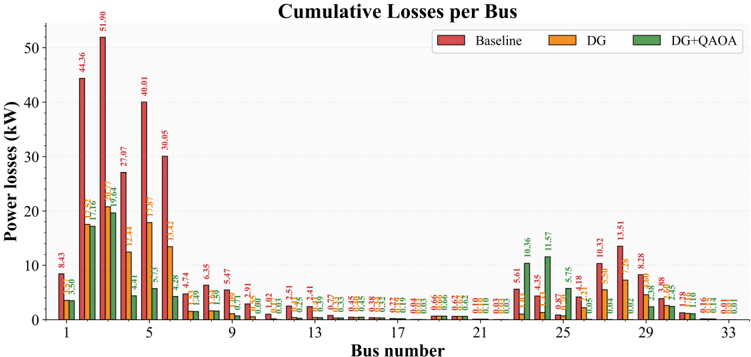
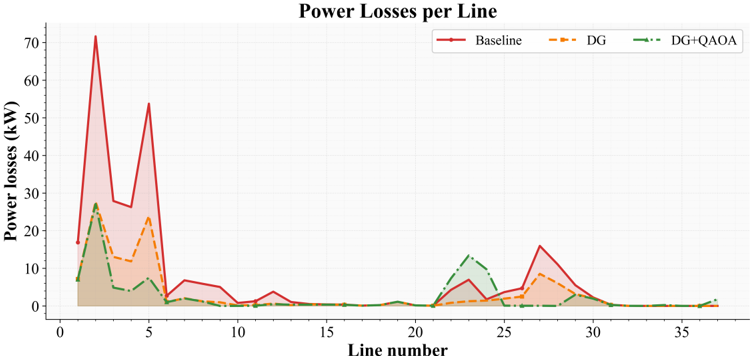
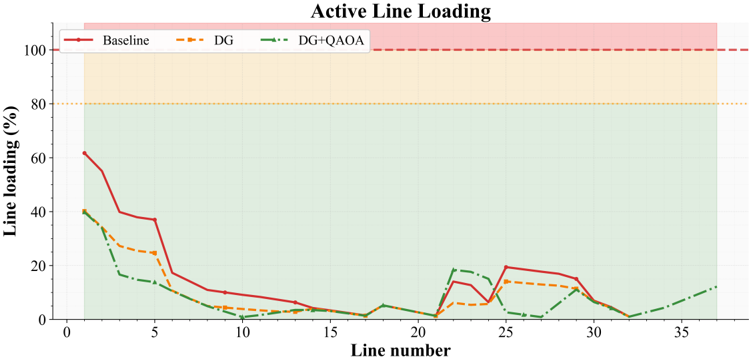
- Three scenarios compared: Baseline (no DG), With DG, and DG+QAOA; metrics include active losses, nodal voltage, voltage deviation, accumulated per-bus losses, per-line losses, and line loading.
Limitations
- The paper states: steady-state single operating condition; no time-varying load or DG intermittency; protection coordination, fault current, and reliability indices not integrated; computational burden may grow for larger networks and multiple time steps; DG modeled mainly as active power injection without reactive/inverter Volt/VAR/dispatch constraints; validation is medium-scale, static, shallow p=1, and no hardware-in-the-loop or real NISQ hardware.
- Evident from the text: the reported QAOA bitstring is internally inconsistent—Section 3.6 gives x*=[1,0,1,0,0], while the Conclusions give [0,1,0,0,1] and Table 3 indicates SW34 and SW37 closed; also, exhaustive enumeration of only 32 configurations means the quantum layer is not shown to outperform classical enumeration at this scale.
Model-written summary. Check it against the paper before relying on it.
Integrity signals
Registry
Cites
Statistics
Figures
Verification
Claims the paper makes
0 Valid · 3 Not valid · 17 Not checked · 133 Own results and interpretations
A result the paper reports from its own data — it cites no other source for it, so there is none to check. The quote shows it is in the paper.
In the paper
“Simulation results show that the coordinated DG + QAOA strategy reduces active power losses from 282.938 kW (baseline) to 95.773 kW, corresponding to a 66.15% reduction relative to the original topology and an additional 20.62% improvement beyond DG-only operation.”
§ Optimal Distribution Network Reconfiguration with Renewable Generation Using a Hybrid Quantum-Classical QAOA for Power Loss Minimization > Abstract
plainstates a causeSingle case- Asserted: passes — The authors put it forward as true.
- Checkable: passes — It can be checked against evidence.
- Load-bearing: passes — The paper’s conclusions depend on it.
- Based: passes — The paper gives a reason why it holds.
- Rests on 2 assumptions not shown here.
A result the paper reports from its own data — it cites no other source for it, so there is none to check. The quote shows it is in the paper.
In the paper
“The minimum bus voltage increases from 0.8828 p.u. to 0.9531 p.u., satisfying IEEE 1547 limits, while requiring only two switching operations.”
§ Optimal Distribution Network Reconfiguration with Renewable Generation Using a Hybrid Quantum-Classical QAOA for Power Loss Minimization > Abstract
plainSingle case- Asserted: passes — The authors put it forward as true.
- Checkable: passes — It can be checked against evidence.
- Load-bearing: unclear — It is unclear whether the paper’s conclusions depend on it.
- Based: passes — The paper gives a reason why it holds.
- Rests on 2 assumptions not shown here.
In the paper
“The minimum bus voltage increases from 0.8828 p.u. to 0.9531 p.u., satisfying IEEE 1547 limits, while requiring only two switching operations.”
§ Optimal Distribution Network Reconfiguration with Renewable Generation Using a Hybrid Quantum-Classical QAOA for Power Loss Minimization > Abstract
What the sources say
- Not checked yetcites [41] (2018). IEEE Standard for Interconnection and Interoperability of Distributed Energy Resources with Associated Electric Power Systems Interfaces (Standard No. IEEE Std 1547-2018).
plain- Asserted: passes — The authors put it forward as true.
- Checkable: passes — It can be checked against evidence.
- Load-bearing: passes — The paper’s conclusions depend on it.
- Based: passes — The paper gives a reason why it holds.
- Rests on 2 assumptions not shown here.
A result the paper reports from its own data — it cites no other source for it, so there is none to check. The quote shows it is in the paper.
In the paper
“Simulation results show that the coordinated DG + QAOA strategy reduces active power losses from 282.938 kW (baseline) to 95.773 kW, corresponding to a 66.15% reduction relative to the original topology and an additional 20.62% improvement beyond DG-only operation.”
§ Optimal Distribution Network Reconfiguration with Renewable Generation Using a Hybrid Quantum-Classical QAOA for Power Loss Minimization > Abstract
plainstates a causeSingle case- Asserted: passes — The authors put it forward as true.
- Checkable: passes — It can be checked against evidence.
- Load-bearing: passes — The paper’s conclusions depend on it.
- Based: passes — The paper gives a reason why it holds.
- Rests on 2 assumptions not shown here.
72 more claims
Create a free account to see all 153 claims and to verify the 17 references still open.
- It may state two separate claims as one. 49
- Probably not a substantial claim. 37
Self-check
Percentages, sums and reported differences re-computed from the paper’s own numbers.
Each contradiction between two passages listed here was confirmed by an independent check.
Rated major: it would touch a result — a value a result rests on, reported and recomputed p-values on opposite sides of the significance level, two passages that conflict with no sign which is right, or a cited work retracted before this paper was published.
In the paper
“Nevertheless, their combined action yields a total loss reduction efficiency of 78.0%, meaning that final losses represent only 22.0% of the Baseline value.”
§ Optimal Distribution Network Reconfiguration with Renewable Generation Using a Hybrid Quantum-Classical QAOA for Power Loss Minimization > 4.2. Electrical Variable Analysis
Reported 78 · recomputed 66.150535
Rated major: it would touch a result — a value a result rests on, reported and recomputed p-values on opposite sides of the significance level, two passages that conflict with no sign which is right, or a cited work retracted before this paper was published.
In the paper
§ Optimal Distribution Network Reconfiguration with Renewable Generation Using a Hybrid Quantum-Classical QAOA for Power Loss Minimization > 3.6. Phase 5: Measurement and Solution Extraction
“In this case, the most probable configuration is x * = [1, 0, 1, 0, 0], with probability P = 0.387.”
§ Optimal Distribution Network Reconfiguration with Renewable Generation Using a Hybrid Quantum-Classical QAOA for Power Loss Minimization > 6. Conclusions
“A depth-p = 1 QAOA circuit converged to optimal parameters γ * = 1.234 rad and β * = 0.678 rad, producing configuration [0, 1, 0, 0, 1] with probability P = 0.387.”
Rated major: it would touch a result — a value a result rests on, reported and recomputed p-values on opposite sides of the significance level, two passages that conflict with no sign which is right, or a cited work retracted before this paper was published.
In the paper
§ Optimal Distribution Network Reconfiguration with Renewable Generation Using a Hybrid Quantum-Classical QAOA for Power Loss Minimization > 6. Conclusions
“| 1 | 0 | 0 | 0 | 0 | 0 | 120.649 | Feasible |”
§ Optimal Distribution Network Reconfiguration with Renewable Generation Using a Hybrid Quantum-Classical QAOA for Power Loss Minimization > 4.2. Electrical Variable Analysis
“In the With DG scenario, the integration of 1.9 MW of distributed generation increases the minimum voltage to 0.9305 p.u. at bus 33.”
Rated major: it would touch a result — a value a result rests on, reported and recomputed p-values on opposite sides of the significance level, two passages that conflict with no sign which is right, or a cited work retracted before this paper was published.
In the paper
§ Optimal Distribution Network Reconfiguration with Renewable Generation Using a Hybrid Quantum-Classical QAOA for Power Loss Minimization > 3.6. Phase 5: Measurement and Solution Extraction
“The corresponding optimal powerflow solution yields P loss (x * ) = 95.77kW, which coincides with the minimum value identified in the complete loss vector constructed in Phase 1.”
§ Optimal Distribution Network Reconfiguration with Renewable Generation Using a Hybrid Quantum-Classical QAOA for Power Loss Minimization > 4.1. Results of the QAOA Optimization Process
“According to Table 3, losses among feasible configurations range from 87.083 kW (configuration 14, global optimum) to 182.301 kW (configuration 19, worst feasible case)”
Rated minor: it would not touch a result — a value no result rests on, a p-value that stays on the same side of the significance level, or a conflict that is clerical, resolved elsewhere in the paper, or outside its own findings.
In the paper
§ Optimal Distribution Network Reconfiguration with Renewable Generation Using a Hybrid Quantum-Classical QAOA for Power Loss Minimization > 3.3. QUBO Matrix Construction
“H(x) = x T Qx = n s ∑ i=1 Q ii x i + n s ∑ i=1 n s ∑ j>i Q ij x i x j ,(91)”
§ Optimal Distribution Network Reconfiguration with Renewable Generation Using a Hybrid Quantum-Classical QAOA for Power Loss Minimization > 3.3. QUBO Matrix Construction
“where x ∈ {0, 1} n s represents the switching state vector and Q ∈ R n s ×n s is a symmetric real matrix.”
4 more findings
Create a free account to see every finding of this check.
Cited works that were retracted
Works this paper cites that were later retracted, from the retraction notices publishers deposit. Major when the notice came out before this paper was published.
A note, not an issue: for example, a cited work that was retracted only after this paper was published, which its authors could not have known.
In the paper
“Kumar, G., Sharma, K., Sharma, K., Dwivedi, S.P., Shrivastava, A., and Bisht, Y.S. (2024). Optimizing Power Distribution Grids Using Particle Swarm Optimization Algorithm. Proceedings of the 2024 4th International Conference on Innovative Practices in Technology and Management (ICIPTM), Noida, India, 22–24 February 2024, IEEE.”
Cited work 10.1109/iciptm59628.2024.10563676 · retracted 2026-08-10 · notice 10.1109/iciptm59628.2024.11650720 · this paper published 2026-02-25
Citations
Cites
1 retracted
Retracted: Optimizing Power Distribution Grids Using Particle Swarm Optimization Algorithm
Kumar, G., Sharma, K., Sharma, K. K., Dwivedi, S. P., Shrivastava, A., & Bisht, Y. S. (2024) · International Conference on Innovative Practices in Technology and Management (ICIPTM) · doi:10.1109/iciptm59628.2024.10563676 · Cited by 4
RetractedEfficient and Sustainable Reconfiguration of Distribution Networks via Metaheuristic Optimization
Helmi, A. M., Carli, R., Dotoli, M., & Ramadan, H. S. (2022) · IEEE Transactions on Automation Science and Engineering · doi:10.1109/tase.2021.3072862 · Cited by 174
Annealing-Based Quantum Computing for Combinatorial Optimal Power Flow
Morstyn, T. (2022) · IEEE Transactions on Smart Grid · doi:10.1109/tsg.2022.3200590 · Cited by 113
Zhou, A., Zhai, H., Yang, M. Y., & Lin, Y. (2021) · IEEE Transactions on Smart Grid · doi:10.1109/tsg.2021.3139763 · Cited by 97
Silveira, C. L. B., Tabares, A., Faria, L. T., & Franco, J. F. (2021) · Electric Power Systems Research · doi:10.1016/j.epsr.2021.107272 · Cited by 82
Data-driven quantum approximate optimization algorithm for power systems
Jing, H., Wang, Y., & Li, Y. (2023) · Communications Engineering · doi:10.1038/s44172-023-00061-8 · Cited by 72
Dynamic Distribution Network Reconfiguration With Generation and Load Uncertainty
Bahrami, S., Chen, Y. C., & Wong, V. W. S. (2024) · IEEE Transactions on Smart Grid · doi:10.1109/tsg.2024.3404859 · Cited by 69
Alshareef, S. M., & Fathy, A. (2023) · Mathematics · doi:10.3390/math11153305 · Cited by 49
Hachemi, A. T., Sadaoui, F., Saim, A., Ebeed, M., & Arif, S. (2024) · Energy Reports · doi:10.1016/j.egyr.2024.07.050 · Cited by 45
Optimal planning of RDGs in electrical distribution networks using hybrid SAPSO algorithm
Ali, M. H., Mehanna, M., & Othman, E. (2020) · International Journal of Power Electronics and Drive Systems/International Journal of Electrical and Computer Engineering · doi:10.11591/ijece.v10i6.pp6153-6163 · Cited by 34
Research works printed but not linked: 2
- Hu, Z.; Zhu, Z. Advancing Hybrid Quantum Neural Network for Alternative Current Optimal Power Flow. arXiv 2024. [CrossRef]
- (2018). IEEE Standard for Interconnection and Interoperability of Distributed Energy Resources with Associated Electric Power Systems Interfaces (Standard No. IEEE Std 1547-2018).
Cited by
Pothinun, T., Rodkumnerd, P., Khunkitti, S., Wirasanti, P., & Watson, N. R. (2026) · Energies · doi:10.3390/en19071809 · Cited by 3
Warm-Start Iterative QITE for Distribution Network Reconfiguration via Branch-Exchange EncodingPreprint
Crum, N., Pritchard, P., Rase, T., Lotshaw, P. C., Regev, S., Girotto, C., Kaushik, A., & Smith, P. (2026) · arXiv · doi:10.48550/arxiv.2609.39602
Dynamic Powergrid Optimization with FPGA-based Neuromorphic Higher-order Ising MachinesPreprint
Maiti, S., Chakrabartty, S., & Thakur, C. S. (2026) · arXiv · doi:10.48550/arxiv.2610.40522
Metadata
- Authors
- Bosmediano, J. L., Aguila Téllez, A., & Martínez, R. A. O.
- Affiliations
- Politecnica Salesiana University (EC)
- GIREI Research Group, Electrical Engineering Department, Universidad Politécnica Salesiana, Quito 170146, Ecuador
- Venue
- Energies
- Publisher
- MDPI AG
- Published
- 2026-02-25
- Volume
- 19
- Issue
- 5
- Pages
- 1148
- ISSN
- 1996-1073 (ISSN-L)
- OpenAlex
- W7131673529
- Cited by
- 3
- References
- 38
- Citations by year
- 2026: 3
- FWCI
- 3.09
- Type
- journal article
- Language
- en
- Open access
- gold
- doi.org
- Licence
- Locations
- Energies (publishedVersion, cc-by)
- DOAJ (DOAJ: Directory of Open Access Journals) (submittedVersion)
- Funders
- Universidad Politécnica Salesiana
- Topics
- Physical Sciences › Engineering › Electrical and Electronic Engineering › Optimal Power Flow Distribution
- Physical Sciences › Engineering › Electrical and Electronic Engineering › Electric Power System Optimization
- Physical Sciences › Engineering › Electrical and Electronic Engineering › Smart Grid and Power Systems
- Keywords
- distribution network reconfiguration, quantum approximate optimization algorithm, hybrid quantum-classical optimization, renewable generation integration, power loss reduction, AC power flow, QUBO, Ising Hamiltonian, combinatorial optimization, IEEE 33-bus system, distributed generation, bus voltage constraints
About these checks
Registry, retraction, Cites and statistics results are computed, not judged, with one exception: a printed reference that no index lists is read once by a model before it counts as a citation error. Claims are extracted by a model and kept only when their quote appears verbatim in the text; each cited source is then checked, with a model’s help, for whether it says what the claim relies on. Those verdicts can be wrong — read the claim’s quote and the cited source before relying on one.
A language model drew the claims from the paper on 2026-11-24, under version 3 of the claim definition (model deepseek-v4.1-flash, prompt extract-v3).
A second model labelled each claim on 2026-11-24 (model jev-1.13-20260917, definition revision gold-guideline-v0.2).
Statistics and arithmetic are recomputed, not judged.
Confidence bands are shown only for fields calibrated on our annotated test set. None is calibrated yet, so no band is shown.
What counts as a claim ›How we measure confidence ›How we check this ›
Are you an author, or do you see a problem with this page? Request a review
How to cite
Cite CoChat for the checks on this page, and the paper for its own findings.
- This page
- CoChat. (2026). Citation check: Optimal Distribution Network Reconfiguration with Renewable Generation Using a Hybrid Quantum–Classical QAOA for Power Loss Minimization. https://app.cochat.ai/papers/10.3390/en19051148
- The paper
- Bosmediano, J. L., Aguila Téllez, A., & Martínez, R. A. O. (2026). Optimal Distribution Network Reconfiguration with Renewable Generation Using a Hybrid Quantum–Classical QAOA for Power Loss Minimization. Energies. https://doi.org/10.3390/en19051148
Data sources
Bibliographic data: Semantic Scholar, OpenAlex, Crossref.
Contains information from the Semantic Scholar Academic Graph Datasets, made available under the ODC Attribution License (ODC-BY 1.0).
Semantic Scholar’s data is described in: Kinney, R., et al. (2023). The Semantic Scholar Open Data Platform. arXiv:2301.10140.
