

A Rest Time-Based Prognostic Framework for State of Health Estimation of Lithium-Ion Batteries with Regeneration Phenomena
Open accessThe DOI matches its Crossref record; 37 of the 37 references it cites were found in a registry or an index.
Abstract
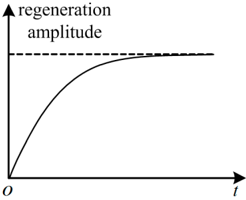
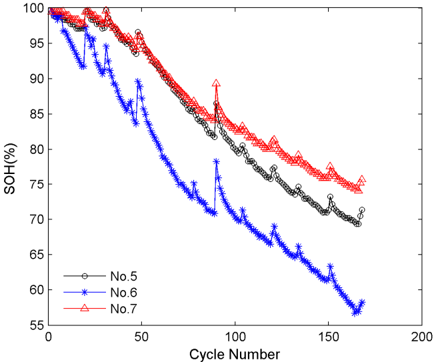
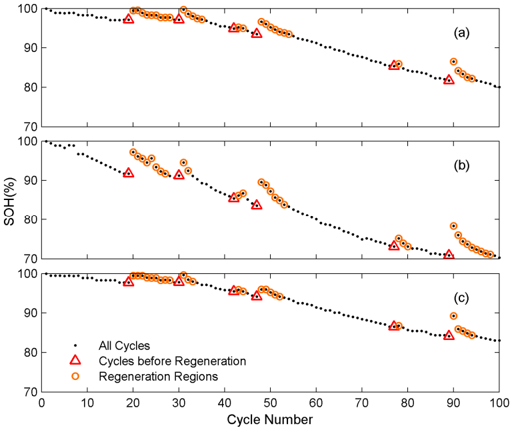
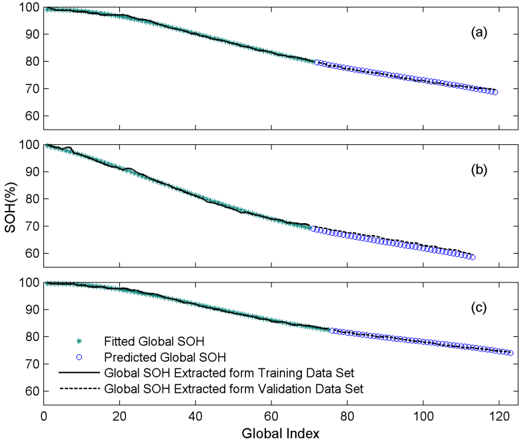
State of health (SOH) prognostics is significant for safe and reliable usage of lithium-ion batteries. To accurately predict regeneration phenomena and improve long-term prediction performance of battery SOH, this paper proposes a rest time-based prognostic framework (RTPF) in which the beginning time interval of two adjacent cycles is adopted to reflect the rest time. In this framework, SOH values of regeneration cycles, the number of cycles in regeneration regions and global degradation trends are extracted from raw SOH time series and predicted respectively, and then the three sets of prediction results are integrated to calculate the final overall SOH prediction values. Regeneration phenomena can be found by support vector machine and hyperplane shift (SVM-HS) model by detecting long beginning time intervals. Gaussian process (GP) model is utilized to predict the global degradation trend, and nonlinear models are utilized to predict the regeneration amplitude and the cycle number of each regeneration region. The proposed framework is validated through experimental data from the degradation tests of lithium-ion batteries. The results demonstrate that both the global degradation trend and the regeneration phenomena of the testing batteries can be well predicted. Moreover, compared with the published methods, more accurate SOH prediction results can be obtained under this framework.
Overview
The claims and statistics of this paper haven’t been checked yet.
Free: it reads the open-access text and checks the first 5 claims that cite a source we can check. Create a free account to check every claim.
Integrity signals
Registry
Cites
Statistics
Figures
Verification
Claims the paper makes
The claims and statistics of this paper haven’t been checked yet.
Free: it reads the open-access text and checks the first 5 claims that cite a source we can check. Create a free account to check every claim.
Claims other papers make about this one
Each is checked against this paper’s own text: does it say what the citing paper says it does?
In the citing paper
“The support vector machine (SVM), as a nonlinear data analysis method, can not only provide relatively accurate estimation and prediction results in the case of fewer data samples, but also overcomes the shortcoming that the neural network model easily falls into the optimal local extremum.”
From A Review of Lithium-Ion Battery State of Health Estimation and Prediction Methods (2021) · cites this paper as [112]
In the citing paper
“Minimizing its structural risk can improve the convergence speed and machine learning ability, thus realizing more accurate SOH estimation and prediction [110-112].”
From A Review of Lithium-Ion Battery State of Health Estimation and Prediction Methods (2021) · cites this paper as [112]
Self-check
Percentages, sums and reported differences re-computed from the paper’s own numbers.
The self-check needs the paper’s full text.
Citations
Cites
Learning with Kernels: Support Vector Machines, Regularization, Optimization, and Beyond
Schölkopf, B., & Smola, A. J. (2001) · The MIT Press eBooks · doi:10.7551/mitpress/4175.001.0001 · Cited by 11,703
Critical review of state of health estimation methods of Li-ion batteries for real applications
Berecibar, M., Gandiaga, I., Villarreal, I., Omar, N., Van Mierlo, J., & Van den Bossche, P. (2016) · Renewable and Sustainable Energy Reviews · doi:10.1016/j.rser.2015.11.042 · Cited by 1,126
He, W., Williard, N., Osterman, M., & Pecht, M. (2011) · Journal of Power Sources · doi:10.1016/j.jpowsour.2011.08.040 · Cited by 1,105 · cited 1×
“In recent years, although it has been noted that there is a close relationship between the regeneration phenomenon and the rest time [16,24,30], no effective prediction approach that uses the rest time to take regeneration into account has been found.”
BackgroundPrognostics methods for battery health monitoring using a bayesian framework
Saha, B., Goebel, K., Poll, S., & Christophersen, J. (2009) · IEEE Transactions on Instrumentation and Measurement · doi:10.1109/tim.2008.2005965 · Cited by 831 · cited 1×
“In the literature, statistical, computational and artificial intelligence algorithms, such as autoregressive model [12], particle filter (PF) [13,14], Gaussian process regression [15], Wiener process [16], relevance vector machine (RVM) [17], Bayesian approach [18], support vector machine (SVM) [19] and neural network…”
MethodSafety focused modeling of lithium-ion batteries: A review
Abada, S., Marlair, G., Lecocq, A., Petit, M., Sauvant-Moynot, V., & Huet, F. (2016) · Journal of Power Sources · doi:10.1016/j.jpowsour.2015.11.100 · Cited by 819 · cited 1×
“Lithium-ion batteries have attracted significant attention for many more energy or power demanding applications such as in consumer electronics, aerospace, hybrid and electric vehicles and smart grids applications, due to their superior energy density and high specific energy over other rechargeable battery technologi…”
BackgroundRezvanizaniani, S. M., Liu, Z., Chen, Y., & Lee, J. (2014) · Journal of Power Sources · doi:10.1016/j.jpowsour.2014.01.085 · Cited by 684
An ensemble model for predicting the remaining useful performance of lithium-ion batteries
Xing, Y., Ma, E. W. M., Tsui, K.-L., & Pecht, M. (2013) · Microelectronics Reliability · doi:10.1016/j.microrel.2012.12.003 · Cited by 673
Simulation of capacity fade in lithium-ion batteries
Spotnitz, R. (2003) · Journal of Power Sources · doi:10.1016/s0378-7753(02)00490-1 · Cited by 573 · cited 1×
“During the rest time, the acidic impurities generated at the positive electrode can destroy the SEI layer at the negative and liberate lithium ions [37,38].”
BackgroundRemaining useful life prediction of lithium-ion battery with unscented particle filter technique
Miao, Q., Xie, L., Cui, H., Liang, W., & Pecht, M. (2013) · Microelectronics Reliability · doi:10.1016/j.microrel.2012.12.004 · Cited by 481 · cited 1×
“In the literature, statistical, computational and artificial intelligence algorithms, such as autoregressive model [12], particle filter (PF) [13,14], Gaussian process regression [15], Wiener process [16], relevance vector machine (RVM) [17], Bayesian approach [18], support vector machine (SVM) [19] and neural network…”
MethodEddahech, A., Briat, O., Bertrand, N., Delétage, J.-Y., & Vinassa, J.-M. (2012) · International Journal of Electrical Power & Energy Systems · doi:10.1016/j.ijepes.2012.04.050 · Cited by 462 · cited 1×
“[39] pointed out that recovery phenomenon may be related to charge redistribution when there is no charge or discharge force acting on them.”
Background
Research works printed but not linked: 2
- Vapnik, V.N. Statistical Learning Theory; John Wiley & Sons: Hoboken, NJ, USA, 1998.
- Murphy, K.P. Machine Learning: A Probabilistic Perspective; MIT Press: Cambridge, MA, USA, 2012.
Cited by
Transformer Network for Remaining Useful Life Prediction of Lithium-Ion Batteries
Chen, D., Hong, W., & Zhou, X. (2022) · IEEE Access · doi:10.1109/access.2022.3151975 · Cited by 408
“The highly dynamic and nonlinear capacity curve affects RNN-based methods [28], [31], [35].”
Ma, G., Zhang, Y., Cheng, C., Zhou, B., Hu, P., & Yuan, Y. (2019) · Applied Energy · doi:10.1016/j.apenergy.2019.113626 · Cited by 342
A Review of Lithium-Ion Battery State of Health Estimation and Prediction Methods
Yao, L., Xu, S., Tang, A., Zhou, F., Hou, J., Xiao, Y., & Fu, Z. (2021) · World Electric Vehicle Journal · doi:10.3390/wevj12030113 · Cited by 237
Liu, J., & Chen, Z. (2019) · IEEE Access · doi:10.1109/access.2019.2905740 · Cited by 215
“This phenomenon is known as capacity regeneration which results in a capacity declining tendency with the local dynamic fluctuation [37], [38].”
BackgroundLithium-ion batteries remaining useful life prediction based on BLS-RVM
Chen, Z., Shi, N., Ji, Y., Niu, M., & Wang, Y. (2021) · Energy · doi:10.1016/j.energy.2021.121269 · Cited by 197
Metadata
- Authors
- Qin, T., Zeng, S., Guo, J., & Skaf, Z.
- Affiliations
- Cranfield University (GB)
- National Key Laboratory of Science and Technology on Reliability and Environmental Engineering (CN)
- Corresponding author
- Guo, Jianbin
- Venue
- Energies
- Publisher
- MDPI AG
- Published
- 2016-11-01
- Volume
- 9
- Issue
- 11
- Pages
- 896
- ISSN
- 1996-1073 (ISSN-L)
- OpenAlex
- W2546416483
- Cited by
- 52
- References
- 37
- Citations by year
- 2026: 3 · 2025: 4 · 2024: 8 · 2023: 3 · 2022: 10 · 2021: 6 · 2020: 4 · 2019: 7 · 2018: 3 · 2017: 3 · 2016: 1
- FWCI
- 4.07
- Type
- journal article
- Language
- en
- Open access
- gold
- doi.org
- Licence
- Locations
- Energies (publishedVersion, cc-by)
- RePEc: Research Papers in Economics (submittedVersion)
- DOAJ (DOAJ: Directory of Open Access Journals) (submittedVersion, cc-by-sa)
- CERES (Cranfield University) (submittedVersion, cc-by)
- Funders
- National Natural Science Foundation of China (61304218)
- Beijing Natural Science Foundation (3153027)
- Topics
- Physical Sciences › Engineering › Automotive Engineering › Battery Modeling and Management
- Physical Sciences › Engineering › Electrical and Electronic Engineering › Advancements in Battery Materials
- Physical Sciences › Engineering › Safety, Risk, Reliability and Quality › Reliability and Maintenance Optimization
- Keywords
- lithium-ion batteries, state of health estimation, battery prognostics, support vector machine, Gaussian process regression, battery degradation
About these checks
Registry, retraction, Cites and statistics results are computed, not judged, with one exception: a printed reference that no index lists is read once by a model before it counts as a citation error. Claims are extracted by a model and kept only when their quote appears verbatim in the text; each cited source is then checked, with a model’s help, for whether it says what the claim relies on. Those verdicts can be wrong — read the claim’s quote and the cited source before relying on one.
Statistics and arithmetic are recomputed, not judged.
Confidence bands are shown only for fields calibrated on our annotated test set. None is calibrated yet, so no band is shown.
What counts as a claim ›How we measure confidence ›How we check this ›
Are you an author, or do you see a problem with this page? Request a review
Data sources
Bibliographic data: Semantic Scholar, OpenAlex, Crossref.
Contains information from the Semantic Scholar Academic Graph Datasets, made available under the ODC Attribution License (ODC-BY 1.0).
Semantic Scholar’s data is described in: Kinney, R., et al. (2023). The Semantic Scholar Open Data Platform. arXiv:2301.10140.
