

A Generalized SOC-OCV Model for Lithium-Ion Batteries and the SOC Estimation for LNMCO Battery
Open accessThe DOI matches its Crossref record; 36 of the 37 references it cites were found in a registry or an index.
Abstract
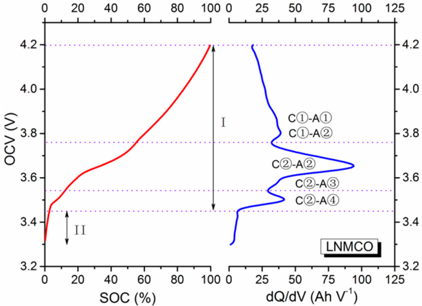
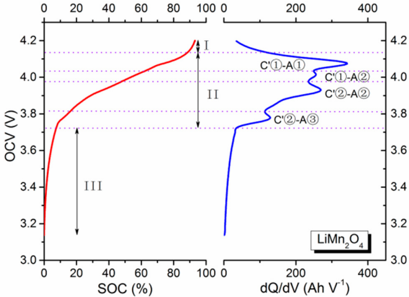
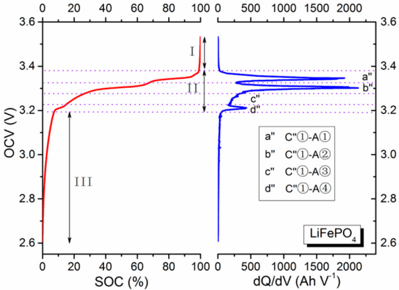
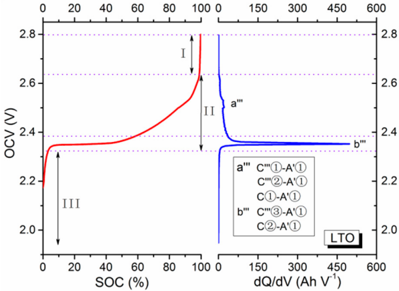
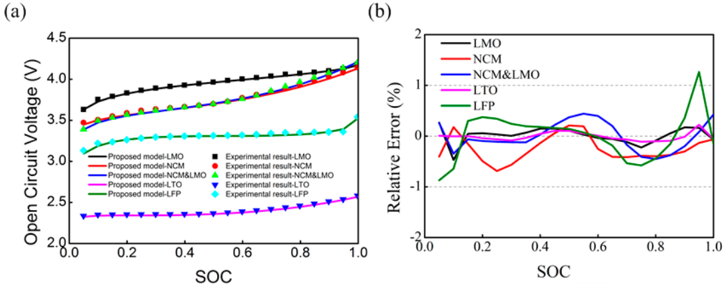
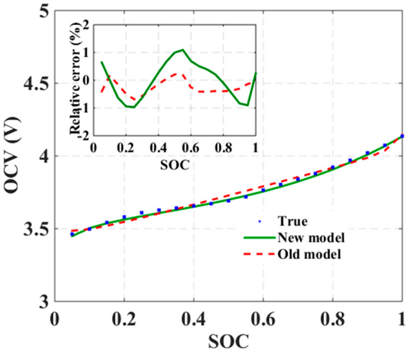
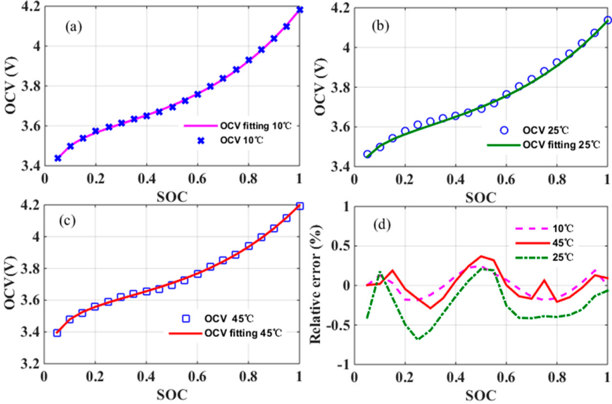
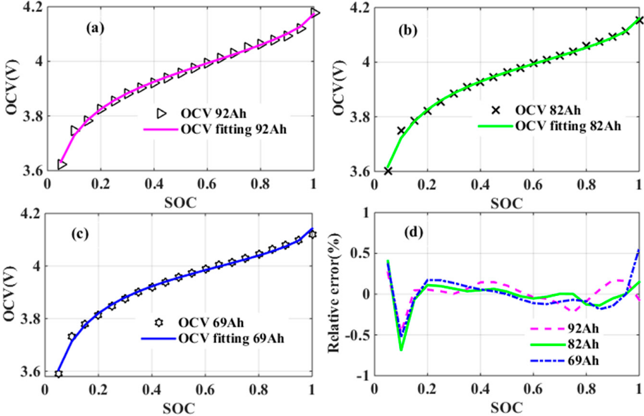
A state-of-charge (SOC) versus open-circuit-voltage (OCV) model developed for batteries should preferably be simple, especially for real-time SOC estimation. It should also be capable of representing different types of lithium-ion batteries (LIBs), regardless of temperature change and battery degradation. It must therefore be generic, robust and adaptive, in addition to being accurate. These challenges have now been addressed by proposing a generalized SOC-OCV model for representing a few most widely used LIBs. The model is developed from analyzing electrochemical processes of the LIBs, before arriving at the sum of a logarithmic, a linear and an exponential function with six parameters. Values for these parameters are determined by a nonlinear estimation algorithm, which progressively shows that only four parameters need to be updated in real time. The remaining two parameters can be kept constant, regardless of temperature change and aging. Fitting errors demonstrated with different types of LIBs have been found to be within 0.5%. The proposed model is thus accurate, and can be flexibly applied to different LIBs, as verified by hardware-in-the-loop simulation designed for real-time SOC estimation.
Overview
The claims and statistics of this paper haven’t been checked yet.
Free: it reads the open-access text and checks the first 5 claims that cite a source we can check. Create a free account to check every claim.
Integrity signals
Registry
Cites
Statistics
Figures
Verification
Claims the paper makes
The claims and statistics of this paper haven’t been checked yet.
Free: it reads the open-access text and checks the first 5 claims that cite a source we can check. Create a free account to check every claim.
Claims other papers make about this one
Each is checked against this paper’s own text: does it say what the citing paper says it does?
The source backs part of the claim, not all of it — or backs it for a different population, condition or comparison.
In the citing paper
“MAE ≤ 3 %”
From Recent developments and challenges in state-of-charge estimation techniques for electric vehicle batteries: A review (2024) · cites this paper as [85]
Experimental — accuracy not yet measured
Self-check
Percentages, sums and reported differences re-computed from the paper’s own numbers.
The self-check needs the paper’s full text.
Citations
Cites
Challenges for Rechargeable Li Batteries
Goodenough, J. B., & Kim, Y. (2010) · Chemistry of Materials · doi:10.1021/cm901452z · Cited by 10,943
Phospho‐olivines as Positive‐Electrode Materials for Rechargeable Lithium Batteries
Padhi, A. K., Nanjundaswamy, K. S., & Goodenough, J. B. (1997) · Journal of The Electrochemical Society · doi:10.1149/1.1837571 · Cited by 7,933 · cited 6×
“A flat voltage plateau is thus produced with two phase regions corresponding to FePO4 and LiFePO4.”
BackgroundInfluentialA comparative study of equivalent circuit models for Li-ion batteries
Hu, X., Li, S., & Peng, H. (2012) · Journal of Power Sources · doi:10.1016/j.jpowsour.2011.10.013 · Cited by 2,179 · cited 1×
“Qmax[n]×SOC[n])+min(Qmax[1]×(1−SOC[1]),.”
Extended Kalman filtering for battery management systems of LiPB-based HEV battery packs
Plett, G. L. (2004) · Journal of Power Sources · doi:10.1016/j.jpowsour.2004.02.032 · Cited by 1,923 · cited 1×
“1 VOC(s) = K0 − K1/s− K2s + K3ln(s) + K4ln(1− s) [20] 16.”
Ohzuku, T., Iwakoshi, Y., & Sawai, K. (1993) · Journal of The Electrochemical Society · doi:10.1149/1.2220849 · Cited by 1,089
Synthesize battery degradation modes via a diagnostic and prognostic model
Dubarry, M., Truchot, C., & Liaw, B. Y. (2012) · Journal of Power Sources · doi:10.1016/j.jpowsour.2012.07.016 · Cited by 1,065 · cited 1×
“Reference [19] developed another type of OCV model that generates OCV vs.”
BackgroundIdentify capacity fading mechanism in a commercial LiFePO4 cell
Dubarry, M., & Liaw, B. Y. (2009) · Journal of Power Sources · doi:10.1016/j.jpowsour.2009.05.036 · Cited by 675 · cited 3×
“Likewise, for the olive LFP cathode shown in Figure 3 and Table 3 [29], it manifests a unique voltage plateau at 3.”
MethodInfluentialYabuuchi, N., Makimura, Y., & Ohzuku, T. (2007) · Journal of The Electrochemical Society · doi:10.1149/1.2455585 · Cited by 387
Rahimi-Eichi, H., Baronti, F., & Chow, M.-Y. (2014) · IEEE Transactions on Industrial Electronics · doi:10.1109/tie.2013.2263774 · Cited by 380
Weng, C., Sun, J., & Peng, H. (2014) · Journal of Power Sources · doi:10.1016/j.jpowsour.2014.02.026 · Cited by 375 · cited 1×
“Reference [17] proposed an OCV model structure in which simplified hyperbolic and exponential functions are used to represent phenomenological characteristics associated with the lithium-ion intercalation/deintercalation process.”
Method
Research works printed but not linked: 1
- Wen, F. Study on Basic Issues of the Li-Ion Battery Pack Management Technology for Pure Electric Vehicles. Ph.D. Thesis, Beijing Jiaotong University, Beijing, China, 2009.
Cited by
Current Li-Ion Battery Technologies in Electric Vehicles and Opportunities for Advancements
Miao, Y., Hynan, P., von Jouanne, A., & Yokochi, A. (2019) · Energies · doi:10.3390/en12061074 · Cited by 874
Shrivastava, P., Soon, T. K., Idris, M. Y. I. B., & Mekhilef, S. (2019) · Renewable and Sustainable Energy Reviews · doi:10.1016/j.rser.2019.06.040 · Cited by 704
“Despite its simple computation, this method is not suitable for online SOC estimation because of its large error accumulation and the need for an initial SOC value [74].”
MethodA review on second-life of Li-ion batteries: prospects, challenges, and issues
Shahjalal, M., Roy, P. K., Shams, T., Fly, A., Chowdhury, J. I., Ahmed, M. R., & Liu, K. (2022) · Energy · doi:10.1016/j.energy.2021.122881 · Cited by 511
Iyer, V. M., Gulur, S., Gohil, G., & Bhattacharya, S. (2020) · IEEE Transactions on Industrial Electronics · doi:10.1109/tie.2019.2945264 · Cited by 237
“The minimum battery pack voltage (725 V) corresponds to around 20% state of charge (SoC) while the maximum battery pack voltage (800 V) corresponds to around 80% SoC based on the LNMCO/graphite lithium ion (Li-ion) cell data provided in [23].”
BackgroundDigital twin and cloud-side-end collaboration for intelligent battery management system
Wang, Y., Xu, R., Zhou, C., Kang, X., & Chen, Z. (2022) · Journal of Manufacturing Systems · doi:10.1016/j.jmsy.2021.11.006 · Cited by 219
Metadata
- Authors
- Zhang, C., Jiang, J., Zhang, L., Liu, S., Wang, L., & Loh, P.
- Affiliations
- Beijing Jiaotong University (CN)
- Department of Electrical and Computer Engineering, Wayne State University, Detroit, MI 48202, USA
- Corresponding author
- Jiang, Jiuchun
- Venue
- Energies
- Publisher
- MDPI AG
- Published
- 2016-11-01
- Volume
- 9
- Issue
- 11
- Pages
- 900
- ISSN
- 1996-1073 (ISSN-L)
- OpenAlex
- W2547367748
- Cited by
- 213
- References
- 37
- Citations by year
- 2026: 18 · 2025: 32 · 2024: 21 · 2023: 32 · 2022: 30 · 2021: 26 · 2020: 19 · 2019: 19 · 2018: 11 · 2017: 5
- FWCI
- 10.16
- Type
- journal article
- Language
- en
- Open access
- gold
- doi.org
- Licence
- Locations
- Energies (publishedVersion, cc-by)
- RePEc: Research Papers in Economics (submittedVersion)
- DOAJ (DOAJ: Directory of Open Access Journals) (submittedVersion, cc-by-sa)
- Funders
- National Natural Science Foundation of China (51477009)
- Topics
- Physical Sciences › Engineering › Automotive Engineering › Battery Modeling and Management
- Physical Sciences › Engineering › Electrical and Electronic Engineering › Advancements in Battery Materials
- Physical Sciences › Engineering › Control and Systems Engineering › Control Systems and Identification
- Keywords
- state of charge estimation, open-circuit voltage, lithium-ion batteries, parameter estimation, battery degradation, temperature effects, hardware-in-the-loop
About these checks
Registry, retraction, Cites and statistics results are computed, not judged, with one exception: a printed reference that no index lists is read once by a model before it counts as a citation error. Claims are extracted by a model and kept only when their quote appears verbatim in the text; each cited source is then checked, with a model’s help, for whether it says what the claim relies on. Those verdicts can be wrong — read the claim’s quote and the cited source before relying on one.
Statistics and arithmetic are recomputed, not judged.
Confidence bands are shown only for fields calibrated on our annotated test set. None is calibrated yet, so no band is shown.
What counts as a claim ›How we measure confidence ›How we check this ›
Are you an author, or do you see a problem with this page? Request a review
How to cite
Cite CoChat for the checks on this page, and the paper for its own findings.
- This page
- CoChat. (2026). Citation check: A Generalized SOC-OCV Model for Lithium-Ion Batteries and the SOC Estimation for LNMCO Battery. https://app.cochat.ai/papers/10.3390/en9110900
- The paper
- Zhang, C., Jiang, J., Zhang, L., Liu, S., Wang, L., & Loh, P. (2016). A Generalized SOC-OCV Model for Lithium-Ion Batteries and the SOC Estimation for LNMCO Battery. Energies. https://doi.org/10.3390/en9110900
Data sources
Bibliographic data: Semantic Scholar, OpenAlex, Crossref.
Contains information from the Semantic Scholar Academic Graph Datasets, made available under the ODC Attribution License (ODC-BY 1.0).
Semantic Scholar’s data is described in: Kinney, R., et al. (2023). The Semantic Scholar Open Data Platform. arXiv:2301.10140.
