

The Discourse Surrounding Polycystic Ovary Syndrome on TikTok: A Social Media Analysis
Open accessThe DOI matches its Crossref record; 30 of the 30 references it cites were found in a registry or an index.
Abstract
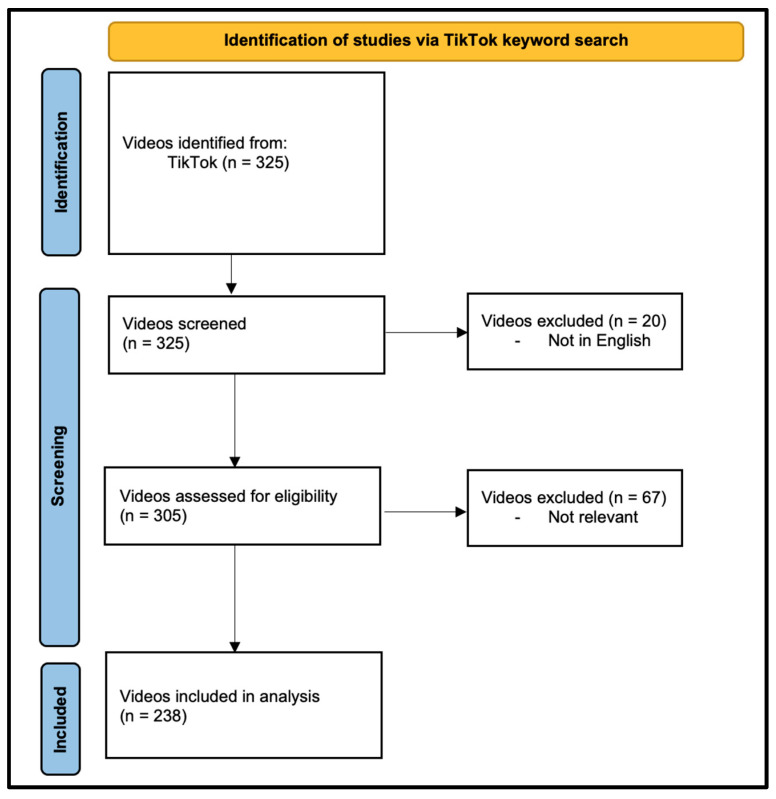
Background/Objectives: Individuals are turning increasingly towards online resources, such as TikTok, to educate themselves on their medical conditions. Polycystic ovary syndrome (PCOS) is a prominent example, as women report dissatisfaction with the diagnosis process and treatment options. This study aims to provide a content analysis of the quality of PCOS health information on TikTok. Methods: A total of 325 TikTok videos were screened. Pertinent data, including likes, comments, shares, and views, along with video content concerning symptoms, interventions, and provider interactions were analyzed. Two reviewers independently used a modified DISCERN criteria to assess the quality of information for each video. A logistic regression was also utilized to model the probability of healthcare professionals creating educational videos. Results: A total of 238 videos met the eligibility criteria for analysis. Videos had a median of 468,400 views (Q1 = 146,400, Q3 = 1,100,000) and 18,000 likes (Q1 = 5631, Q3 = 65,100). The mean modified DISCERN scores were 3.6 ± 0.9 for physicians (n = 23), 2.0 ± 1.1 for non-physician healthcare providers (n = 52), and 1.0 ± 0.2 for non-healthcare professionals (n = 141) (p < 0.001). Healthcare professionals were 10.9 times more likely to create educational videos in comparison to non-healthcare professionals (p < 0.001). Conclusions: TikTok videos related to PCOS attract considerable engagement but provide low-quality information. Most videos were made by non-healthcare professionals, who discussed treatment options with limited or no research. Healthcare providers should be aware of the impacts on patients’ preconceived notions and help to improve patient education.
Overview
The claims and statistics of this paper haven’t been checked yet.
Free: it reads the open-access text and checks the first 5 claims that cite a source we can check. Create a free account to check every claim.
Integrity signals
Registry
Cites
Statistics
Figures
Verification
Claims the paper makes
The claims and statistics of this paper haven’t been checked yet.
Free: it reads the open-access text and checks the first 5 claims that cite a source we can check. Create a free account to check every claim.
Self-check
Percentages, sums and reported differences re-computed from the paper’s own numbers.
The self-check needs the paper’s full text.
Citations
Cites
Charnock, D., Shepperd, S., Needham, G., & Gann, R. (1999) · Journal of Epidemiology and Community Health · doi:10.1136/jech.53.2.105 · Cited by 3,329 · cited 1×
“Video reliability was assessed using a modified version of the DISCERN criteria consisting of 5 questions [16].”
Epidemiology, diagnosis, and management of polycystic ovary syndrome
Sirmans, S., & Pate, K. (2013) · Clinical Epidemiology · doi:10.2147/clep.s37559 · Cited by 1,302 · cited 1×
“PCOS is a common endocrinopathy, affecting 4–8% of reproductive women [12].”
Social Media Use for Health Purposes: Systematic Review
Chen, J., & Wang, Y. (2021) · Journal of Medical Internet Research · doi:10.2196/17917 · Cited by 1,073 · cited 1×
“Many individuals rely on social media to find health information, particularly for those with limited access to health resources [2–4].”
Pittman, M., & Reich, B. (2016) · Computers in Human Behavior · doi:10.1016/j.chb.2016.03.084 · Cited by 907 · cited 1×
“Furthermore, image-based posts, compared to text-only content, have also been shown to generate more engagement [23].”
Lifestyle changes in women with polycystic ovary syndrome
Lim, S. S., Hutchison, S. K., Van Ryswyk, E., Norman, R. J., Teede, H. J., & Moran, L. J. (2019) · Cochrane Database of Systematic Reviews · doi:10.1002/14651858.cd007506.pub4 · Cited by 725
Trends in the diffusion of misinformation on social media
Allcott, H., Gentzkow, M., & Yu, C. (2019) · Research & Politics · doi:10.1177/2053168019848554 · Cited by 643 · cited 1×
“Recent studies have highlighted the dangers of misinformation not only in the political realm but across multiple sectors, including business, consumer reviews, climate change discussions, popular culture, and healthcare [25,28–30].”
Wang, Y. (2020) · Computers in Human Behavior · doi:10.1016/j.chb.2020.106373 · Cited by 424 · cited 1×
“Additionally, short-form videos, typically lasting from a few seconds to a few minutes, have seen a surge in popularity due to their concise format and lower production costs, which contribute to increased engagement and more positive viewer responses [20–22].”
Says Who? The Effects of Presentation Format and Source Rating on Fake News in Social Media1
Kim, A., & Dennis, A. R. (2019) · MIS Quarterly · doi:10.25300/misq/2019/15188 · Cited by 387 · cited 1×
“Research indicates that fake news is particularly harmful because it is designed to mimic key features of credible news—such as accuracy, verifiability, conciseness, balance, and truthfulness—to deceive the public [26,27].”
Genetic Basis of Polycystic Ovary Syndrome (PCOS): Current Perspectives
Khan, M. J., Ullah, A., & Basit, S. (2019) · The Application of Clinical Genetics · doi:10.2147/tacg.s200341 · Cited by 354 · cited 2×
“The manifestations of the disease and the effectiveness of treatments can differ widely giving conflicting information to social media users [14].”
The disaster of misinformation: a review of research in social media
Muhammed T, S., & Mathew, S. K. (2022) · International Journal of Data Science and Analytics · doi:10.1007/s41060-022-00311-6 · Cited by 343
Research works printed but not linked: 1
- American College of Obstetrics and Gynecology Polycystic Ovary Syndrome ACOG 2022 Available online: www.acog.org/clinical/clinical-guidance/practice-bulletin/articles/2018/06/polycystic-ovary-syndrome (accessed on 12 October 2024)
Cited by
Wright, P. J., Burts, C., Harmon, C., & Corbett, C. F. (2025) · JMIR Infodemiology · doi:10.2196/68469 · Cited by 8
“…were found to be deficient and negatively affected digital technology use among women with PCOS, including lack of accessibility (eg, cost of Wi-Fi or platform) [33,53], content that required high health literacy [46,51,52], and concerns about the reliability of health information [14,24,40,44].”
Liu, Y., Wu, R., & Zhang, L. (2026) · Digital Health · doi:10.1177/20552076261415927 · Cited by 7
Darcy, R., Almgren‐Bell, A., Almgren-Bell, J., Cromack, S. C., Boots, C. E., & Pavone, M. E. (2025) · American Journal of Obstetrics and Gynecology · doi:10.1016/j.ajog.2025.09.052 · Cited by 1
Examining the Representation of Polycystic Ovary Syndrome (PCOS) on Social Media: A Scoping Review
Kumari, S., & Raj, P. (2026) · Humanities & Social Sciences Reviews · doi:10.18510/hssr.2026.1412
Hak, K. J., Leszczyńska, K. M., Wieczorek, M. T., Mitan, A. M., Tomaszewska, A. M., Kańska, K. T., Krawczyk, K., Jasiński, J. L., Krzysztofik, A., & Napierała, W. (2026) · International Journal of Innovative Technologies in Social Science · doi:10.31435/ijitss.1(49).2026.5190
Exploring lifestyle management in polycystic ovary syndrome through implementation frameworks
Mcgowan, M., Cowan, S., Tay, C. T., McGowan, M. Μ., & Ng, A. H. (2026) · Experimental Physiology · doi:10.1113/ep092880 · Cited by 1
“However, social media posts are often non-HP led (Horvath et al., 2024; Naroji et al., 2024) and provide low-quality information and treatment options that have limited or no scientific evidence (Horvath et al., 2024).”
MOBILE HEALTH AND PEER SUPPORT NETWORKS IN PCOS SELF-MANAGEMENT: A NARRATIVE REVIEW
Kępa, W., Kadłuczka, J., Papuga, A., Grzymek, M., Pawlucka, A., Pawłucka, K., Bury, J., Kraska, K., Potoniec, J., Sobek, A., et al. (2026) · International Journal of Innovative Technologies in Social Science · doi:10.31435/ijitss.3(51).2026.6217
Dubé‐Zinatelli, E., Kamineni, D., Alyafei, N., & Smith, A. (2026) · Women s Reproductive Health · doi:10.1080/23293691.2026.2747213
Metadata
- Authors
- Horvath, A., Chaffin, K., Ahmad, S., Goel, V. S., Netski, D. M., Ahad, R., Batra, K., & Lee, R.
- Affiliations
- University of Nevada, Las Vegas (US)
- Corresponding author
- Batra, Kavita
- Lee, Rebecca
- ORCID
- Venue
- Healthcare
- Publisher
- MDPI AG
- Published
- 2024-11-12
- Volume
- 12
- Issue
- 22
- Pages
- 2253
- ISSN
- 2227-9032 (ISSN-L)
- PMC
- PMC11593613
- OpenAlex
- W4404253969
- Cited by
- 8
- References
- 30
- Citations by year
- 2026: 6 · 2025: 2
- FWCI
- 0.76
- Type
- journal article
- Language
- en
- Open access
- gold
- doi.org
- Licence
- Locations
- Healthcare (publishedVersion, cc-by)
- PubMed Central (publishedVersion, cc-by)
- PubMed (publishedVersion)
- Topics
- Social Sciences › Health › Social Media in Health Education
- Health Sciences › Health Professions › General Health Professions › Health Literacy and Information Accessibility
- Health Sciences › Medicine › Reproductive Medicine › Ovarian function and disorders
- Keywords
- polycystic ovary syndrome, TikTok, health information quality, DISCERN criteria, social media health education, patient engagement, online health information, patient education
About these checks
Registry, retraction, Cites and statistics results are computed, not judged, with one exception: a printed reference that no index lists is read once by a model before it counts as a citation error. Claims are extracted by a model and kept only when their quote appears verbatim in the text; each cited source is then checked, with a model’s help, for whether it says what the claim relies on. Those verdicts can be wrong — read the claim’s quote and the cited source before relying on one.
Statistics and arithmetic are recomputed, not judged.
Confidence bands are shown only for fields calibrated on our annotated test set. None is calibrated yet, so no band is shown.
What counts as a claim ›How we measure confidence ›How we check this ›
Are you an author, or do you see a problem with this page? Request a review
Data sources
Bibliographic data: Semantic Scholar, OpenAlex, Crossref.
Contains information from the Semantic Scholar Academic Graph Datasets, made available under the ODC Attribution License (ODC-BY 1.0).
Semantic Scholar’s data is described in: Kinney, R., et al. (2023). The Semantic Scholar Open Data Platform. arXiv:2301.10140.
