

The DOI matches its Crossref record; 21 of the 23 references it cites were found in a registry or an index, and 2 are not checked yet.
Three Year Quantitative Study of Compassion Satisfaction and Fatigue Among Teachers and Educational Workers in Alberta, Canada
Open accessAbstract
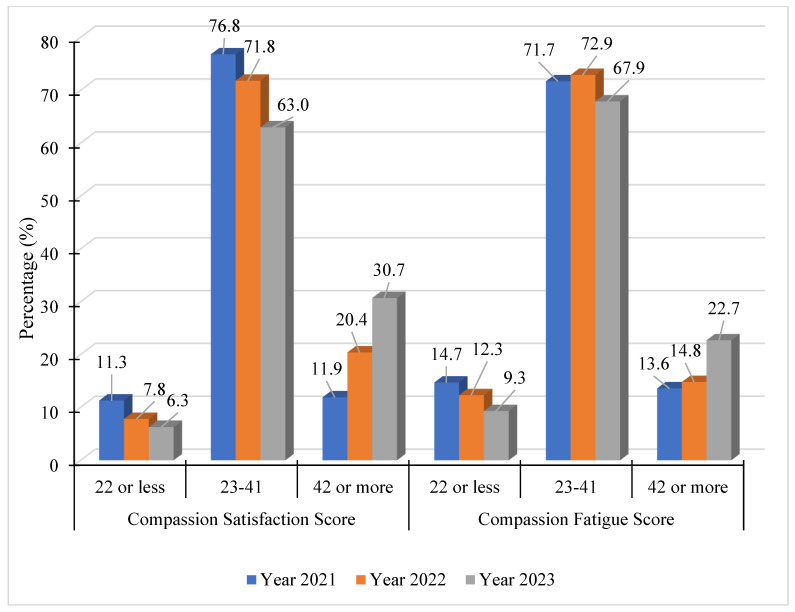
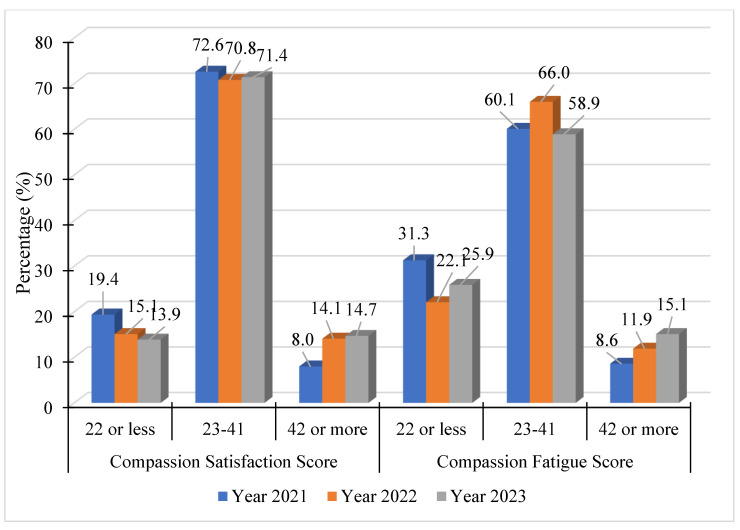
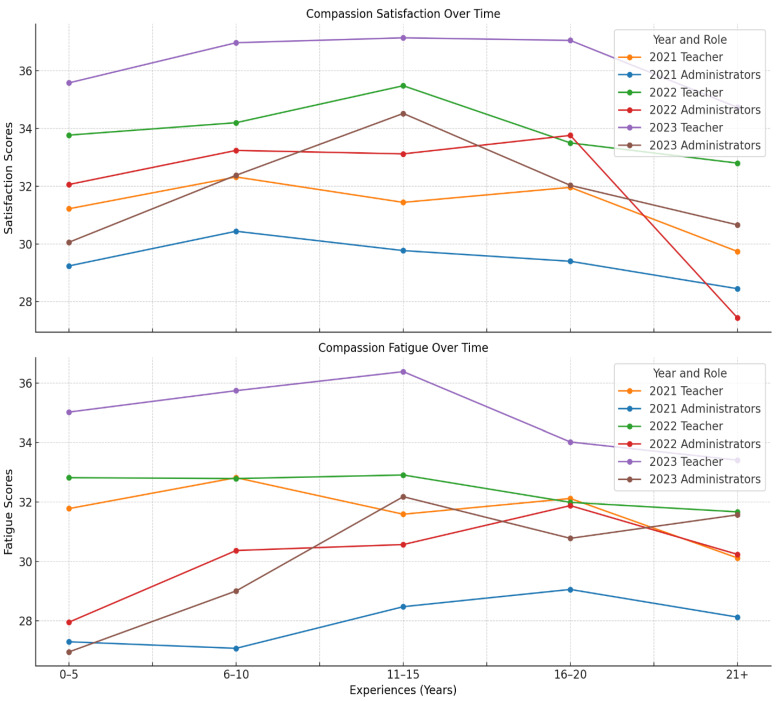
Although the psychological workplace hazards of compassion satisfaction and compassion fatigue are a known risk factor for mental and emotional health distress for caring professionals, the extent of these hazards has not been explored in Alberta, Canada. Understanding and tracking the experiences of compassion fatigue and satisfaction of teachers and other educational workers was the primary focus of this three-year, cross-sectional research study. METHODS: A multimethod, longitudinal study was conducted from June 2020 to May 2023. Data were collected at three different time points between 2020 and 2023 to explore the mental and emotional health of teachers and other educational workers, and the quantitative analysis of these data suggests that mental and emotional health distress is widespread and intensifying across Alberta. FINDINGS: This paper discusses the extent of compassion fatigue and satisfaction across Alberta both at a general level and related to years of experience in the education field. Data analysis suggests worsening workplace wellbeing over time in both number and intensity, across gender and job role. DISCUSSION: This article provides further evidence of the deepening crisis in education and contains some suggestions for policymakers, teacher educators, and system decision-makers invested in improving workplace wellbeing in educational settings.
Overview
The claims and statistics of this paper haven’t been checked yet.
Run the check — free, no account needed. It reads the open-access text and checks the sources it cites.
Integrity signals
Registry
Cites
Statistics
Figures
Verification
Claims the paper makes
The claims and statistics of this paper haven’t been checked yet.
Run the check — free, no account needed. It reads the open-access text and checks the sources it cites.
Claims other papers make about this one
Each is checked against this paper’s own text: does it say what the citing paper says it does?
The source backs part of the claim, not all of it — or backs it for a different population, condition or comparison.
In the citing paper
“In a recent study conducted in Alberta, Kendrick et al. (2025) found increasing rates of symp -toms of burnout among teachers and administrators related to continuous underfunding and increasing reporting/assessment expectations.”
From Education Leadership in K-12 Systems from a Métis Worldview: Infusing Education Leadership with an Understanding of Wâhkôhtowin (2025) · cites this paper as Kendrick et al., 2025
Experimental — accuracy not yet measuredThe source backs part of the claim, not all of it — or backs it for a different population, condition or comparison.
In the citing paper
“The rising rates of teacher burnout, lowered levels of academic achievement, increased incidences of violence and disruption within schools, and decreased parent satisfaction with the school system will eventually overwhelm our ability to educate all children in Alberta (Agyapong et al., 2024; Kendrick et al., 2025).”
From Education Leadership in K-12 Systems from a Métis Worldview: Infusing Education Leadership with an Understanding of Wâhkôhtowin (2025) · cites this paper as Kendrick et al., 2025
Experimental — accuracy not yet measuredThe cited source says what the claim attributes to it.
In the citing paper
“The education system in Alberta has been struggling for years to provide quality education within increasingly complex learning environments.”
From Education Leadership in K-12 Systems from a Métis Worldview: Infusing Education Leadership with an Understanding of Wâhkôhtowin (2025) · cites this paper as Kendrick et al., 2025
Self-check
Percentages, sums and reported differences re-computed from the paper’s own numbers.
The self-check needs the paper’s full text.
Citations
Cites
Understanding the burnout experience: Recent research and its implications for psychiatry
Maslach, C., & Leiter, M. P. (2016) · World Psychiatry · doi:10.1002/wps.20311 · Cited by 4,200 · cited 2×
“To assess burnout, a checklist of common signs and symptoms based on the Maslach and Jackson Burnout scale (1984) [42] was created, with additional symptoms specific to teaching and learning added to the January 2021 checklist that emerged from the qualitative data analysis [46].”
Teachers Matter: Attracting, Developing and Retaining Effective Teachers
OECD (2005) · Education and training policy · doi:10.1787/9789264018044-en · Cited by 992
Compassion fatigue: Toward a new understanding of the costs of caring.
Figley, C. R. (1995) · Cited by 487
Viac, C., & Fraser, P. (2020) · OECD education working papers · doi:10.1787/c36fc9d3-en · Cited by 346
Ludick, M., & Figley, C. R. (2016) · Traumatology An International Journal · doi:10.1037/trm0000096 · Cited by 267
Rauvola, R. S., Vega, D. M., & Lavigne, K. N. (2019) · Occupational Health Science · doi:10.1007/s41542-019-00045-1 · Cited by 225
Toward a comprehensive, theoretical model of compassion fatigue: A n integrative literature review
Coetzee, S. K., & Laschinger, H. K. S. (2017) · Nursing and Health Sciences · doi:10.1111/nhs.12387 · Cited by 125
The impact of COVID-19 on the learning and achievement of vulnerable Canadian children and youth
Whitley, J., Beauchamp, M. H., & Brown, C. (2021) · FACETS · doi:10.1139/facets-2021-0096 · Cited by 104
Woodcock, S., & Woolfson, L. M. (2018) · International Journal of Educational Research · doi:10.1016/j.ijer.2018.11.004 · Cited by 94
Oberg, G., Carroll, A., & MacMahon, S. J. (2023) · Frontiers in Education · doi:10.3389/feduc.2023.1128618 · Cited by 93
The Co-Creation of Caring Student-Teacher Relationships: Does Teacher Understanding Matter?
Cooper, K. S., & Miness, A. (2014) · The High School journal/The High school journal · doi:10.1353/hsj.2014.0005 · Cited by 90
The Compassion Fatigue Workbook
Mathieu, F. (2012) · Routledge eBooks · doi:10.4324/9780203803349 · Cited by 62
Kanov, J. M. (2020) · Journal of Management Inquiry · doi:10.1177/1056492620929766 · Cited by 61
Maslach, C., & Leiter, M. P. (2022) · Harvard University Press eBooks · doi:10.4159/9780674287297 · Cited by 59
Gabrielli, J., Gill, M., Koester, L. S., & Borntrager, C. F. (2013) · Children & Society · doi:10.1111/chso.12010 · Cited by 19
Moral distress among school leaders: an Alberta, Canada study with global implications
Stelmach, B., Smith, L., & O’Connor, B. (2024) · International Journal of Leadership in Education · doi:10.1080/13603124.2021.1926545 · Cited by 12
Overcoming Burnout and Compassion Fatigue in Schools
DuBois, A. L., & Mistretta, M. A. (2019) · Routledge eBooks · doi:10.4324/9781351030021 · Cited by 12
Compassion Fatigue, Burnout, and the Emotional Labor of Educational Workers
Kendrick, A. (2022) · The International Journal of Health Wellness and Society · doi:10.18848/2156-8960/cgp/v13i01/31-55 · Cited by 11
Self-citationNeoliberalism and Education in Canada
Davidson‐Harden, A., Kuehn, L. A., & Schugurensky, D. (2010) · doi:10.4324/9780203894668-9 · Cited by 9
The Changing Teacher Labor Market in Canada: Patterns and Conditions
Press, H., & Lawton, S. B. (1999) · Alberta Journal of Educational Research · doi:10.55016/ojs/ajer.v45i2.54665 · Cited by 6
Kendrick, A., Tay, M. K., Everitt, L. M., Pagaling, R., & Russell‐Mayhew, S. (2024) · Healthcare · doi:10.3390/healthcare12222200 · Cited by 3
Self-citationDuffin, J. M. (2022) · McGill-Queen's University Press eBooks · doi:10.1515/9780228015086 · Cited by 2
Harnessing Formative Data for K-12 Leaders
Mekhitarian, S. (2022) · Eye on Education eBooks · doi:10.4324/9781003245247 · Cited by 1
Research works printed but not linked: 5
- Cardinal, J. (2020). Mixed COVID Messages in Alberta Leave Parents and Teachers Concerned About Schools Reopening with Inadequate Supports, The Canadian Press, Canadian Press Enterprises Inc.
- Bennett, P.W. (2020). The State of the System: A Reality Check on Canada’s Schools; In The State of the System, McGill-Queen’s University Press. [1st ed.].
- 2007, Human Rights Tribunal Finds Underfunding Plus Program Cutbacks Equals Discrimination against Students with Severe Learning Disabilities, Educ. Law J., 17, 147
- Nguyen, T.D., Pham, L., Springer, M., and Crouch, M. (2019). The Factors of Teacher Attrition and Retention: An Updated and Expanded Meta-Analysis of the Literature, Annenberg Institute at Brown University. EdWorkingPaper: 19-149.
- Figley, C.R. (2001). Compassion Fatigue: Coping with Secondary Stress Disorder in Those Who Treat the Traumatized, Routledge.
Cited by
Sorted by citations
Hollweck, T., Everitt, L. M., & Kendrick, A. (2025) · Journal of Educational Administration · doi:10.1108/jea-01-2025-0036 · Cited by 3
Self-citationSun, Y., Berger, E., Skouteris, H., Barrett, E. L., & Blewitt, C. (2026) · Early Childhood Education Journal · doi:10.1007/s10643-026-02132-9 · Cited by 2
Chaulk, D. (2025) · Canadian Journal of Education / Revue canadienne de l éducation · doi:10.53967/cje-rce.7521 · Cited by 1
Chen, F., Xu, W., Ge, Y., & Li, W. (2026) · Frontiers in Psychology · doi:10.3389/fpsyg.2025.1717699
Mirzoyan, V. (2026) · Bulletin of Psychological Practice in Education · doi:10.17759/bppe.2026230206
Metadata
- Authors
- Kendrick, A. H., Tay, M. K., & Shahin, M. J. H.
- Affiliations
- University of Calgary (CA)
- Corresponding author
- Kendrick, Astrid Helene
- Venue
- Healthcare
- Publisher
- MDPI AG
- Published
- 2025-01-23
- Volume
- 13
- Issue
- 3
- Pages
- 226
- ISSN
- 2227-9032 (ISSN-L)
- PMC
- PMC11816448
- OpenAlex
- W4406764824
- Cited by
- 8
- References
- 21
- Citations by year
- 2026: 7 · 2025: 1
- FWCI
- 14.66
- Type
- journal article
- Language
- en
- Open access
- gold
- doi.org
- Licence
- Locations
- Healthcare (publishedVersion, cc-by)
- Preprints.org (acceptedVersion, cc-by)
- PubMed Central (publishedVersion, cc-by)
- PubMed (publishedVersion)
- Funders
- Social Sciences and Humanities Council of Canada (890-2021-0057)
- Topics
- Health Sciences › Medicine › Public Health, Environmental and Occupational Health › Occupational Health and Burnout
- Social Sciences › Psychology › Social Psychology › Stress and Burnout Research
- Health Sciences › Health Professions › General Health Professions › Healthcare professionals’ stress and burnout
- Keywords
- compassion fatigue, compassion satisfaction, teachers, educational workers, psychiatric distress, emotional well-being, occupational stress, employee well-being, years of teaching experience, gender differences, job roles, educational crisis, Alberta
About these checks
Registry, retraction, Cites and statistics results are computed, not judged, with one exception: a printed reference that no index lists is read once by a model before it counts as a citation error. Claims are extracted by a model and kept only when their quote appears verbatim in the text; each cited source is then checked, with a model’s help, for whether it says what the claim relies on. Those verdicts can be wrong — read the claim’s quote and the cited source before relying on one.
Statistics and arithmetic are recomputed, not judged.
Confidence bands are shown only for fields calibrated on our annotated test set. None is calibrated yet, so no band is shown.
What counts as a claim ›How we measure confidence ›How we check this ›
Are you an author, or do you see a problem with this page? Request a review
