

Dental Caries Status of Children and Adolescents in West Africa—A Literature Review
Open accessThe DOI matches its Crossref record; 34 of the 34 references it cites were found in a registry or an index.
Abstract
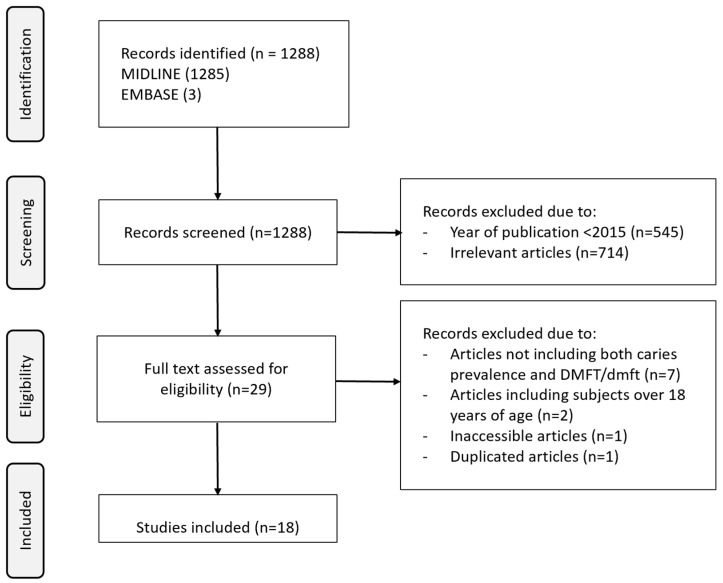
Objectives: Dental caries is one of the most prevalent oral diseases worldwide, including in Africa. The aim of this article was to provide a comprehensive review of dental caries status of children and adolescents living in the West African region. Methods: Articles that fulfilled the study selection criteria were identified through systematic search in electronic databases (EMBASE and MEDLINE). Titles and abstracts were examined manually to screen for articles that study the caries prevalence and experience of children under the age of 18, and only English publications published from the years 2015 to 2024 were included. Publications that include participants with special healthcare needs were excluded. Relevant data related to caries prevalence and severity of participants below 18 were extracted with a standardized spreadsheet. Results: Out of 1288 studies, a total of 18 studies were included. Among the 16 countries in West Africa, only 3 countries (19%) including Ghana, Nigeria, and Senegal met the inclusion criteria, with a majority (15/18, 78.9%) focusing on Nigerian children and adolescents. The dmft scores of the included studies ranged from 0.06 to 3.04, and the DMFT scores ranged from 0.02 to 2.65. It is worth noting that dmft/DMFT scores across different countries were collected with a high heterogeneity in study design, and were thereby not directly comparable. Conclusions: The majority of the included studies were conducted in Nigeria. There are significant variations in caries prevalence and caries experience among children and adolescent in West Africa. Further research on oral health surveillance in West Africa is needed.
Overview
The claims and statistics of this paper haven’t been checked yet.
Free: it reads the open-access text and checks the first 5 claims that cite a source we can check. Create a free account to check every claim.
Integrity signals
Registry
Cites
Statistics
Figures
Verification
Claims the paper makes
The claims and statistics of this paper haven’t been checked yet.
Free: it reads the open-access text and checks the first 5 claims that cite a source we can check. Create a free account to check every claim.
Claims other papers make about this one
Each is checked against this paper’s own text: does it say what the citing paper says it does?
The cited source doesn’t support the claim as written.
In the citing paper
“In Ghana and Nigeria, the frequency of adolescent dental caries is as high as 80%, significantly higher than in many high-income countries (16).”
From Oral health in Africa: a neglected public health priority (2026) · cites this paper as [16]
Checked by a reasoning model — may be wrong.
Experimental — accuracy not yet measuredThe cited source says what the claim attributes to it.
In the citing paper
“Recent estimates indicate that 28.5% of individuals aged 5 years and older in the WHO African Region have untreated dental caries in their permanent teeth, while 38.6% of children aged 1 to 9 years suffer from untreated caries in their primary teeth (16).”
From Oral health in Africa: a neglected public health priority (2026) · cites this paper as [16]
The cited source says what the claim attributes to it.
In the citing paper
“Recent estimates indicate that 28.5% of individuals aged 5 years and older in the WHO African Region have untreated dental caries in their permanent teeth, while 38.6% of children aged 1 to 9 years suffer from untreated caries in their primary teeth (16).”
From Oral health in Africa: a neglected public health priority (2026) · cites this paper as [16]
Self-check
Percentages, sums and reported differences re-computed from the paper’s own numbers.
The self-check needs the paper’s full text.
Citations
Cites
Selwitz, R. H., Ismail, A. I., & Pitts, N. B. (2007) · The Lancet · doi:10.1016/s0140-6736(07)60031-2 · Cited by 2,617 · cited 1×
“Dental caries, in particular, is a multifactorial disease resulting from the interaction of dietary sugars, oral bacteria, and the host’s dentition over time [6,7].”
Oral Health-related Quality of Life: What, Why, How, and Future Implications
Sischo, L., & Broder, H. L. (2011) · Journal of Dental Research · doi:10.1177/0022034511399918 · Cited by 1,448 · cited 1×
“Oral health is a critical component contributing to an individual’s overall health and well-being [1].”
Mechanisms of Action of Fluoride for Caries Control
Buzalaf, M. A. R., Pessan, J. P., Honório, H. M., & ten Cate, J. M. (2011) · Monographs in Oral Science · doi:10.1159/000325151 · Cited by 554
Water fluoridation for the prevention of dental caries
Iheozor-Ejiofor, Z., Worthington, H. V., Walsh, T., O'Malley, L., Clarkson, J. E., Macey, R., Alam, R., Tugwell, P., Welch, V., & Glenny, A.-M. (2015) · Cochrane Database of Systematic Reviews · doi:10.1002/14651858.cd010856.pub2 · Cited by 214
A review of fluoride in african groundwater and local remediation methods
Kut, K. M. K., Sarswat, A., Srivastava, A., Pittman, C. U., & Mohan, D. (2016) · Groundwater for Sustainable Development · doi:10.1016/j.gsd.2016.09.001 · Cited by 170 · cited 2×
“[13], lower middle (USD 1146–4515 GNI per capita in 2023); ˆ, the fluoride status in these countries has been investigated based on the concentration of fluoride in drinking groundwater sourced from rocks or minerals [22].”
Prevalence, and early childhood caries risk indicators in preschool children in suburban Nigeria
Foláyan, M. O., Kolawole, K. A., Oziegbe, E. O., Oyedele, T. A., Oshomoji, O. V., Chukwumah, N. M., & Onyejaka, N. K. (2015) · BMC Oral Health · doi:10.1186/s12903-015-0058-y · Cited by 166 · cited 1×
“Sixteen studies reported the caries prevalence and severity in Nigeria [26–40 , 42 ].”
The impact of dental caries on children and young people: what they have to say?
Gilchrist, F., Marshman, Z., Deery, C., & Rodd, H. D. (2015) · International Journal of Paediatric Dentistry · doi:10.1111/ipd.12186 · Cited by 150
Children's dental health, school performance, and psychosocial well-being
Guarnizo-Herreño, C. C., & Wehby, G. L. (2012) · The Journal of Pediatrics · doi:10.1016/j.jpeds.2012.05.025 · Cited by 143
Oral health-related quality of life in Hong Kong preschool children
Wong, H. M., McGrath, C. P. J., King, N. M., & Lo, E. C. M. (2011) · Caries Research · doi:10.1159/000330231 · Cited by 135 · cited 1×
“It is characterized by the demineralization of teeth, leading to cavities and, if left untreated, potentially more severe dental and systemic health issues [8].”
Self-citationDental Caries and Growth in School-Age Children
Alkarimi, H. A., Watt, R. G., Pikhart, H., Sheiham, A., & Tsakos, G. (2014) · Pediatrics · doi:10.1542/peds.2013-0846 · Cited by 129 · cited 1×
“Significant correlations were found between the number of decayed teeth and oral symptoms, which in turn affects the individual’s oral health-related quality of life [4].”
Consumption frequency of added sugars and UK children's dental caries
Hong, J., Whelton, H. P., Douglas, G. V. A., & Kang, J. X. (2018) · Community Dentistry And Oral Epidemiology · doi:10.1111/cdoe.12413 · Cited by 121 · cited 1×
“Dental caries, in particular, is a multifactorial disease resulting from the interaction of dietary sugars, oral bacteria, and the host’s dentition over time [6,7].”
Teshome, A., Muche, A., & Girma, B. (2021) · Frontiers in Public Health · doi:10.3389/fpubh.2021.645091 · Cited by 114 · cited 1×
“In comparison to caries prevalence in East Africa over the past 20 years, among children and adolescents under the age of 18, caries prevalence was reported at 45.7% [43].”
InfluentialOlatosi, O. O., Inem, V. A., Sofola, O., Prakash, P., & Sote, E. O. (2015) · Nigerian Journal of Clinical Practice · doi:10.4103/1119-3077.156887 · Cited by 107
Kolawole, K. A., & Foláyan, M. O. (2019) · BMC Oral Health · doi:10.1186/s12903-019-0959-2 · Cited by 100
Government expenditure on education, total (% of GDP)
Mugisha, E. (2020) · Cited by 97
Oral–Health–Related Quality of Life in Children and Adolescents
Thomson, W. M., & Broder, H. L. (2018) · Pediatric Clinics of North America · doi:10.1016/j.pcl.2018.05.015 · Cited by 90 · cited 1×
“It holds particular importance for children as it allows them to eat, speak, and socialize without discomfort [2], thereby playing a significant role in their growth and development [3].”
Mothers’ oral health literacy and children’s oral health status in Pikine, Senegal: A pilot study
Dieng, S. N., Cissé, D., Lombrail, P., & Azogui‐Lévy, S. (2020) · PLoS ONE · doi:10.1371/journal.pone.0226876 · Cited by 87 · cited 2×
“Ultimately, only 18 studies conducted in Ghana, Nigeria, and Senegal were included [24–41].”
InfluentialAssociation between early childhood caries and malnutrition in a sub-urban population in Nigeria
Foláyan, M. O., Arije, O., Tantawi, M. E., Kolawole, K. A., Obiyan, M. O., Arowolo, O., & Oziegbe, E. O. (2019) · BMC Pediatrics · doi:10.1186/s12887-019-1810-2 · Cited by 65
Chukwumah, N. M., Foláyan, M. O., Oziegbe, E. O., & Umweni, A. A. (2015) · International Journal of Paediatric Dentistry · doi:10.1111/ipd.12162 · Cited by 62
Akinyamoju, C. A., Dairo, M. D., Adeoye, I., & Akinyamoju, A. O. (2018) · Nigerian Postgraduate Medical Journal · doi:10.4103/npmj.npmj_138_18 · Cited by 55
Adeniyi, A. A., & Odusanya, O. O. (2017) · Nigerian Postgraduate Medical Journal · doi:10.4103/npmj.npmj_7_17 · Cited by 40
Foláyan, M. O., Kolawole, K. A., Oziegbe, E. O., Oyedele, T. A., Agbaje, H. O., Onjejaka, N. K., & Oshomoji, V. O. (2017) · Journal of Indian Society of Pedodontics and Preventive Dentistry · doi:10.4103/0970-4388.206034 · Cited by 35
Kolawole, K. A., Foláyan, M. O., Agbaje, H. O., Oyedele, T. A., Oziegbe, E. O., Onyejaka, N. K., Chukwumah, N. M., & Oshomoji, O. V. (2016) · PLoS ONE · doi:10.1371/journal.pone.0148322 · Cited by 32
Foláyan, M. O., Adeniyi, A. A., Arowolo, O., Chukwumah, N. M., Alade, M., & Tantawi, M. E. (2022) · BMC Oral Health · doi:10.1186/s12903-022-02470-1 · Cited by 30
Oyedele, T. A., Fadeju, A. D., Adeyemo, Y. I., Nzomiwu, C. L., & Ladeji, A. M. (2018) · European Archives of Paediatric Dentistry · doi:10.1007/s40368-018-0342-z · Cited by 28
Kimmie‐Dhansay, F., & Bhayat, A. (2022) · BMC Oral Health · doi:10.1186/s12903-022-02489-4 · Cited by 27 · cited 1×
“…meta-analysis on caries prevalence in 12-year-olds in Africa revealed that from 2000 to 2020, only decayed, missing, and filled teeth (DMFT) data from 3 countries including Nigeria (0.60), Burkina Faso (0.70), and Gambia (2.27) were available out of the 16 countries in the West African region [17].”
InfluentialCommon oral conditions and correlates: an oral health survey in Kwara State Nigeria
Tobin, A. O., & Ajayi, I. O. (2017) · BMC Research Notes · doi:10.1186/s13104-017-2894-0 · Cited by 21
Blankson, P., Amoah, G., Thadani, M., Newman-Nartey, M., Amarquaye, G. N., Hewlett, S. A., Ampofo, P. C., & Sackeyfio, J. (2021) · International Dental Journal · doi:10.1016/j.identj.2021.02.004 · Cited by 21 · cited 3×
“One study that was carried out in urban schools reflected a mean DMFT of 0.27 with a caries prevalence of 13.3% [24].”
InfluentialDental Caries Severity and Nutritional Status of Nigerian Preschool Children
Olatosi, O. O., Alade, A. A., Naicker, T., Busch, T. D., Oyapero, A., Li, M., Pape, J., Olotu, J., Awotoye, W. A., Hassan, M., et al. (2021) · JDR Clinical & Translational Research · doi:10.1177/23800844211002108 · Cited by 20 · cited 1×
“Nigeria, with an HDI of 0.548, well below the world average of 0.739, presented a caries prevalence up to 96% [38].”
InfluentialREVIEW OF DENTISTRY IN WEST AFRICA- CHALLENGES AND PROSPECTS.
Fomete, B., & Adebayo, E. T. (2018) · Europe PMC (PubMed Central) · Cited by 17
Peters, A., Brandt, K. V., Wienke, A., & Schaller, H. (2022) · International Journal of Environmental Research and Public Health · doi:10.3390/ijerph19095771 · Cited by 16
Nazir, M. A., AlHumaid, J., & Alhareky, M. S. (2021) · Journal of Public Health Dentistry · doi:10.1111/jphd.12467 · Cited by 10 · cited 1×
“…significant negative correlation between the percentage of GDP allocated to education and caries experience, suggesting that government expenditure on education can impact oral health behaviors, such as oral hygiene practices, and subsequently influence caries prevalence and risks [48].”
Dental Caries, Traumatic Dental Injuries and Gingivitis among Street-Children in Kano, Nigeria.
Okolo, C. C., Oredugba, F. A., Denloye, O. O., & Adeyemo, Y. I. (2022) · PubMed · Cited by 6
Adeniyi, A. A., Foláyan, M. O., Chukwumah, N. M., Oziegbe, E. O., & Tantawi, M. E. (2023) · Brazilian Oral Research · doi:10.1590/1807-3107bor-2023.vol37.0091 · Cited by 5 · cited 1×
“Sixteen studies reported the caries prevalence and severity in Nigeria [26–40 , 42 ].”
Cited by
Oral health in Africa: a neglected public health priority
Nwabunka, M., Sowunmi, A. O., Osadolor, U. E., Akinyosoye, A. D., Nnyanzi, L., Adeloye, D., & Zohoori, V. (2026) · Frontiers in Oral Health · doi:10.3389/froh.2026.1754189 · Cited by 4
Dolo, S. S., & Diallo, B. (2025) · Journal of Clinical Advances in Dentistry · doi:10.29328/journal.jcad.1001052
“While community-based adolescents in Mali and neighboring countries show slightly lower DMFT scores, detention ampli(cid:976)ies risk due to structural barriers, restricted autonomy, and inadequate oral healthcare infrastructure [25].”
Güncel Pedodonti Çalışmaları VIII
Nacakgediği, İ., Beyaz, E. N., Bardakçı, E., Taskaya, B., Gümüşboğa, Z. Ş., Yabaş, Ş. M., Tez, B. Ç., Güler, B., Avcı, B., Akgün, S. E., et al. (2026) · Akademisyen Kitabevi eBooks · doi:10.37609/akya.4129
Farouk, M., Oumayma, W. H., & Bentahar, O. (2026) · Frontiers in Oral Health · doi:10.3389/froh.2026.1901145
“However, the relative contribution of these determinants appears to vary across populations and settings, reflecting differences in social and health system contexts (5, 6).”
Metadata
- Authors
- Chan, W.-L., Wong, H.-Y., Yue, R., Duangthip, D., & Lam, P.
- Affiliations
- University of Hong Kong (HK)
- The Ohio State University (US)
- Corresponding author
- Lam, Phoebe
- Venue
- Healthcare
- Publisher
- MDPI AG
- Published
- 2025-04-22
- Volume
- 13
- Issue
- 9
- Pages
- 961
- ISSN
- 2227-9032 (ISSN-L)
- PMC
- PMC12072052
- OpenAlex
- W4409682213
- Semantic Scholar
- fbe55a693eeda59f0ae4112238f6888e782f2152
- Cited by
- 4
- References
- 34
- Citations by year
- 2026: 3 · 2025: 1
- FWCI
- 0.68
- Type
- journal article
- Language
- en
- Open access
- gold
- doi.org
- Licence
- Locations
- Healthcare (publishedVersion, cc-by)
- PubMed Central (publishedVersion, cc-by)
- PubMed (publishedVersion)
- The HKU Scholars Hub (University of Hong Kong) (submittedVersion)
- Topics
- Health Sciences › Dentistry › General Dentistry › Dental Health and Care Utilization
- Health Sciences › Dentistry › Periodontics › Oral microbiology and periodontitis research
- Health Sciences › Dentistry › General Dentistry › dental development and anomalies
- Keywords
- dental caries, caries prevalence, caries experience, children, adolescents, DMFT index, oral health surveillance, West Africa, Nigeria, Ghana, Senegal
About these checks
Registry, retraction, Cites and statistics results are computed, not judged, with one exception: a printed reference that no index lists is read once by a model before it counts as a citation error. Claims are extracted by a model and kept only when their quote appears verbatim in the text; each cited source is then checked, with a model’s help, for whether it says what the claim relies on. Those verdicts can be wrong — read the claim’s quote and the cited source before relying on one.
Statistics and arithmetic are recomputed, not judged.
Confidence bands are shown only for fields calibrated on our annotated test set. None is calibrated yet, so no band is shown.
What counts as a claim ›How we measure confidence ›How we check this ›
Are you an author, or do you see a problem with this page? Request a review
Data sources
Bibliographic data: Semantic Scholar, OpenAlex, Crossref.
Contains information from the Semantic Scholar Academic Graph Datasets, made available under the ODC Attribution License (ODC-BY 1.0).
Semantic Scholar’s data is described in: Kinney, R., et al. (2023). The Semantic Scholar Open Data Platform. arXiv:2301.10140.
