

A Systematic Review of Tuberculosis Stigma Reduction Interventions
Open accessThe DOI matches its Crossref record; 32 of the 33 references it cites were found in a registry or an index, and 1 are not checked yet.
Abstract
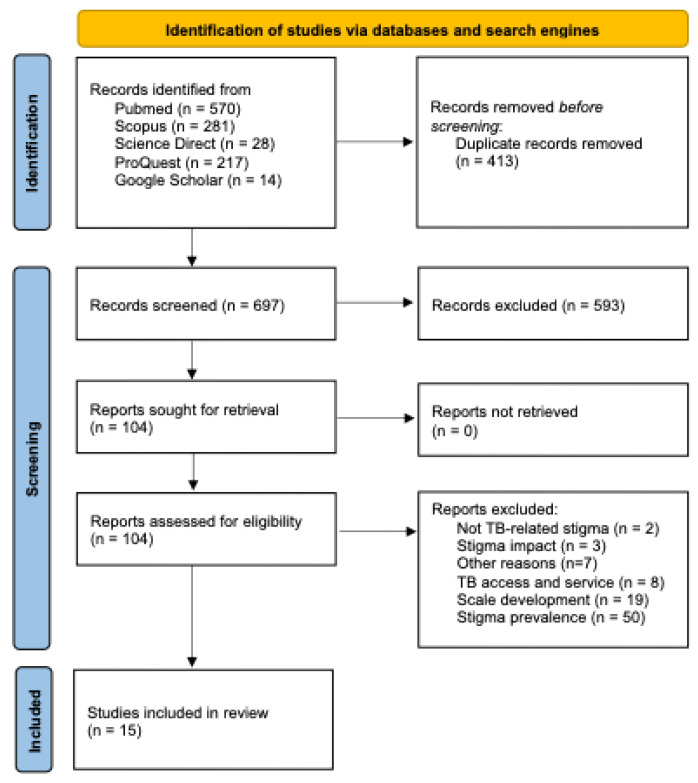
Background: Stigma associated with tuberculosis (TB) continues to undermine patient well-being, treatment adherence, and public health goals and objectives. This study aims to systematically review the literature to identify and synthesize TB stigma reduction interventions published between 2015 and 2025. Methods: Following the PRISMA guidelines, we conducted a comprehensive literature search across PubMed, Scopus, Science Direct, ProQuest, and Google Scholar. Eligible studies included those with qualitative, quantitative, and mixed-methods designs that focused on interventions related to TB-related stigma. We categorized the studies into three groups: (1) intervention development studies, (2) TB treatment programs with stigma reduction outcomes, (3) stigma-specific interventions. Data extraction and quality appraisal were conducted independently by two reviewers using the Mixed Methods Appraisal Tool (MMAT). Results: A total of 15 studies met the inclusion criteria. Five studies focused on co-developing stigma interventions, which incorporated multi-level and multicomponent strategies targeting internalized, enacted, anticipated, and intersectional stigma. Two studies assessed TB treatment-related interventions (e.g., home-based care, digital adherence tools) with incidental stigma reduction effects. The remaining seven studies implemented stigma-targeted interventions, including educational programs, video-based therapy, peer-led support, and anti-self-stigma toolkits. Interventions addressed stigma across individual, interpersonal, institutional, community, and policy levels. Conclusions: This review highlights the evolution and diversification of TB stigma interventions over the past decade. While earlier interventions emphasized education and support, recent strategies increasingly integrate peer leadership, digital platforms, and socio-ecological frameworks. The findings underscore the need for comprehensive, contextually grounded interventions that reflect the lived experiences of people affected by TB.
Overview
The claims and statistics of this paper haven’t been checked yet.
Free: it reads the open-access text and checks the first 5 claims that cite a source we can check. Create a free account to check every claim.
Integrity signals
Registry
Cites
Statistics
Figures
Verification
Claims the paper makes
The claims and statistics of this paper haven’t been checked yet.
Free: it reads the open-access text and checks the first 5 claims that cite a source we can check. Create a free account to check every claim.
Claims other papers make about this one
Each is checked against this paper’s own text: does it say what the citing paper says it does?
The source backs part of the claim, not all of it — or backs it for a different population, condition or comparison.
In the citing paper
“It may contribute to depression and anxiety through internalized shame and experiences of discrimination; delay help-seeking because of fear of disclosure; interfere with adherence by making treatment-taking visible; and intensify social isolation through both self-protective withdrawal and rejection by others [6,27,35].”
From Psychosocial Interventions for Improving Treatment Adherence in Tuberculosis Patients: A Scoping Review of Evidence-Based Approaches. (2026) · cites this paper as [27]
Experimental — accuracy not yet measured
Self-check
Percentages, sums and reported differences re-computed from the paper’s own numbers.
The self-check needs the paper’s full text.
Citations
Cites
Tuberculosis and Stigmatization: Pathways and Interventions
Courtwright, A., & Turner, A. N. (2010) · Public Health Reports® · doi:10.1177/00333549101250s407 · Cited by 534 · cited 2×
“TB-related stigma is complex and multidimensional, encompassing internalized, anticipated, enacted, perceived, and secondary stigma [10].”
Craig, G. M., Daftary, A., Engel, N., O’Driscoll, S., & Ioannaki, A. (2017) · International Journal of Infectious Diseases · doi:10.1016/j.ijid.2016.10.011 · Cited by 271
Thomas, B. E., Shanmugam, P., Malaisamy, M., Ovung, S., Suresh, C., Subbaraman, R., Adinarayanan, S., & Nagarajan, K. (2016) · PLOS ONE · doi:10.1371/journal.pone.0147397 · Cited by 187 · cited 1×
“Stigma not only impedes timely diagnosis and disclosure of TB status but also leads to social isolation, discrimination, and economic constraints [6,7].”
Stigma matters in ending tuberculosis: Nationwide survey of stigma in Ethiopia
Datiko, D. G., Jerene, D., & Suarez, P. G. (2020) · BMC Public Health · doi:10.1186/s12889-019-7915-6 · Cited by 156 · cited 1×
“Hence, stigma reduction represents an essential component of successful TB eradication efforts [12].”
Yuan, K., Huang, X.-L., Yan, W., Zhang, Y.-X., Gong, Y.-M., Su, S.-Z., Huang, Y.-T., Zhong, Y., Wang, Y.-J., Yuan, Z., et al. (2022) · Molecular Psychiatry · doi:10.1038/s41380-021-01295-8 · Cited by 148 · cited 1×
“Social and structural determinants of health significantly influence TB-related stigma [3], which remains prevalent, affecting approximately 34% of individuals with infectious diseases, with higher rates observed in low-and middle-income countries [4].”
Evidence-based interventions to reduce tuberculosis stigma: a systematic review
Sommerland, N., Wouters, E., Mitchell, E. M. H., Ngicho, M., Redwood, L., Masquillier, C., van Hoorn, R., van den Hof, S., & Van Rie, A. (2017) · The International Journal of Tuberculosis and Lung Disease · doi:10.5588/ijtld.16.0788 · Cited by 111 · cited 2×
“The present findings build upon and expand the scope of the systematic review by Sommerland et al. (2017) [17], which identified only seven eligible studies prior to 2015.”
Nuttall, C., Fuady, A., Nuttall, H., Dixit, K., Mansyur, M., & Wingfield, T. (2022) · Infectious Diseases of Poverty · doi:10.1186/s40249-022-01021-8 · Cited by 75 · cited 1×
“Previous analyses of intervention pathways for TB stigma reduction have proposed a framework targeting four key groups simultaneously: the general population, healthcare providers, TB patients, and TB survivors [36].”
Structural forces and the production of TB-related stigma among Haitians in two contexts
Coreil, J., Mayard, G., Simpson, K. M. J., Lauzardo, M., Zhu, Y., & Weiss, M. G. (2010) · Social Science & Medicine · doi:10.1016/j.socscimed.2010.07.017 · Cited by 67 · cited 1×
“Research suggests that TB stigma emerges through sociostructural processes, wherein macroeconomic factors, health policies, and service delivery mechanisms interact to generate experiences of both anticipated and internalized stigma among affected populations [33].”
To End TB, First-Ever High-Level Meeting on Tuberculosis Must Address Stigma
Daftary, A., Mitchell, E. M. H., Reid, M. J. A., Fekadu, E., & Goosby, E. (2018) · American Journal of Tropical Medicine and Hygiene · doi:10.4269/ajtmh.18-0591 · Cited by 50
Foster, I., Biewer, A., Vanqa, N., Makanda, G., Tisile, P., Hayward, S. E., Wademan, D. T., Anthony, M. G., Mbuyamba, R., Galloway, M., et al. (2024) · BMC Global and Public Health · doi:10.1186/s44263-024-00070-5 · Cited by 45 · cited 2×
“Foster (2024) [24] emphasized community engagement and survivor-led messaging in multicomponent interventions.”
Patel, D., Berger, C. A., Kityamuwesi, A., Ggita, J., Kunihira Tinka, L., Turimumahoro, P., Feler, J., Chehab, L., Chen, A. Z., Gupta, N., et al. (2020) · JMIR Formative Research · doi:10.2196/19270 · Cited by 37 · cited 2×
“Patel, 2020 [18] Anticipated stigma The study developed a human-centered redesign of the 99DOTS digital adherence technology, focusing on the pill packaging envelope displaying toll-free numbers for dose reporting and enhancing the overall patient experience with the system.”
Idris, N. A., Zakaria, R., Muhamad, R., Husain, N. R. N., Ishak, A., & Mohammad, W. M. Z. W. (2020) · Malaysian Journal of Medical Sciences · doi:10.21315/mjms2020.27.6.10 · Cited by 36 · cited 2×
“Idris, 2020 [31] Perceived, enacted, and internalized stigma assessed using the KAPS questionnaire The intervention comprised a school-based TB education program for high school students that included a lecture on TB symptoms and treatment, a quiz, small group discussions to address local myths and…”
Anindhita, M., Haniifah, M., Putri, A. M. N., Karnasih, A., Agiananda, F., Yani, F. F., Haya, M. A. N., Pakasi, T. A., Widyahening, I. S., Fuady, A., et al. (2024) · Infectious Diseases of Poverty · doi:10.1186/s40249-024-01257-6 · Cited by 35 · cited 1×
“Additionally, a scoping review by Anindhita et al. (2024) identified community-based psychosocial support interventions—such as peer-led counseling and support groups—as effective in reducing internalized and anticipated stigma among TB-affected populations [38].”
Zumla, A. I., Sahu, S., Diţiu, L., Singh, U., Park, Y. J., Yeboah‐Manu, D., Osei-Wusu, S., Asogun, D., Nyasulu, P. S., Tembo, J. M., et al. (2025) · IJID Regions · doi:10.1016/j.ijregi.2025.100587 · Cited by 32
Fuady, A., Anindhita, M., Hanifah, M., Putri, A. M. N., Karnasih, A., Agiananda, F., Yani, F. F., Haya, M. A. N., Pakasi, T. A., & Wingfield, T. (2025) · npj Primary Care Respiratory Medicine · doi:10.1038/s41533-024-00407-5 · Cited by 31 · cited 2×
“Fuady, 2025 [25] Internalized, enacted, and anticipated stigma The study developed individualized psychological evaluations and counseling sessions; monthly peer-facilitated group counseling interventions; peer-delivered one-on-one psychosocial support; and community-centered educational sessions…”
Taneja, N., Chellaiyan, V. G., Daral, S., Adhikary, M., & Das, T. K. (2017) · JOURNAL OF CLINICAL AND DIAGNOSTIC RESEARCH · doi:10.7860/jcdr/2017/27594.10401 · Cited by 30 · cited 2×
“Taneja (2017) [26] implemented a home-based care model incorporating counseling, rehabilitation, and nutritional support alongside pharmacological treatment, reporting reductions in enacted stigma.”
Tuberculosis patient and family education through videography in El Salvador
Wilson, J. W., Ramos, J. G., Castillo, F. J., Castellanos-Flores, E., & Escalante, P. (2016) · Journal of Clinical Tuberculosis and Other Mycobacterial Diseases · doi:10.1016/j.jctube.2016.05.001 · Cited by 29 · cited 3×
“Tuberculosis Treatment-Related Interventions with Demonstrated Impact on Stigma Reduction Wilson, 2016 [23] Anticipated and enacted stigma The study developed a video-based TB education program comprising four key components: (1) general TB information, (2) TB screening and treatment protocols, (3)…”
InfluentialAranas, L. L., Alam, K., Gyawali, P., & Alam, R. M. (2023) · INQUIRY The Journal of Health Care Organization Provision and Financing · doi:10.1177/00469580231180754 · Cited by 26 · cited 1×
“A review on drug-resistant TB highlighted three priorities for protecting healthcare workers: strengthening infection control, improving staff competence, and providing psychosocial support [15].”
Stigma and infectious diseases in Africa: examining impact and strategies for reduction
Omosigho, P. O., John, O. O., Musa, M. B., Aboelhassan, Y. M. E. I., Olabode, O. N., Bouaddi, O., Mengesha, D. T., Micheal, A. S., Modber, M. A. K. A., Sow, A. U., et al. (2023) · Annals of Medicine and Surgery · doi:10.1097/ms9.0000000000001470 · Cited by 24 · cited 1×
“Effective initiatives aimed at reducing stigma emphasize the crucial role of community involvement, awareness campaigns, and professional development for healthcare providers in creating a more supportive and inclusive space for those affected [34,35].”
Hayward, S. E., Vanqa, N., Makanda, G., Tisile, P., Ngwatyu, L., Foster, I., Mcinziba, A., Biewer, A., Mbuyamba, R., Galloway, M., et al. (2024) · BMC Global and Public Health · doi:10.1186/s44263-024-00084-z · Cited by 18 · cited 2×
“Notably, recent studies by Hayward (2024) [22], Foster (2024) [24], and van der Westhuizen (2024) [20] employed intersectional stigma frameworks and socio-ecological models to design interventions spanning multiple domains, including the individual, interpersonal, institutional, community, and…”
van der Westhuizen, H., Ehrlich, R. I., Somdyala, N., Greenhalgh, T., Tonkin-Crine, S. K., & Butler, C. (2024) · BMC Global and Public Health · doi:10.1186/s44263-024-00097-8 · Cited by 15 · cited 2×
“Similarly, van der Westhuizen (2024) [20] applied Link and Phelan’s framework to identify stigma mechanisms, proposing patient education, respectful communication of infection control measures, reframing of institutional policies, and implementation of universal airborne precautions as critical…”
Sabin, L., Thulasingam, M., Carwile, M. E., Babu, S. P., Knudsen, S., Dong, L., Stephens, J., Fernandes, P., Cintron, C., Horsburgh, C. R., et al. (2021) · Global Public Health · doi:10.1080/17441692.2021.1990372 · Cited by 14 · cited 1×
“Sabin (2021) [19] highlighted the use of celebrity advocacy and school-based education to address enacted stigma, while support groups and counseling were recommended to mitigate internalized stigma.”
Wang, N., Wu, L., Liu, Z., Liu, J., Liu, X., Feng, Y., Zhang, H., Yin, X., Liu, Y., Zhou, Y., et al. (2024) · BMC Public Health · doi:10.1186/s12889-024-19812-z · Cited by 12 · cited 1×
“Despite the availability of effective diagnostics and treatment, TB control continues to be hampered by pervasive stigma, which compromises health-seeking behavior, treatment adherence, and psychosocial well-being [5].”
Kara, G. C., & Yalçın, B. M. (2022) · PubMed · doi:10.3122/jabfm.2022.ap.210514 · Cited by 10 · cited 2×
“Kara, 2022 [27] Internalized, enacted, and anticipated stigma The study implemented video directly observed therapy for TB patients with the following components: video observation, asynchronous or synchronous communication, patient education and training.”
Moonsarn, S., Kasetjaroen, Y., Bettex-Baars, A.-M., & Phanumartwiwath, A. (2023) · International Journal of Environmental Research and Public Health · doi:10.3390/ijerph20054136 · Cited by 10 · cited 2×
“For instance, Moonsarn (2023) [28] implemented a four-part education program targeting stigma knowledge, cognitive restructuring, and empowerment.”
Piloting “From the Inside Out” — a toolkit addressing tuberculosis-related self-stigma
Macdonald, S. H.-F., France, N. F., Hodgson, I. J., Ali, F., Dewi, C., Abdurrakhman, I., Runtu, Y. M., Juan, A., Sugiharto, J., Byrne, E., et al. (2024) · BMC Global and Public Health · doi:10.1186/s44263-024-00062-5 · Cited by 9 · cited 2×
“Macdonald, 2024 [29] Self-stigma The study deployed an anti-self-stigma toolkit based on a socio-ecological model, comprising eight modules: (1) self-stigma introduction, (2) shame coping strategies, (3) DR-TB-specific impacts, (4) infection control contexts, (5) health rights linkages, (6)…”
Vibulchai, N., Dana, K., Sanchan, M., Churari, C., Jadboonnak, B., Sawangsri, W., Pothiporn, W. T., & Sutthicharoen, U. (2024) · Belitung Nursing Journal · doi:10.33546/bnj.3327 · Cited by 9 · cited 2×
“Vibulchai, 2024 [30] Internalized stigma The peer-delivered intervention incorporated four components: TB-specific health education, psychoeducation, self-management training, and community-based home visits.”
Faraade, M. H., Jeffree, M. S., Lin, L. J., Fiidow, O. A., Avoi, R., Pasupuleti, V. R., & Hassan, M. R. (2022) · Malaysian Journal of Public Health Medicine · doi:10.37268/mjphm/vol.22/no.2/art.1753 · Cited by 8 · cited 1×
“A systematic review of TB stigma interventions in developing economies found that optimal implementation depends on the healthcare setting, available resources, and local TB epidemiology [16].”
Tuberculosis and stigma: Break the silence…
Arora, V. K., Chopra, K. K., & Rajpal, S. (2025) · Indian Journal of Tuberculosis · doi:10.1016/j.ijtb.2025.02.015 · Cited by 8 · cited 1×
“It is driven by a combination of cultural beliefs, misinformation, fear of contagion, and health system practices that inad-vertently reinforce negative stereotypes [11].”
Mawey, F. M., Karimah, A., & Kusmiati, T. (2023) · Bali Medical Journal · doi:10.15562/bmj.v12i2.4287 · Cited by 5 · cited 2×
“Mawey, 2023 [21] Enacted stigma The study implemented workplace psychosocial intervention on TB spread, and patient education and counseling.”
Villar, M., & Carroll, J. J. (2023) · Medicine Anthropology Theory · doi:10.17157/mat.10.1.6521 · Cited by 3
Maulia, J. T. T. (2022) · Jurnal Riset Kualitatif dan Promosi Kesehatan · doi:10.61194/jrkpk.v1i2.654 · Cited by 2 · cited 1×
“Effective initiatives aimed at reducing stigma emphasize the crucial role of community involvement, awareness campaigns, and professional development for healthcare providers in creating a more supportive and inclusive space for those affected [34,35].”
Faraade, M. H. (2023) · AEA Randomized Controlled Trials · doi:10.1257/rct.12166-1.0
Research works printed but not linked: 1
- Toure A.F. Multidimensional Impact of Tuberculosis on Quality of Life: Physical, Psychological, Social and Economic Aspects J. Infect. Dis. Pneumol. 2025 1 1
Cited by
Asriadi, A., & Andriani, D. E. (2026) · Leadership and Policy in Schools · doi:10.1080/15700763.2026.2646345 · Cited by 12
Bin Qamar, R. A., Pereira, H., & Alckmin-Carvalho, F. (2026) · Advances in respiratory medicine · doi:10.3390/arm94030032 · Cited by 1
“The remaining six studies were multinational evidence syntheses or conceptual reviews drawing on data from multiple countries and regions [6,7,9,25–27].”
Wijayanti, S. P. M., Suratman, S., Rejeki, D. S. S., Aji, B., & Jayanti, R. D. (2025) · Frontiers in Public Health · doi:10.3389/fpubh.2025.1592191 · Cited by 1
Law, S. J., Baddeley, A., Carlqvist, A., Mavhunga, F., Viney, K. A., & Daftary, A. (2025) · BMJ Open · doi:10.1136/bmjopen-2025-106529 · Cited by 6
Mohammed, H. S. (2026) · Journal of Korean Biological Nursing Science · doi:10.7586/jkbns.25.070 · Cited by 1
“Tackling these issues is crucial for improving treatment outcomes and lowering the TB burden in Egypt [3].”
Metadata
- Authors
- Aitambayeva, N., Aringazina, A., Nazarova, L., Faizullina, K., Bapayeva, M., Narymbayeva, N., & Svetlanova, S.
- Affiliations
- Kazakhstan Medical University (KZ)
- Almaty Management University (KZ)
- Almaty City Branch of the Salidat Kairbekova National Research Center for Health Development, Almaty 050010, Kazakhstan
- Corresponding author
- Aitambayeva, Nadira
- ORCID
- Venue
- Healthcare
- Publisher
- MDPI AG
- Published
- 2025-07-29
- Volume
- 13
- Issue
- 15
- Pages
- 1846
- ISSN
- 2227-9032 (ISSN-L)
- PMC
- PMC12346600
- OpenAlex
- W4412899804
- Semantic Scholar
- c1b6bc33fd8712ca536306ef06deebe9e21f774a
- Cited by
- 19
- References
- 32
- Citations by year
- 2026: 15 · 2025: 4
- FWCI
- 3.33
- Type
- journal article
- Language
- en
- Open access
- gold
- doi.org
- Licence
- Locations
- Healthcare (publishedVersion, cc-by)
- Europe PMC (PubMed Central) (publishedVersion, cc-by)
- PubMed Central (publishedVersion, cc-by)
- PubMed (publishedVersion)
- Topics
- Health Sciences › Medicine › Infectious Diseases › Tuberculosis Research and Epidemiology
- Health Sciences › Medicine › Infectious Diseases › HIV/AIDS Research and Interventions
- Health Sciences › Medicine › Psychiatry and Mental health › Mental Health Treatment and Access
- Keywords
- tuberculosis, stigma reduction, stigma reduction interventions, self-stigma, intersectional stigma, peer-led support, video-based therapy, home care, educational programs, medication adherence
About these checks
Registry, retraction, Cites and statistics results are computed, not judged, with one exception: a printed reference that no index lists is read once by a model before it counts as a citation error. Claims are extracted by a model and kept only when their quote appears verbatim in the text; each cited source is then checked, with a model’s help, for whether it says what the claim relies on. Those verdicts can be wrong — read the claim’s quote and the cited source before relying on one.
Statistics and arithmetic are recomputed, not judged.
Confidence bands are shown only for fields calibrated on our annotated test set. None is calibrated yet, so no band is shown.
What counts as a claim ›How we measure confidence ›How we check this ›
Are you an author, or do you see a problem with this page? Request a review
Data sources
Bibliographic data: Semantic Scholar, OpenAlex, Crossref.
Contains information from the Semantic Scholar Academic Graph Datasets, made available under the ODC Attribution License (ODC-BY 1.0).
Semantic Scholar’s data is described in: Kinney, R., et al. (2023). The Semantic Scholar Open Data Platform. arXiv:2301.10140.
