

Association between Work-Family Conflict and Depressive Symptoms among Chinese Female Nurses: The Mediating and Moderating Role of Psychological Capital
Open accessThe DOI matches its Crossref record; 48 of the 49 references it cites were found in a registry or an index.
Abstract
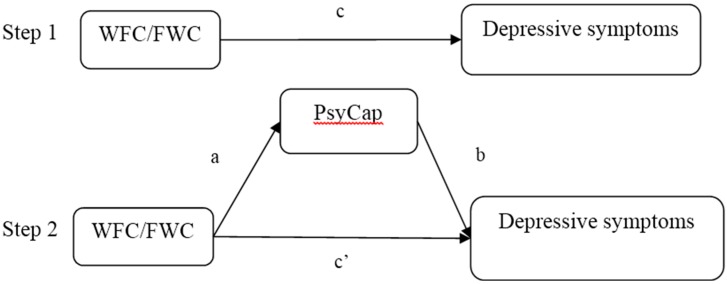
Depressive symptoms have been in the limelight for many kinds of people, but few studies have explored positive resources for combating depressive symptoms among Chinese nurses. The purpose of this study is to explore the association between work-family conflict (WFC) and depressive symptoms among Chinese female nurses, along with the mediating and moderating role of psychological capital (PsyCap) in this relationship. This cross-sectional study was completed during the period of September and October 2013. A questionnaire that consisted of the Center for Epidemiologic Studies Depression Scale, the Work-Family Conflict scale and the Psychological Capital Questionnair scale was distributed to nurses in Shenyang, China. A total of 824 individuals (effective response rate: 74.9%) participated. Asymptotic and resampling strategies explored the mediating role of PsyCap in the relationship between WFC and depressive symptoms. Hierarchical linear regression analyses were performed to explore the moderating role of PsyCap. Both WFC and family-work conflict (FWC) were positively related with depressive symptoms. PsyCap positively moderated the relationship of WFC with depressive symptoms. Self-efficacy and hope positively moderated the relationship of WFC with depressive symptoms. PsyCap partially mediated the relationship of FWC with depressive symptoms. Hope and optimism partially mediated the relationship of FWC with depressive symptoms. Work-family conflict, as the risk factor of depressive symptoms, can increase nurses’ depressive symptoms, and PsyCap is a positive resource to combat nurses’ depressive symptoms. PsyCap can aggravate the effects of WFC on depressive symptoms and FWC can impact PsyCap to increase nurses’ depressive symptoms.
Overview
The claims and statistics of this paper haven’t been checked yet.
Free: it reads the open-access text and checks the first 5 claims that cite a source we can check. Create a free account to check every claim.
Integrity signals
Registry
Cites
Statistics
Figures
Verification
Claims the paper makes
The claims and statistics of this paper haven’t been checked yet.
Free: it reads the open-access text and checks the first 5 claims that cite a source we can check. Create a free account to check every claim.
Claims other papers make about this one
Each is checked against this paper’s own text: does it say what the citing paper says it does?
The source backs part of the claim, not all of it — or backs it for a different population, condition or comparison.
In the citing paper
“Consistent with the findings of previous research [31–35], our study found that nurses experience more work-to-family conflict than family-to-work conflict, leading to a feeling of stress and guilt.”
From Factors associated with clinical nurse’s mental health: a qualitative study applying the social ecological model (2024) · cites this paper as [31]
Experimental — accuracy not yet measured
Self-check
Percentages, sums and reported differences re-computed from the paper’s own numbers.
The self-check needs the paper’s full text.
Citations
Cites
The CES-D Scale: A Self-Report Depression Scale for Research in the General Population
Radloff, L. S. (1977) · Applied Psychological Measurement · doi:10.1177/014662167700100306 · Cited by 53,267
Preacher, K. J., & Hayes, A. F. (2008) · Behavior Research Methods · doi:10.3758/brm.40.3.879 · Cited by 34,117 · cited 1×
“Asymptotic and resampling strategies were used to examine PsyCap as a potential mediator of the association between WFC and depressive symptoms [39].”
MethodApplied Multiple Regression/Correlation Analysis for the Behavioral Sciences
Cohen, P., Cohen, P., West, S. G., & Aiken, L. S. (2014) · Psychology Press eBooks · doi:10.4324/9781410606266 · Cited by 20,737
Sources of Conflict between Work and Family Roles
Greenhaus, J. H., & Beutell, N. J. (1985) · The Academy of Management Review · doi:10.2307/258214 · Cited by 6,427
Sources of Conflict Between Work and Family Roles
Greenhaus, J. H., & Beutell, N. J. (1985) · Academy of Management Review · doi:10.5465/amr.1985.4277352 · Cited by 4,788
Development and validation of work–family conflict and family–work conflict scales
Netemeyer, R. G., Boles, J. S., & McMurrian, R. (1996) · Journal of Applied Psychology · doi:10.1037/0021-9010.81.4.400 · Cited by 3,864 · cited 2×
“Work-family conflict was measured by two scales: the WFC scale and FWC scale [11].”
BackgroundMethodPsychological Capital: Developing the Human Competitive Edge
Luthans, F., Youssef, C. M., & Avolio, B. J. (2006) · Cited by 2,079
Human, Social, and Now Positive Psychological Capital Management:
LUTHANS, F., & YOUSSEF, C. M. (2004) · Organizational Dynamics · doi:10.1016/j.orgdyn.2004.01.003 · Cited by 1,786
Positive psychological capital: beyond human and social capital
Luthans, F., Luthans, K. W., & Luthans, B. C. (2004) · Business Horizons · doi:10.1016/j.bushor.2003.11.007 · Cited by 1,557
Psychological capital development: toward a micro‐intervention
Luthans, F., Avey, J. B., Avolio, B. J., Norman, S. M., & Combs, G. M. (2006) · Journal of Organizational Behavior · doi:10.1002/job.373 · Cited by 1,483
Research works printed but not linked: 7
- Tian X Yan X.H. Liu L. Exploring superiority of male nurses in nursing specialty development Chin. Nurs. Res. 2009 23 539 540 (In Chinese)
- Liu X.C. Tang M.Q. The comparison of SDS and CES-D on college students’ depressive symptoms Chin. Ment. Health J. 1995 9 19 21 (In Chinese)
- Zhou H.Y. Chang H. Liu D. Guo J.J. Correlation analysis of work-family conflict, social support and job satisfaction Chin. Nurs. Manag. 2011 11 57 60 (In Chinese)
- Chen C.R. Chen C.P. Zhao S.S. Duan G. Chen C.R. Chen C.P. Zhao S.S. Duan G.X. Survey on work-family conflict of nurses Chin. J. Nurs. 2010 45 629 630 (In Chinese)
- Zhong L.F. Effects of Psychological capital on employees’ Job performance, organizational commitment, and organizational citizenship behavior Acta. Psychol. Sin. 2007 39 328 334 (In Chinese)
- Zhang K. Zhang S. Dong Y.H. Positive psychological capital: Measurement and its association with mental health Stud. Psychol. Behav. 2010 8 58 64 (In Chinese)
- Avey J.B. Patera J.L. West B.J. Positive psychological capital: A new lens to view absenteeism JLOS 2006 13 42 60
Cited by
Items 101–102 of 102
Tumamak, K. S., & Bandiola, A. N. (2026) · International Journal of Sustainable and Integrated Studies · doi:10.65339/ijsis.v1.i1.34
欧婉齐, Cai, S., Chen, M., Guan, Q., Liang, H., Cao, Y., Wang, Y., Huang, H., & Chen, X. (2026) · Journal of Nursing Management · doi:10.1155/jonm/9914092
Metadata
- Authors
- Hao, J., Wu, D., Liu, L., Li, X., & Wu, H.
- Affiliations
- China Medical University (CN)
- Department of English, School of Basic Medicine, China Medical University, No.77 Puhe Road, Shenyang North New Area, Shenyang 110013, China
- Corresponding author
- Wu, Hui
- Venue
- International Journal of Environmental Research and Public Health
- Publisher
- MDPI AG
- Published
- 2015-06-12
- Volume
- 12
- Issue
- 6
- Pages
- 6682-6699
- ISSN
- 1660-4601 (ISSN-L)
- PMC
- PMC4483724
- OpenAlex
- W1505772971
- Cited by
- 102
- References
- 49
- Citations by year
- 2026: 4 · 2025: 9 · 2024: 7 · 2023: 15 · 2022: 20 · 2021: 15 · 2020: 9 · 2019: 4 · 2018: 6 · 2017: 8 · 2016: 5
- FWCI
- 20.96
- Type
- journal article
- Language
- en
- Open access
- gold
- doi.org
- Licence
- Locations
- International Journal of Environmental Research and Public Health (publishedVersion, cc-by)
- PubMed Central (publishedVersion, cc-by)
- PubMed (publishedVersion)
- RePEc: Research Papers in Economics (submittedVersion)
- DOAJ (DOAJ: Directory of Open Access Journals) (submittedVersion, cc-by-sa)
- Topics
- Social Sciences › Sociology and Political Science › Work-Family Balance Challenges
- Health Sciences › Medicine › Public Health, Environmental and Occupational Health › Occupational Health and Burnout
- Health Sciences › Medicine › Public Health, Environmental and Occupational Health › Workplace Health and Well-being
- Keywords
- work-family conflict, family-work conflict, depressive symptoms, psychological capital, female nurses, self-efficacy, hope, optimism, mediation, moderation, Chinese nurses
- MeSH terms
- Adult, Mental Disorders, China, Cross-Sectional Studies, Depression, Female, Humans, Male, Middle Aged, Nurses, Surveys and Questionnaires, Work Schedule Tolerance, Self Efficacy, Asian People, Family Conflict, Resilience, Psychological
About these checks
Registry, retraction, Cites and statistics results are computed, not judged, with one exception: a printed reference that no index lists is read once by a model before it counts as a citation error. Claims are extracted by a model and kept only when their quote appears verbatim in the text; each cited source is then checked, with a model’s help, for whether it says what the claim relies on. Those verdicts can be wrong — read the claim’s quote and the cited source before relying on one.
Statistics and arithmetic are recomputed, not judged.
Confidence bands are shown only for fields calibrated on our annotated test set. None is calibrated yet, so no band is shown.
What counts as a claim ›How we measure confidence ›How we check this ›
Are you an author, or do you see a problem with this page? Request a review
Data sources
Bibliographic data: Semantic Scholar, OpenAlex, Crossref.
Contains information from the Semantic Scholar Academic Graph Datasets, made available under the ODC Attribution License (ODC-BY 1.0).
Semantic Scholar’s data is described in: Kinney, R., et al. (2023). The Semantic Scholar Open Data Platform. arXiv:2301.10140.
