

In-Class Cycling to Augment College Student Academic Performance and Reduce Physical Inactivity: Results from an RCT
Open accessThe DOI matches its Crossref record; 33 of the 34 references it cites were found in a registry or an index.
Abstract
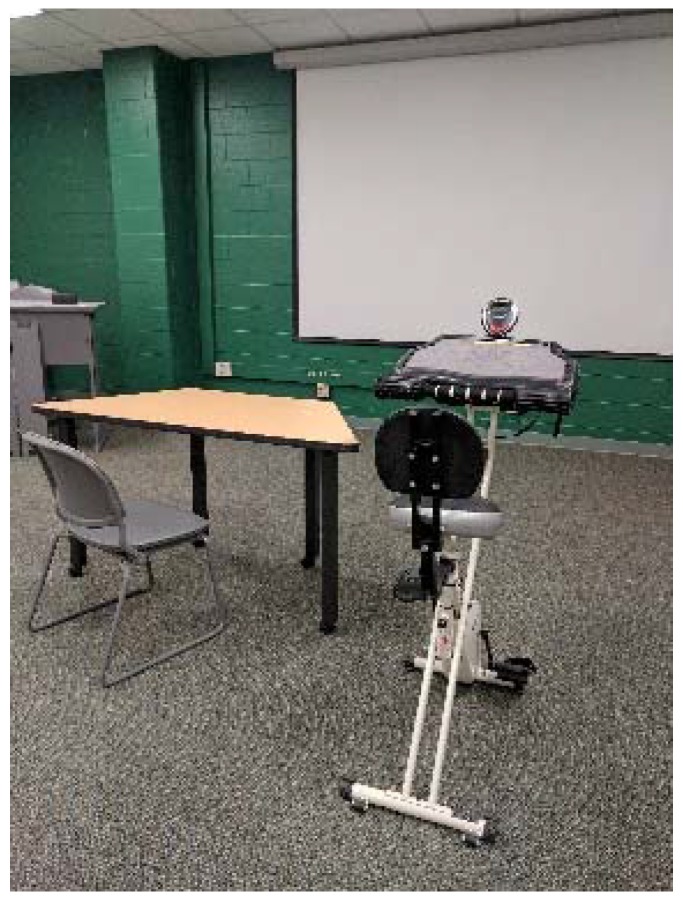
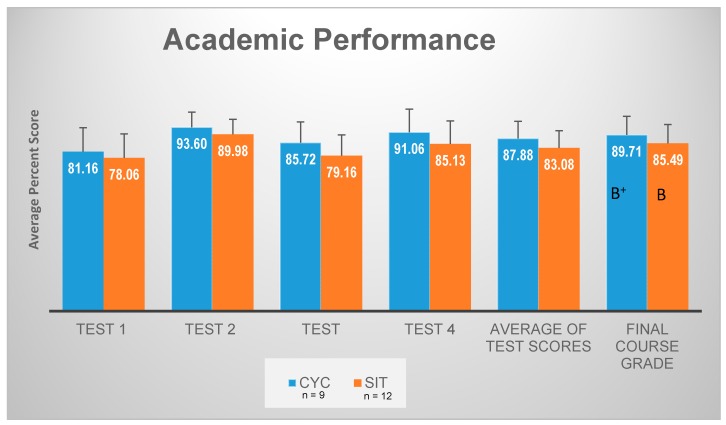
Most college students sit 14 hours per week on average, excluding sedentary study time. Researchers observing workplace and elementary school settings with active workstations to combat sedentary behavior have shown enhanced cognition without distraction. Until now, incorporating active workstations in college classroom settings remained relatively unexplored. This study’s purpose was to assess academic performance using in-class stationary cycle desks during a semester-long lecture course. Twenty-one college students (19–24 years) enrolled in a lecture course volunteered and were split into traditional sit (SIT) and stationary cycle (CYC) groups randomly, matched on a calculated factor equal to a physical activity (PA) score (0–680) multiplied by grade point average (GPA; 4.0 scale). CYC pedaled a prescribed rate of perceived exertion (RPE) of less than 2 out of 10 during a 50-min lecture, 3 × week for 12 weeks. CYC averaged 42 min, 7.9 miles, and 1.7 RPE during class throughout the semester. No significant differences (p > 0.05) were observed between CYC and SIT on in-class test scores or overall course grades. Although statistically insignificant, CYC had higher mean test scores and overall course grades vs. SIT (i.e., B+ vs. B, respectively). Low intensity cycling during a college lecture course maintained student academic performance and possibly reduced weekly sedentary behavior time.
Overview
The claims and statistics of this paper haven’t been checked yet.
Free: it reads the open-access text and checks the first 5 claims that cite a source we can check. Create a free account to check every claim.
Integrity signals
Registry
Cites
Statistics
Figures
Verification
Claims the paper makes
The claims and statistics of this paper haven’t been checked yet.
Free: it reads the open-access text and checks the first 5 claims that cite a source we can check. Create a free account to check every claim.
Claims other papers make about this one
Each is checked against this paper’s own text: does it say what the citing paper says it does?
The cited source says what the claim attributes to it.
In the citing paper
“However, most studies failed to address attrition or blinding, with only two studies providing attrition information [14, 35] and only one study implementing subject blinding [28].”
From Effect of classroom physical activity breaks on learning behaviors and academic achievements in university students: a systematic review (2026) · cites this paper as [35]
The cited source says what the claim attributes to it.
In the citing paper
“However, studies evaluating active workstations found no significant differences in academic exam scores between users of these workstations and those using traditional desks”
From Effect of classroom physical activity breaks on learning behaviors and academic achievements in university students: a systematic review (2026) · cites this paper as [35]
The cited source says what the claim attributes to it.
In the citing paper
“Six studies assessed academic performance, with four studies indicating improvements [23, 28, 30, 32] and two showing no effects [35, 38], also yielding unclear evidence (66.7%).”
From Effect of classroom physical activity breaks on learning behaviors and academic achievements in university students: a systematic review (2026) · cites this paper as [35]
The cited source says what the claim attributes to it.
In the citing paper
“suggesting that active workstations do not impair cognitive performance [30, 35].”
From Effect of classroom physical activity breaks on learning behaviors and academic achievements in university students: a systematic review (2026) · cites this paper as [35]
Self-check
Percentages, sums and reported differences re-computed from the paper’s own numbers.
The self-check needs the paper’s full text.
Citations
Cites
Biswas, A., Oh, P. I., Faulkner, G. E., Bajaj, R. R., Silver, M. A., Mitchell, M. S., & Alter, D. A. (2015) · Annals of Internal Medicine · doi:10.7326/m14-1651 · Cited by 2,726 · cited 1×
“Reduced levels of PA over a lifetime are linked with several cardiometabolic diseases, such as type 2 diabetes, cardiovascular disease, some cancers, and all-cause mortality [6,7].”
BackgroundGlobal strategy on diet, physical activity and health
Samuelson, G. (2004) · Food & Nutrition Research · doi:10.3402/fnr.v48i2.1503 · Cited by 2,319
Dvorak, J., McCrory, P., Aubry, M., Molloy, M., & Engebretsen, L. (2009) · British Journal of Sports Medicine · doi:10.1136/bjsm.2009.059360 · Cited by 907
61 Physical inactivity: the biggest public health problem of the 21st Century
(2007) · Journal of Science and Medicine in Sport · doi:10.1016/s1440-2440(07)70066-x · Cited by 735
Effects of a classroom-based program on physical activity and on-task behavior
MAHAR, M. T., MURPHY, S. K., ROWE, D. A., GOLDEN, J., SHIELDS, A. T., & RAEDEKE, T. D. (2006) · Medicine & Science in Sports & Exercise · doi:10.1249/01.mss.0000235359.16685.a3 · Cited by 674 · cited 2×
“On a college campus, Pilcher and Baker [15] compared undergraduate student test results during two different situations: taking an exam (i.e., logical reasoning section of the Law School Admissions Test-LSAT) while (1) stationary cycling versus (2) traditional stationary sitting position.”
BackgroundToo much sitting – A health hazard
Dunstan, D. W., Howard, B., Healy, G. N., & Owen, N. (2012) · Diabetes Research and Clinical Practice · doi:10.1016/j.diabres.2012.05.020 · Cited by 574 · cited 1×
“Reduced levels of PA over a lifetime are linked with several cardiometabolic diseases, such as type 2 diabetes, cardiovascular disease, some cancers, and all-cause mortality [6,7].”
BackgroundReplacing sitting time with standing or stepping: associations with cardio-metabolic risk biomarkers
Healy, G. N., Winkler, E. A. H., Owen, N., Anuradha, S., & Dunstan, D. W. (2015) · European Heart Journal · doi:10.1093/eurheartj/ehv308 · Cited by 310 · cited 1×
“replace some sedentary time, such as incorporating standing, cycling, or stepping into weekly work day schedules, cardio-metabolic risk may be attenuated [8].”
BackgroundThe interactive effect of exercise intensity and task difficulty on human cognitive processing
Kamijo, K., Nishihira, Y., Higashiura, T., & Kuroiwa, K. (2007) · International Journal of Psychophysiology · doi:10.1016/j.ijpsycho.2007.04.001 · Cited by 300 · cited 1×
“The minimal cycling RPE was intended to minimize the effect of PA intensity on cognitive control [18,19].”
BackgroundIntegration of Short Bouts of Physical Activity Into Organizational Routine
Barr-Anderson, D. J., AuYoung, M., Whitt-Glover, M. C., Glenn, B. A., & Yancey, A. K. (2011) · American Journal of Preventive Medicine · doi:10.1016/j.amepre.2010.09.033 · Cited by 211 · cited 1×
“[34] assessed the impacts of a workplace web-based intervention (Walk@WorkSpain) on self-reported sitting time, step counts and physical risk factors for chronic disease.”
BackgroundWANNARKA, R., & RUHL, K. (2008) · Support for Learning · doi:10.1111/j.1467-9604.2008.00375.x · Cited by 192
Cited by
Lynch, J., O’Donoghue, G., & Peiris, C. L. (2022) · International Journal of Environmental Research and Public Health · doi:10.3390/ijerph19137775 · Cited by 44
“Three of the PAL studies used a portable peddle machine or static cycling desk [45,51,52], two used a standing desk or sit to stand desk [58,59], and three included both cycling and standing”
BackgroundMethodInfluentialCarpenter, C. A., Byun, S., Turner‐McGrievy, G. M., & West, D. S. (2021) · International Journal of Environmental Research and Public Health · doi:10.3390/ijerph18189930 · Cited by 66
Chronic Lumbar Pain and Insomnia in College-Aged Students
Hamaoka, K., Ashizawa, R., Hida, M., Suganuma, I., & Yoshimoto, Y. (2022) · Healthcare · doi:10.3390/healthcare10040701 · Cited by 18
“Excessive time spent in a seated position has a known burden on health [49], leading to both physical and mental discomfort [50].”
BackgroundThe Effects of Bike Desks in Formal Education Classroom-Based Physical Activity: A Systematic Review
Polo-Recuero, B., Rojo-Tirado, M. Á., Ordóñez-Dios, A., Breitkreuz, D., & Lorenzo, A. (2021) · Sustainability · doi:10.3390/su13137326 · Cited by 9
“Logically, substantial differences were found between the experimental studies’ scores [46,47] and quasi-experimental studies’ scores [48–51].”
BackgroundMethodInfluentialNüesch, C., Kreppke, J.-N., Mündermann, A., & Donath, L. (2018) · International Journal of Environmental Research and Public Health · doi:10.3390/ijerph15122723 · Cited by 10
Self-citationFrodsham, K. M., Randall, N. R., Carbine, K. A., Rodeback, R. E., LeCheminant, J. D., & Larson, M. J. (2020) · PLoS ONE · doi:10.1371/journal.pone.0237348 · Cited by 12
Polo-Recuero, B., Ordóñez-Dios, A., Rojo‐Tirado, M. Á., & Calvo, A. L. (2023) · Children · doi:10.3390/children10101641 · Cited by 10
“This finding of no academic detriment agrees with earlier active desk studies [34] and bike desk interventions [35].”
Polo-Recuero, B., Moreno-Barrio, A., & Ordóñez-Dios, A. (2020) · RICYDE Revista Internacional de Ciencias del Deporte · doi:10.5232/ricyde2020.06201 · Cited by 7
Dupont, F., Oliva, F., Pitois, L., Chagnon, M., DeFátima Guimarães, R., & Mathieu, M.-E. (2025) · Journal of American College Health · doi:10.1080/07448481.2024.2427065 · Cited by 3
“29 Also, cycling desks may enhance physiological health indicators; meta-analyses report large effect sizes in the increase of energy expenditure 30,31 and some experimental studies showed improvement in cardiometabolic factors such as a 5% decrease of systolic blood pressure 32 and a 3% decrease…”
Chen, Y., Wu, J., Xu, Z., Chen, R., & Sun, Q. (2025) · Frontiers in Public Health · doi:10.3389/fpubh.2025.1570768 · Cited by 5
Schuck, L., Reisman, B. L., Walker, E. J., Wiafe, S., Wilson, S. M., & Brown, C. L. (2026) · Frontiers in Sports and Active Living · doi:10.3389/fspor.2026.1807791 · Cited by 2
Li, Z., Liu, X., Cheng, J., Yuan, Y., & Yue, M. (2023) · Advances in Computer and Engineering Technology Research · doi:10.61935/acetr.1.1.2023.p174
The impact of physical activity on academic performance in children and adolescents: a meta-analysis
Feng, Z., Zhao, Z., Chen, R., & Liu, Y. (2026) · Frontiers in Psychology · doi:10.3389/fpsyg.2026.1836195
“Regarding the performance bias, 5 studies (Donnelly et al., 2017; Solberg et al., 2021a; Ardoy et al., 2014; Joubert et al., 2017; Peternelj et al., 2009) were rated as low risk, 2 studies (Mullender-Wijnsma et al., 2016; Vetter et al., 2018) were rated as having unclear risk, and 8 studies (Lubans…”
InfluentialDeng, Q., Wu, C., & Yang, L. (2026) · International Journal of Behavioral Nutrition and Physical Activity · doi:10.1186/s12966-026-01936-7
“However, most studies failed to address attrition or blinding, with only two studies providing attrition information [14, 35] and only one study implementing subject blinding [28].”
InfluentialDoes Walking Help to Generate a Differential Diagnosis?
Kaminska, M. E., & Rikers, R. M. J. P. (2021) · Teaching and Learning in Medicine · doi:10.1080/10401334.2021.1949995
Polo-Recuero, B. (2021) · UPM Digital Archive (Technical University of Madrid) · doi:10.20868/upm.thesis.66468 · Cited by 1
Andrade-Lara, K. E., & García, R. M. (2023) · MLS Sport Research · doi:10.54716/mlssr.v3i1.2238
“De igual manera a los hallazgos de este estudio, otros autores señalaron que el ciclismo de baja intensidad durante un curso universitario mantuvo el rendimiento académico de los estudiantes y posiblemente redujo el tiempo de comportamiento sedentario semanal (Joubert et al., 2017).”
Background
Metadata
- Authors
- Joubert, L., Kilgas, M., Riley, A., Gautam, Y., Donath, L., & Drum, S.
- Affiliations
- Northern Michigan University (US)
- Michigan Technological University (US)
- German Sport University Cologne (DE)
- Corresponding author
- Joubert, Lanae
- Venue
- International Journal of Environmental Research and Public Health
- Publisher
- MDPI AG
- Published
- 2017-11-04
- Volume
- 14
- Issue
- 11
- Pages
- 1343
- ISSN
- 1660-4601 (ISSN-L)
- PMC
- PMC5707982
- OpenAlex
- W2765896889
- Semantic Scholar
- 1f335c5977365d580d5e0bf5b016cc3844f2f253
- Cited by
- 17
- References
- 34
- Citations by year
- 2026: 3 · 2025: 1 · 2024: 1 · 2023: 3 · 2022: 2 · 2021: 4 · 2020: 2 · 2018: 1
- FWCI
- 0.61
- Type
- journal article
- Language
- en
- Open access
- gold
- doi.org
- Licence
- Locations
- International Journal of Environmental Research and Public Health (publishedVersion, cc-by)
- Europe PMC (PubMed Central) (publishedVersion, cc-by)
- PubMed Central (publishedVersion, cc-by)
- PubMed (publishedVersion)
- Digital Commons - Michigan Tech (Michigan Technological University) (submittedVersion, cc-by)
- RePEc: Research Papers in Economics (submittedVersion)
- DOAJ (DOAJ: Directory of Open Access Journals) (submittedVersion)
- Funders
- Northern Michigan University
- Topics
- Health Sciences › Medicine › Public Health, Environmental and Occupational Health › Physical Activity and Health
- Social Sciences › Human Factors and Ergonomics › Ergonomics and Musculoskeletal Disorders
- Social Sciences › Transportation › Urban Transport and Accessibility
- Keywords
- stationary cycling, active workstations, sedentary behavior, university students, academic performance, physical inactivity, lecture course, test scores, grade point average
- MeSH terms
- Academic Performance, Bicycling, Cognition, Female, Humans, Male, Students, Universities, Exercise, Young Adult
About these checks
Registry, retraction, Cites and statistics results are computed, not judged, with one exception: a printed reference that no index lists is read once by a model before it counts as a citation error. Claims are extracted by a model and kept only when their quote appears verbatim in the text; each cited source is then checked, with a model’s help, for whether it says what the claim relies on. Those verdicts can be wrong — read the claim’s quote and the cited source before relying on one.
Statistics and arithmetic are recomputed, not judged.
Confidence bands are shown only for fields calibrated on our annotated test set. None is calibrated yet, so no band is shown.
What counts as a claim ›How we measure confidence ›How we check this ›
Are you an author, or do you see a problem with this page? Request a review
Data sources
Bibliographic data: Semantic Scholar, OpenAlex, Crossref.
Contains information from the Semantic Scholar Academic Graph Datasets, made available under the ODC Attribution License (ODC-BY 1.0).
Semantic Scholar’s data is described in: Kinney, R., et al. (2023). The Semantic Scholar Open Data Platform. arXiv:2301.10140.
