

The Effect of a Leisure Time Physical Activity Intervention Delivered via a Workplace: 15-Month Follow-Up Study
Open accessThe DOI matches its Crossref record; 39 of the 39 references it cites were found in a registry or an index.
Abstract
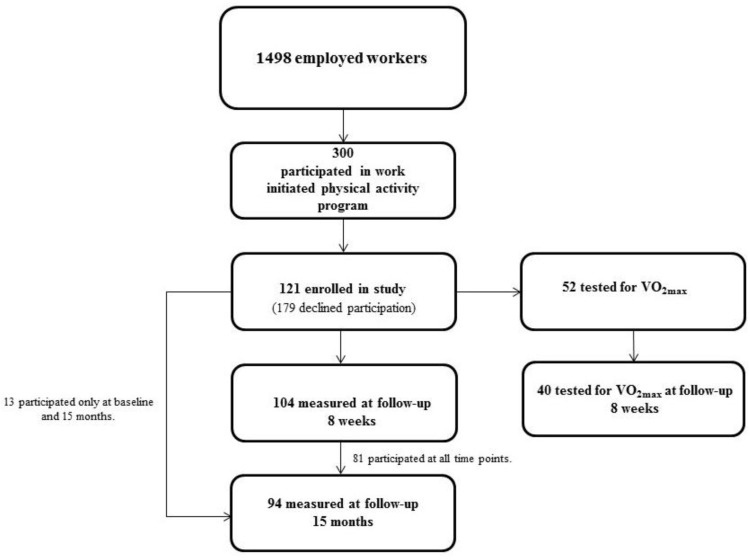
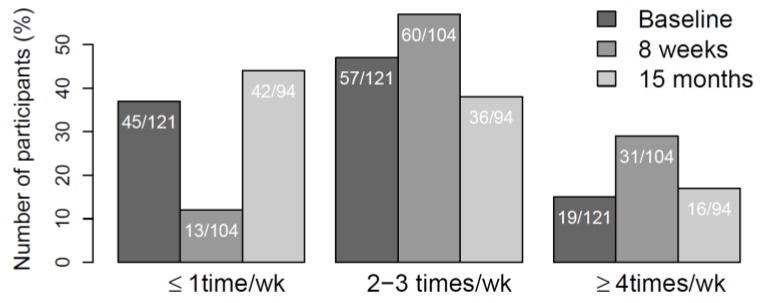
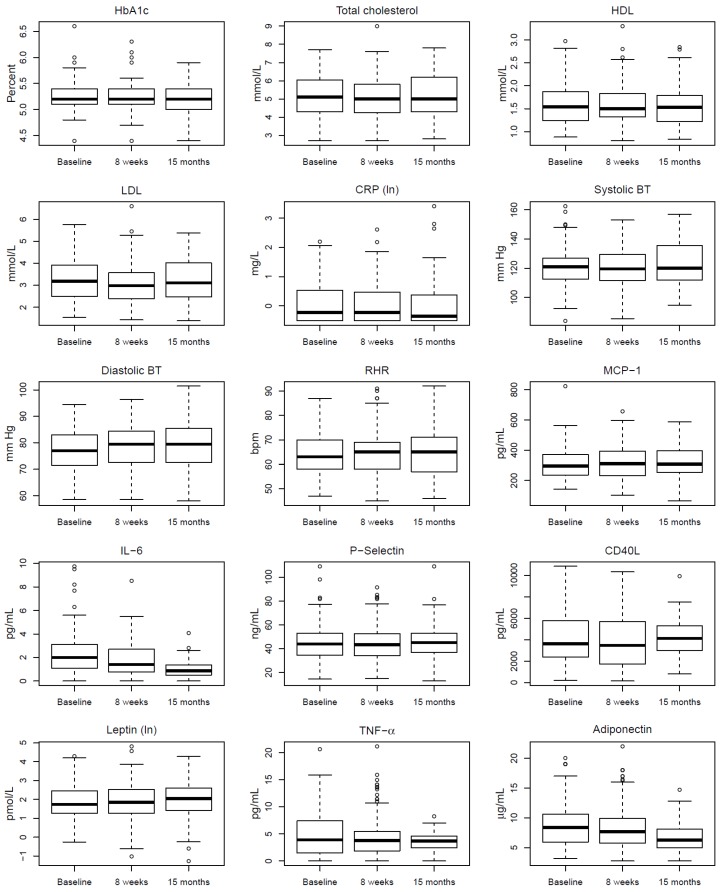
In line with recommendations from both the World Health Organization and the European Union some employers encourage workplace health promotion through physical activity (PA) facilities and leisure time PA-initiatives. The current study describes a 15-month follow-up after an 8-week workplace delivered PA-initiative, investigates if improvements in cardiovascular risk status are sustainable, and elucidates differences according to educational level. One hundred and twenty one employees (43 women) were examined before and after the 8-week PA-initiative and 94 at the 15-month follow-up. PA-levels, blood pressure, resting heart rate, lipids, glycosylated hemoglobin (HbA1c), C-reactive protein (CRP), and selected markers of inflammation were registered at baseline, immediately after the 8-week PA-initiative, and 15 months after baseline. At the end of follow-up (15-month), PA-levels—increased during the 8-week intervention—had returned to baseline values. None of the five improvements in cardiovascular markers (total cholesterol, low density lipoprotein (LDL), P-selectin, CD40Ligand (CD40L) and Monocyte chemoattractant protein-1 (MCP-1)) seen at the 8-week follow-up were sustained. At the 15-month follow-up as compared to baseline HbA1c, CRP (log) and interleukin-6 (IL-6) were reduced by 0.06 mmol/L (95% CI −0.11,−0.01), 0.25 mg/L (95% CI −0.46,−0.04) and 0.39 pg/mL (95% CI −0.75, −0.04), respectively. At baseline, there were differences in cardiovascular risk factors comparing men with low versus high levels of education. No differences in changes in outcomes between these groups of men were found during follow-up. In this study highly educated men generally have lower levels of cardiovascular risk factors, but the effect of PA on such markers in this group do not differ from the effects seen in less educated men.
Overview
The claims and statistics of this paper haven’t been checked yet.
Free: it reads the open-access text and checks the first 5 claims that cite a source we can check. Create a free account to check every claim.
Integrity signals
Registry
Cites
Statistics
Figures
Verification
Claims the paper makes
The claims and statistics of this paper haven’t been checked yet.
Free: it reads the open-access text and checks the first 5 claims that cite a source we can check. Create a free account to check every claim.
Claims other papers make about this one
Each is checked against this paper’s own text: does it say what the citing paper says it does?
The source backs part of the claim, not all of it — or backs it for a different population, condition or comparison.
In the citing paper
“These studies are heterogeneous regarding duration, physical activity intervention, degree of supervision, and study population.”
From Healthy weight loss maintenance with exercise, GLP-1 receptor agonist, or both combined followed by one year without treatment: a post-treatment analysis of a randomised placebo-controlled trial (2024) · cites this paper as [22]
Experimental — accuracy not yet measuredThe cited source says what the claim attributes to it.
In the citing paper
“Most, but not all, studies on physical activity treatment programs have reported small, sustained increases in physical activity levels after termination of the supervised program.20, 21, 22, 23, 24”
Self-check
Percentages, sums and reported differences re-computed from the paper’s own numbers.
The self-check needs the paper’s full text.
Citations
Cites
Ryan, R. M., & Deci, E. L. (2000) · American Psychologist · doi:10.1037//0003-066x.55.1.68 · Cited by 54,599 · cited 1×
“Based on the self-determination theory which may be favorably applied to health contexts [24,25], and believing that behavioral changes occur through group dynamic processes, the enterprise management organized an 8-week activity intervention, running from September to November 2014.”
MethodCoussens, L. M., & Werb, Z. (2002) · Nature · doi:10.1038/nature01322 · Cited by 15,111
European Guidelines on cardiovascular disease prevention in clinical practice (version 2012)
Authors/Task Force Members:, Perk, J., De Backer, G., Gohlke, H., Graham, I., Reiner, Ž., Verschuren, M., Albus, C., Benlian, P., Boysen, G., et al. (2012) · European Heart Journal · doi:10.1093/eurheartj/ehs092 · Cited by 8,490
Inflammation and Atherosclerosis
Libby, P., Ridker, P. M., & Maseri, A. (2002) · Circulation · doi:10.1161/hc0902.104353 · Cited by 7,724
Moral Identity and Developmental Theory
Lapsley, D. (2015) · Human Development · doi:10.1159/000435926 · Cited by 3,819
Authors/Task Force Members, Graham, I., Atar, D., Borch-Johnsen, K., Boysen, G., Burell, G., Cifkova, R., Dallongeville, J., De Backer, G., Ebrahim, S., et al. (2007) · European Heart Journal · doi:10.1093/eurheartj/ehm316 · Cited by 3,753
Physical Activity, All-Cause Mortality, and Longevity of College Alumni
Paffenbarger, R. S., Hyde, R., Wing, A. L., & Hsieh, C.-C. (1986) · New England Journal of Medicine · doi:10.1056/nejm198603063141003 · Cited by 2,742
The Prognostic Value of C-Reactive Protein and Serum Amyloid A Protein in Severe Unstable Angina
Liuzzo, G., Biasucci, L. M., Gallimore, J. R., Grillo, R. L., Rebuzzi, A. G., Pepys, M. B., & Maseri, A. (1994) · New England Journal of Medicine · doi:10.1056/nejm199408183310701 · Cited by 2,357 · cited 1×
“A reduction of CRP and IL-6 by PA is also beneficial since there is an increased vascular risk with high levels of these biomarkers [32,33] and even some cancers [34].”
BackgroundSelf-Determination Theory Applied to Health Contexts: A Meta-Analysis
Ng, J. Y. Y., Ntoumanis, N., Thøgersen-Ntoumani, C., Deci, E. L., Ryan, R. M., Duda, J. L., & Williams, G. C. (2012) · Perspectives on Psychological Science · doi:10.1177/1745691612447309 · Cited by 1,959
CORONARY HEART-DISEASE AND PHYSICAL ACTIVITY OF WORK
Morris, J. N., Heady, J. A., Raffle, P. A. B., Roberts, C. G., & Parks, J. W. (1953) · The Lancet · doi:10.1016/s0140-6736(53)90665-5 · Cited by 1,698
Cited by
Jensen, S. B. K., Blond, M. B., Sandsdal, R. M., Olsen, L. M., Juhl, C. R., Lundgren, J. R., Janus, C., Stallknecht, B. M., Holst, J. J., Madsbad, S., et al. (2024) · eClinicalMedicine · doi:10.1016/j.eclinm.2024.102475 · Cited by 207
Strain, T., Wijndaele, K., Sharp, S. J., Dempsey, P. C., Wareham, N., & Brage, S. (2020) · International Journal of Epidemiology · doi:10.1093/ije/dyz212 · Cited by 120
“showed, some health benefits of physical activity may not persist if levels are not maintained: after an 8 week physical activity intervention, both physical activity levels and various biomarkers of CVD risk returned to baseline levels 15 months later.(20) Therefore, one should expect some attenuation as follow-up ti…”
BackgroundLunde, L.-K., Skare, Ø., Mamen, A., Sirnes, P. A., Aass, H. C. D., Øvstebø, R., Goffeng, E. M., Matre, D., Nielsen, P., Heglum, H. S. A., et al. (2020) · International Journal of Environmental Research and Public Health · doi:10.3390/ijerph17020589 · Cited by 66
Self-citationKaltenegger, H. C., Becker, L., Rohleder, N., Nowak, D., & Weigl, M. (2021) · Scandinavian Journal of Work Environment & Health · doi:10.5271/sjweh.3982 · Cited by 31
“Two uncontrolled NRSI were identified: a leisure time physi - cal activity program in a road maintenance company initiated by the employer (79) and a promotional cam - paign for stair use in a hospital (77).”
InfluentialScapellato, M. L., Comiati, V., Buja, A., Buttignol, G., Valentini, R., Burati, V., Serra, L. L., Maccà, I., Mason, P., Scopa, P., et al. (2018) · International Journal of Environmental Research and Public Health · doi:10.3390/ijerph15092053 · Cited by 30
Occupational physical activity: the good, the bad, and the proinflammatory
Jordakieva, G., Hasenoehrl, T., Steiner, M. M., Jensen‐Jarolim, E., & Crevenna, R. (2023) · Frontiers in Medicine · doi:10.3389/fmed.2023.1253951 · Cited by 24
Working conditions and technostress in the workplace
Kaltenegger, H. C. (2024) · doi:10.5282/edoc.34303 · Cited by 4
Role of physical activity in GLP-1 receptor agonist therapy for obesity treatment
Zdziebkowski, Ł., Wilska, H., Szatkowska, D., Ziętara, D., Kmieć, K. K., Topolska, A., Komorowski, M., Janiszewski, M., Surosz, N., Grochowalski, M., et al. (2025) · Quality in Sport · doi:10.12775/qs.2025.43.62342 · Cited by 2
“Participants who completed a one-year long intervention involving regular physical exercise remained more active on their own at one-year follow-up after the intervention [29].”
Malkin, J. D., Alqunaibet, A., Albreht, T., Finkelstein, E. A., Rakić, S., & El-Saharty, S. (2021) · World Bank, Washington, DC eBooks · doi:10.1596/978-1-4648-1717-5_ch7 · Cited by 1
Barene, S., Krustrup, P., Litleskare, S., & Holtermann, A. (2025) · European Journal of Sport Science · doi:10.1002/ejsc.12330
“However, a previous 15‐month follow‐up of an 8‐week physical activity intervention delivered in the workplace also found that the improvements seen in total cholesterol at 8‐week follow‐up were not maintained at 15‐month follow‐up (Skogstad et al. 2018).”
Santner, S. (2021) · Hochschule für öffentliche Verwaltung und Finanzen Ludwigsburg Bibliothek (University of Applied Sciences)
Utilizing a Digital Application in Promoting Employee Health and Work Ability: Case Study
Mäkitalo, H. (2019) · UEF eRepo (University of Eastern Finland)
Effet d'un programme d'activité physique en entreprise auprès de salariés du secteur tertiaire
Genin, P. M. (2018) · theses.fr (ABES) · doi:10.70675/d83849bfze19ez414dzbb7dz166a0ab868a0
Metadata
- Authors
- Skogstad, M., Lunde, L.-K., Ulvestad, B., Aass, H., Clemm, T., Mamen, A., & Skare, Ø.
- Affiliations
- National Institute of Occupational Health (NO)
- Oslo University Hospital (NO)
- Occupational Health Service Department, Mesta AS, Fanaveien 221 C, 5239 Rådal, Norway
- Høyskolen Kristiania (NO)
- Corresponding author
- Skogstad, Marit
- ORCID
- Venue
- International Journal of Environmental Research and Public Health
- Publisher
- MDPI AG
- Published
- 2018-02-04
- Volume
- 15
- Issue
- 2
- Pages
- 264
- ISSN
- 1660-4601 (ISSN-L)
- PMC
- PMC5858333
- OpenAlex
- W2791110436
- Cited by
- 9
- References
- 39
- Citations by year
- 2025: 1 · 2024: 1 · 2023: 1 · 2021: 2 · 2020: 1 · 2019: 1 · 2018: 2
- FWCI
- 1.03
- Type
- journal article
- Language
- en
- Open access
- gold
- doi.org
- Licence
- Locations
- International Journal of Environmental Research and Public Health (publishedVersion, cc-by)
- Europe PMC (PubMed Central) (publishedVersion, cc-by)
- PubMed Central (publishedVersion, cc-by)
- PubMed (publishedVersion)
- RePEc: Research Papers in Economics (submittedVersion)
- DOAJ (DOAJ: Directory of Open Access Journals) (submittedVersion)
- NORA - Norwegian Open Research Archives (submittedVersion, cc-by-sa)
- NORA - Norwegian Open Research Archives (submittedVersion, other-oa)
- Topics
- Health Sciences › Medicine › Public Health, Environmental and Occupational Health › Physical Activity and Health
- Health Sciences › Medicine › Public Health, Environmental and Occupational Health › Workplace Health and Well-being
- Health Sciences › Medicine › Physiology (medical) › Cardiovascular and exercise physiology
- Keywords
- leisure-time physical activity, workplace health promotion, cardiovascular risk factors, intervention sustainability, educational attainment, blood pressure, lipids, HbA1c, C-reactive protein, inflammatory markers, interleukin-6, P-selectin, CD40 ligand, MCP-1
- MeSH terms
- Adult, Blood Pressure, C-Reactive Protein, Female, Follow-Up Studies, Health Promotion, Glycated Hemoglobin, Humans, Inflammation, Leisure Activities, Lipids, Male, Middle Aged, Motor Activity, Norway, Biomarkers, Exercise, Occupational Health, Workplace
About these checks
Registry, retraction, Cites and statistics results are computed, not judged, with one exception: a printed reference that no index lists is read once by a model before it counts as a citation error. Claims are extracted by a model and kept only when their quote appears verbatim in the text; each cited source is then checked, with a model’s help, for whether it says what the claim relies on. Those verdicts can be wrong — read the claim’s quote and the cited source before relying on one.
Statistics and arithmetic are recomputed, not judged.
Confidence bands are shown only for fields calibrated on our annotated test set. None is calibrated yet, so no band is shown.
What counts as a claim ›How we measure confidence ›How we check this ›
Are you an author, or do you see a problem with this page? Request a review
Data sources
Bibliographic data: Semantic Scholar, OpenAlex, Crossref.
Contains information from the Semantic Scholar Academic Graph Datasets, made available under the ODC Attribution License (ODC-BY 1.0).
Semantic Scholar’s data is described in: Kinney, R., et al. (2023). The Semantic Scholar Open Data Platform. arXiv:2301.10140.
