

Changes in Psychological and Cognitive Outcomes after Green versus Suburban Walking: A Pilot Crossover Study
Open accessThe DOI matches its Crossref record; 57 of the 60 references it cites were found in a registry or an index.
Abstract
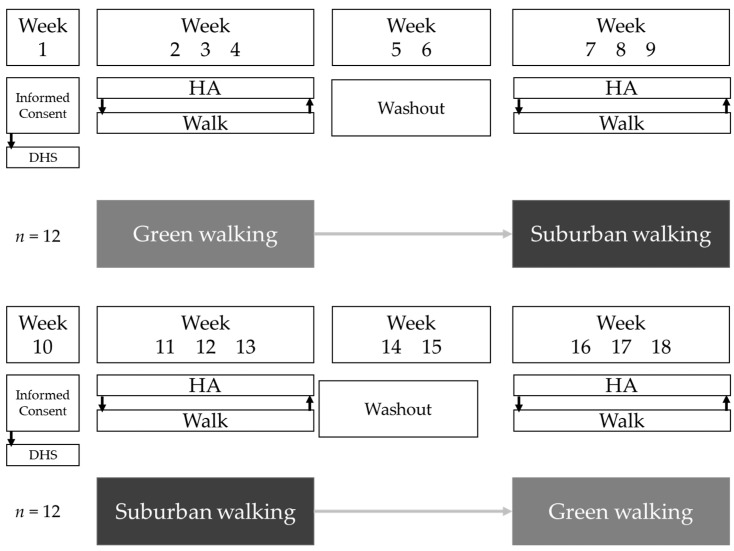
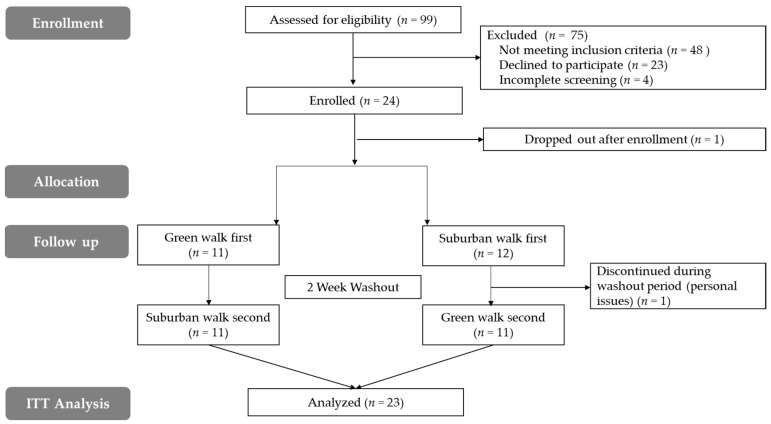
This study investigated the acute effects of repeated walking sessions within green and suburban environments on participants’ psychological (anxiety and mood) and cognitive (directed-attention) outcomes. Twenty-three middle-aged adults (19 female) participated in a non-randomized crossover study comprised of once-weekly 50-min moderate-intensity walking sessions. Participants walked for three weeks in each of two treatment conditions: green and suburban, separated by a two-week washout period. Eleven participants completed green walking first and 12 suburban walking first. For each walk, we used validated psychological questionnaires to measure pre- and post-walk scores for: (1) mood, evaluated via the Positive and Negative Affect Schedule (PANAS); (2) anxiety, assessed by the State-Trait Anxiety Inventory (STAI-S); and (3) directed-attention, measured using the visual Backwards Digit Span test (BDS). Repeated measures linear mixed models assessed pre- to post-walk changes within-treatment conditions and post-walk contrasts between-treatment conditions. Results indicated that anxiety decreased after green walking and increased after suburban walking (−1.8 vs. +1.1 units, respectively; p = 0.001). For mood, positive affect improved after green walking and decreased after suburban walking (+2.3 vs. −0.3 units, respectively; p = 0.004), and negative affect decreased after green walking and remained similar after suburban walking (−0.5 vs. 0 units, respectively; p = 0.06). Directed-attention did not improve from pre- to post-walk for either condition. Our results suggested that green walking may be more effective at reducing state anxiety and increasing positive affect compared to suburban walking.
Overview
The claims and statistics of this paper haven’t been checked yet.
Free: it reads the open-access text and checks the first 5 claims that cite a source we can check. Create a free account to check every claim.
Integrity signals
Registry
Cites
Statistics
Figures
Verification
Claims the paper makes
The claims and statistics of this paper haven’t been checked yet.
Free: it reads the open-access text and checks the first 5 claims that cite a source we can check. Create a free account to check every claim.
Claims other papers make about this one
Each is checked against this paper’s own text: does it say what the citing paper says it does?
The cited source doesn’t support the claim as written.
In the citing paper
“One final limitation that should be noted is that the wording for one of the response scale for the STAI was inadvertently changed from “Almost Never, Sometimes, Often, and Almost Always” to “Not at all, Somewhat, Moderately So, and Frequently So” [59,63,64].”
From Walking Green: Developing an Evidence Base for Nature Prescriptions (2019) · cites this paper as [59]
Checked by a reasoning model — may be wrong.
Experimental — accuracy not yet measuredThe source backs part of the claim, not all of it — or backs it for a different population, condition or comparison.
In the citing paper
“The fact that both the forest and roadside walks started from the same location, the parking lot of the Forest Preserve, and the fact that the roadside walk took place on a suburban roadside, may also explain why the differences between the psychological outcomes for roadside and forest walk were attenuated as compared to other studies [46,47,48,59].”
From Walking Green: Developing an Evidence Base for Nature Prescriptions (2019) · cites this paper as [59]
Experimental — accuracy not yet measuredThe source backs part of the claim, not all of it — or backs it for a different population, condition or comparison.
In the citing paper
“We also expand on those findings by showing that forest walks also led to reduced state-anxiety and perceived stress, which is consistent with other studies [59,90,91].”
From Walking Green: Developing an Evidence Base for Nature Prescriptions (2019) · cites this paper as [59]
Experimental — accuracy not yet measuredThe cited source says what the claim attributes to it.
In the citing paper
“Other studies have also failed to see improvements in working memory in response to green exercise [59,92,93,94].”
From Walking Green: Developing an Evidence Base for Nature Prescriptions (2019) · cites this paper as [59]
Self-check
Percentages, sums and reported differences re-computed from the paper’s own numbers.
The self-check needs the paper’s full text.
Citations
Cites
Development and validation of brief measures of positive and negative affect: The PANAS scales.
Watson, D., Clark, L. A., & Tellegen, A. (1988) · Journal of Personality and Social Psychology · doi:10.1037/0022-3514.54.6.1063 · Cited by 32,433 · cited 5×
“HA refers to th assessment of psychological (State-Trait Anxiety Inventory (STAI-S) and Positive and Negative Affe t Schedule (PANAS)) and cognitive outcomes (Backwards Digit Span t st, f t ee l 50- i al i sessi l t it i t ree a s b rban settings.”
BackgroundMethodInfluentialCONSORT 2010 Statement: updated guidelines for reporting parallel group randomised trials
the CONSORT Group, Schulz, K. F., Altman, D. G., & Moher, D. (2010) · BMC Medicine · doi:10.1186/1741-7015-8-18 · Cited by 13,371
Cook, R. J., Dickens, B. M., & Fathalla, M. F. (2003) · Reproductive Health and Human Rights · doi:10.1093/acprof:oso/9780199241323.003.0025 · Cited by 10,769
The Physical Activity Guidelines for Americans
Piercy, K. L., Troiano, R. P., Ballard, R. M., Carlson, S. A., Fulton, J. E., Galuska, D. A., George, S. M., & Olson, R. D. (2018) · JAMA · doi:10.1001/jama.2018.14854 · Cited by 9,755
The restorative benefits of nature: toward an integrative framework
Kaplan, S. (1995) · Journal of Environmental Psychology · doi:10.1016/0272-4944(95)90001-2 · Cited by 6,923 · cited 1×
“, work demands, family responsibilities) [27,28].”
Stress recovery during exposure to natural and urban environments
Ulrich, R. S., Simons, R. F., Losito, B. D., Fiorito, E., Miles, M. A., & Zelson, M. (1991) · Journal of Environmental Psychology · doi:10.1016/s0272-4944(05)80184-7 · Cited by 5,990 · cited 1×
“Additionally, the Stress Recovery Theory posits that exposure to restorative environments produces a more relaxed and positive emotional state thus fostering recovery from stress [29].”
BackgroundSample size of 12 per group rule of thumb for a pilot study
Julious, S. A. (2005) · Pharmaceutical Statistics · doi:10.1002/pst.185 · Cited by 3,068 · cited 1×
“Therefore, a total analytical sample size of 23 was considered adequate as suggested in previous literature [45].”
MethodA Standardized Memory Scale for Clinical Use
Wechsler, D. (1945) · The Journal of Psychology · doi:10.1080/00223980.1945.9917223 · Cited by 2,919 · cited 8×
“Analyses of the visual BDS scores were adjusted for participants’ baseline visual BDS score to control for the influence of any learned effect from the repeated administration of the visual BDS task.”
MethodInfluentialPenedo, F. J., & Dahn, J. R. (2005) · Current Opinion in Psychiatry · doi:10.1097/00001504-200503000-00013 · Cited by 2,851 · cited 2×
“Literature indicates that regular PA participation is positively correlated with improvements in overall mental health, wellbeing, and mood, in addition to reductions in depression, anxiety, and stress symptomology [1,3,4].”
Background
Research works printed but not linked: 2
- Hug S.M. Hansmann R. Monn C. Krütli P. Seeland K. Restorative effects of physical activity in forests and indoor settings Int. J. Fit. 2008 4 25 37
- Spielberger C.D. Gorsuch R.L. Lushene R. Vagg P.R. Jacobs G.A. Manual for State-Trait Anxiety Inventory: STAI (Form Y) Consulting Psychologists Press Palo Alto, CA, USA 1983
Cited by
Nature-based outdoor activities for mental and physical health: Systematic review and meta-analysis
Coventry, P. A., Brown, J. E., Pervin, J., Brabyn, S., Pateman, R., Breedvelt, J., Gilbody, S., Stancliffe, R., McEachan, R., & White, P. L. (2021) · SSM - Population Health · doi:10.1016/j.ssmph.2021.100934 · Cited by 453
“…al., 2011; Vujcic et al., 2017); eighteen studies (19 papers) were controlled studies (Bang et al., 2017; Barton et al., 2010; Berman et al., 2012; de Brito et al., 2019; Gerber et al., 2017; Hawkins et al., 2015; Holt et al., 2019; Johansson et al., 2011; Lanki et al., 2017; Lee et al., 2011,…”
BackgroundMethodWicks, C., Barton, J., Orbell, S., & Andrews, L. (2022) · Applied Psychology: Health and Well-Being · doi:10.1111/aphw.12353 · Cited by 210
How do different types and characteristics of green space impact mental health? A scoping review
Beute, F., Marselle, M. R., Olszewska-Guizzo, A., Andreucci, M. B., Lammel, A., Davies, Z. G., Glanville, J., Keune, H., O’Brien, L., Remmen, R., et al. (2023) · People and Nature · doi:10.1002/pan3.10529 · Cited by 182
The effects of forest bathing on psychological well‐being: A systematic review and meta‐analysis
Siah, C. J. R., Goh, Y. S., Lee, J., Poon, S. N., Yong, J. Q. Y. O., & Tam, W. W. (2023) · International Journal of Mental Health Nursing · doi:10.1111/inm.13131 · Cited by 150
Ma, J., Lin, P., & Williams, J. M. (2023) · Current Psychology · doi:10.1007/s12144-023-05112-z · Cited by 108
“Two studies employed multiple walking sessions, namely, 30-minutes sessions for five consecu - tive days (Keenan et al., 2021), and once-weekly sessions for three weeks (de Brito et al., 2019).”
InfluentialWalking Green: Developing an Evidence Base for Nature Prescriptions
Koselka, E. P. D., Weidner, L. C., Minasov, A., Berman, M. G., Leonard, W. R., Santoso, M. V., de Brito, J. N., Pope, Z. C., Pereira, M. A., & Horton, T. H. (2019) · International Journal of Environmental Research and Public Health · doi:10.3390/ijerph16224338 · Cited by 89
Self-citationYen, H., Chiu, H., & Huang, H.-Y. (2021) · Landscape and Urban Planning · doi:10.1016/j.landurbplan.2021.104093 · Cited by 93
Silva, A. L., de Matos, M. A. V., & Gonçalves, M. (2023) · Journal of Environmental Planning and Management · doi:10.1080/09640568.2023.2227761 · Cited by 91
Yao, W., Chen, F., Wang, S., & Zhang, X. (2021) · Frontiers in Public Health · doi:10.3389/fpubh.2021.758457 · Cited by 76
Woo, M. K., MacNaughton, P., Lee, J., Tinianov, B. D., Satish, U., & Boubekri, M. (2021) · Frontiers in Sustainable Cities · doi:10.3389/frsc.2021.690055 · Cited by 49
“…wellness programs such as a weeklong yoga intervention, meditation exercises, walking in nature and mindfulness courses to impact positive affect on the order of 1–4 points using the same PANAS scale (Narasimham et al., 2011; Howells et al., 2014; de Brito et al., 2019; Beacham et al., 2020).”
MethodDaytime dynamic of spontaneous expressions of pedestrians in an urban forest park
Wei, H., Hauer, R. J., & Guo, S. (2021) · Urban forestry & urban greening · doi:10.1016/j.ufug.2021.127326 · Cited by 47
Saenen, N. D., Nawrot, T. S., Hautekiet, P., Wang, C., Roels, H. A., Dadvand, P., Plusquin, M., & Bijnens, E. M. (2023) · Environmental Health · doi:10.1186/s12940-023-00982-z · Cited by 42
“However, other studies found no performance improvement on the Digit Span Test after walking in nature compared to walking in urban environments [49, 50].”
ResultCurrent methodologies of greenspace exposure and mental health research—a scoping review
Freymüller, J., Schmid, H., Senkler, B., Lumbi, S. L., Zerbe, S., Hornberg, C., & McCall, T. (2024) · Frontiers in Public Health · doi:10.3389/fpubh.2024.1360134 · Cited by 40
A systematic review of the anxiety-alleviation benefits of exposure to the natural environment
Zhang, X., Zhang, Y., Yun, J., & Yao, W. (2022) · Reviews on Environmental Health · doi:10.1515/reveh-2021-0157 · Cited by 41
Saadi, D., Schnell, I., Tirosh, E., Basagaña, X., & Agay‐Shay, K. (2020) · Environmental Research · doi:10.1016/j.envres.2020.109687 · Cited by 39
How Does Nature Exposure Affect Adults With Symptoms of Mental Illness? A Meta‐Analysis
Bettmann, J. E., Speelman, E. A., Blumenthal, E., Couch, S., & McArthur, T. (2024) · International Journal of Mental Health Nursing · doi:10.1111/inm.13400 · Cited by 31
Pearson, A. L., Pfeiffer, K. A., Gardiner, J. C., Horton, T. H., Buxton, R. T., Hunter, R. F., Breeze, V., & McDade, T. W. (2020) · BMC Public Health · doi:10.1186/s12889-020-08716-3 · Cited by 37
“Parks serve as places to engage in PA in direct contact with nature — called ‘green PA’ — which has been shown to lower anxiety [28] and perceived stress [29, 30] over and above the effects of indoor PA [23] or outdoor PA without greenery [31].”
BackgroundSelf-citationBell, C. N., George, R. S., Honan, C. A., Bell, L. J., Jolly, A. T. W., & Matthews, A. J. (2025) · Journal of Environmental Psychology · doi:10.1016/j.jenvp.2025.102632 · Cited by 32
Affective Outcomes of Group versus Lone Green Exercise Participation
Rogerson, M., Colbeck, I., Bragg, R., Dosumu, A. A., & Griffin, M. (2020) · International Journal of Environmental Research and Public Health · doi:10.3390/ijerph17020624 · Cited by 23
Veitch, J., Timperio, A. F., Salmon, J., Hall, S. J., Abbott, G., Flowers, E. P., & Turner, A. I. (2022) · Urban forestry & urban greening · doi:10.1016/j.ufug.2022.127660 · Cited by 21
Passive nature exposure positively predicts prosocial behavior by alleviating perceived crowdedness
Liu, J., Sun, X., Chen, H., & Yang, Z. (2023) · Journal of Environmental Psychology · doi:10.1016/j.jenvp.2023.102146 · Cited by 19
Paraskevopoulou, A. T., Chletsou, M., & Malesios, C. (2022) · Sustainability · doi:10.3390/su142316280 · Cited by 17
LoTemplio, S. B., Bettmann, J. E., Scott, E. E., & Blumenthal, E. (2023) · Current Environmental Health Reports · doi:10.1007/s40572-023-00407-6 · Cited by 16
Flowers, E. P., Turner, A. I., Abbott, G., Timperio, A. F., Salmon, J., & Veitch, J. (2022) · Urban forestry & urban greening · doi:10.1016/j.ufug.2022.127587 · Cited by 17
Firnhaber, M., Varol, T., Gugushvili, N., Kwaśnicka, D., Kleuters, P., Keller, J., Massar, K., de Visser, I., & ten Hoor, G. A. (2025) · Current Research in Ecological and Social Psychology · doi:10.1016/j.cresp.2025.100244 · Cited by 14
Vanhöfen, J., Stuck, K., Haag, R., Härtel, T., & Randler, C. (2025) · Landscape and Urban Planning · doi:10.1016/j.landurbplan.2025.105456 · Cited by 13
Cognitive-Emotional Benefits of Weekly Exposure to Nature: A Taiwanese Study on Young Adults
Yeung, Y.-Y., & Yu, C.-P. (2022) · Sustainability · doi:10.3390/su14137828 · Cited by 12
Glover, S., Cleland, C., Trott, M., & Hunter, R. F. (2024) · Environmental Research Health · doi:10.1088/2752-5309/ad44cc · Cited by 17
“UGBSs were described as improving mental health and feelings of well-being in multiple studies [41, 45, 50–52, 57–59, 67, 69, 70].”
BackgroundInfluentialDietrich, K. M., & Bidart, M. G. (2021) · OBM Integrative and Complementary Medicine · doi:10.21926/obm.icm.2104046 · Cited by 9
“The most common type of green exercise study compares walking in natural versus urban environments [38, 39].”
BackgroundSchnell, I., Hijazi, B., Saadi, D., & Tirosh, E. (2022) · International Journal of Environmental Research and Public Health · doi:10.3390/ijerph19138190 · Cited by 7
Bell, C. N., George, R. J. S., Honan, C. A., & Matthews, A. J. (2026) · Journal of Cognitive Neuroscience · doi:10.1162/jocn.a.2416 · Cited by 6
Tu, R., Xiao, Y., Huang, J., Zhou, J., Yin, S., & Song, S. (2025) · Journal of Transport & Health · doi:10.1016/j.jth.2025.102246 · Cited by 5
Effects of green exercise on mental health: a systematic review and meta-analysis
Liu, X., Sun, Z., Wang, X. Y., Dong, D., & Samsudin, S. (2026) · Frontiers in Psychology · doi:10.3389/fpsyg.2026.1802759 · Cited by 5
Carter, E., Douglas, C. C., & Saxton, J. (2025) · Health Psychology Review · doi:10.1080/17437199.2025.2597312 · Cited by 5
“…interventions with a duration of 20–120 min significantly improved measures of general wellbeing (Brown et al., 2014; Krieger et al., 2009), anxiety (de Brito et al., 2019; Thompson, 2014), stress (Bang et al., 2017; Thompson, 2014), positive and negative affect (Marselle et al., 2016),…”
InfluentialBaena‐Morales, S., Oria, H. M., Ramos-Pérez, D., & González-Férnandez, F. T. (2020) · Summer Conferences of Sports Science · doi:10.14198/jhse.2020.15.proc4.09 · Cited by 3
“However, the effect of a physical exercise intervention in natural environments does not always offer an improvement in DST performance compared to artificial environments (Bodin & Hartig, 2003; Bratman et al., 2015; de Brito et al., 2019).”
BackgroundSudimac, S., Drewelies, J., de Weerth, C., & Kühn, S. (2026) · Environmental Research · doi:10.1016/j.envres.2026.125125 · Cited by 2
The therapeutic effects of urban walks on healthcare workers: green vs. barren settings
Saeidi-Rizi, F., Chang, C., & SULLIVAN, W. C. (2025) · Landscape and Ecological Engineering · doi:10.1007/s11355-025-00668-3 · Cited by 2
“A potential explanation as argued by (de Brito et al. 2019) that the participants in these studies were exposed to a fatigue-inducing task prior to the walk.”
Spitzer, A. N., Ramey, M. R., Yu, Y. “., Oselinsky, K. M., McMahon, K., Kelley, B., Rojas‐Rueda, D., Dean, D., LoTemplio, S. B., Ortega, F. R., et al. (2025) · Transportation Research Record Journal of the Transportation Research Board · doi:10.1177/03611981251365899 · Cited by 1
“Though some research has found that mood differentially improves when individuals walk in nature compared with urban environments ( 8 , 9 ), other research has found that both urban and outdoor nature walks succeed equally in improving mood ( 10 , 11 ).”
Baena‐Morales, S., García-Taibo, O., Extremera, A. B., & González-Férnandez, F. T. (2021) · doi:10.37766/inplasy2021.3.0038 · Cited by 1
Saadi, D., Hijazi, B., Tirosh, E., & Schnell, I. (2021) · Research Square · doi:10.21203/rs.3.rs-1055926/v1 · Cited by 1
Embodied Trauma and Pastoral Relief: The Rhetoric of the Flight 93 National Memorial
Haliliuc, A., & Conners, P. (2023) · Western Journal of Communication · doi:10.1080/10570314.2023.2169053 · Cited by 1
“Likewise, public health scholars describe nature’s ability to reassure people “of the ultimate sanity of life” (Tuan, 2001, p. 143) and to mediate between stressful life events and mental health (de Brito et al., 2019; Marsell et al., 2019; Smiley et al., 2020).”
Exploring the spatial-temporal distribution and push-pull factors of green exercise flowPreprint
Cai, Z., Fang, C., Zheng, J., & Zhou, L. (2023) · Research Square · doi:10.21203/rs.3.rs-2703798/v1
Yang, C., & Ruoyao, M. I. N. (2025) · Landscape Architecture · doi:10.3724/j.fjyl.202407050364
Lassell, R., Metaxas, A., Wang, K. W., Hantgan, S. L., Gottipati, P., Zwerling, S., Pena, T., Pollak, C., Gitlin, L. N., & Jariwala, S. P. (2025) · JMIR Formative Research · doi:10.2196/64930
“Nature activity can lower anxiety more than physical activity without contact with nature (indoors or outdoors) [23,24].”
Saenen, N. D., Nawrot, T. S., Hautekiet, P., Wang, C., Roels, H. A., Dadvand, P., Plusquin, M., & Bijnens, E. M. (2024) · Figshare · doi:10.6084/m9.figshare.26579126
Carter, E. (2025) · Repository@Hull (Worktribe) (University of Hull)
Zhang, M., Zhang, Y., Zhang, Z., & Sun, H. (2026) · Frontiers in Psychology · doi:10.3389/fpsyg.2026.1743865
Rindler, V. (2021) · theses.fr (ABES) · doi:10.70675/c5577089z9368z4f20z8d94z7f763356eabd
Vanhöfen, J., Härtel, T., Teufel, L., Schaffer, L., & Randler, C. (2026) · Journal of Urban Ecology · doi:10.1093/jue/juag013
Shattuck, E. C., McKinnon, L., Herrera, I. M. R., Sagastume, R. C., Cruz, Q. D., Hernández, P. T. G., Sunil, T. S., & Samson, D. R. (2026) · American Journal of Human Biology · doi:10.1002/ajhb.70298
Effects of green exercise on mental health in older adults: a systematic review and meta-analysis
Wang, X. Y., Yang, X., Yu, Y., & Dong, D. (2026) · Frontiers in Public Health · doi:10.3389/fpubh.2026.1848669
Huang, T.-C., Li, C., & Huang, M.-W. (2026) · Frontiers in Sports and Active Living · doi:10.3389/fspor.2026.1887724
David, S., & Kulkarni, R. (2026) · Journal of Child & Adolescent Trauma · doi:10.1007/s40653-026-00968-2
Kaia, W.-M., Frederick, P., Fuoco, J., Loose, T., Chartrand, E., Alain, G., Bolanis, D., Pennestri, M., Khoury, B., Ouellet‐Morin, I., et al. (2026) · Journal of Environmental Psychology · doi:10.1016/j.jenvp.2026.103188
Zheng, C., Wu, Y., Wu, L., Phillip, A., Zuo, L., & Zhang, Y. (2026) · City and Environment Interactions · doi:10.1016/j.cacint.2026.100477
Rizzuti, M., Berretta, E., Gosti, V., Baglioni, C., Serra, L., & Gelfo, F. (2026) · Brain Sciences · doi:10.3390/brainsci16101031
Metadata
- Authors
- de Brito, J. N., Pope, Z. C., Mitchell, N. R., Schneider, I. E., Larson, J. M., Horton, T. H., & Pereira, M. A.
- Affiliations
- Division of Epidemiology & Community Health, School of Public Health, University of Minnesota, 1300 S 2nd St, Suite 300 Minneapolis, MN 55455, USA
- University of Minnesota (US)
- Northwestern University (US)
- Corresponding author
- Pereira, Mark A.
- Venue
- International Journal of Environmental Research and Public Health
- Publisher
- MDPI AG
- Published
- 2019-08-13
- Volume
- 16
- Issue
- 16
- Pages
- 2894
- ISSN
- 1660-4601 (ISSN-L)
- PMC
- PMC6719990
- OpenAlex
- W2968446380
- Cited by
- 54
- References
- 60
- Citations by year
- 2026: 11 · 2025: 9 · 2024: 4 · 2023: 9 · 2022: 7 · 2021: 9 · 2020: 4 · 2019: 1
- FWCI
- 2.27
- Type
- journal article
- Language
- en
- Open access
- gold
- dx.doi.org
- Licence
- Locations
- International Journal of Environmental Research and Public Health (publishedVersion, cc-by)
- PubMed Central (publishedVersion, cc-by)
- PubMed (publishedVersion)
- RePEc: Research Papers in Economics (submittedVersion)
- DOAJ (DOAJ: Directory of Open Access Journals) (submittedVersion, cc-by-sa)
- Funders
- University of Minnesota Office of the Vice President for Research’s Grant-in-Aid Program (145634)
- Topics
- Social Sciences › Urban Studies › Urban Green Space and Health
- Health Sciences › Medicine › Public Health, Environmental and Occupational Health › Physical Activity and Health
- Social Sciences › Transportation › Urban Transport and Accessibility
- Keywords
- nature exposure, state anxiety, mood, positive affect, negative affect, directed attention, walking, middle-aged adults
- MeSH terms
- Affect, Anxiety, Cities, Cognition, Environment, Female, Humans, Male, Middle Aged, Pilot Projects, Walking, Cross-Over Studies, Forests
About these checks
Registry, retraction, Cites and statistics results are computed, not judged, with one exception: a printed reference that no index lists is read once by a model before it counts as a citation error. Claims are extracted by a model and kept only when their quote appears verbatim in the text; each cited source is then checked, with a model’s help, for whether it says what the claim relies on. Those verdicts can be wrong — read the claim’s quote and the cited source before relying on one.
Statistics and arithmetic are recomputed, not judged.
Confidence bands are shown only for fields calibrated on our annotated test set. None is calibrated yet, so no band is shown.
What counts as a claim ›How we measure confidence ›How we check this ›
Are you an author, or do you see a problem with this page? Request a review
Data sources
Bibliographic data: Semantic Scholar, OpenAlex, Crossref.
Contains information from the Semantic Scholar Academic Graph Datasets, made available under the ODC Attribution License (ODC-BY 1.0).
Semantic Scholar’s data is described in: Kinney, R., et al. (2023). The Semantic Scholar Open Data Platform. arXiv:2301.10140.
