

Understanding the Problem of Access to Public Health Insurance Schemes among Cross-Border Migrants in Thailand through Systems Thinking
Open accessPublished version of a preprint
The DOI matches its Crossref record; 27 of the 27 references it cites were found in a registry or an index.
Abstract
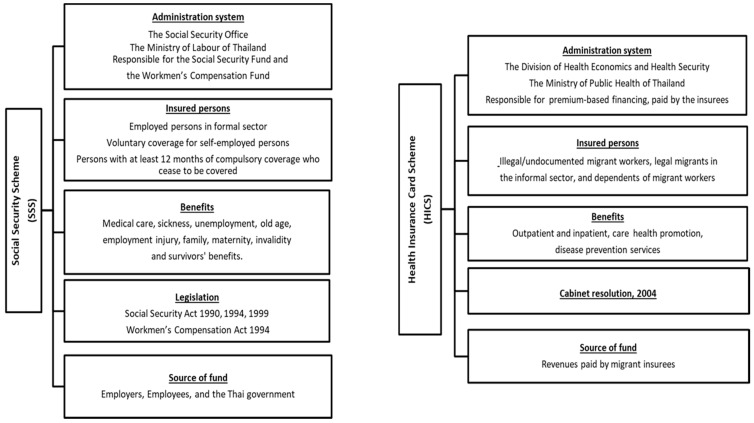
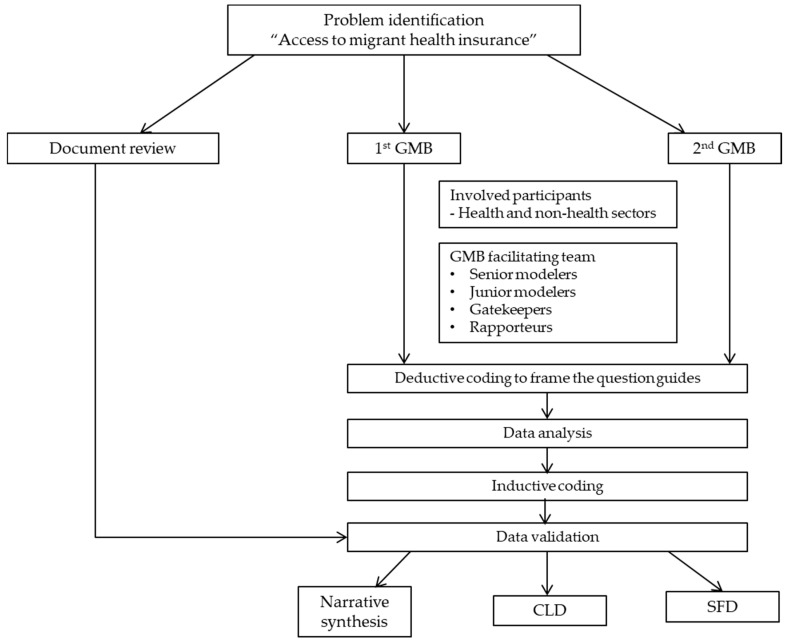
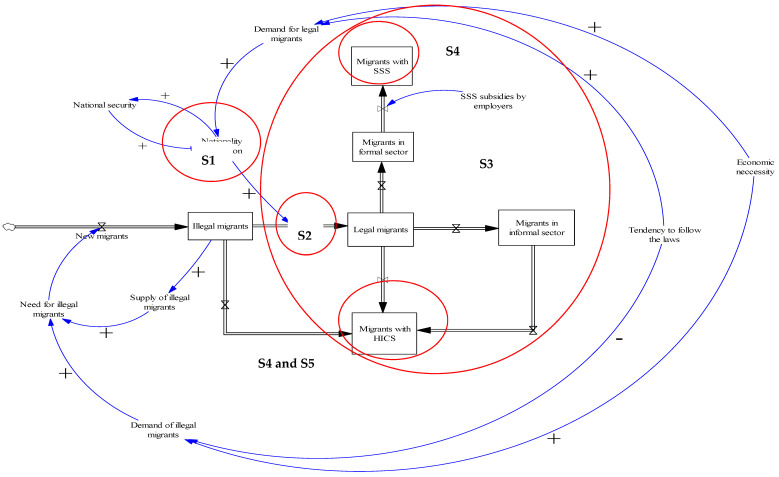
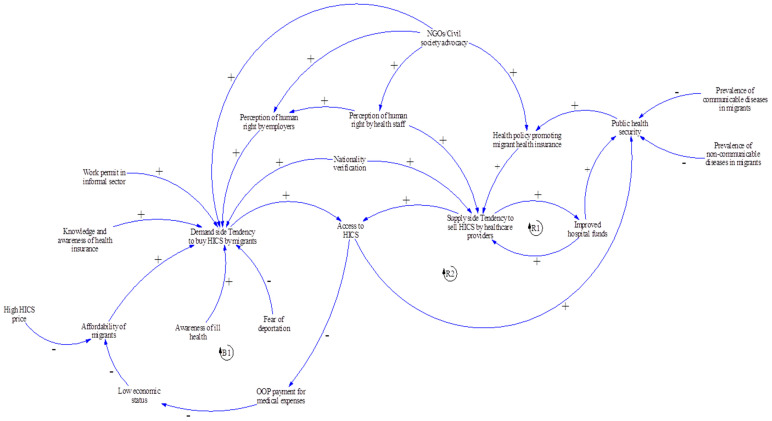
Abstract Background The migrant health agenda in Thailand has been shaped by domestic and international pressures relating to social and economic dimensions. Thailand has become a popular destination for international migrant workers particularly from Cambodia, Lao PDR, and Myanmar. However, only a fraction of these migrant workers were insured by public health insurance. This study aimed to apply systems thinking to explore contextual factors affecting access to public health insurance arrangements among cross-border migrants in Thailand. Methods A group model building (GMB) was applied to explore contextual factors and their interplay influencing access to health insurance for migrants in Thailand. Participants (n = 20) were encouraged to share ideas about underlying drivers and barriers of access to health insurance among migrants. Triangulation was performed with the document review. The findings were analysed by a thematic approach. The causal loop diagramme (CLD) and stock and flow diagramme (SFD) were synthesised to identify the dynamics relating to access to migrant health insurance. Results Nationality verification was recognised as one of the most important mechanisms that the Thai government exercises to deal with the precarious citizenship status of undocumented migrants. Also, it is the key function that links economic necessity, national security, and public health concerns. In the formal sector, the government plays an important role in the enrollment of migrant workers in the Social Security Scheme (SSS) run by the Ministry of Labour (MOL). In the informal sector, the Health Insurance Card Scheme (HICS) managed by the Ministry of Public Health (MOPH) is the key option for migrant workers. However, some migrants are still left uninsured. The likely explanations are the semi-voluntary nature of the HICS, administrative delay of the enrollment process, and the resistance of some employers to hiring migrants. Conclusions Effective communication is required to raise awareness and acceptance towards the insurance among migrants and their employers. This needs cohesive effort from all stakeholders in society including the government, the business sector, civic groups, and even migrant communities. A public policy participatory process is needed to create a good balance of migrant policies among diverse authorities.
Overview
The claims and statistics of this paper haven’t been checked yet.
Free: it reads the open-access text and checks the first 5 claims that cite a source we can check. Create a free account to check every claim.
Integrity signals
Registry
Cites
Statistics
Figures
Verification
Claims the paper makes
The claims and statistics of this paper haven’t been checked yet.
Free: it reads the open-access text and checks the first 5 claims that cite a source we can check. Create a free account to check every claim.
Claims other papers make about this one
Each is checked against this paper’s own text: does it say what the citing paper says it does?
The source backs part of the claim, not all of it — or backs it for a different population, condition or comparison.
In the citing paper
“Being worried about security is an important barrier to positive action towards accessing health care and applying for health insurance (Kunpeuk et al., 2020, Tschirhart et al., 2021).”
From Migrant women’s experience of antenatal care in an urban and rural setting in north and North-West Thailand: A cross sectional survey (2025) · cites this paper as Kunpeuk et al., 2020
Experimental — accuracy not yet measured
Self-check
Percentages, sums and reported differences re-computed from the paper’s own numbers.
The self-check needs the paper’s full text.
Citations
Cites
Learning from Evidence in a Complex World
Sterman, J. D. (2006) · American Journal of Public Health · doi:10.2105/ajph.2005.066043 · Cited by 978
Community Based System Dynamics
Hovmand, P. S. (2014) · Springer eBooks · doi:10.1007/978-1-4614-8763-0 · Cited by 613
Group model building: problem structuring, policy simulation and decision support
Andersen, D. F., Vennix, J. A. M., Richardson, G. P., & Rouwette, E. A. J. A. (2007) · Journal of the Operational Research Society · doi:10.1057/palgrave.jors.2602339 · Cited by 288
Petticrew, M., Knai, C., Thomas, J., Rehfuess, E. A., Noyes, J., Gerhardus, A., Grimshaw, J. M., Rutter, H., & McGill, E. (2019) · BMJ Global Health · doi:10.1136/bmjgh-2018-000899 · Cited by 204
Anatomy of a group model‐building intervention: building dynamic theory from case study research
Luna‐Reyes, L. F., Martinez‐Moyano, I. J., Pardo, T. A., Cresswell, A. M., Andersen, D. F., & Richardson, G. P. (2006) · System Dynamics Review · doi:10.1002/sdr.349 · Cited by 189
Carrara, V. I., Lwin, K. M., Phyo, A. P., Ashley, E., Wiladphaingern, J., Sriprawat, K., Rijken, M., Boel, M., McGready, R., Proux, S., et al. (2013) · PLoS Medicine · doi:10.1371/journal.pmed.1001398 · Cited by 185
Davies, H. T., Powell, A. E., & Nutley, S. M. (2015) · Health Services and Delivery Research · doi:10.3310/hsdr03270 · Cited by 144
Malaria ecology along the Thailand-Myanmar border.
Parker, D. M., Carrara, V. I., Pukrittayakamee, S., McGready, R., & Nosten, F. H. (2015) · Malaria Journal · doi:10.1186/s12936-015-0921-y · Cited by 142
Group Model Building and Community-Based System Dynamics Process
Hovmand, P. S. (2013) · Springer eBooks · doi:10.1007/978-1-4614-8763-0_2 · Cited by 134
Semwanga, A. R., Nakubulwa, S., Nakakeeto-Kijjambu, M., & Adam, T. (2014) · Health Research Policy and Systems · doi:10.1186/1478-4505-12-36 · Cited by 116
van Hees, S. G. M., O’Fallon, T., Hofker, M., Dekker, M., Polack, S., Banks, L. M., & Spaan, E. J. A. M. (2019) · International Journal for Equity in Health · doi:10.1186/s12939-019-1040-0 · Cited by 91
Implementing health insurance for migrants, Thailand
Tangcharoensathien, V., Thwin, A. A., & Patcharanarumol, W. (2017) · Bulletin of the World Health Organization · doi:10.2471/blt.16.179606 · Cited by 81
The Political Economy of UHC Reform in Thailand: Lessons for Low- and Middle-Income Countries
Tangcharoensathien, V., Patcharanarumol, W., Kulthanmanusorn, A., Saengruang, N., & Kosiyaporn, H. (2019) · Health Systems & Reform · doi:10.1080/23288604.2019.1630595 · Cited by 78
Self-citationNew York Declaration for Refugees and Migrants
(2021) · Encyclopedia of the UN sustainable development goals · doi:10.1007/978-3-319-95882-8_300122 · Cited by 66
Suphanchaimat, R., Putthasri, W., Prakongsai, P., & Tangcharoensathien, V. (2017) · Risk Management and Healthcare Policy · doi:10.2147/rmhp.s130442 · Cited by 65
Self-citationPocock, N. S., Chan, Z., Loganathan, T., Suphanchaimat, R., Kosiyaporn, H., Allotey, P., Chan, W.-K., & Tan, D. (2020) · PLOS ONE · doi:10.1371/journal.pone.0231154 · Cited by 63
Self-citationFreebairn, L., Occhipinti, J., Kelly, P., McDonnell, G., & Rychetnik, L. (2016) · Health Research Policy and Systems · doi:10.1186/s12961-016-0143-y · Cited by 51
Mumba, C., Skjerve, E., Rich, M., & Rich, K. M. (2017) · PLoS ONE · doi:10.1371/journal.pone.0189878 · Cited by 44
Suphanchaimat, R., Pudpong, N., Prakongsai, P., Putthasri, W., Hanefeld, J., & Mills, A. (2019) · International Journal of Environmental Research and Public Health · doi:10.3390/ijerph16061016 · Cited by 37
Self-citationMigrant tuberculosis patient needs and health system response along the Thailand–Myanmar border
Tschirhart, N., Nosten, F. H., & Foster, A. M. (2017) · Health Policy and Planning · doi:10.1093/heapol/czx074 · Cited by 36
Musumari, P. M., & Chamchan, C. (2016) · PLoS ONE · doi:10.1371/journal.pone.0154669 · Cited by 31
How Adverse Selection Affects the Health Insurance Market
Belli, P. (2001) · World Bank, Washington, DC eBooks · doi:10.1596/1813-9450-2574 · Cited by 25
Dynamic Modeling of Labor Migration Impact on the Economic System Development
Tarasyev, A. A., & Jabbar, J. B. (2018) · IFAC-PapersOnLine · doi:10.1016/j.ifacol.2018.11.418 · Cited by 23
Improving the health of migrants
Wickramage, K. P., Simpson, P. J., & Abbasi, K. A. (2019) · BMJ · doi:10.1136/bmj.l5324 · Cited by 21
Suphanchaimat, R., Kunpeuk, W., Phaiyarom, M., & Nipaporn, S. (2019) · Risk Management and Healthcare Policy · doi:10.2147/rmhp.s219571 · Cited by 21
Self-citationPedamallu, C. S., Özdamar, L., Akar, H., Weber, G., & Özsoy, A. (2011) · International Journal of Production Economics · doi:10.1016/j.ijpe.2011.03.016 · Cited by 20
Tangmunkongvorakul, A., Musumari, P. M., Srithanaviboonchai, K., Manoyos, V., Techasrivichien, T., Suguimoto, S. P., Ono‐Kihara, M., Kihara, M., & Chariyalertsak, S. (2017) · PLoS ONE · doi:10.1371/journal.pone.0183255 · Cited by 14
Research works printed but not linked: 1
- Chalamwong Y. Prugsamatz R. Labor Migration in Thailand: Recent Trends and Implications for Development TDRI Q. Rev. 2009 24 3 9
Cited by
Thelen, J., Fruchtman, C. S., Bilal, M., Gabaake, K., Iqbal, S., Keakabetse, T. R., Kwamie, A., Mokalake, E. N., Mupara, L. M., Seitio-Kgokgwe, O., et al. (2023) · BMJ Global Health · doi:10.1136/bmjgh-2022-010191 · Cited by 110
Jung, S., Son, J., Kim, C., & Chung, K. (2023) · Processes · doi:10.3390/pr11030811 · Cited by 74
The determinant of health insurance ownership among pregnant women in Indonesia
Laksono, A. D., Wulandari, R. D., & Matahari, R. (2021) · BMC Public Health · doi:10.1186/s12889-021-11577-z · Cited by 37
Kunpeuk, W., Julchoo, S., Phaiyarom, M., Sinam, P., Pudpong, N., Loganathan, T., Yi, H., & Suphanchaimat, R. (2022) · International Journal of Environmental Research and Public Health · doi:10.3390/ijerph19053083 · Cited by 34
Self-citationA Systematic Scoping Review on Migrant Health Coverage in Thailand
König, A., Nabieva, J., Manssouri, A., Antia, K., Dambach, P., Deckert, A., Horstick, O., Kohler, S., & Winkler, V. F. (2022) · Tropical Medicine and Infectious Disease · doi:10.3390/tropicalmed7080166 · Cited by 35
Metadata
- Authors
- Kunpeuk, W., Teekasap, P., Kosiyaporn, H., Julchoo, S., Phaiyarom, M., Sinam, P., Pudpong, N., & Suphanchaimat, R.
- Affiliations
- Ministry of Public Health (TH)
- Stamford International University (TH)
- Corresponding author
- Kunpeuk, Watinee
- ORCID
- Venue
- International Journal of Environmental Research and Public Health
- Publisher
- MDPI AG
- Published
- 2020-07-15
- Volume
- 17
- Issue
- 14
- Pages
- 5113
- ISSN
- 1660-4601 (ISSN-L)
- PMC
- PMC7400460
- OpenAlex
- W3042354312
- Cited by
- 27
- References
- 27
- Citations by year
- 2026: 6 · 2025: 1 · 2024: 3 · 2023: 9 · 2022: 4 · 2021: 3
- FWCI
- 5.35
- Type
- journal article
- Language
- en
- Open access
- gold
- doi.org
- Licence
- Locations
- International Journal of Environmental Research and Public Health (publishedVersion, cc-by)
- Research Square (acceptedVersion, cc-by)
- PubMed Central (publishedVersion, cc-by)
- PubMed (publishedVersion)
- RePEc: Research Papers in Economics (submittedVersion)
- DOAJ (DOAJ: Directory of Open Access Journals) (submittedVersion)
- Funders
- Health Systems Research Institute (62-064)
- Topics
- Social Sciences › Sociology and Political Science › Migration, Identity, and Health
- Social Sciences › Law › Migration, Racism, and Human Rights
- Health Sciences › Medicine › Public Health, Environmental and Occupational Health › Healthcare Systems and Reforms
- Keywords
- migrant workers, public health insurance, health insurance access, Thailand, Cambodia, Laos, Myanmar, undocumented immigrants, citizenship status, employer resistance, health insurance uptake, participatory policymaking
- MeSH terms
- Myanmar, Cambodia, Health Services Accessibility, Humans, Insurance, Health, Systems Analysis, Thailand, Transients and Migrants
About these checks
Registry, retraction, Cites and statistics results are computed, not judged, with one exception: a printed reference that no index lists is read once by a model before it counts as a citation error. Claims are extracted by a model and kept only when their quote appears verbatim in the text; each cited source is then checked, with a model’s help, for whether it says what the claim relies on. Those verdicts can be wrong — read the claim’s quote and the cited source before relying on one.
Statistics and arithmetic are recomputed, not judged.
Confidence bands are shown only for fields calibrated on our annotated test set. None is calibrated yet, so no band is shown.
What counts as a claim ›How we measure confidence ›How we check this ›
Are you an author, or do you see a problem with this page? Request a review
Data sources
Bibliographic data: Semantic Scholar, OpenAlex, Crossref.
Contains information from the Semantic Scholar Academic Graph Datasets, made available under the ODC Attribution License (ODC-BY 1.0).
Semantic Scholar’s data is described in: Kinney, R., et al. (2023). The Semantic Scholar Open Data Platform. arXiv:2301.10140.
