

Through the Looking Glass of Social Media. Focus on Self-Presentation and Association with Mental Health and Quality of Life. A Cross-Sectional Survey-Based Study
Open accessPublished version of a preprint
The DOI matches its Crossref record; 61 of the 63 references it cites were found in a registry or an index.
Abstract
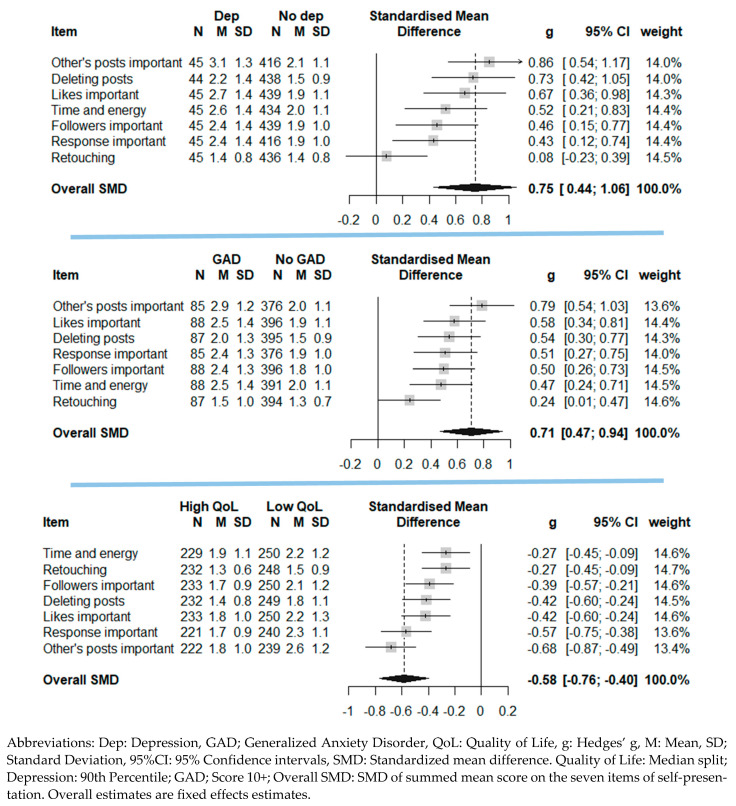
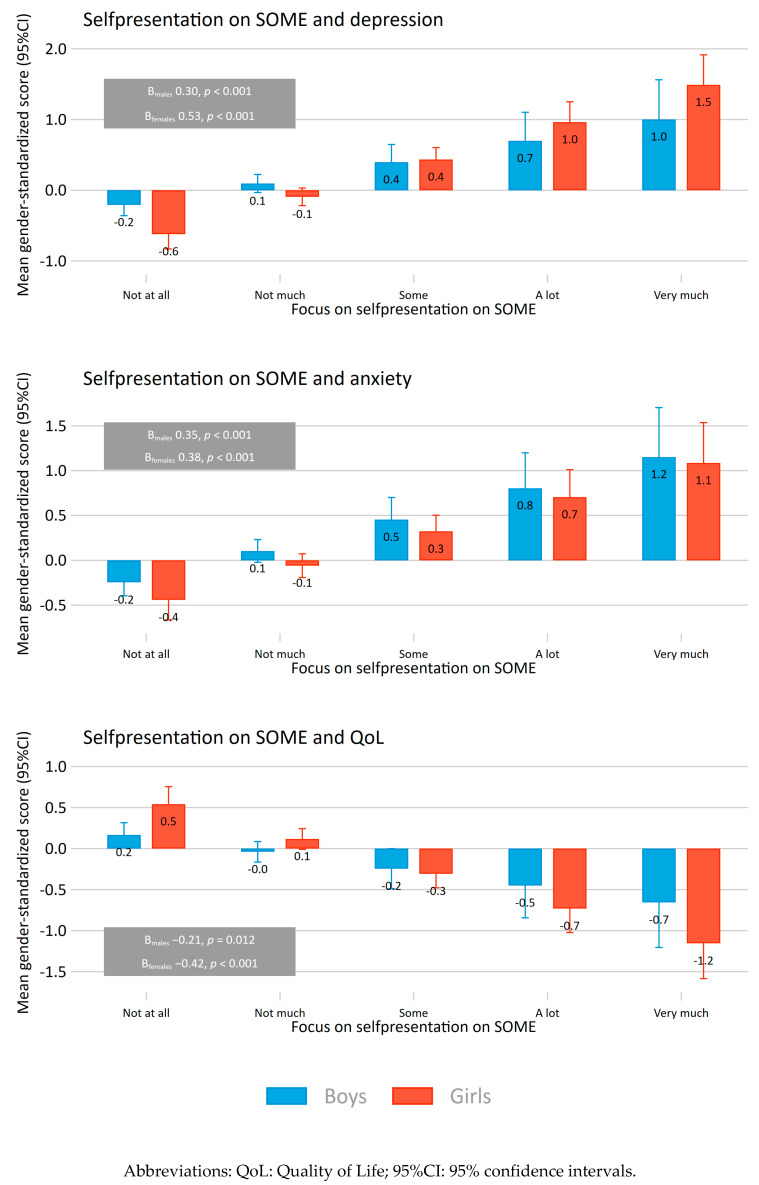
Social media (SOME) use among adolescents has been linked to mental health and well-being. SOME self-presentation has been highlighted as an important factor to better understand the potential links. The aims of this study were to investigate the association between focus on SOME self-presentation and mental health and quality of life among adolescents. We used a cross-sectional survey, with n = 513 (56%; mean age 17.1 years; 58% boys) students from a senior high school in Norway. Associations between focus on SOME self-presentation and symptoms of anxiety and depression and quality of life were investigated using blobbograms, standardized mean difference (SMD), and gender-specific linear regression models. A high focus on SOME self-presentation was associated with more mental health problems and reduced quality of life. The strength of the associations with symptoms of depression (0.75SMD) and anxiety (0.71SMD) was large, while it was medium-large for quality of life (−0.58SMD). The association was similar across gender in relation to symptoms of anxiety. For symptoms of depression and quality of life, the association was stronger for girls compared to boys. Our findings yield preliminary evidence of a potential relationship between focus on SOME self-presentation and mental health.
Overview
The claims and statistics of this paper haven’t been checked yet.
Free: it reads the open-access text and checks the first 5 claims that cite a source we can check. Create a free account to check every claim.
Integrity signals
Registry
Cites
Statistics
Figures
Verification
Claims the paper makes
The claims and statistics of this paper haven’t been checked yet.
Free: it reads the open-access text and checks the first 5 claims that cite a source we can check. Create a free account to check every claim.
Claims other papers make about this one
Each is checked against this paper’s own text: does it say what the citing paper says it does?
The source backs part of the claim, not all of it — or backs it for a different population, condition or comparison.
In the citing paper
“This digital landscape becomes a battleground for self-esteem, where the pressure to conform to these standards can lead to profound dissatisfaction with one’s own body, potentially spiraling into disordered eating behaviors and distorted body image [43].”
From Body Perceptions and Psychological Well-Being: A Review of the Impact of Social Media and Physical Measurements on Self-Esteem and Mental Health with a Focus on Body Image Satisfaction and Its Relationship with Cultural and Gender Factors (2024) · cites this paper as [43]
Experimental — accuracy not yet measured
Self-check
Percentages, sums and reported differences re-computed from the paper’s own numbers.
The self-check needs the paper’s full text.
Citations
Cites
A Brief Measure for Assessing Generalized Anxiety Disorder: The GAD-7
Spitzer, R. L., Kroenke, K., Williams, J. B. W., & Löwe, B. (2006) · Archives of Internal Medicine · doi:10.1001/archinte.166.10.1092 · Cited by 31,765 · cited 2×
“Dependent Variables: Measures of Mental Health and Quality of Life Symptoms of Anxiety Anxiety was measured by the questionnaire General Anxiety Disorder 7 (GAD-7; Spitzer, Kroenke [39]).”
Methodlavaan : An R Package for Structural Equation Modeling
Rosseel, Y. (2012) · Journal of Statistical Software · doi:10.18637/jss.v048.i02 · Cited by 27,955
Sensitivity of Goodness of Fit Indexes to Lack of Measurement Invariance
Chen, F. F. (2007) · Structural Equation Modeling: A Multidisciplinary Journal · doi:10.1080/10705510701301834 · Cited by 12,217 · cited 1×
“08 or less were collectively considered an indication of good model fit to data [43].”
BackgroundHow to perform a meta-analysis with R: a practical tutorial
Balduzzi, S., Rücker, G., & Schwarzer, G. (2019) · Evidence Based Mental Health · doi:10.1136/ebmental-2019-300117 · Cited by 5,827
The Warwick-Edinburgh Mental Well-being Scale (WEMWBS): development and UK validation
Tennant, R., Hiller, L., Fishwick, R., Platt, S., Joseph, S., Weich, S., Parkinson, J., Secker, J., & Stewart-Brown, S. (2007) · Health and Quality of Life Outcomes · doi:10.1186/1477-7525-5-63 · Cited by 5,031 · cited 2×
“Quality of Life Quality of Life (QoL) was measured using the Warwick–Edinburgh Well-being Scale (WEMWBS; Tennant, Hiller [41]).”
MethodSocial media? Get serious! Understanding the functional building blocks of social media
Kietzmann, J. H., Hermkens, K., McCarthy, I. P., & Silvestre, B. S. (2011) · Business Horizons · doi:10.1016/j.bushor.2011.01.005 · Cited by 4,970 · cited 1×
“Social media can be de ned as “highly interactive platforms via which individuals and communities share, co-create, discuss, and modify user-generated content” [4].”
BackgroundOur future: a Lancet commission on adolescent health and wellbeing
Patton, G. C., Sawyer, S. M., Santelli, J. S., Ross, D. A., Afifi, R., Allen, N. B., Arora, M., Azzopardi, P., Baldwin, W., Bonell, C., et al. (2016) · The Lancet · doi:10.1016/s0140-6736(16)00579-1 · Cited by 3,785 · cited 2×
“Adolescence is an important period in life characterised by increased independence from parents and an expanded social life dominated by one’s peers [1].”
BackgroundDiscourse: studies in the cultural politics of education
Weiler, K. (2008) · Cited by 2,316
Keles, B., McCrae, N., & Grealish, A. (2020) · International Journal of Adolescence and Youth · doi:10.1080/02673843.2019.1590851 · Cited by 1,909 · cited 2×
“However, by focusing primarily on frequency and duration of use [5,9,10], these studies provide little knowledge of how various types of social media activities may be differentially linked to mental health and well-being.”
BackgroundWoods, H. C., & Scott, H. (2016) · Journal of Adolescence · doi:10.1016/j.adolescence.2016.05.008 · Cited by 1,302
Research works printed but not linked: 3
- 20. McKenna, K., Joinson, A.N., Reips, U.D., Postmes, T., Eds.; Oxford University Press: New York, NY, USA, 2012.
- 58. Prensky, M.H. sapiens Digital: From Digital Immigrants and Digital Natives to Digital Wisdom. J. Innov. J. Online Educ. 2009, 5, 9.
- 59. Zur, O.; Zur, A. On digital immigrants and digital natives: How the digital divide affects families, educational institutions, and the workplace. Zur Inst. Online Publ. 2011, 21, 13.
Cited by
Merino, M., Tornero-Aguilera, J. F., Rubio-Zarapuz, A., Villanueva-Tobaldo, C. V., Martín-Rodríguez, A., & Clemente-Suárez, V. J. (2024) · Healthcare · doi:10.3390/healthcare12141396 · Cited by 349
Problematic Social Media Use and Its Relationship with Depression or Anxiety: A Systematic Review
Lopes, L. S., Valentini, J. P., Monteiro, T. H., Costacurta, M. C. D. F., Soares, L. O. N., Telfar-Barnard, L., & Nunes, P. V. (2022) · Cyberpsychology, Behavior, and Social Networking · doi:10.1089/cyber.2021.0300 · Cited by 197
“120 Moreover, women are more likely to compare themselves to others in terms of physical attractiveness—social comparison, 60,66,89,90,95,110,114 and girls are more exposed to cyberbullying, 45,121,122 including different response to stressors due to some personality traits—particularly…”
Svensson, R., Johnson, B., & Olsson, A. (2022) · BMC Public Health · doi:10.1186/s12889-022-12670-7 · Cited by 79
“have shown girls to have lower well-being as indicated by, for example, depressive symptoms [6, 37, 45], anxiety [6, 45] and internalizing problems [16].”
BackgroundResultInfluentialHjetland, G. J., Schønning, V., Hella, R. T., Veseth, M., & Skogen, J. C. (2021) · BMC Psychology · doi:10.1186/s40359-021-00582-x · Cited by 103
Self-citationTFOS Lifestyle: Impact of societal challenges on the ocular surface
Stapleton, F. J., Abad, J. C., Barabino, S., Burnett, A. M., Iyer, G. K., Lekhanont, K., Li, T., Liu, Y., Navas, A., Obinwanne, C. J., et al. (2023) · The Ocular Surface · doi:10.1016/j.jtos.2023.04.006 · Cited by 80
“A cross-sectional study from Norway indicated that self-presentation in social media was associated with increased mental health problems and decreased quality of life in adolescents [546].”
Background
Metadata
- Authors
- Skogen, J. C., Hjetland, G. J., Bøe, T., Hella, R. T., & Knudsen, A. K.
- Affiliations
- Norwegian Institute of Public Health (NO)
- University of Bergen (NO)
- Bergen Kommune (NO)
- Corresponding author
- Skogen, Jens Christoffer
- Venue
- International Journal of Environmental Research and Public Health
- Publisher
- MDPI AG
- Published
- 2021-03-23
- Volume
- 18
- Issue
- 6
- Pages
- 3319
- ISSN
- 1660-4601 (ISSN-L)
- PMC
- PMC8004637
- OpenAlex
- W3112569429
- Cited by
- 73
- References
- 63
- Citations by year
- 2026: 10 · 2025: 22 · 2024: 15 · 2023: 7 · 2022: 12 · 2021: 7
- FWCI
- 14.23
- Type
- journal article
- Language
- en
- Open access
- gold
- doi.org
- Licence
- Locations
- International Journal of Environmental Research and Public Health (publishedVersion, cc-by)
- Research Square (acceptedVersion, cc-by)
- PubMed Central (publishedVersion, cc-by)
- PubMed (publishedVersion)
- RePEc: Research Papers in Economics (submittedVersion)
- NORA - Norwegian Open Research Archives (submittedVersion, cc-by)
- DOAJ (DOAJ: Directory of Open Access Journals) (submittedVersion)
- NORA - Norwegian Open Research Archives (submittedVersion, other-oa)
- Funders
- Helsedirektoratet
- Topics
- Social Sciences › Sociology and Political Science › Impact of Technology on Adolescents
- Social Sciences › Psychology › Clinical Psychology › Body Image and Dysmorphia Studies
- Social Sciences › Psychology › Social Psychology › Mental Health via Writing
- Keywords
- social media self-presentation, adolescents, mental health, quality of life, anxiety, depression, gender differences, high school students, social media use
- MeSH terms
- Adolescent, Anxiety, Cross-Sectional Studies, Depression, Female, Humans, Male, Mental Health, Norway, Quality of Life, Social Media
About these checks
Registry, retraction, Cites and statistics results are computed, not judged, with one exception: a printed reference that no index lists is read once by a model before it counts as a citation error. Claims are extracted by a model and kept only when their quote appears verbatim in the text; each cited source is then checked, with a model’s help, for whether it says what the claim relies on. Those verdicts can be wrong — read the claim’s quote and the cited source before relying on one.
Statistics and arithmetic are recomputed, not judged.
Confidence bands are shown only for fields calibrated on our annotated test set. None is calibrated yet, so no band is shown.
What counts as a claim ›How we measure confidence ›How we check this ›
Are you an author, or do you see a problem with this page? Request a review
Data sources
Bibliographic data: Semantic Scholar, OpenAlex, Crossref.
Contains information from the Semantic Scholar Academic Graph Datasets, made available under the ODC Attribution License (ODC-BY 1.0).
Semantic Scholar’s data is described in: Kinney, R., et al. (2023). The Semantic Scholar Open Data Platform. arXiv:2301.10140.
