

The DOI matches its Crossref record; 119 of the 120 references it cites were found in a registry or an index.
Relationship between Green and Blue Spaces with Mental and Physical Health: A Systematic Review of Longitudinal Observational Studies
Open accessAbstract
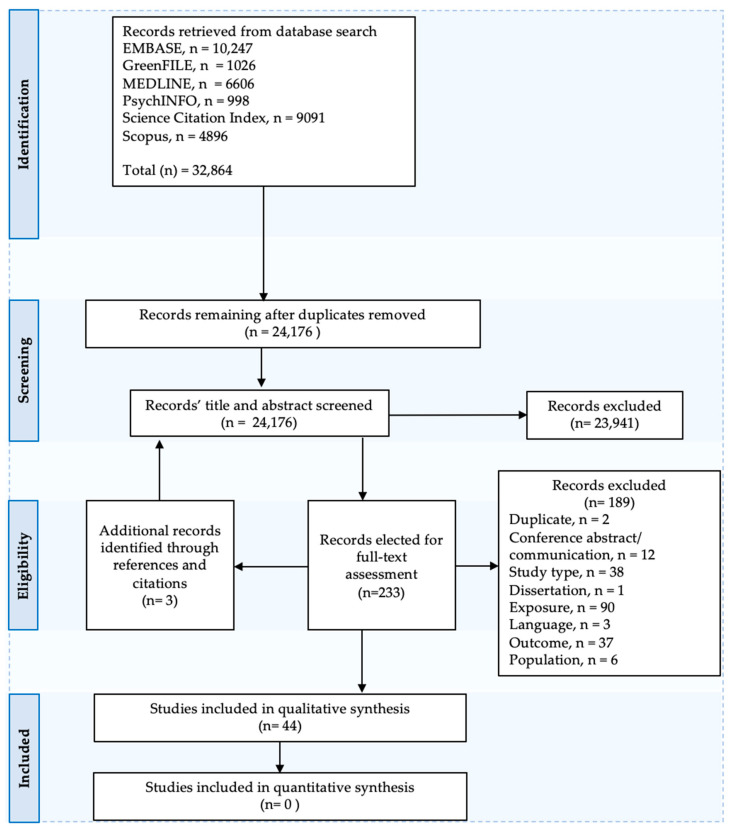
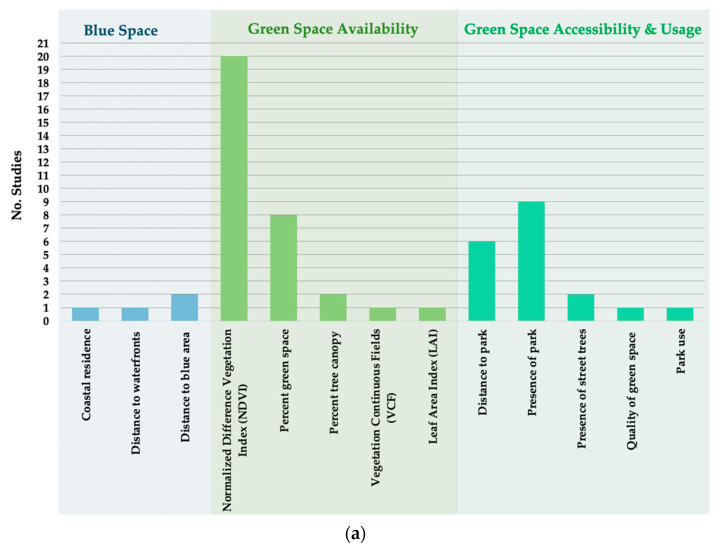
There is growing interest in the ways natural environments influence the development and progression of long-term health conditions. Vegetation and water bodies, also known as green and blue spaces, have the potential to affect health and behaviour through the provision of aesthetic spaces for relaxation, socialisation and physical activity. While research has previously assessed how green and blue spaces affect mental and physical wellbeing, little is known about the relationship between these exposures and health outcomes over time. This systematic review summarised the published evidence from longitudinal observational studies on the relationship between exposure to green and blue space with mental and physical health in adults. Included health outcomes were common mental health conditions, severe mental health conditions and noncommunicable diseases (NCDs). An online bibliographic search of six databases was completed in July 2020. After title, abstract and full-text screening, 44 eligible studies were included in the analysis. Depression, diabetes and obesity were the health conditions most frequently studied in longitudinal relationships. The majority of exposures included indicators of green space availability and urban green space accessibility. Few studies addressed the relationship between blue space and health. The narrative synthesis pointed towards mixed evidence of a protective relationship between exposure to green space and health. There was high heterogeneity in exposure measures and adjustment for confounding between studies. Future policy and research should seek a standardised approach towards measuring green and blue space exposures and employ theoretical grounds for confounder adjustment.
Overview
The claims and statistics of this paper haven’t been checked yet.
Run the check — free, no account needed. It reads the open-access text and checks the sources it cites.
Integrity signals
Registry
Cites
Statistics
Figures
Verification
Claims the paper makes
The claims and statistics of this paper haven’t been checked yet.
Run the check — free, no account needed. It reads the open-access text and checks the sources it cites.
Claims other papers make about this one
Each is checked against this paper’s own text: does it say what the citing paper says it does?
The cited source says what the claim attributes to it.
In the citing paper
“reviews of longitudinal and experimental studies have evaluated the evidence as inconsistent or suggestive.9–12”
From Cross-sectional associations of different types of nature exposure with psychotropic, antihypertensive and asthma medication (2023) · cites this paper as [9]
Self-check
Percentages, sums and reported differences re-computed from the paper’s own numbers.
The self-check needs the paper’s full text.
Citations
Cites
PRISMA-P Group, Moher, D., Shamseer, L., Clarke, M., Ghersi, D., Liberati, A., Petticrew, M., Shekelle, P., & Stewart, L. A. (2015) · Systematic Reviews · doi:10.1186/2046-4053-4-1 · Cited by 26,223
Rayyan-a web and mobile app for systematic reviews.
Ouzzani, M., Hammady, H., Fedorowicz, Z., & Elmagarmid, A. (2016) · Systematic Reviews · doi:10.1186/s13643-016-0384-4 · Cited by 26,092
ROBINS-I: a tool for assessing risk of bias in non-randomised studies of interventions
Sterne, J. A., Hernán, M. A., Reeves, B. C., Savović, J., Berkman, N. D., Viswanathan, M., Henry, D., Altman, D. G., Ansari, M. T., Boutron, I., et al. (2016) · BMJ · doi:10.1136/bmj.i4919 · Cited by 20,329
Cochrane Handbook for Systematic Reviews of Interventions
(2019) · doi:10.1002/9781119536604 · Cited by 14,828
Developing and evaluating complex interventions: the new Medical Research Council guidance
Craig, P., Dieppe, P., Macintyre, S., Michie, S., Nazareth, I., & Petticrew, M. (2008) · BMJ · doi:10.1136/bmj.a1655 · Cited by 10,995
Wolch, J. R., Byrne, J., & Newell, J. P. (2014) · Landscape and Urban Planning · doi:10.1016/j.landurbplan.2014.01.017 · Cited by 4,450
No health without mental health
Prince, M. J., Patel, V., Saxena, S., Maj, M., Maselko, J., Phillips, M. R., & Rahman, A. (2007) · The Lancet · doi:10.1016/s0140-6736(07)61238-0 · Cited by 4,028
Exploring pathways linking greenspace to health: theoretical and methodological guidance
Markevych, I., Schoierer, J., Hartig, T., Chudnovsky, A., Hystad, P., Dzhambov, A. M., de Vries, S., Triguero-Mas, M., Brauer, M., Nieuwenhuijsen, M. J., et al. (2017) · Environmental Research · doi:10.1016/j.envres.2017.06.028 · Cited by 2,543
Newcastle-Ottawa Scale: comparing reviewers’ to authors’ assessments
Lo, C. K.-L., Mertz, D., & Loeb, M. (2014) · BMC Medical Research Methodology · doi:10.1186/1471-2288-14-45 · Cited by 2,477
Twohig-Bennett, C., & Jones, A. (2018) · Environmental Research · doi:10.1016/j.envres.2018.06.030 · Cited by 1,766
Cited by
Sorted by citations
The social determinants of mental health and disorder: evidence, prevention and recommendations
Kirkbride, J. B., Anglin, D. M., Colman, I., Dykxhoorn, J. L., Jones, P. B., Patalay, P., Pitman, A., Soneson, E., Steare, T., Wright, T., et al. (2024) · World Psychiatry · doi:10.1002/wps.21160 · Cited by 1,619
Green space exposure on depression and anxiety outcomes: A meta-analysis
Liu, Z., Chen, X., Cui, H., Ma, Y., Gao, N., Li, X., Meng, X., Lin, H., Abudou, H., Guo, L., et al. (2023) · Environmental Research · doi:10.1016/j.envres.2023.116303 · Cited by 155
The relationship between urban green space and social health of individuals: A scoping review
Huang, W., & Lin, G. (2023) · Urban forestry & urban greening · doi:10.1016/j.ufug.2023.127969 · Cited by 114
Tate, C., Wang, R., Akaraci, S., Burns, C., García, L., Clarke, M. J., & Hunter, R. F. (2023) · Cities · doi:10.1016/j.cities.2023.104706 · Cited by 104
Geary, R. S., Thompson, D., Mizen, A., Akbari, A., Garrett, J. K., Rowney, F. M., Watkins, A. J., Lyons, R. A., Stratton, G., Lovell, R., et al. (2023) · The Lancet Planetary Health · doi:10.1016/s2542-5196(23)00212-7 · Cited by 83
Metadata
- Authors
- Geneshka, M., Coventry, P., Cruz, J., & Gilbody, S.
- Affiliations
- University of York (GB)
- University College London (GB)
- Corresponding author
- Geneshka, Mariya
- Coventry, Peter
- Venue
- International Journal of Environmental Research and Public Health
- Publisher
- MDPI AG
- Published
- 2021-08-26
- Volume
- 18
- Issue
- 17
- Pages
- 9010
- ISSN
- 1660-4601 (ISSN-L)
- PMC
- PMC8431638
- OpenAlex
- W3194666234
- Cited by
- 150
- References
- 120
- Citations by year
- 2026: 27 · 2025: 43 · 2024: 44 · 2023: 30 · 2022: 5 · 2021: 1
- FWCI
- 1.90
- Type
- journal article
- Language
- en
- Open access
- gold
- doi.org
- Licence
- Locations
- International Journal of Environmental Research and Public Health (publishedVersion, cc-by)
- PubMed Central (publishedVersion, cc-by)
- PubMed (publishedVersion)
- White Rose Research Online (University of Leeds, The University of Sheffield, University of York) (submittedVersion)
- DOAJ (DOAJ: Directory of Open Access Journals) (submittedVersion, cc-by-sa)
- Funders
- NIHR Applied Research Collaboration Yorkshire and Humber (n/a)
- Topics
- Social Sciences › Urban Studies › Urban Green Space and Health
- Social Sciences › Health › Health disparities and outcomes
- Social Sciences › Sociology and Political Science › Environmental Justice and Health Disparities
- Keywords
- green spaces, blue spaces, mental health, physical health, non-communicable diseases, depression, diabetes mellitus, obesity, urban green space accessibility, vegetation, water bodies, chronic disease, confounding adjustment
- MeSH terms
- Parks, Recreational, Environment, Longitudinal Studies, Mental Health, Exercise
About these checks
Registry, retraction, Cites and statistics results are computed, not judged, with one exception: a printed reference that no index lists is read once by a model before it counts as a citation error. Claims are extracted by a model and kept only when their quote appears verbatim in the text; each cited source is then checked, with a model’s help, for whether it says what the claim relies on. Those verdicts can be wrong — read the claim’s quote and the cited source before relying on one.
Statistics and arithmetic are recomputed, not judged.
Confidence bands are shown only for fields calibrated on our annotated test set. None is calibrated yet, so no band is shown.
What counts as a claim ›How we measure confidence ›How we check this ›
Are you an author, or do you see a problem with this page? Request a review
