

Using GIS to Estimate Population at Risk Because of Residence Proximity to Asbestos Processing Facilities in Colombia
Open accessThe DOI matches its Crossref record; 35 of the 35 references it cites were found in a registry or an index.
Abstract
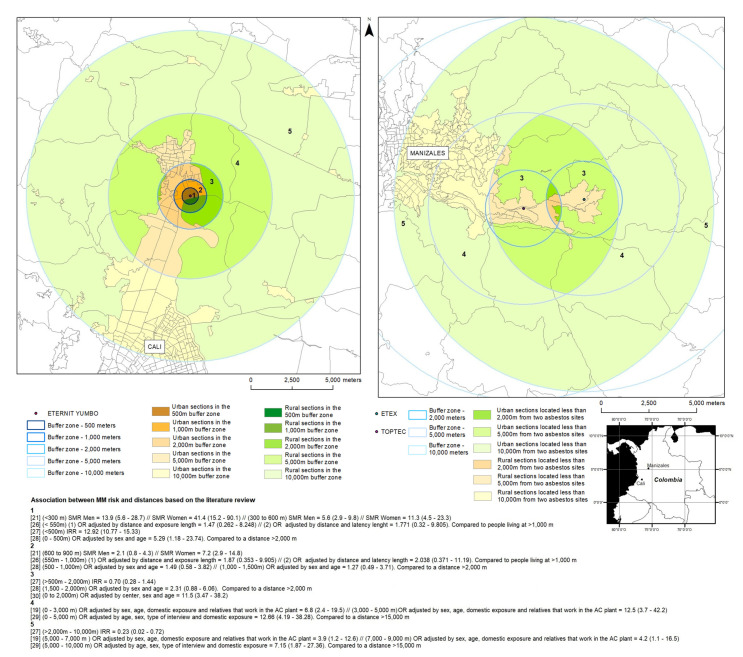
The recent enactment of the law banning asbestos in Colombia raises a significant number of challenges. The largest factories that have historically processed asbestos include five asbestos-cement facilities located in the cities of Sibaté (Cundinamarca), Cali (Valle del Cauca), and Barranquilla (Atlántico), and Manizales (Caldas), which has two, as well as a friction products facility in Bogotá D.C. An asbestos chrysotile mine has also operated in Colombia since 1980 in Campamento (Antioquia). In the framework of developing the National Asbestos Profile for Colombia, in this study, we estimated the population residing in the vicinity of asbestos processing plants or the mine and, therefore, potentially at risk of disease. Using a geographic information system, demographic data obtained from the last two general population censuses were processed to determine the number of people living within the concentric circles surrounding the asbestos facilities and the mine. In previous studies conducted in different countries of the world, an increased risk of asbestos-related diseases has been reported for people living at different distance bands from asbestos processing facilities. Based on these studies, circles of 500, 1000, 2000, 5000, and 10,000 m radii, centered on the asbestos processing facilities and the mine that operated in Colombia, were combined with the census data to estimate the number of people living within these radii. Large numbers of people were identified. It is estimated that in 2005, at the country level, 10,489 people lived within 500 m of an asbestos processing facility or mine. In 2018, and within a distance of 10,000 m, the number of people was 6,724,677. This information can aid public health surveillance strategies.
Overview
The claims and statistics of this paper haven’t been checked yet.
Free: it reads the open-access text and checks the first 5 claims that cite a source we can check. Create a free account to check every claim.
Integrity signals
Registry
Cites
Statistics
Figures
Verification
Claims the paper makes
The claims and statistics of this paper haven’t been checked yet.
Free: it reads the open-access text and checks the first 5 claims that cite a source we can check. Create a free account to check every claim.
Claims other papers make about this one
Each is checked against this paper’s own text: does it say what the citing paper says it does?
The cited source says what the claim attributes to it.
In the citing paper
“It was estimated that, in 2005, throughout the country, 10,489 people lived within 500 m of an asbestos processing plant or mine.”
From A critical review of asbestos concentrations in water and air, according to exposure sources (2023) · cites this paper as [78]
The cited source says what the claim attributes to it.
In the citing paper
“In 2018, and over a distance of 10,000 m, the number of people was more than 6 million.”
From A critical review of asbestos concentrations in water and air, according to exposure sources (2023) · cites this paper as [78]
Self-check
Percentages, sums and reported differences re-computed from the paper’s own numbers.
The self-check needs the paper’s full text.
Citations
Cites
IARC monographs on the evaluation of carcinogenic risks to humans
Hopkins, J. (1989) · Food and Chemical Toxicology · doi:10.1016/0278-6915(89)90054-9 · Cited by 2,876
Multicentric study on malignant pleural mesothelioma and non-occupational exposure to asbestos
Magnani, C., Agudo, A., González, C. A., Andrion, A., Calleja, A., Chellini, E., Dalmasso, P., Escolar, A., Hernandez, S., Ivaldi, C., et al. (2000) · British Journal of Cancer · doi:10.1054/bjoc.2000.1161 · Cited by 175
Environmental Exposure to Crocidolite and Mesothelioma: Exposure-Response Relationships
HANSEN, J., de KLERK, N. H., MUSK, A. W., & HOBBS, M. S. T. (1998) · American Journal of Respiratory and Critical Care Medicine · doi:10.1164/ajrccm.157.1.96-11086 · Cited by 172
Environmental asbestos exposure and risk of mesothelioma
Noonan, C. W. (2017) · Annals of Translational Medicine · doi:10.21037/atm.2017.03.74 · Cited by 142 · cited 2×
“In the case of Libby, Noonan [37] found that local residents suffered from elevated mesothelioma incidence rates between 1.5 and 11 km from the mine.”
BackgroundInfluentialMapping the risk of mesothelioma due to neighborhood asbestos exposure
Kurumatani, N., & Kumagai, S. (2008) · American Journal of Respiratory and Critical Care Medicine · doi:10.1164/rccm.200801-063oc · Cited by 126 · cited 2×
“The cases of Casale Monferrato (Italy) [18,19], Amagasaki (Japan) [20,21], Wittenoom (Australia) [22], Libby (USA) [23]—among other examples—are particularly well documented.”
BackgroundModeling mesothelioma risk associated with environmental asbestos exposure
Maule, M. M., Magnani, C., Dalmasso, P., Mirabelli, D., Merletti, F., & Biggeri, A. (2007) · Environmental Health Perspectives · doi:10.1289/ehp.9900 · Cited by 113 · cited 1×
“The cases of Casale Monferrato (Italy) [18,19], Amagasaki (Japan) [20,21], Wittenoom (Australia) [22], Libby (USA) [23]—among other examples—are particularly well documented.”
BackgroundA review of carcinogenicity studies of asbestos and non-asbestos tremolite and other amphiboles
Addison, J., & McConnell, E. E. (2007) · Regulatory Toxicology and Pharmacology · doi:10.1016/j.yrtph.2007.10.001 · Cited by 100
Ferrante, D., Mirabelli, D., Tunesi, S., Terracini, B., & Magnani, C. (2016) · Occupational and Environmental Medicine · doi:10.1136/oemed-2015-102803 · Cited by 93 · cited 1×
“Previous studies have shown that the risk for lung cancer from asbestos exposure is variable according to the type of exposure (environmental, domestic, or occupational) [10], level of exposure, the relative toxicity of asbestos type [11], awareness of the health and socio-economic impact of asbestos use and bans [12]…”
BackgroundThe mineral nature of asbestos
Ross, M., Langer, A. M., Nord, G. L., Jr., Nolan, R. P., Lee, R. J., Orden, D. V., & Addison, J. (2007) · Regulatory Toxicology and Pharmacology · doi:10.1016/j.yrtph.2007.09.008 · Cited by 93 · cited 1×
“Because of their physical and chemical characteristics, asbestos minerals have been used in many products and in several industrial sectors [5,6].”
BackgroundThe health impact of nonoccupational exposure to asbestos: what do we know?
Goldberg, M., & Luce, D. (2009) · European Journal of Cancer Prevention · doi:10.1097/cej.0b013e32832f9bee · Cited by 85 · cited 1×
“The highest levels of asbestos exposure and the burden of asbestosrelated diseases occur primarily in occupationally exposed workers, but it is important to acknowledge that the role of non-occupational exposure cannot be neglected [1,14].”
Background
Cited by
A critical review of asbestos concentrations in water and air, according to exposure sources
Peña-Castro, M., Montero-Acosta, M., & Saba, M. (2023) · Heliyon · doi:10.1016/j.heliyon.2023.e15730 · Cited by 58
Sirizi, M. E., Zirvani, E. T., Esmailzadeh, A., Khosravian, J., Ahmadi, R., Mijani, N., Soltannia, R., & Arsanjani, J. J. (2023) · Sustainability · doi:10.3390/su152015054 · Cited by 15
“Given the existence of suitable infrastructure, access to raw materials and equipment, and access to technology in industrial areas, the shorter the proximity, the higher the suitability [51].”
Mahoney, K., Driscoll, T., Collins, J., & Ross, J. (2023) · Sustainability · doi:10.3390/su15118492 · Cited by 12
Gutiérrez, P. F., Cely‐García, M. F., & Larrahondo, J. M. (2023) · Integrated Environmental Assessment and Management · doi:10.1002/ieam.4736 · Cited by 10
Self-citationRamos-Bonilla, J. P., Giraldo, M., Marsili, D., Pasetto, R., Terracini, B., Mazzeo, A., Magnani, C., Comba, P., Lysaniuk, B., Cely‐García, M. F., et al. (2023) · Annals of Global Health · doi:10.5334/aogh.4166 · Cited by 6
Self-citationSinani, B., Boev, B., Reka, A. A., Sinani, B., & Boev, I. (2025) · Geosciences · doi:10.3390/geosciences15090335 · Cited by 4
Surveillance of Non-Malignant Asbestos-Related Diseases in an Exposed Population: A Scoping Review
de la Pava, C., Torres, E. P., Driscoll, T., Jones, C. A., Coles, J., McArdle, S., Brislane, K., Peters, M. J., Villamizar, G. A., Algranti, E., et al. (2026) · Annals of Global Health · doi:10.5334/aogh.4983 · Cited by 2
Geographic information systems for occupational cancer surveillance: a scoping review
Universidad El Bosque, B., Calderón, D. C. S., Talero, L. L., Mejia-Duarte, J. F., Monsalve, M. A. M., Licht-Ardila, M., & Hurtado‐Ortiz, A. (2025) · Revista CUIDARTE · doi:10.15649/cuidarte.4747 · Cited by 1
Castro, M. P. (2023) · Encuentro Internacional de Educación en Ingeniería · doi:10.26507/paper.2825
Albert, A., Tania, Q., Giraldo‐Osorio, J. D., & Luna‐Acosta, A. (2025) · Springer eBooks · doi:10.1007/978-3-031-72127-4_2
Using Geospatial Environmental and Income Variables as Predictors of Diabetes in Appalachia
Huth, J. K. (2026) · ScholarWorks (Walden University)
Modelling hazardous mineral fibres – Do we just need more data?
Zelman-Fahm, D., Siła-Nowicka, K., & Salmond, J. (2026) · Journal of Hazardous Materials · doi:10.1016/j.jhazmat.2026.143975
Metadata
- Authors
- Lysaniuk, B., Cely-García, M. F., Giraldo, M., Larrahondo, J. M., Serrano-Calderón, L. M., Guerrero-Bernal, J. C., Briceno-Ayala, L., Cruz Rodriguez, E., & Ramos-Bonilla, J. P.
- Affiliations
- Centre National de la Recherche Scientifique (FR)
- Departamento de Ingeniería Civil y Ambiental, Universidad de Los Andes, Bogotá 111711, Colombia
- Universidad de Los Andes (CO)
- Pontificia Universidad Javeriana (CO)
- Departamento de Ingeniería Civil, Facultad de Ingeniería, Pontificia Universidad Javeriana, Bogotá 110231, Colombia
- Facultad de Estudios Internacionales, Políticos y Urbanos (FEIPU), Universidad del Rosario, Bogotá 111711, Colombia
- Escuela de Medicina y Ciencias de la Salud, Universidad del Rosario, Bogotá 111711, Colombia
- Corresponding author
- Ramos-Bonilla, Juan Pablo
- ORCID
- Venue
- International Journal of Environmental Research and Public Health
- Publisher
- MDPI AG
- Published
- 2021-12-17
- Volume
- 18
- Issue
- 24
- Pages
- 13297
- ISSN
- 1660-4601 (ISSN-L)
- PMC
- PMC8703708
- OpenAlex
- W4200298529
- Semantic Scholar
- 541f5801d489207b471b039153bdaf6819bf895f
- Cited by
- 10
- References
- 35
- Citations by year
- 2026: 2 · 2025: 2 · 2023: 6
- FWCI
- 0.97
- Type
- journal article
- Language
- en
- Open access
- gold
- doi.org
- Licence
- Locations
- International Journal of Environmental Research and Public Health (publishedVersion, cc-by)
- PubMed Central (publishedVersion, cc-by)
- PubMed (publishedVersion)
- HAL (submittedVersion, other-oa)
- LA Referencia (Red Federada de Repositorios Institucionales de Publicaciones Científicas) (submittedVersion, cc-by-nc-sa)
- RePEc: Research Papers in Economics (submittedVersion)
- DOAJ (DOAJ: Directory of Open Access Journals) (submittedVersion, cc-by-sa)
- Funders
- Institut de Recherche pour le Développement (XXXXXX)
- Universidad de Los Andes (XXXXX)
- Pontificia Universidad Javeriana (XXXXXX)
- Universidad del Rosario (XXXXXX)
- Topics
- Health Sciences › Medicine › Pulmonary and Respiratory Medicine › Occupational and environmental lung diseases
- Social Sciences › Health › Occupational Health and Global Justice
- Physical Sciences › Environmental Science › Health, Toxicology and Mutagenesis › Air Quality and Health Impacts
- Keywords
- asbestos exposure, vulnerable populations, residential proximity, asbestos-related diseases, asbestos ban, disease surveillance, Colombia
- MeSH terms
- Asbestos, Colombia, Humans, Mesothelioma, Risk Factors, Asbestos, Serpentine, Geographic Information Systems
About these checks
Registry, retraction, Cites and statistics results are computed, not judged, with one exception: a printed reference that no index lists is read once by a model before it counts as a citation error. Claims are extracted by a model and kept only when their quote appears verbatim in the text; each cited source is then checked, with a model’s help, for whether it says what the claim relies on. Those verdicts can be wrong — read the claim’s quote and the cited source before relying on one.
Statistics and arithmetic are recomputed, not judged.
Confidence bands are shown only for fields calibrated on our annotated test set. None is calibrated yet, so no band is shown.
What counts as a claim ›How we measure confidence ›How we check this ›
Are you an author, or do you see a problem with this page? Request a review
Data sources
Bibliographic data: Semantic Scholar, OpenAlex, Crossref.
Contains information from the Semantic Scholar Academic Graph Datasets, made available under the ODC Attribution License (ODC-BY 1.0).
Semantic Scholar’s data is described in: Kinney, R., et al. (2023). The Semantic Scholar Open Data Platform. arXiv:2301.10140.
