

Pain Neuroscience Education and Motor Control Exercises versus Core Stability Exercises on Pain, Disability, and Balance in Women with Chronic Low Back Pain
Open accessThe DOI matches its Crossref record; 62 of the 62 references it cites were found in a registry or an index.
Abstract
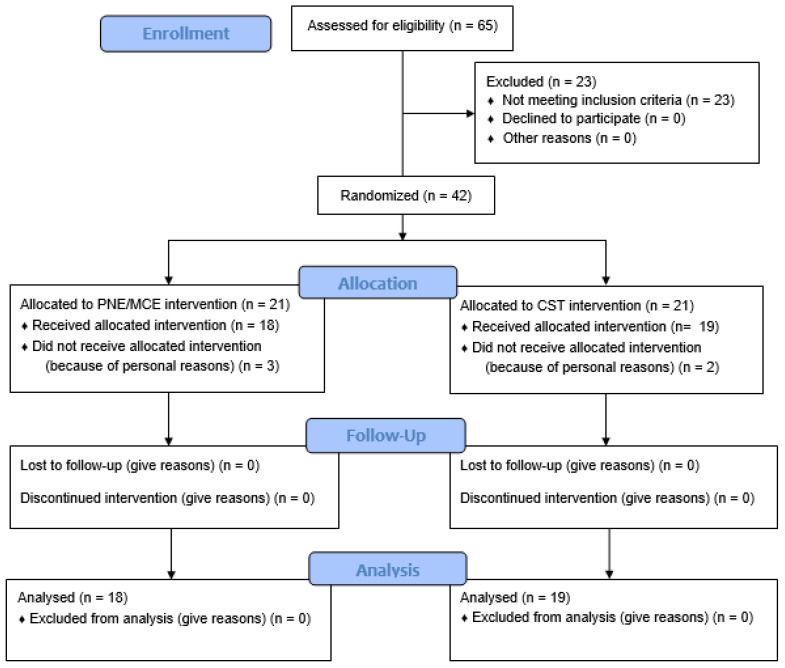
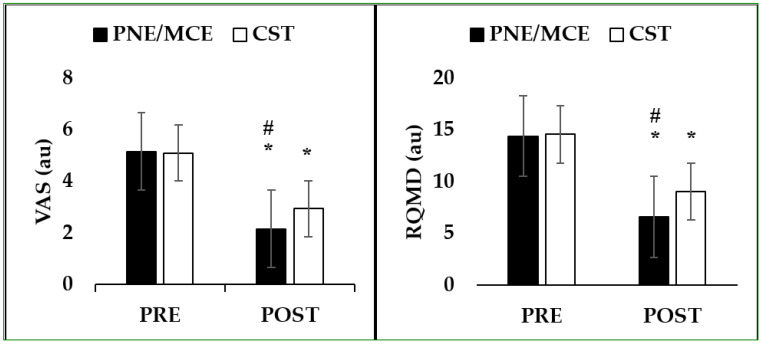
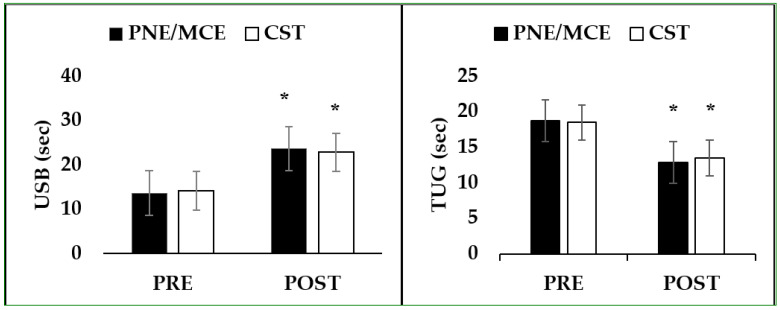
Background: Several interventions have been used to relieve chronic low back pain (CLBP). This study aimed to compare the effects of pain neuroscience education (PNE) followed by motor control exercises (MCEs) with core stability training (CST) on pain, disability, and balance in women with CLBP. Methods: Thirty-seven women with CLBP were randomly divided into two groups of PNE/MCE (n = 18, 55.2 ± 2.6 years) or CST (n = 19, 54.6 ± 2.4 years). Eight weeks of PNE/MCE or CST were prescribed for each group, independently. Pain intensity (VAS scale), disability (Roland Morris Disability Questionnaire), unipodal static balance, and dynamic balance (time up and go test) were measured at the beginning and 8 weeks after the intervention. Two-way mixed ANOVA was used to analyze the results with alpha of 5%. Results: After 8 weeks, there was a significant difference in VAS scale between groups (p = 0.024), with both PNE/MCE and CST showing 58% and 42% reductions, respectively. There were no differences for all other variables between groups. Regarding pre- to post-comparisons, both groups showed improvements in all dependent variables (p < 0.001). Conclusion: The treatment with PNE/MCE was more effective in improving pain disability and unipodal static and dynamic balance than treatment with CST. Even so, both treatments were shown to be valid and safe in improving all dependent variables analyzed in women with CLBP.
Overview
The claims and statistics of this paper haven’t been checked yet.
Free: it reads the open-access text and checks the first 5 claims that cite a source we can check. Create a free account to check every claim.
Integrity signals
Registry
Cites
Statistics
Figures
Verification
Claims the paper makes
The claims and statistics of this paper haven’t been checked yet.
Free: it reads the open-access text and checks the first 5 claims that cite a source we can check. Create a free account to check every claim.
Claims other papers make about this one
Each is checked against this paper’s own text: does it say what the citing paper says it does?
The source backs part of the claim, not all of it — or backs it for a different population, condition or comparison.
In the citing paper
“The combination of exercise therapy and health education has a strong effect on the pain variable compared to exercise therapy alone or health education alone [31,32,33,34,35,36,37,38,39,40,43].”
From Prevention of non-specific back pain through exercise and education: A systematic review and meta-analysis (2024) · cites this paper as [39]
Experimental — accuracy not yet measuredThe cited source says what the claim attributes to it.
In the citing paper
“The disability variable also showed a strong effect in the meta-analysis [28,29,30,31,32,33,36,37,39,40,41,43].”
From Prevention of non-specific back pain through exercise and education: A systematic review and meta-analysis (2024) · cites this paper as [39]
Self-check
Percentages, sums and reported differences re-computed from the paper’s own numbers.
The self-check needs the paper’s full text.
Citations
Cites
Qaseem, A., Wilt, T. J., McLean, R. M., Forciea, M. A., & for the Clinical Guidelines Committee of the American College of Physicians* (2017) · Annals of Internal Medicine · doi:10.7326/m16-2367 · Cited by 3,234
Prevention and treatment of low back pain: evidence, challenges, and promising directions
Foster, N. E., Anema, J. R., Cherkin, D., Chou, R., Cohen, S. P., Gross, D. P., Ferreira, P. H., Fritz, J. M., Koes, B. W., Peul, W., et al. (2018) · The Lancet · doi:10.1016/s0140-6736(18)30489-6 · Cited by 2,398 · cited 1×
“Several non-surgical treatments have been offered to help and decrease LBP, such as joint manipulation [2], acupuncture [6], traditional therapeutic exercises [7,8], and medication [9,10].”
BackgroundHayden, J. A., van Tulder, M. W., & Tomlinson, G. (2005) · Annals of Internal Medicine · doi:10.7326/0003-4819-142-9-200505030-00014 · Cited by 848
Louw, A., Zimney, K., Puentedura, E. J., & Diener, I. (2016) · Physiotherapy Theory and Practice · doi:10.1080/09593985.2016.1194646 · Cited by 720
Keselman, H. J., Huberty, C. J., Lix, L. M., Olejnik, S., Cribbie, R. A., Donahue, B., Kowalchuk, R. K., Lowman, L. L., Petoskey, M. D., Keselman, J. C., et al. (1998) · Review of Educational Research · doi:10.2307/1170601 · Cited by 627 · cited 2×
“A p-value 0.05 was used to determine statistical significance, while Partial Eta Squared (ηp2) values were calculated as effect size (ES), which were considered as 0.2 = small effect, 0.5 = moderate effect, and 0.8 = large effect based on the study of Cohen [41].”
BackgroundInfluentialMuscle control–pain control. What exercises would you prescribe?
Richardson, C. A., & Jull, G. A. (1995) · Manual Therapy · doi:10.1054/math.1995.0243 · Cited by 625 · cited 1×
“This phase consists of a proprioception, coordination, and sensorimotor control training program based on the principles and ideas of researchers and clinicians such as Sahrmann [38], Comerford and Mottram [39], and Richardson and Jull [40].”
MethodRadebold, A., Cholewicki, J., Polzhofer, G. K., & Greene, H. S. (2001) · Spine · doi:10.1097/00007632-200104010-00004 · Cited by 584
Motor control exercise for chronic non-specific low-back pain
Saragiotto, B. T., Maher, C. G., Yamato, T. P., Costa, L. O., Menezes Costa, L. C., Ostelo, R. W., & Macedo, L. G. (2016) · Cochrane Database of Systematic Reviews · doi:10.1002/14651858.cd012004 · Cited by 433
Mousavi, S. J., Parnianpour, M., Mehdian, H., Montazeri, A., & Mobini, B. (2006) · Spine · doi:10.1097/01.brs.0000222141.61424.f7 · Cited by 427 · cited 3×
“Time recording stops when the support foot moves, the free foot touches the ground, or the hand is detached from the waist [33].”
BackgroundMethodInfluentialHides, J., Stanton, W., Mcmahon, S., Sims, K., & Richardson, C. (2008) · Journal of Orthopaedic & Sports Physical Therapy · doi:10.2519/jospt.2008.2658 · Cited by 334 · cited 1×
“Thus, training protocols for LBP have aimed to reduce it through lumbar stability exercises that target multifidus muscles [14,15].”
Background
Cited by
Ma, X., Chen, R., Wei, L., & Huang, P. (2023) · Physiotherapy Theory and Practice · doi:10.1080/09593985.2023.2232003 · Cited by 55
“…et al., 2018; Wong et al., 2017) a growing number of studies have assessed the effect of PNE plus exercise and found controversial results (Alves, Puentedura, and Silva, 2022; Gorji et al., 2022; Kim et al., 2022; Rabiei, Sheikhi, and Letafatkar, 2021; Sharma, Jensen, Moseley, and Abbott, 2019).”
InfluentialMultifidus dysfunction and restorative neurostimulation: a scoping review
Francio, V. T., Westerhaus, B. D., Carayannopoulos, A. G., & Sayed, D. (2023) · Pain Medicine · doi:10.1093/pm/pnad098 · Cited by 51
Núñez‐Cortés, R., Salazar‐Méndez, J., Calatayud, J., Malfliet, A., Lluch, E., Méndez-Rebolledo, G., Guzmán-Muñoz, E., López‐Bueno, R., & Suso‐Martí, L. (2023) · Pain · doi:10.1097/j.pain.0000000000003126 · Cited by 46
Ryan, C. G., Karran, E. L., Wallwork, S. B., Pate, J. W., O’Keeffe, M., Fullen, B. M., Livadas, N., Jones, N., Toumbourou, J. W., Gilchrist, P. N., et al. (2023) · Journal of Pain · doi:10.1016/j.jpain.2023.10.024 · Cited by 40
Ibrahim, A. A., Akindele, M. O., & Ganiyu, S. O. (2023) · BMC Musculoskeletal Disorders · doi:10.1186/s12891-022-06108-9 · Cited by 42
Wang, C., Feng, Y., Zhong, L., Zhu, S.-Y., Zhang, C., Zheng, S.-Q., Liang, C., Wang, Y.-T., He, C.-J., Yu, C., et al. (2023) · Proceedings of the ACM on Interactive Mobile Wearable and Ubiquitous Technologies · doi:10.1145/3643552 · Cited by 13
Samakosh, H. M. N., Brito, J. P., Shojaedin, S. S., Hadadnezhad, M., & Oliveira, R. F. S. (2022) · Healthcare · doi:10.3390/healthcare10101822 · Cited by 26
“Randomization was performed with each person-specific naming code (up to 39) previously sealed: the blind person was asked to place 13 cards in three balls [18].”
MethodSelf-citationDimitrijević, V., Rašković, B., Jevtić, N., Nikolić, S., Viduka, D., & Obradović, B. (2025) · Healthcare · doi:10.3390/healthcare13090960 · Cited by 24
Mardon, A. K., Chalmers, J., Heathcote, L. C., Curtis, L.-A., Freedman, L., Malani, R., Parker, R., Neumann, P., Moseley, G. L., & Leake, H. B. (2024) · Pain · doi:10.1097/j.pain.0000000000003205 · Cited by 23
Salazar‐Méndez, J., Cuyúl-Vásquez, I., Ponce‐Fuentes, F., Guzmán-Muñoz, E., Núñez‐Cortés, R., Huysmans, E., Lluch‐Girbés, E., Viscay‐Sanhueza, N., & Fuentes, J. (2024) · Patient Education and Counseling · doi:10.1016/j.pec.2024.108201 · Cited by 22
Carral, J. M. C., Vázquez, O. C., Ledesma, S. N., & Pruimboom, L. (2025) · Annals of Physical and Rehabilitation Medicine · doi:10.1016/j.rehab.2025.102020 · Cited by 21
Tatikola, S. P., Natarajan, V., Amaravadi, S. K., Desai, V. K., Asirvatham, A. R., & Nagaraja, R. (2024) · Journal of Bodywork and Movement Therapies · doi:10.1016/j.jbmt.2024.11.016 · Cited by 18
Zheng, D. K. Y., Liu, J. Q., Chang, J. R., Ng, J. C. Y., Zhou, Z., Wu, J., Cheung, C. K. C., Huang, F. F.-Y., Pinto, S. M., Samartzis, D., et al. (2024) · Journal of sport and health science/Journal of Sport and Health Science · doi:10.1016/j.jshs.2024.100989 · Cited by 15
Sánchez-Robalino, A., Sinchi-Sinchi, H., & Ramírez, A. (2025) · Brain Sciences · doi:10.3390/brainsci15060658 · Cited by 16
“[16,19,20,24,29–31 , 33 The duration of the interventions implemented in the studies ranged from 2 to 24 weeks, with a mean intervention duration of 7.21 weeks (SD = 4.86).”
InfluentialOkudan, B., Çelik, D., & Koban, O. (2023) · European Journal of Pain · doi:10.1002/ejp.2187 · Cited by 13
“A recent study (Gorji et al., 2022) investigated the effects of motor control exercises combined with PNE and core stability exercises alone on pain intensity and disability.”
BackgroundHernandez-Lucas, P., Leirós-Rodríguez, R., Lopez-Barreiro, J., & García-Soidán, J. L. (2024) · Journal of Back and Musculoskeletal Rehabilitation · doi:10.3233/bmr-230252 · Cited by 10
“The overall risk of bias was low in eight articles [29,31,33,35,36,37,40,41], in four articles was some concerns [30,34,38,39] and in four articles was high [28,32,42,43] (Fig.”
InfluentialLendraitienė, E., Styraitė, B., Šakalienė, R., Misytė, G., & Bilevičiūtė-Ljungar, I. (2024) · Journal of Clinical Medicine · doi:10.3390/jcm13072081 · Cited by 11
“For example, in a study by Gorji et al., an educational program with motor lization exercises [29].”
von Piekartz, H., Bleiss, S., Herzer, S., Hall, T. M., & Ballenberger, N. (2024) · Journal of Oral Rehabilitation · doi:10.1111/joor.13740 · Cited by 12
Miki, T., Kondo, Y., Kurakata, H., Takebayashi, T., & Samukawa, M. (2023) · PM&R · doi:10.1002/pmrj.13002 · Cited by 13
Kircali, S., Özcan, Ö. Ö., & Karahan, M. (2024) · Brain and Behavior · doi:10.1002/brb3.70013 · Cited by 9
ALMohiza, M. A., Reddy, R. S., Alkhamis, B. A., Alghamdi, N. H., Alshahrani, A., Ponneru, B. R., & Mukherjee, D. (2023) · Biomedicines · doi:10.3390/biomedicines11072068 · Cited by 9
“Secondly, lumbar proprioception plays a crucial role in maintaining spinal stability, coordinating trunk movements, and protecting against low back pain [49]; impaired proprioception in these key lumbar movement patterns may contribute to chronic low back pain and functional limitations commonly observed in individual…”
Núñez‐Cortés, R., Salazar‐Méndez, J., Calatayud, J., Lluch‐Girbés, E., López‐Bueno, R., Horment-Lara, G., Cruz‐Montecinos, C., & Suso‐Martí, L. (2024) · Neuroscience & Biobehavioral Reviews · doi:10.1016/j.neubiorev.2024.105740 · Cited by 9
Adenis, N., Wieczorek, V., Corbinau, S., Mortain, L., & Thévenon, A. (2024) · Musculoskeletal Science and Practice · doi:10.1016/j.msksp.2024.103176 · Cited by 11
Verdugo, S. A. A., Silva, S. P. G., Saavedra, G. D. C., Araya, A. R. M., Sánchez, C. E. Z., Guzmán-Muñoz, E., Selaive, R. A. S., Alarcón-Rivera, M., & Cabezas, G. (2024) · Retos · doi:10.47197/retos.v58.103964 · Cited by 7
Si, X., Zhang, L., Li, F., & Liang, H. (2025) · BMC Women s Health · doi:10.1186/s12905-025-03644-z · Cited by 10
“Subsequently, dynamic core stability training was conducted to bolster neuromuscular control capacity [35].”
Sexual Disability in Low Back Pain: Diagnostic and Therapeutic Framework for Physical Therapists
Vanti, C., Ferrari, S., Chiodini, M., Olivoni, C., Bortolami, A., & Pillastrini, P. (2023) · Healthcare · doi:10.3390/healthcare12010080 · Cited by 7
“There is some growing evidence that it could be combined with usual care in individuals with LBP to reach better outcomes [76,77 Patients The PROMs suggested for identifying this condition and measuring clinical outcomes are the ODI [55], the ALBPS [56], and the Optimal Screening for Prediction of…”
BackgroundWójcik, M., Kampioni, M., Hudáková, Z., Siatkowski, I., Kędzia, W., & Jarząbek‐Bielecka, G. (2025) · Journal of Clinical Medicine · doi:10.3390/jcm14030767 · Cited by 8
Alvani, E., Sheikhi, B., Letafatkar, A., & Rossettini, G. (2024) · PLoS ONE · doi:10.1371/journal.pone.0309679 · Cited by 6
Zheng, D. K. Y., Sun, Z., Chang, J. R., Huang, F., Liu, Y., Yu, S., Wu, J., Wang, Z., Wong, A. Y. L., & Wang, X. (2025) · Pain Research and Management · doi:10.1155/prm/5224748 · Cited by 5
“Te timer stopped if the supporting foot moved, the free leg touched the ground or the supporting leg, or if either hand was taken of the waist [44].”
Sariana, E., Aisy, S. R., & Ali, M. (2022) · Jurnal Fisioterapi dan Kesehatan Indonesia · doi:10.59946/jfki.2022.129 · Cited by 4
“Meningkatkan stabilitas trunk dan kontrol posisi tubuh merupakan peranan penting yang dapat menetralisir muscle imbalances untuk mempertahankan posisi tubuh, sehingga mengurangi disabilitas dan meningkatkan kemampuan fungsional (Gorji et al., 2022).”
BackgroundInfluentialSamakosh, H. M. N., Oliveira, R. F. S., Shahabi, S., Sarvarifar, B., Gorji, S. M., Amirkhanloo, A., Bădicu, G., Yağın, F. H., & Alghannam, A. F. (2024) · Retos · doi:10.47197/retos.v55.105913 · Cited by 6
Self-citationZhong, Z., Guo, W., Gu, Q., Pang, T., Li, L., & Hao, A. (2025) · BMC Musculoskeletal Disorders · doi:10.1186/s12891-025-08876-6 · Cited by 8
“…the study type was RCT, and the language was limited to English and Chinese; the participants were patients who underwent ACLR, with no restrictions on gender, age, physical activity level, or graft type; the intervention measures were exercise therapies, including IT, CT, ET, WR, BFRT, MCT [19]”
Liechti, M., Schurz, A. P., Marnef, A. Q., Taeymans, J., Clijsen, R., Baur, H., Lutz, N., Deliens, T., Clarys, P., Nijs, J., et al. (2025) · Physical Therapy · doi:10.1093/ptj/pzaf097 · Cited by 3
“13,21,22 Moreover, overweight and obesity are increasingly recognized as a plausible therapeutic target for people with CNLBP. 23 Despite their close interaction, few treatment programs for people with CNLBP take overweight or obesity into account and a systematic review identif ied the need for…”
Effectiveness of pain neuroscience education among adults with chronic neck pain. Systematic review
Palahí-Calsina, I., Jubany, J., Sordo, L., Lorente, S., Espelt, A., & Borao, O. (2024) · European Journal of Physiotherapy · doi:10.1080/21679169.2024.2365694 · Cited by 4
Sotiropoulos, S., Plavoukou, T., & Georgoudis, G. (2025) · Cureus · doi:10.7759/cureus.81492 · Cited by 3
“Studies in the past have demonstrated positive outcomes in proprioception, both when physiotherapy was combined with exercise programs and when standalone strengthening or Qigong exercise programs were employed [34-36].”
Efektivitas Core Stability Exercise terhadap Pasien Low Back Pain Kronis : Literature Review
Wahyuni, W., & Rianto, S. L. P. (2025) · Quantum Wellness : Jurnal Ilmu Kesehatan · doi:10.62383/quwell.v2i2.1473 · Cited by 2
Ghasemi, E., Naji, S. S., Najafi, M. R., Ghasemi, M., & Karimi, A. (2023) · Middle East Journal of Rehabilitation and Health Studies · doi:10.5812/mejrh-136156 · Cited by 2
“Other studies have measured the effect of PNE on fatigue (10), fibromyalgia (11), chronic low back pain (12-15), and chronic neck pain (5, 16-18).”
BackgroundResultEnsiye, R., Oliveira, R. F. S., Sarvari, F. B., Molaee, F., & Mohammadi, N. S. H. (2024) · Journal of Novel Physiotherapy and Physical Rehabilitation · doi:10.17352/2455-5487.000103 · Cited by 1
Self-citationNidaussolihah, U., Ghufroni, A., & Haryatno, P. (2024) · Jurnal Nasional Fisioterapi · doi:10.64974/jnf.v2i1.34 · Cited by 1
Zhang, F., Peng, B., Tang, X., & Peng, L. (2026) · Frontiers in Human Neuroscience · doi:10.3389/fnhum.2026.1739419 · Cited by 1
Александровна, Г. А., & Golovacheva, V. A. (2024) · Neurology neuropsychiatry Psychosomatics · doi:10.14412/2074-2711-2024-5-9-16 · Cited by 2
KINEZITERAPIJOS IR SKAUSMO NEUROMOKSLO EDUKACIJOS POVEIKIS LĖTINIO SKAUSMO VALDYMUI
Šidlauskienė, A., Daubaris, K., Indriūnienė, J., Aukštikalnis, T., Bilotienė-Motiejūnienė, A., & Raistenskis, J. (2025) · Health Sciences · doi:10.35988/sm-hs.2025.031 · Cited by 1
Александровна, Г. А., Golovacheva, V. A., & Fateeva, T. G. (2025) · Meditsinskiy sovet = Medical Council · doi:10.21518/ms2024-525 · Cited by 3
Nakagawa, K., & Shimizu, H. (2023) · Exercise Medicine · doi:10.26644/em.2023.002
“Additionally, the effects of core training have been reported in numerous cases, especially for nonspecific low back pain, and there are reports that core training is effective for improving pain disorders, improving static and dynamic standing balance [5], relieving pain, improving the fatigue tolerance of core muscl…”
BackgroundLuo, S., Yang, M., Yang, H., Guo, Q., Wang, Y., & Wang, E. (2023) · Journal of Personalized Medicine · doi:10.3390/jpm14010050
“In addition, recent studies have proved that the binomial education in pain neuroscience and therapeutic exercise have a high impact on CP [49–51], that is to say, education in pain neuroscience will also influence the role of exercise in CP.”
BackgroundEffects of Core Stability Exercise on Functional Performance among Adults with Low Back Pain
Pipeng, L., Zahari, Z., Azizan, A., & Yajun, Y. (2024) · Environment-Behaviour Proceedings Journal · doi:10.21834/e-bpj.v9i28.5790
“One study showed that pain neuroscience education plus muscle control exercise could be more helpful than CSE in alleviating pain in CLBP patients(Gorji et al., 2022).”
BackgroundSinghal, T., Jain, S., Kalra, S., Chorsiya, V., Dhiman, S., Chhabra, C., & Bhutani, J. (2024) · Journal of Society of Indian Physiotherapists · doi:10.4103/jsip.jsip_40_24
Alhomidani, A. A., Alanazi, H. H., Almutairi, R. H., Almutairi, A. S., Al-Sulami, H. A., Alarifi, A. I., Almutairi, M. S., Alanazi, H. O., Alawad, F. H., & Aldanyowi, S. N. (2024) · Journal of Advanced Trends in Medical Research · doi:10.4103/atmr.atmr_161_24
Yalfani, A., Sori, F., Ahmadi, M., & Asgarpoor, A. (2025) · مجله علمی دانشگاه علوم پزشکی رفسنجان · doi:10.61186/jrums.23.12.1076
Hanif, W., Mukhtar, T., Hafeez, M., Subhani, F. U. R., Rehman, H., & Ishfaq, M. U. (2025) · Anaesthesia Pain & Intensive Care · doi:10.35975/apic.v29i7.2946
“8,9 The exercises that are central to core stabilization work to strengthen these deep muscles, thus relieving strain on the lower back and easing pain.”
Dash, S., Kumar, S., & Pal, S. (2025) · Springer transactions in civil and environmental engineering · doi:10.1007/978-981-96-4926-6_12
Ibrahim, A. A., Akindele, M. O., & Ganiyu, S. O. (2024) · Figshare · doi:10.6084/m9.figshare.26570827
Ibrahim, A. A., Akindele, M. O., & Ganiyu, S. O. (2024) · Figshare · doi:10.6084/m9.figshare.26570824
Ibrahim, A. A., Akindele, M. O., & Ganiyu, S. O. (2024) · Figshare · doi:10.6084/m9.figshare.26570833
Jacobson, A., & Lasson von Mentzer, D. (2025) · DiVA (Luleå University of Technology)
Alamri, N., Ambarika, R., & Anggraen, N. A. (2025) · Health and Technology Journal (HTechJ) · doi:10.53713/htechj.v3i5.483
Ahn, S. I., Kang, T. W., & Hong, S. (2025) · Physical therapy rehabilitation science · doi:10.14474/ptrs.2025.14.4.627
Adenis, N. (2025) · theses.fr (ABES) · doi:10.70675/37675cd0z9427z45fczaa8az3f1af854d94e
Gülyilmaz, S., & Tuncer, A. (2026) · Journal of Exercise Therapy and Rehabilitation · doi:10.15437/jetr.1460724
Sensomotorik und Schmerzsyndrome
Laube, W. (2026) · Springer eBooks · doi:10.1007/978-3-662-72826-0_13
İsmail, A. L. A. K., HATIK, S. H., BÜYÜKKIRLI, İ. C., & Aydın, E. B. (2026) · Balneo and PRM Research Journal · doi:10.12680/balneo.2026.961
Park, K.-H., & Kim, D. H. (2026) · The Journal of Korean Academy of Physical Therapy Science · doi:10.26862/jkpts.2026.06.33.2.74
Effects of Visual Feedback-based Eccentric Pulley Training on Static and Dynamic Balance Ability
Kim, D. (2026) · Archives of Orthopedic and Sports Physical Therapy · doi:10.24332/aospt.2026.22.1.05
Miki, T. (2024) · Institutional Repositories DataBase (IRDB) · doi:10.14943/doctoral.k15828
Nursafira, R. N., & Purnamawati, D. (2026) · Jurnal Kesehatan Tambusai · doi:10.31004/jkt.v7i3.60228
Wada, Z. H., Ranti, R. A., & Inatonia, I. (2024) · JOURNAL SAINS STUDENT RESEARCH
(2026) · International Journal of Drug Delivery Technology · doi:10.25258/ijddt.16.77s.177
Letafatkar, A., Alvani, E., Sheikhi, B., Hadadnezhad, M., Amirizadeh, F., Khazaei, O., & Rossettini, G. (2026) · Scientific Reports · doi:10.1038/s41598-026-67962-4
Takı, F. N., & Çankaya, M. (2026) · Sleep Science and Practice · doi:10.1186/s41606-026-00215-5
Metadata
- Authors
- Gorji, S. M., Mohammadi Nia Samakosh, H., Watt, P., Henrique Marchetti, P., & Oliveira, R.
- Affiliations
- Arak University (IR)
- Department of Biomechanics and Corrective Exercises and Sports Injuries, University of Kharazmi, Tehran 15719-14911, Iran
- University of Brighton (GB)
- Department of Kinesiology, California State University, Northridge, CA 91330, USA
- Life Quality Research Centre (PT)
- Corresponding author
- Gorji, Sahar Modares
- ORCID
- Venue
- International Journal of Environmental Research and Public Health
- Publisher
- MDPI AG
- Published
- 2022-02-25
- Volume
- 19
- Issue
- 5
- Pages
- 2694
- ISSN
- 1660-4601 (ISSN-L)
- PMC
- PMC8910692
- OpenAlex
- W4214690720
- Cited by
- 58
- References
- 61
- Citations by year
- 2026: 6 · 2025: 14 · 2024: 23 · 2023: 13 · 2022: 2
- FWCI
- 7.78
- Type
- journal article
- Language
- en
- Open access
- gold
- doi.org
- Licence
- Locations
- International Journal of Environmental Research and Public Health (publishedVersion, cc-by)
- PubMed Central (publishedVersion, cc-by)
- PubMed (publishedVersion)
- University of Brighton Repository (University of Brighton) (publishedVersion, cc-by)
- RePEc: Research Papers in Economics (submittedVersion)
- DOAJ (DOAJ: Directory of Open Access Journals) (submittedVersion, cc-by-sa)
- Portuguese National Funding Agency for Science, Research and Technology (RCAAP Project by FCT) (submittedVersion, cc-by)
- Topics
- Health Sciences › Health Professions › Physical Therapy, Sports Therapy and Rehabilitation › Musculoskeletal pain and rehabilitation
- Health Sciences › Medicine › Obstetrics and Gynecology › Pregnancy-related medical research
- Health Sciences › Medicine › Orthopedics and Sports Medicine › Spine and Intervertebral Disc Pathology
- Keywords
- chronic low back pain, pain neuroscience education, motor control exercises, core stability training, women, pain intensity, disability, balance, dynamic balance
- MeSH terms
- Core Stability, Postural Balance, Exercise Therapy, Female, Humans, Time and Motion Studies, Low Back Pain, Chronic Pain
About these checks
Registry, retraction, Cites and statistics results are computed, not judged, with one exception: a printed reference that no index lists is read once by a model before it counts as a citation error. Claims are extracted by a model and kept only when their quote appears verbatim in the text; each cited source is then checked, with a model’s help, for whether it says what the claim relies on. Those verdicts can be wrong — read the claim’s quote and the cited source before relying on one.
Statistics and arithmetic are recomputed, not judged.
Confidence bands are shown only for fields calibrated on our annotated test set. None is calibrated yet, so no band is shown.
What counts as a claim ›How we measure confidence ›How we check this ›
Are you an author, or do you see a problem with this page? Request a review
Data sources
Bibliographic data: Semantic Scholar, OpenAlex, Crossref.
Contains information from the Semantic Scholar Academic Graph Datasets, made available under the ODC Attribution License (ODC-BY 1.0).
Semantic Scholar’s data is described in: Kinney, R., et al. (2023). The Semantic Scholar Open Data Platform. arXiv:2301.10140.
