

The Prevalence of Adolescent Social Fears and Social Anxiety Disorder in School Contexts
Open accessThe DOI matches its Crossref record; 69 of the 72 references it cites were found in a registry or an index; 15 of the 52 sources its claims cite were checked for support.
Abstract
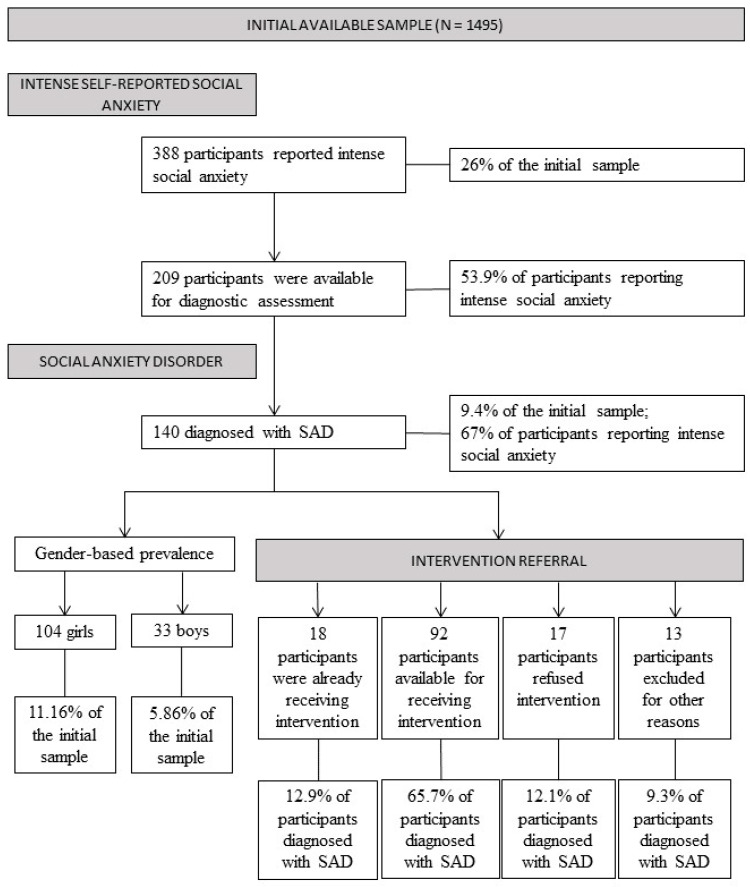
Social fears arise when fearing to be judged in social events. When these fears are intense, persistent, and debilitating, the individual may suffer from social anxiety disorder (SAD), which has its most frequent onset during adolescence and tends to be chronic. Still, evidence on the prevalence of social fears and SAD in adolescence is scarce. This study analyzed the prevalence of social fears and of SAD in Portuguese adolescents. Of the initial sample (n = 1495), 26% presented with intense self-reported social fears. Of those, 53.9% accepted to be further assessed for diagnosis, resulting in a point-estimate prevalence of adolescent SAD of 9.4%; this is slightly higher than previously found. Social performance was the most feared social event. Of the adolescents with SAD, 12.9% were receiving psychological intervention, 12.1% refused intervention, and 92 (65.7%) accepted intervention. Findings confirm SAD as a highly prevalent mental disorder among adolescents, particularly girls, and additionally, that most of these adolescents did not seek treatment but are willing to receive help if made available. Hence, schools should be invested not only in identifying vulnerable adolescents but also in providing diverse intervention options, tailored to their needs, and directing them to successful developmental trajectories. © 2022 by the authors.
Overview
CoChat Summary
TL;DR
This school-based study estimated that 26% of Portuguese adolescents reported intense self-reported social fears, and 9.4% had a point-estimate prevalence of social anxiety disorder (SAD). Among adolescents with SAD, most were not in treatment, but 65.7% were willing to accept intervention when it was offered.
Key findings
- In the initial sample of 1,495 adolescents aged 15–18 years, 26% (n = 388) scored high enough on the SAS-A to be classified as having intense self-reported social fears.
- Of those with intense social fears, 53.9% (209/388) accepted diagnostic assessment; among those assessed, 67% (140/209) received a SAD diagnosis, yielding a 9.4% prevalence in the full sample.
- SAD prevalence was higher in girls than boys: 76.4% of diagnosed adolescents were girls (n = 107), corresponding to point-estimate prevalence of 11.16% in girls and 5.86% in boys.
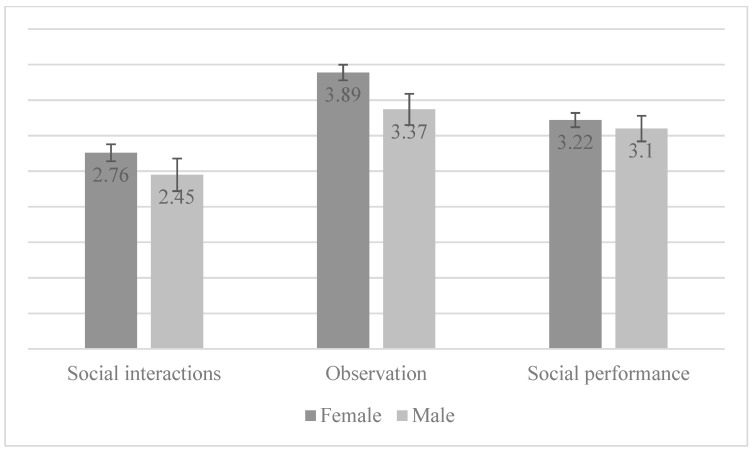
- For adolescents with SAD who entered the intervention phase, performance situations were the most feared social events, with mean scores of 3.77 (SD = 0.99) versus 3.19 (SD = 0.82) for social interactions and 2.69 (SD = 1.05) for being observed.
- Among adolescents diagnosed with SAD, only 12.9% (18/140) were already receiving psychological intervention, while 65.7% (92/140) accepted intervention when it was offered and 12.1% (17/140) refused it.
Methods
- Three-phase school-based design: screening for intense social fears, diagnostic assessment, and intervention referral.
- Sample came from Portuguese high schools in the north and center regions of Portugal; the initial sample was 1,495 students aged 15–18 years (62.3% girls).
- Screening used the Portuguese SAS-A; adolescents scoring one standard deviation above the mean on the SAS-A were invited to a MINI-KID diagnostic interview for SAD, and those in the intervention phase completed the SAASA to compare core social fears.
Limitations
- The paper states that only gender was assessed as a sociodemographic variable, so it could not examine differences by age group, school year, or socioeconomic status.
- The study was limited to schools in the north and center regions of Portugal, so broader recruitment would be needed for wider generalization.
- The paper notes a selection limitation: not the entire sample was evaluated diagnostically, only adolescents who scored high on the SAS-A, so teenagers who did not self-report social fears may have been missed.
Model-written summary. Check it against the paper before relying on it.
Integrity signals
Registry
Cites
Statistics
Figures
Verification
Claims the paper makes
8 Valid · 3 Not valid · 23 Not checked · 35 Own results and interpretations
Every source the paper cites for this claim was checked and supports it.
In the paper
“The prospective association between fear of negative evaluation and social anxiety over time has been found for adolescence [63], and so may be one of the mechanisms through which girls are more vulnerable to social anxiety than boys.”
§ The Prevalence of Adolescent Social Fears and Social Anxiety Disorder in School Contexts > 4. Discussion
What the sources say
- Supportedcites [63] Fredrick J.W. Luebbe A.M. Prospective Associations between Fears of Negative Evaluation, Fears of Positive Evaluation, and Social Anxiety Symptoms in Adolescence Child Psychiatry Hum. Dev. 2022 1 11 10.1007/s10578-022-01396-7 35790648 PMC9255539 source
The Abstract reports that adolescent- and parent-reported fear of negative evaluation predicted increased social anxiety symptoms approximately six months later. The citation supports the sentence’s prospective-association clause; the proposed explanation for girls’ greater vulnerability is the citing authors’ inference, not a finding attributed to this source. (LLM, conf=0.92)
hedgedstates a possible cause- Asserted: passes — The authors put it forward as true.
- Checkable: passes — It can be checked against evidence.
- Load-bearing: unclear — It is unclear whether the paper’s conclusions depend on it.
- Based: passes — The paper gives a reason why it holds.
- Supported
The cited sources support only part of this claim — read each source’s verdict below.
In the paper
“SAD has its most frequent onset during adolescence (i.e., before the age of 18) [4,5,6].”
§ The Prevalence of Adolescent Social Fears and Social Anxiety Disorder in School Contexts > 1. Introduction
What the sources say
- Partly supportedcites [4] Stein D.J. Lim C.C.W. Roest A.M. De Jonge P. Aguilar-Gaxiola S. Al-Hamzawi A. Alonso J. Benjet C. Bromet E.J. Bruffaerts R. The cross-national epidemiology of social anxiety disorder: Data from the World Mental Health Survey Initiative BMC Med. 2017 15 1 21 10.1186/s12916-017-0889-2 28756776 PMC5535284 sourceExperimental — accuracy not yet measured
The Results section (Age of onset; page unavailable) reports early median onset ages, with several country estimates at or before 17. It does not establish that adolescence is the most frequent onset period across all countries: the reported risk period extends into the early 40s, and South Africa’s median estimate is age 26. (LLM, conf=0.78)
- Not checked — no full text of the sourcecites [5] Knappe S. Sasagawa S. Creswell C. Developmental Epidemiology of Social Anxiety and Social Phobia in Adolescents Social Anxiety and Phobia in Adolescents Springer Cham, Switzerland 2015 39 70 10.1007/978-3-319-16703-9_3 source
- Not checked — no full text of the sourcecites [6] Kessler R.C. Berglund P. Demler O. Jin R. Merikangas K.R. Walters E.E. Lifetime Prevalence and Age-of-Onset Distributions of DSM-IV Disorders in the National Comorbidity Survey Replication Arch. Gen. Psychiatry 2005 62 593 602 10.1001/archpsyc.62.6.593 15939837 source
plain- Asserted: passes — The authors put it forward as true.
- Checkable: passes — It can be checked against evidence.
- Load-bearing: unclear — It is unclear whether the paper’s conclusions depend on it.
- Based: passes — The paper gives a reason why it holds.
- Partly supported
The cited sources that could be checked couldn’t confirm or dispute this claim.
In the paper
“On the one hand, this lends support to some youth presenting with a more evident (and perhaps circumscribed) fear of performance events, such as anticipated in the DSM-V specifier for performance SAD only [2].”
§ The Prevalence of Adolescent Social Fears and Social Anxiety Disorder in School Contexts > 4. Discussion
What the sources say
- Could not verifycites [2] American Psychiatric Association Diagnostic and Statistical Manual of Mental Disorders 5th ed. American Psychiatric Association Arlington, VA, USA 2013 10.1176/appi.books.9780890425596 sourceExperimental — accuracy not yet measured
Split into 2 atoms — 0 confirmed, 0 partially supported, 0 disputed, 0 misattributed, 2 unverifiable. Expand the claim to see per-atom verdicts.
hedgedstates an association- Asserted: passes — The authors put it forward as true.
- Checkable: passes — It can be checked against evidence.
- Load-bearing: unclear — It is unclear whether the paper’s conclusions depend on it.
- Based: passes — The paper gives a reason why it holds.
- Could not verify
A result the paper reports from its own data — it cites no other source for it, so there is none to check. The quote shows it is in the paper.
In the paper
“Relating to the initial sample (n = 1495), 9.4% of the participants had a SAD diagnosis, of which 7.9% had SAD as their primary diagnosis.”
§ The Prevalence of Adolescent Social Fears and Social Anxiety Disorder in School Contexts > 3. Results > 3.2. Prevalence of Social Anxiety Disorder Of adolescents participating in the diagnostic assessment phase of the study (n = 209), 140 (67%) presented a diagnosis of SAD, of which 118 (56.5%) had SAD as their primary diagnosis; alternatively, 33% (n = 69) did not fulfil diagnostic criteria for SAD. Those who fulfilled (M = 67.64, SD = 7.59) and did not fulfil (M = 67.12, SD = 737) those diagnostic criteria did not differ significantly on self-reported social anxiety based on the complete measure of the SAS-A (t(207) = 0.48, p = 0.63, d = 0.06). Relating to the initial sample (n = 1495), 9.4% of the participants had a SAD diagnosis, of which 7.9% had SAD as their primary diagnosis. Of the 140 adolescents diagnosed with SAD, 76.4% were girls (n = 107) and 23.6% were boys (n = 33). In relation to the complete sample (n = 1495), this signifies a prevalence point-estimate of SAD of 11.16% in girls and 5.86% for boys. Significant differences were found between boys and girls regarding the presence/absence of a SAD diagnosis (χ2(1) = 13.82, p < 0.001, d = 0.19). The standardized residual value (>|1.9|) shows that there are more girls than boys than statistically expected to have a SAD diagnosis. Alternatively, fewer boys than statistically expected had a SAD diagnosis. Still, though girls scored higher (M = 68.34, SD = 7.55) than boys (M = 65.39, SD = 7.39), the between-gender difference on the complete measure of the SAS-A was not statistically significant (t(138) = 1.97, p = 0.05, d = 0.39); it was, however, statistically significant for the fear of negative evaluation subscale only (t(138) = 3.04, p = 0.003, d = 0.56), with girls presenting significantly higher scores (M = 25.39, SD = 3.33) than boys (M = 23.21, SD = 4.30).
plainn = 1,495- Asserted: passes — The authors put it forward as true.
- Checkable: passes — It can be checked against evidence.
- Load-bearing: passes — The paper’s conclusions depend on it.
- Based: passes — The paper gives a reason why it holds.
- Rests on an assumption not shown here.
A result the paper reports from its own data — it cites no other source for it, so there is none to check. The quote shows it is in the paper.
In the paper
“Of adolescents participating in the diagnostic assessment phase of the study (n = 209), 140 (67%) presented a diagnosis of SAD, of which 118 (56.5%) had SAD as their primary diagnosis; alternatively, 33% (n = 69) did not fulfil diagnostic criteria for SAD.”
§ The Prevalence of Adolescent Social Fears and Social Anxiety Disorder in School Contexts > 3. Results > 3.2. Prevalence of Social Anxiety Disorder Of adolescents participating in the diagnostic assessment phase of the study (n = 209), 140 (67%) presented a diagnosis of SAD, of which 118 (56.5%) had SAD as their primary diagnosis; alternatively, 33% (n = 69) did not fulfil diagnostic criteria for SAD. Those who fulfilled (M = 67.64, SD = 7.59) and did not fulfil (M = 67.12, SD = 737) those diagnostic criteria did not differ significantly on self-reported social anxiety based on the complete measure of the SAS-A (t(207) = 0.48, p = 0.63, d = 0.06). Relating to the initial sample (n = 1495), 9.4% of the participants had a SAD diagnosis, of which 7.9% had SAD as their primary diagnosis. Of the 140 adolescents diagnosed with SAD, 76.4% were girls (n = 107) and 23.6% were boys (n = 33). In relation to the complete sample (n = 1495), this signifies a prevalence point-estimate of SAD of 11.16% in girls and 5.86% for boys. Significant differences were found between boys and girls regarding the presence/absence of a SAD diagnosis (χ2(1) = 13.82, p < 0.001, d = 0.19). The standardized residual value (>|1.9|) shows that there are more girls than boys than statistically expected to have a SAD diagnosis. Alternatively, fewer boys than statistically expected had a SAD diagnosis. Still, though girls scored higher (M = 68.34, SD = 7.55) than boys (M = 65.39, SD = 7.39), the between-gender difference on the complete measure of the SAS-A was not statistically significant (t(138) = 1.97, p = 0.05, d = 0.39); it was, however, statistically significant for the fear of negative evaluation subscale only (t(138) = 3.04, p = 0.003, d = 0.56), with girls presenting significantly higher scores (M = 25.39, SD = 3.33) than boys (M = 23.21, SD = 4.30).
plainn = 209- Asserted: passes — The authors put it forward as true.
- Checkable: passes — It can be checked against evidence.
- Load-bearing: passes — The paper’s conclusions depend on it.
- Based: passes — The paper gives a reason why it holds.
26 more claims
Create a free account to see all 69 claims and to verify the 3 references still open.
- It may state two separate claims as one. 22
- Probably not a substantial claim. 21
Claims other papers make about this one
Each is checked against this paper’s own text: does it say what the citing paper says it does?
The cited source says what the claim attributes to it.
In the citing paper
“12-month prevalence estimates of 4.8% [20] and point prevalence estimates of 9.4% [67] have been reported for SAD”
From Acceptance and commitment therapy as a transdiagnostic approach to adolescents with different anxiety disorders: study protocol. (2025) · cites this paper as [67]
Statistics recomputed
Every reported test result, recomputed from its test statistic and degrees of freedom. A result shows as not adding up only once an independent check has confirmed it.
- Consistentt(1493) = 7.96reported p < .001 · recomputed p < .001
“t(1493) = 7.96, p < .001”
- Consistentt(386) = 3.05reported p = .002 · recomputed p = .002
“t(386) = 3.05, p = .002”
- Consistentt(207) = 0.48reported p = .63 · recomputed p = .632
“t(207) = 0.48, p = .63”
- Consistentχ²(1) = 13.82reported p < .001 · recomputed p < .001
“χ2(1) = 13.82, p < .001”
- Consistentt(138) = 1.97reported p = .05 · recomputed p = .051
“t(138) = 1.97, p = .05”
3 more recomputed tests
Create a free account to see every test the Stats check recomputed.
Self-check
Percentages, sums and reported differences re-computed from the paper’s own numbers.
Self-check results appear here once an independent check has confirmed them.
Citations
Cites
Diagnostic and Statistical Manual of Mental Disorders
American Psychiatric Association (2013) · doi:10.1176/appi.books.9780890425596 · Cited by 116,369
Kessler, R. C., Berglund, P., Demler, O., Jin, R., Merikangas, K. R., & Walters, E. E. (2005) · Archives of General Psychiatry · doi:10.1001/archpsyc.62.6.593 · Cited by 20,391
Merikangas, K. R., He, J.-P., Burstein, M., Swanson, S. A., Avenevoli, S., Cui, L., Benjet, C., Georgiades, K., & Swendsen, J. (2010) · Journal of the American Academy of Child & Adolescent Psychiatry · doi:10.1016/j.jaac.2010.05.017 · Cited by 6,278 · cited 4×
“[38] United States 13–18 CIDI [24] (structured interview of DSM-IV diagnoses) 9.”
BackgroundResultInfluentialKessler, R. C., & Üstün, T. B. (2004) · International Journal of Methods in Psychiatric Research · doi:10.1002/mpr.168 · Cited by 4,771 · cited 4×
“MCMI-III = Millon Clinical Multiaxial Inventory, third edition; K-SADS-PL = Kiddie Schedule for Affective Disorders and Schizophrenia for School-Age Children-Present and Lifetime Version; CGAS = Children’s Global Assessment Scale; LOI-CV = Leyton Obsessional Inventory-Child Version; SCARED = Screen for Child Anxiety R…”
BackgroundInfluentialSHAFFER, D., FISHER, P., LUCAS, C. P., DULCAN, M. K., & SCHWAB-STONE, M. E. (2000) · Journal of the American Academy of Child & Adolescent Psychiatry · doi:10.1097/00004583-200001000-00014 · Cited by 3,505 · cited 3×
“MCMI-III = Millon Clinical Multiaxial Inventory, third edition; K-SADS-PL = Kiddie Schedule for Affective Disorders and Schizophrenia for School-Age Children-Present and Lifetime Version; CGAS = Children’s Global Assessment Scale; LOI-CV = Leyton Obsessional Inventory-Child Version; SCARED = Screen for Child Anxiety R…”
BackgroundInfluentialMattick, R. P., & Clarke, J. C. (1998) · Behaviour Research and Therapy · doi:10.1016/s0005-7967(97)10031-6 · Cited by 3,367
BIRMAHER, B., KHETARPAL, S., BRENT, D., CULLY, M., BALACH, L., KAUFMAN, J., & NEER, S. M. (1997) · Journal of the American Academy of Child & Adolescent Psychiatry · doi:10.1097/00004583-199704000-00018 · Cited by 2,846 · cited 2×
“MCMI-III = Millon Clinical Multiaxial Inventory, third edition; K-SADS-PL = Kiddie Schedule for Affective Disorders and Schizophrenia for School-Age Children-Present and Lifetime Version; CGAS = Children’s Global Assessment Scale; LOI-CV = Leyton Obsessional Inventory-Child Version; SCARED = Screen for Child Anxiety R…”
InfluentialLiebowitz, M. R. (2015) · Modern Trends in Pharmacopsychiatry · doi:10.1159/000414022 · Cited by 2,266
Sheehan, D. V., Sheehan, K. H., Shytle, R. D., Janavs, J., Bannon, Y., Rogers, J. E., Milo, K. M., Stock, S. L., & Wilkinson, B. (2010) · The Journal of Clinical Psychiatry · doi:10.4088/jcp.09m05305whi · Cited by 1,730 · cited 10×
“The Mini International Neuropsychiatric Interview for Children and Adolescents (MINI-KID) [22,52] was used for defining the presence/absence of a diagnosis of SAD.”
MethodInfluentialSocial Anxiety among Adolescents: Linkages with Peer Relations and Friendships
La Greca, A. M., & Lopez, N. (1998) · Journal of Abnormal Child Psychology · doi:10.1023/a:1022684520514 · Cited by 1,656 · cited 12×
“There were significant differences between participants reporting and not reporting intense self-reported fears concerning their scores on the complete measure of the SAS-A (M = 66.38, SD = 7.68 and M = 41.69, SD = 9.07; t(1493) = 7.96, p < 0.001, d = 2.94).”
BackgroundMethodInfluential
Research works printed but not linked: 2
- Cunha M. Pinto-Gouveia J. Soares I. Natureza, Frequência e Consequências Dos Medos Sociais Na Adolescência: Dados Na População Portuguesa Psychologica 2007 44 207 236
- Cunha M. Pinto-Gouveia J. Alegre S. Salvador M.C. Avaliação Da Ansiedade Na Adolescência: A Versão Portuguesa Da SAS-A Psychologica 2004 35 245 263
Cited by
The relationship between social anxiety and problematic smartphone use: a chain mediation model
Liu, C., Yang, H., Hao, Z., & Li, J. (2023) · Current Psychology · doi:10.1007/s12144-023-04574-5 · Cited by 25
“Social anxiety disorder, also known as social phobia, is an individual’s anxiety and fear caused by the possibility of being evaluated and scrutinized by others (Alves et al., 2022; Lu, 2022 ).”
Liu, C., Elhai, J. D., Montag, C., & Yang, H. (2024) · BMC Psychiatry · doi:10.1186/s12888-024-05938-2 · Cited by 25
“Studies have found that social anxiety often appears in college students [1, 3].”
Backgroundde Mooij, B., Fekkes, M., Miers, A. C., van den Akker, A. L., Scholte, R. H. J., & Overbeek, G. J. (2023) · Journal of Child and Family Studies · doi:10.1007/s10826-023-02536-w · Cited by 26
“In the long term, this may be associated with a higher quality of life, therefore acting as a protective mechanism (Alves et al., 2022).”
BackgroundFigueiredo, D. V., Alves, F., & Vagos, P. (2024) · Current Psychology · doi:10.1007/s12144-023-04650-w · Cited by 13
“Despite its significant prevalence rates in adolescence (e.g., Alves et al., 2022), evidence regarding the processes contributing to social anxiety in this developmental period is still scarce.”
Self-citationAkbari, A., Torabizadeh, C., Nick, N., Setoodeh, G., & Ghaemmaghami, P. (2025) · Child and Adolescent Psychiatry and Mental Health · doi:10.1186/s13034-025-00860-1 · Cited by 19
“Yet, these disorders are frequently ignored and few adolescents with the symptoms of social anxiety seek treatment, but are willing to get help if health services are available [14].”
Matsumoto, K., Hamatani, S., Shiga, K., Iiboshi, K., Kasai, M., Kimura, Y., Yokota, S., Watanabe, K., Kubo, Y., & Nakamura, M. (2024) · JMIR Pediatrics and Parenting · doi:10.2196/55786 · Cited by 16
“Another research focused on social fears and SAD among Portuguese youth, and 26% reported with intense self-reported social fear [9].”
BackgroundÜSTÜNDAĞ, A., Haydaroğlu, S., Sayan, D., & GÜNGÖR, M. (2025) · Scientific Reports · doi:10.1038/s41598-025-00800-1 · Cited by 22
Raeymaecker, K. D., Baetens, I., & Heel, M. V. (2025) · Journal of Research on Adolescence · doi:10.1111/jora.70052 · Cited by 7
Gu, C., Sun, X., Wei, W., Sun, J. L., Zeng, Y., & Zhang, L. (2025) · Journal of theoretical and applied electronic commerce research · doi:10.3390/jtaer20010014 · Cited by 6
Lian, W., Zhu, X., Xu, T., Fan, L., & Sun, Y. (2025) · Depression and Anxiety · doi:10.1155/da/8658973 · Cited by 9
“The prevalence of social anxiety disorder (SAD) among adolescents varies widely, ranging from approximately 0.8 % to 22.9 % [33].”
InfluentialAlhujaili, N. A., Alsubaie, B., Alzahrani, S., Aljahdali, F. H., Alghamdi, W., Almatrafi, M. M., & Alghamdi, A. A. (2024) · Adolescent Psychiatry · doi:10.2174/0122106766334789241004103754 · Cited by 4
Brustad, I. J., Haugan, T., Bjerkeset, O. A., Sund, E. R., Aune, T. K., Nordahl, H. M., & Vaag, J. R. (2024) · BMC Public Health · doi:10.1186/s12889-024-18271-w · Cited by 9
“Therefore, school may represent one of the most anxiety-provoking settings for adolescents with social anxiety [12–14].”
BackgroundBalaban, F. E., & Potas, N. (2024) · Florence Nightingale Journal of Nursing · doi:10.5152/fnjn.2024.24073 · Cited by 4
Figueiredo, D. V., Salvador, M. D. C., Rijo, D., & Vagos, P. (2025) · European Child & Adolescent Psychiatry · doi:10.1007/s00787-024-02608-2 · Cited by 2
“…GAD are ADs that hold significant prevalence rates in adolescence: 12-month prevalence estimates of 4.8% [20] and point prevalence estimates of 9.4% [67] have been reported for SAD,12-month prevalence estimates of 2.1% [20] and 6-month prevalence estimates of 9.7% [3] have been reported for GAD.”
InfluentialSelf-citationSocial Anxiety Disorder among Teenagers
Zhang, Q. (2023) · Lecture Notes in Education Psychology and Public Media · doi:10.54254/2753-7048/7/2022910 · Cited by 2
Rowe, N., & Whelan, M. (2025) · The Educational and Developmental Psychologist · doi:10.1080/20590776.2024.2445298 · Cited by 1
“During adolescence, school is one of the most common contexts in which social anxiety symptoms are reported (Alves et al., 2022; Jystad et al., 2024), often with detrimental impacts to academic (Vilaplana-Pérez et al., 2021) and social functioning and wellbeing (Lochner et al., 2003).”
Bavi, S., Salar, A. R., Talayeri, A., & Bahmaei, H. (2025) · Journal of Contemporary Psychotherapy · doi:10.1007/s10879-025-09676-8 · Cited by 1
The comorbidity of problematic smartphone use and social anxiety: evidence from a network analysis
Liu, C., Yang, H., & Hao, Z. (2025) · Current Psychology · doi:10.1007/s12144-025-08441-3 · Cited by 2
“Social anxiety is anxiety and fear experienced due to evaluation and scrutiny when individuals come into contact with others (Alves et al., 2022; Lu, 2022 ).”
Velthuizen, S. L. M., Miers, A. C., van den Bos, E., Hagen, A., & Westenberg, P. M. (2025) · Journal of Child and Family Studies · doi:10.1007/s10826-025-03187-9 · Cited by 3
“Directly approaching socially anxious adolescents via schools to offer treatment has been shown to be a successful way to increase treatment-seeking rates (Alves et al., 2022).”
Cui, L., Zhang, J., Hu, H., Jia, S., & Tang, X. (2025) · Research on Social Work Practice · doi:10.1177/10497315251399894 · Cited by 3
Darlami, S., Aryal, R., Rajbanshi, M., Bhandari, S., Bhandari, K., Oli, L., & Joshi, M. (2025) · Medicine · doi:10.1097/md.0000000000046845 · Cited by 1
“[29] Other personal factors like behavioral inhibition and how they interpret social situations, as well as interpersonal factors like their social interactions, might influence the progression of their social anxiety symptoms.”
InfluentialFigueiredo, D. V., Vagos, P., Ganho-Ávila, A., Salvador, M. D. C., Nobre-Lima, L., & Rijo, D. (2023) · Journal of Evidence-Based Psychotherapies · doi:10.24193/jebp.2023.1.2 · Cited by 3
Self-citationAnsiedad social en la adolescencia: un estudio transnacional entre Francia y España
Delgado, B., Martínez, M., Martínez-Monteagudo, M. C., & Sória, I. N. (2024) · European Journal of Education and Psychology · doi:10.32457/ejep.v17i1.2426 · Cited by 7
Carrozzino, M. A., Santaguida, E., Marconi, C., Pisani, S., Calvis, I., Sanchez-Vives, M. V., Slater, M., & Bergamasco, M. (2024) · Lecture notes in computer science · doi:10.1007/978-3-031-71704-8_17 · Cited by 2
Barata, M., Ferreira, A., & Vagos, P. (2022) · Psicologia · doi:10.17575/psicologia.1786 · Cited by 1
Self-citationEdukasi dan Pemeriksaan Kesehatan Jiwa Remaja Menggunakan Instrumen IDASS-Y di SMPN 23 Padang
Wenny, B. P., Mahathir, M., Ningsih, A. R., Freska, W., Lenggogeni, D. P., Sarfika, R., Refnandes, R., Sribanowo, A., Susianty, S., & Yuliharni, S. (2023) · Warta Pengabdian Andalas · doi:10.25077/jwa.30.4.655-667.2023
Urdu Adaptation and Validation of Social Interaction Anxiety Scale: A Confirmatory Factor Analysis.
Ilyas, U., & Dawood, S. (2024) · PubMed Central
Reichert, R. A., Fidalgo, T. M., do Pinho, J. C. G., Valachinski, Á. W., de MICHELI, D., & da Silveira, D. X. (2025) · Springer eBooks · doi:10.1007/978-3-031-82614-6_19
The Arabic Version Validation of the Social Worries Questionnaire for Preadolescent Children
Saraireh, A., & Aldahadha, B. (2025) · Children · doi:10.3390/children12080994 · Cited by 1
Vagos, P., Figueiredo, D. V., & Cunha, M. I. V. A. (2025) · European Child & Adolescent Psychiatry · doi:10.1007/s00787-025-02824-4 · Cited by 1
Self-citationVisualization of Fear, or Fear Makes the Wolf Bigger Than He Is
Tarasova, S. (2025) · Lecture notes in networks and systems · doi:10.1007/978-3-032-10289-8_12
Silent Struggles: Exploring Social Anxiety and Its Impact on Nigerian Adolescents
Muhammed, S., & Omidire, M. F. (2026) · Journal of Educational Cultural and Psychological Studies (ECPS Journal) · doi:10.7358/ecps-2025-032-muom · Cited by 1
Bahramkhani, M., & Isazadeh, M. (2026) · Iranian Journal of Psychiatry and Behavioral Sciences · doi:10.5812/ijpbs-162436
“…the most prevalent emotional challenges during this stage is social anxiety, the early onset of which impacts an individual’s psychological and social life, for instance, creating difficulties in peer relationships, participation in group and school activities, and most social executive tasks (1).”
Dias, T., & Moreira, H. (2026) · Child Psychiatry & Human Development · doi:10.1007/s10578-026-02000-y · Cited by 1
Armas, H. M. A., Calmet, V. G. V., Ballesteros, M. A. A., Alva, L. A. Y., Noé-Grijalva, M., & Villarreal, M. D. C. Q. (2026) · Healthcare · doi:10.3390/healthcare14081029
Biopsychosocial Correlates of Facial Emotion Recognition in Early Adolescence
Ball, P. L., Boyes, A., Andrews, S. C., Parker, M. J., Prince, T., Mills, L., & Hermens, D. F. (2026) · New Directions for Child and Adolescent Development · doi:10.1155/cad/3910344
Fernández‐Martínez, I., Morales, A., & Orgilés, M. (2026) · The Spanish Journal of Psychology · doi:10.1017/sjp.2026.10044
“…comparison, external or internal threat-related cues — such as social fears, worries, or fear of physiological arousal — catastrophic misinterpretations, and anxiety-related impairment in school and social settings) (Alves et al., 2022; Baker et al., 2022; Beesdo et al., 2009; Rapee et al., 2019).”
Metadata
- Authors
- Alves, F., Figueiredo, D. V., & Vagos, P.
- Affiliations
- University of Coimbra (PT)
- Universidade Portucalense (PT)
- Corresponding author
- Vagos, Paula
- Venue
- International Journal of Environmental Research and Public Health
- Publisher
- MDPI AG
- Published
- 2022-09-30
- Volume
- 19
- Issue
- 19
- Pages
- 12458
- ISSN
- 1660-4601 (ISSN-L)
- PMC
- PMC9566153
- OpenAlex
- W4303685725
- Semantic Scholar
- e0e9dbf9a1718502b74a2430730dbc0b4c2f4c82
- Cited by
- 38
- References
- 72
- Citations by year
- 2026: 6 · 2025: 15 · 2024: 10 · 2023: 6 · 2022: 1
- FWCI
- 7.35
- Type
- journal article
- Language
- en
- Open access
- gold
- doi.org
- Licence
- Locations
- International Journal of Environmental Research and Public Health (publishedVersion, cc-by)
- PubMed Central (publishedVersion, cc-by)
- PubMed (publishedVersion)
- RePEc: Research Papers in Economics (submittedVersion)
- DOAJ (DOAJ: Directory of Open Access Journals) (submittedVersion)
- Funders
- European Social Fund (POCI-01-0145-FEDER-029445)
- Portuguese Foundation for Science and Technology (FCT) (POCI-01-0145-FEDER-029445)
- Topics
- Social Sciences › Psychology › Experimental and Cognitive Psychology › Anxiety, Depression, Psychometrics, Treatment, Cognitive Processes
- Social Sciences › Psychology › Clinical Psychology › Child and Adolescent Psychosocial and Emotional Development
- Health Sciences › Medicine › Psychiatry and Mental health › Mental Health Treatment and Access
- Keywords
- social anxiety disorder, social fear, adolescents, prevalence, school mental health, help-seeking, gender differences, social performance, psychological intervention, Portuguese adolescents
- MeSH terms
- Phobia, Social, Adolescent, Anxiety, Fear, Female, Humans, Schools, Prevalence
About these checks
Registry, retraction, Cites and statistics results are computed, not judged, with one exception: a printed reference that no index lists is read once by a model before it counts as a citation error. Claims are extracted by a model and kept only when their quote appears verbatim in the text; each cited source is then checked, with a model’s help, for whether it says what the claim relies on. Those verdicts can be wrong — read the claim’s quote and the cited source before relying on one.
The claim verdicts this report counts are experimental: their accuracy is not yet measured.
A language model drew the claims from the paper on 2026-10-11, under version 3 of the claim definition (model deepseek-v4.1-flash, prompt extract-v3).
A second model labelled each claim on 2026-10-11 (model jev-1.13-20260917, definition revision gold-guideline-v0.2).
Cited sources are checked with a language model’s help (gpt-6-sol).
Statistics and arithmetic are recomputed, not judged.
Confidence bands are shown only for fields calibrated on our annotated test set. None is calibrated yet, so no band is shown.
What counts as a claim ›How we measure confidence ›How we check this ›
Are you an author, or do you see a problem with this page? Request a review
Data sources
Bibliographic data: Semantic Scholar, OpenAlex, Crossref.
Contains information from the Semantic Scholar Academic Graph Datasets, made available under the ODC Attribution License (ODC-BY 1.0).
Semantic Scholar’s data is described in: Kinney, R., et al. (2023). The Semantic Scholar Open Data Platform. arXiv:2301.10140.
