

Association between Chronotype and Sleep Quality among Chinese College Students: The Role of Bedtime Procrastination and Sleep Hygiene Awareness
Open accessThe DOI matches its Crossref record; 62 of the 62 references it cites were found in a registry or an index.
Abstract
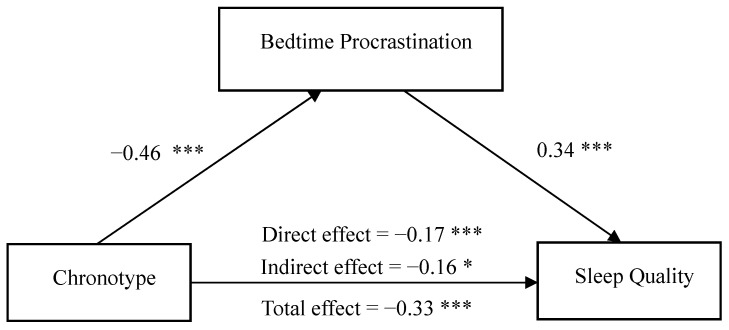
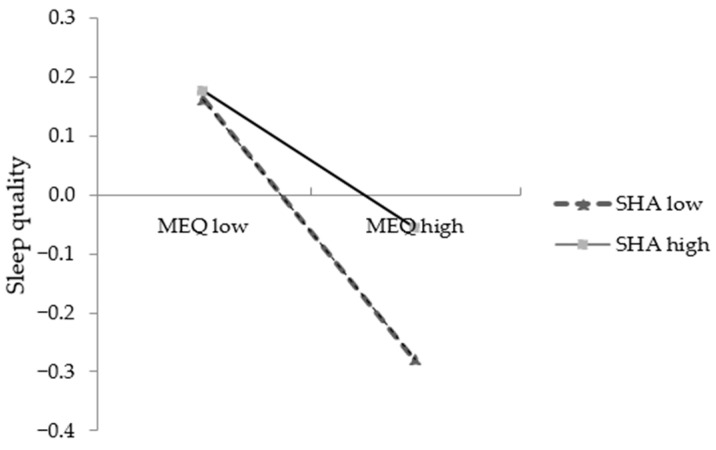
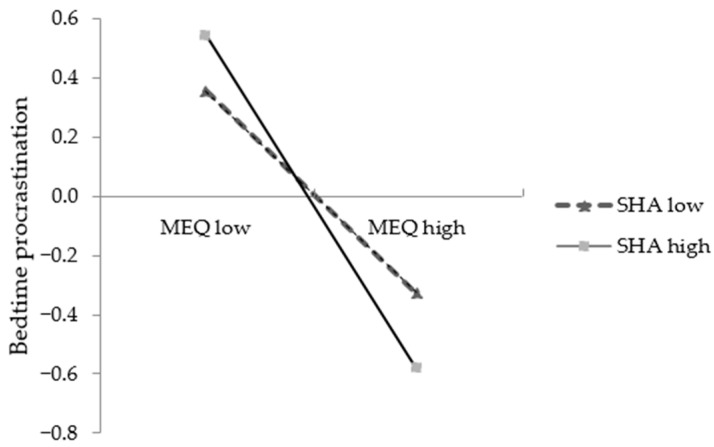
Chronotype and sleep quality have been shown to play significant roles in influencing people’s physical and mental health. The current study focuses on examining the relationship between chronotype and sleep quality among Chinese college students and exploring the mediating role of bedtime procrastination and the moderating role of sleep hygiene awareness. A sample of 2822 college students (female = 71.4%) aged between 17 and 29 years (M = 19.77, SD = 1.41) were included and completed the measures of the Pittsburgh Sleep Quality Index (PSQI), Morningness–Eveningness Questionnaire (MEQ), Bedtime Procrastination Scale (BPS) and Sleep Hygiene Awareness Scale (SHAS). The results showed that evening-type students reported the lowest sleep quality and highest levels of bedtime procrastination. In contrast, the highest sleep quality and lowest levels of bedtime procrastination were shown by morning-type, exhibiting the neither-type students’ intermediate chronotype. Bedtime procrastination partially mediated the relationship between chronotype and sleep quality. Furthermore, sleep hygiene awareness moderated the direct effect of chronotype on sleep quality and the effect of chronotype in the path from chronotype to bedtime procrastination. Specifically, higher levels of sleep hygiene awareness could buffer the adverse effect of chronotype on self-reported sleep quality but bolstered the negative effect of chronotype on bedtime procrastination. Our results suggest that individuals with an evening preference are inclined to postpone their bedtime and further experience poorer sleep quality at night. Sleep hygiene awareness may serve as a protective factor for poor nocturnal sleep. Overall, the findings highlight the importance of reducing bedtime procrastination and improving sleep hygiene awareness in the interventions designed to help college students to own a better sleep quality, especially for those with evening chronotypes.
Overview
The claims and statistics of this paper haven’t been checked yet.
Free: it reads the open-access text and checks the first 5 claims that cite a source we can check. Create a free account to check every claim.
Integrity signals
Registry
Cites
Statistics
Figures
Verification
Claims the paper makes
The claims and statistics of this paper haven’t been checked yet.
Free: it reads the open-access text and checks the first 5 claims that cite a source we can check. Create a free account to check every claim.
Claims other papers make about this one
Each is checked against this paper’s own text: does it say what the citing paper says it does?
The cited source says what the claim attributes to it.
In the citing paper
“The Cronbach’s α coefficient for this scale was 0.60, indicating moderate reliability [33].”
From Neglected sleep quality problems in women with gestational diabetes mellitus: a multi-center cross-sectional study (2024) · cites this paper as [33]
Self-check
Percentages, sums and reported differences re-computed from the paper’s own numbers.
The self-check needs the paper’s full text.
Citations
Cites
The Pittsburgh Sleep Quality Index: a new instrument for psychiatric practice and research
Buysse, D. J., Reynolds, C. F., Monk, T. H., Berman, S. R., & Kupfer, D. J. (1989) · Psychiatry Research · doi:10.1016/0165-1781(89)90047-4 · Cited by 35,234 · cited 1×
“Sleep quality was measured with the Pittsburgh Sleep Quality Index (PSQI) which is a self-rated questionnaire that assesses participants’ sleep quality and sleep disturbance during a 1-month period [49].”
MethodA self-assessment questionnaire to determine morningness- eveningness in human circadian rhythms
Home, J. K. (1976) · Medical Entomology and Zoology · Cited by 4,783
(1976) · PubMed · Cited by 3,979
Life between Clocks: Daily Temporal Patterns of Human Chronotypes
Roenneberg, T., Wirz-Justice, A., & Merrow, M. (2003) · Journal of Biological Rhythms · doi:10.1177/0748730402239679 · Cited by 2,662
Social Jetlag: Misalignment of Biological and Social Time
Wittmann, M., Dinich, J., Merrow, M., & Roenneberg, T. (2006) · Chronobiology International · doi:10.1080/07420520500545979 · Cited by 2,625 · cited 2×
“, work and school schedules) [17], but for those with evening chronotypes, it seems to be difficult to fall asleep in the time frame before the biologically preferred bedtime, indicating that once eveningness generates the intention to go to bed earlier or ‘on time’ to get sufficient sleep, they are prone to failing t…”
BackgroundHayes, A. F., & Matthes, J. (2009) · Behavior Research Methods · doi:10.3758/brm.41.3.924 · Cited by 2,448 · cited 1×
“Finally, to further understand the nature of the moderation effect, conditional direct and indirect effects (“simple slopes”) were estimated by using the “pick-a-point” approach [54], with the sample plus and minus 1 SD from the mean representing “high” and “low” sleep hygiene awareness.”
MethodCircadian typology: a comprehensive review
Adan, A., Archer, S. N., Hidalgo, M. P., Di Milia, L., Natale, V., & Randler, C. (2012) · Chronobiology International · doi:10.3109/07420528.2012.719971 · Cited by 1,384 · cited 1×
“Specifically, morning-type individuals tend to wake up early in the morning and achieve their peak mental and physical performance at this time, whereas eveningtypes, the so-called ‘owls’, demonstrate the opposite characteristics: wake up and go to bed late in the evening and perform best at the end of the day, often…”
BackgroundWoods, H. C., & Scott, H. (2016) · Journal of Adolescence · doi:10.1016/j.adolescence.2016.05.008 · Cited by 1,302 · cited 1×
“Not getting enough sleep has also been confirmed by numerous studies to be associated with many other health problems, including lower life satisfaction [71], high levels of anxiety and depression [72], poor academic performance and daytime sleepiness [73].”
BackgroundProtective and risk factors for adolescent sleep: A meta-analytic review
Bartel, K. A., Gradisar, M., & Williamson, P. (2015) · Sleep Medicine Reviews · doi:10.1016/j.smrv.2014.08.002 · Cited by 563 · cited 1×
“Not getting enough sleep has also been confirmed by numerous studies to be associated with many other health problems, including lower life satisfaction [71], high levels of anxiety and depression [72], poor academic performance and daytime sleepiness [73].”
BackgroundBrown, F. C., Buboltz, W. C., & Soper, B. (2002) · Behavioral Medicine · doi:10.1080/08964280209596396 · Cited by 421 · cited 2×
“Some cross-sectional studies investigating the relationship between circadian typology and sleep hygiene knowledge indicated that evening-type subjects showed more wrong beliefs about sleep than that of the morning- and neither-types [39,40], further supporting previous findings that poor sleep health knowledge may le…”
BackgroundResult
Research works printed but not linked: 12
- Zhu Y.Y. Ma X.Q. Tang Z.Y. Yang M.Q. Impact of Chronotype on Symptoms of Depression in College Students: A Moderate Mediation Model Stud. Psychol. Behav. 2021 19 657 664
- Li L. Sun H.M. Review of research on bedtime procrastination China J. Health Psychol. 2020 28 316 320
- Parker B.J. Plank R.E. A uses and gratifications perspective on the internet as a new information source Lat. Am. Bus. Rev. 2020 18 43 49
- You Z.Q. Xu Y. Zhang L. Sun X.J. The Predictive Effect of Self-Control on Sleep Quality: The Mediating Role of Rumination and Bedtime Procrastination Chin. J. Appl. Psychol. 2020 26 75 82
- Perlis M. Aloia M. Kuhn B. Behavioral Treatments for Sleep Disorders Elsevier Inc. London, UK 2011
- Ma X.H. Zhu L.W. Guo J. Zhao Y. Fu Y.M. Mu L. Reliability and Validity of the Bedtime Procrastination Scale in Chinese College Students Chin. J. Clin. Psychol. 2021 29 717 720
- Liu X.C. Tang M.Q. Hu L. Wang A.Z. Wu H.X. Zhao G.F. Gao C.N. Li W.S. Reliability and validity of the Pittsburgh sleep quality index Chin. J. Psychiatry 1996 29 103 107
- Pan J.Y. The Diagnosis and Management of Sleep Disorders South China University of Technology Press Guangzhou, China 2001
- Zhang Y.G. Yu C.H. Li J.Y. Correlation of sleep quality with sleep hygiene awareness, beliefs and attitudes about sleep in patients with lung cancer Guangxi Med. J. 2019 41 1749 1752
- Hayes A.F. Introduction to Mediation, Moderation, and Conditional Process Analysis The Guilford Press New York, NY, USA 2013
- Lian S. Liu Q.Q. Sun X.J. Zhou Z.K. Mobile Phone Addiction and College Students’Procrastination: Analysis of a Moderated Mediation Model Psychol. Dev. Educ. 2018 34 595 604
- Wang Z.H. The research of college students’ sleep health consciousness and habits Acta Univ. Med. Nanjing 2013 55 134 138
Cited by
Zhao, Z., & Kou, Y. (2024) · Frontiers in Psychology · doi:10.3389/fpsyg.2023.1287735 · Cited by 74
Günal, A. M. (2023) · Frontiers in Nutrition · doi:10.3389/fnut.2023.1301818 · Cited by 34
“Sleep quality, in turn, is influenced by the alignment of sleep patterns with individual chronotypes, impacting overall restfulness and vitality (7, 8).”
BackgroundQi, H., Liu, R., Zhou, J. L., Feng, Y., Feng, L., Feng, Z., & Fang, Y. (2023) · Sleep And Breathing · doi:10.1007/s11325-023-02798-0 · Cited by 33
“Sleep hygiene awareness is the knowledge or awareness of sleep hygiene people acquire, such as reducing caffeine intake, taking regular exercise, not sleeping too late, and getting up at the same time each day [9].”
BackgroundMao, B., Xie, Z., Liu, M., Gong, Y., Wang, H., Yang, S., Liao, M., Xiao, T., Tang, S., Wang, Y., et al. (2024) · Journal of Affective Disorders · doi:10.1016/j.jad.2024.01.188 · Cited by 31
The Relationship between Sleep, Chronotype, and Dental Caries—A Narrative Review
Kurtović, A., Talapko, J., Bekić, S., & Škrlec, I. (2023) · Clocks & Sleep · doi:10.3390/clockssleep5020023 · Cited by 36
Metadata
- Authors
- Zhu, Y., Huang, J., & Yang, M.
- Affiliations
- Tianjin Normal University (CN)
- Zhengzhou University (CN)
- Corresponding author
- Yang, Minqi
- Venue
- International Journal of Environmental Research and Public Health
- Publisher
- MDPI AG
- Published
- 2022-12-23
- Volume
- 20
- Issue
- 1
- Pages
- 197
- ISSN
- 1660-4601 (ISSN-L)
- PMC
- PMC9820042
- OpenAlex
- W4312173240
- Cited by
- 60
- References
- 62
- Citations by year
- 2026: 16 · 2025: 16 · 2024: 19 · 2023: 9
- FWCI
- 10.12
- Type
- journal article
- Language
- en
- Open access
- gold
- doi.org
- Licence
- Locations
- International Journal of Environmental Research and Public Health (publishedVersion, cc-by)
- PubMed Central (publishedVersion, cc-by)
- PubMed (publishedVersion)
- RePEc: Research Papers in Economics (submittedVersion)
- Funders
- Philosophy and Social Science Planning Project of Tianjin City (TJJXQN19-006)
- Topics
- Social Sciences › Psychology › Experimental and Cognitive Psychology › Sleep and related disorders
- Social Sciences › Psychology › Experimental and Cognitive Psychology › Sleep and Work-Related Fatigue
- Life Sciences › Neuroscience › Endocrine and Autonomic Systems › Circadian rhythm and melatonin
- Keywords
- chronotype, sleep quality, bedtime procrastination, university students, evening chronotype, mediation, moderation, Chinese students
- MeSH terms
- Sleep Hygiene, Procrastination, Sleep Quality, Chronotype, Adolescent, Adult, Circadian Rhythm, Female, Humans, Sleep Initiation and Maintenance Disorders, Surveys and Questionnaires, Sleep, Students, Young Adult
About these checks
Registry, retraction, Cites and statistics results are computed, not judged, with one exception: a printed reference that no index lists is read once by a model before it counts as a citation error. Claims are extracted by a model and kept only when their quote appears verbatim in the text; each cited source is then checked, with a model’s help, for whether it says what the claim relies on. Those verdicts can be wrong — read the claim’s quote and the cited source before relying on one.
Statistics and arithmetic are recomputed, not judged.
Confidence bands are shown only for fields calibrated on our annotated test set. None is calibrated yet, so no band is shown.
What counts as a claim ›How we measure confidence ›How we check this ›
Are you an author, or do you see a problem with this page? Request a review
Data sources
Bibliographic data: Semantic Scholar, OpenAlex, Crossref.
Contains information from the Semantic Scholar Academic Graph Datasets, made available under the ODC Attribution License (ODC-BY 1.0).
Semantic Scholar’s data is described in: Kinney, R., et al. (2023). The Semantic Scholar Open Data Platform. arXiv:2301.10140.
