

The DOI matches its Crossref record; 304 of the 304 references it cites were found in a registry or an index.
Axonal Organelles as Molecular Platforms for Axon Growth and Regeneration after Injury
Abstract
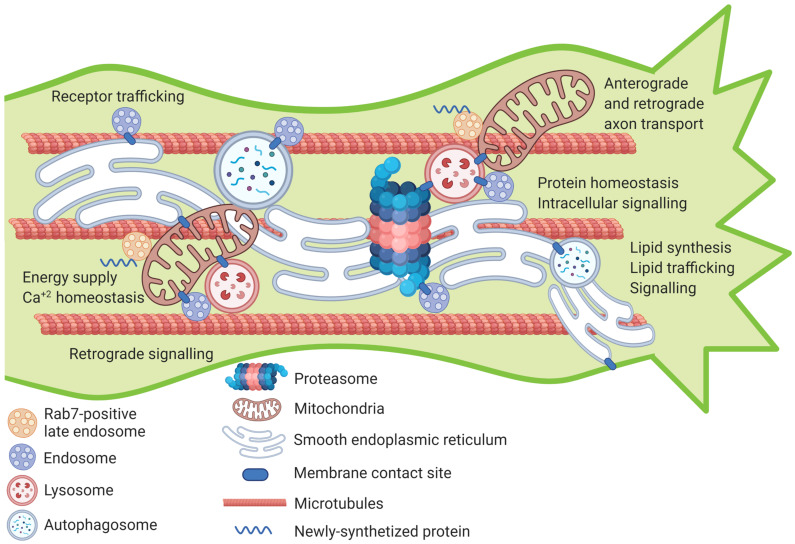
Investigating the molecular mechanisms governing developmental axon growth has been a useful approach for identifying new strategies for boosting axon regeneration after injury, with the goal of treating debilitating conditions such as spinal cord injury and vision loss. The picture emerging is that various axonal organelles are important centers for organizing the molecular mechanisms and machinery required for growth cone development and axon extension, and these have recently been targeted to stimulate robust regeneration in the injured adult central nervous system (CNS). This review summarizes recent literature highlighting a central role for organelles such as recycling endosomes, the endoplasmic reticulum, mitochondria, lysosomes, autophagosomes and the proteasome in developmental axon growth, and describes how these organelles can be targeted to promote axon regeneration after injury to the adult CNS. This review also examines the connections between these organelles in developing and regenerating axons, and finally discusses the molecular mechanisms within the axon that are required for successful axon growth.
Overview
The claims and statistics of this paper haven’t been checked yet.
Run the check — free, no account needed. It reads the open-access text and checks the sources it cites.
Integrity signals
Registry
Cites
Statistics
Figures
Verification
Claims the paper makes
The claims and statistics of this paper haven’t been checked yet.
Run the check — free, no account needed. It reads the open-access text and checks the sources it cites.
Claims other papers make about this one
Each is checked against this paper’s own text: does it say what the citing paper says it does?
In the citing paper
“Conversely, loss-of-function mutations or down-regulation of Rab5, Rab4, Rab35, Rab33a or Rab10 result in impaired axonal growth.13”
From Endosomal protein DENND10 promotes developmental competence of neurite extension (2025) · cites this paper as [13]
In the citing paper
“Rab11 and Rab35, two small GTPases found on recycling endosomes, promote neurite outgrowth and axonal elongation.7,13”
From Endosomal protein DENND10 promotes developmental competence of neurite extension (2025) · cites this paper as [13]
Self-check
Percentages, sums and reported differences re-computed from the paper’s own numbers.
The self-check needs the paper’s full text.
Citations
Cites
Mutations in the parkin gene cause autosomal recessive juvenile parkinsonism
Kitada, T., Asakawa, S., Hattori, N., Matsumine, H., Yamamura, Y., Minoshima, S., Yokochi, M., Mizuno, Y., & Shimizu, N. (1998) · Nature · doi:10.1038/33416 · Cited by 5,227
Control of inositol 1,4,5-trisphosphate-induced Ca2+ release by cytosolic Ca2+
Bootman, M. D., Missiaen, L., Parys, J. B., SMEDT, H. D., & Casteels, R. (1995) · Biochemical Journal · doi:10.1042/bj3060445 · Cited by 5,131
Hereditary Early-Onset Parkinson's Disease Caused by Mutations in PINK1
Valente, E. M., Abou-Sleiman, P. M., Caputo, V., Muqit, M. M. K., Harvey, K., Gispert, S., Ali, Z., Del Turco, D., Bentivoglio, A. R., Healy, D. G., et al. (2004) · Science · doi:10.1126/science.1096284 · Cited by 3,481
Rab GTPases as coordinators of vesicle traffic
Stenmark, H. (2009) · Nature Reviews Molecular Cell Biology · doi:10.1038/nrm2728 · Cited by 3,413
Chen, H., Detmer, S. A., Ewald, A. J., Griffin, E. E., Fraser, S. E., & Chan, D. C. (2003) · The Journal of Cell Biology · doi:10.1083/jcb.200211046 · Cited by 2,601
Mitochondria as multifaceted regulators of cell death
Bock, F. J., & Tait, S. W. G. (2019) · Nature Reviews Molecular Cell Biology · doi:10.1038/s41580-019-0173-8 · Cited by 2,593
The establishment of polarity by hippocampal neurons in culture.
Dotti, C., Sullivan, C., & Banker, G. (1988) · The Journal of Neuroscience · doi:10.1523/jneurosci.08-04-01454.1988 · Cited by 1,862
Kinesin superfamily motor proteins and intracellular transport
Hirokawa, N., Noda, Y., Tanaka, Y., & Niwa, S. (2009) · Nature Reviews Molecular Cell Biology · doi:10.1038/nrm2774 · Cited by 1,859
Promoting Axon Regeneration in the Adult CNS by Modulation of the PTEN/mTOR Pathway
Park, K. K., Liu, K., Hu, Y., Smith, P. D., Wang, C., Cai, B., Xu, B., Connolly, L., Kramvis, I., Sahin, M., et al. (2008) · Science · doi:10.1126/science.1161566 · Cited by 1,686
Mutations in the mitochondrial GTPase mitofusin 2 cause Charcot-Marie-Tooth neuropathy type 2A
Züchner, S., Mersiyanova, I. V., Muglia, M., Bissar-Tadmouri, N., Rochelle, J., Dadali, E. L., Zappia, M., Nelis, E., Patitucci, A., Senderek, J., et al. (2004) · Nature Genetics · doi:10.1038/ng1341 · Cited by 1,572
Research works printed but not linked: 2
- Valenzuela, 2014, Transport along the dendritic endoplasmic reticulum mediates the trafficking of GABAB receptors, J. Cell Sci., 127, 3382
- Mattson, 1999, Evidence for mitochondrial control of neuronal polarity, J. Neurosci. Res., 56, 8, 10.1002/(SICI)1097-4547(19990401)56:1<8::AID-JNR2>3.0.CO;2-G · DOI
Cited by
Roy, D., & Tedeschi, A. (2021) · Cells · doi:10.3390/cells10051078 · Cited by 68
Endosomal protein DENND10 promotes developmental competence of neurite extension
Li, A., Zhang, J., Ma, C., Qi, L., Hu, Q., Li, Q., Fang, Y., Song, J., Liu, Y., & Zhang, Y. (2025) · iScience · doi:10.1016/j.isci.2025.112385
Metadata
- Authors
- Petrova, V., Nieuwenhuis, B., Fawcett, J. W., & Eva, R.
- Affiliations
- John van Geest Centre for Brain Repair, Department of Clinical Neurosciences, University of Cambridge, Cambridge CB2 0PY, UK
- Venue
- International Journal of Molecular Sciences
- Publisher
- MDPI AG
- Published
- 2021-02-11
- Volume
- 22
- Issue
- 4
- Pages
- 1798
- ISSN
- 1422-0067
- PMC
- PMC7918155
- Cited by
- 32
- References
- 304
- Language
- en
- Funders
- Medical Research Council (MR/R004544/1)
- Czech Ministry of Education (CZ.02.1.01/0.0./0.0/ 15_003/0000419)
- International Foundation for Research in Paraplegia (RG88062)
About these checks
Registry, retraction, Cites and statistics results are computed, not judged, with one exception: a printed reference that no index lists is read once by a model before it counts as a citation error. Claims are extracted by a model and kept only when their quote appears verbatim in the text; each cited source is then checked, with a model’s help, for whether it says what the claim relies on. Those verdicts can be wrong — read the claim’s quote and the cited source before relying on one.
Statistics and arithmetic are recomputed, not judged.
Confidence bands are shown only for fields calibrated on our annotated test set. None is calibrated yet, so no band is shown.
What counts as a claim ›How we measure confidence ›How we check this ›
Are you an author, or do you see a problem with this page? Request a review
How to cite
Cite CoChat for the checks on this page, and the paper for its own findings.
- This page
- CoChat. (2026). Citation check: Axonal Organelles as Molecular Platforms for Axon Growth and Regeneration after Injury. https://app.cochat.ai/papers/10.3390/ijms22041798
- The paper
- Petrova, V., Nieuwenhuis, B., Fawcett, J. W., & Eva, R. (2021). Axonal Organelles as Molecular Platforms for Axon Growth and Regeneration after Injury. International Journal of Molecular Sciences. https://doi.org/10.3390/ijms22041798
Data sources
Bibliographic data: Semantic Scholar, OpenAlex, Crossref.
Contains information from the Semantic Scholar Academic Graph Datasets, made available under the ODC Attribution License (ODC-BY 1.0).
Semantic Scholar’s data is described in: Kinney, R., et al. (2023). The Semantic Scholar Open Data Platform. arXiv:2301.10140.
