

Skeletal Muscle–Adipose Tissue–Tumor Axis: Molecular Mechanisms Linking Exercise Training in Prostate Cancer
Open accessThe DOI matches its Crossref record; 188 of the 189 references it cites were found in a registry or an index.
Abstract
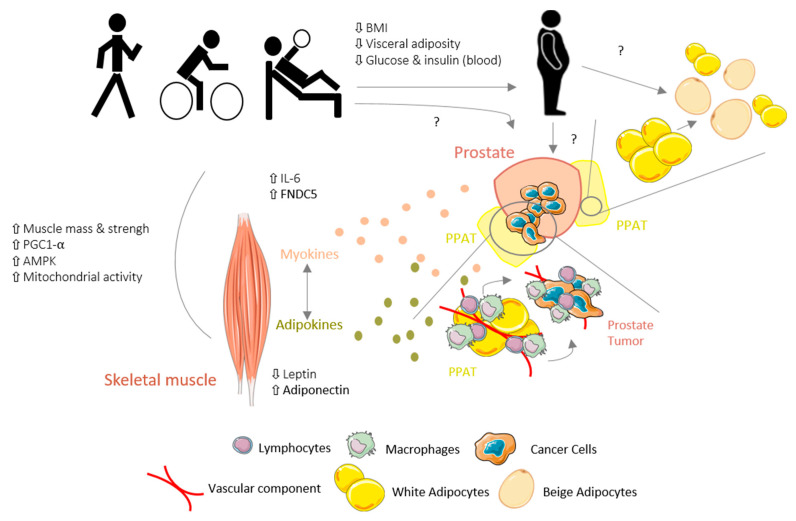
Increased visceral adiposity may influence the development of prostate cancer (PCa) aggressive tumors and cancer mortality. White adipose tissue (WAT), usually referred to as periprostatic adipose tissue (PPAT), surrounds the prostatic gland and has emerged as a potential mediator of the tumor microenvironment. Exercise training (ET) induces several adaptations in both skeletal muscle and WAT. Some of these effects are mediated by ET-induced synthesis and secretion of several proteins, known as myo- and adipokines. Together, myokines and adipokines may act in an endocrine-like manner to favor communication between skeletal muscle and WAT, as they may work together to improve whole-body metabolic health. This crosstalk may constitute a potential mechanism by which ET exerts its beneficial role in the prevention and treatment of PCa-related disorders; however, this has not yet been explored. Therefore, we reviewed the current evidence on the effects of skeletal muscle–WAT–tumor crosstalk in PCa, and the potential mediators of this process to provide a better understanding of underlying ET-related mechanisms in cancer.
Overview
The claims and statistics of this paper haven’t been checked yet.
Free: it reads the open-access text and checks the first 5 claims that cite a source we can check. Create a free account to check every claim.
Integrity signals
Registry
Cites
Statistics
Figures
Verification
Claims the paper makes
The claims and statistics of this paper haven’t been checked yet.
Free: it reads the open-access text and checks the first 5 claims that cite a source we can check. Create a free account to check every claim.
Claims other papers make about this one
Each is checked against this paper’s own text: does it say what the citing paper says it does?
The source backs part of the claim, not all of it — or backs it for a different population, condition or comparison.
In the citing paper
“There is a close physical proximity and interplay between the SM and AT regarding their anatomy and physiology, a scenario that is ripe for bidirectional paracrine effects.”
From Optimised Skeletal Muscle Mass as a Key Strategy for Obesity Management (2025) · cites this paper as [37]
Experimental — accuracy not yet measuredThe cited source says what the claim attributes to it.
In the citing paper
“Changes within the AT influence the SM and vice versa.”
From Optimised Skeletal Muscle Mass as a Key Strategy for Obesity Management (2025) · cites this paper as [37]
Self-check
Percentages, sums and reported differences re-computed from the paper’s own numbers.
The self-check needs the paper’s full text.
Citations
Cites
1 retracted
Obesity Is Associated with Inflammation and Elevated Aromatase Expression in the Mouse Mammary Gland
Subbaramaiah, K., Howe, L. R., Bhardwaj, P., Du, B., Gravaghi, C., Yantiss, R. K., Zhou, X. K., Blaho, V. A., Hla, T., Yang, P., et al. (2011) · Cancer Prevention Research · doi:10.1158/1940-6207.capr-10-0381 · Cited by 363
RetractedBray, F., Ferlay, J., Soerjomataram, I., Siegel, R. L., Torre, L. A., & Jemal, A. (2018) · CA: A Cancer Journal for Clinicians · doi:10.3322/caac.21492 · Cited by 84,109
World Health Organization 2020 guidelines on physical activity and sedentary behaviour
Bull, F. C., Al-Ansari, S. S., Biddle, S., Borodulin, K., Buman, M. P., Cardon, G., Carty, C., Chaput, J.-P., Chastin, S., Chou, R., et al. (2020) · British Journal of Sports Medicine · doi:10.1136/bjsports-2020-102955 · Cited by 11,657 · cited 2×
“Resistance exercise is widely recognized as a key strategy to promote beneficial effects for the average population, such as reversing muscle loss, reducing body fat, and improving physical function and mental health [140,141].”
BackgroundOrigin and physiological roles of inflammation
Medzhitov, R. (2008) · Nature · doi:10.1038/nature07201 · Cited by 6,618
Definition and classification of cancer cachexia: an international consensus
Fearon, K., Strasser, F., Anker, S. D., Bosaeus, I., Bruera, E., Fainsinger, R. L., Jatoi, A., Loprinzi, C., MacDonald, N., Mantovani, G., et al. (2011) · The Lancet Oncology · doi:10.1016/s1470-2045(10)70218-7 · Cited by 5,767
Renehan, A. G., Tyson, M., Egger, M., Heller, R. F., & Zwahlen, M. (2008) · The Lancet · doi:10.1016/s0140-6736(08)60269-x · Cited by 5,219 · cited 2×
“Obesity has been established as a major risk factor for several cancers, including PCa [19,20].”
BackgroundA PGC1-α-dependent myokine that drives brown-fat-like development of white fat and thermogenesis
Boström, P., Wu, J., Jedrychowski, M. P., Korde, A., Ye, L., Lo, J. C., Rasbach, K. A., Boström, E. A., Choi, J. H., Long, J. Z., et al. (2012) · Nature · doi:10.1038/nature10777 · Cited by 4,810 · cited 2×
“The cleaved product of fibronectin type III-domain containing 5 (FNDC5), a PGC-1α-dependent myokine, is secreted into the circulation, designed as irisin, and has the ability to initiate a brown-adipocyte-like phenotype program in WAT [18].”
BackgroundTargeting hypoxia in cancer therapy
Wilson, W. R., & Hay, M. P. (2011) · Nature Reviews Cancer · doi:10.1038/nrc3064 · Cited by 3,172 · cited 1×
“Thus, the increase in WAT mass is responsible for the development of several obesityrelated complications when white adipocyte hypertrophy is accompanied by an inadequate supply of nutrients, growth factors, and oxygen [26,27].”
BackgroundMartin, L., Birdsell, L., MacDonald, N., Reiman, T., Clandinin, M. T., McCargar, L. J., Murphy, R., Ghosh, S., Sawyer, M. B., & Baracos, V. E. (2013) · Journal of Clinical Oncology · doi:10.1200/jco.2012.45.2722 · Cited by 2,680
Adipocytes promote ovarian cancer metastasis and provide energy for rapid tumor growth
Nieman, K. M., Kenny, H. A., Penicka, C. V., Ladanyi, A., Buell-Gutbrod, R., Zillhardt, M. R., Romero, I. L., Carey, M. S., Mills, G. B., Hotamisligil, G. S., et al. (2011) · Nature Medicine · doi:10.1038/nm.2492 · Cited by 2,279
Research works printed but not linked: 2
- Liguori G. ACSM’s Guidelines for Exercise Testing and Prescription Lippincott Williams & Wilkins Philadelphia, PA, USA 2020
- Potter M. Freedland S. Poulton S. Dewhirst M. Jones L. Effects of voluntary wheel running on prostate cancer growth and progression in LAPC-4 xenografts Proceedings of the AACR Annual Meeting San Diego, CA, USA 12–16 April 2008
Cited by
Circadian rhythms and cancers: the intrinsic links and therapeutic potentials
Zhou, L., Zhang, Z., Nice, E. C., Huang, C., Zhang, W., & Tang, Y. C. (2022) · Journal of Hematology & Oncology · doi:10.1186/s13045-022-01238-y · Cited by 178
Shah, U. A., Ballinger, T. J., Bhandari, R., Dieli-Conwright, C. M., Guertin, K. A., Hibler, E. A., Kalam, F., Lohmann, A. E., & Ippolito, J. E. (2023) · JNCI Monographs · doi:10.1093/jncimonographs/lgad001 · Cited by 49
Optimised Skeletal Muscle Mass as a Key Strategy for Obesity Management
Barber, T. M., Kabisch, S., Pfeiffer, A. F. H., & Weickert, M. O. (2025) · Metabolites · doi:10.3390/metabo15020085 · Cited by 19
Periprostatic Adipose Tissue: A New Perspective for Diagnosing and Treating Prostate Cancer
Cao, H., Wang, Y., Zhang, D., Liu, B., Zhou, H., & Wang, S. (2023) · Journal of Cancer · doi:10.7150/jca.89750 · Cited by 23
Voluntarily wheel running inhibits the growth of CRPC xenograft by inhibiting HMGB1 in mice
Yang, Z., Gao, Y., He, K., Sui, X., Chen, J., Wang, T., Chen, M., Wang, Z., Jiang, Y., & Zhao, L. (2023) · Experimental Gerontology · doi:10.1016/j.exger.2023.112118 · Cited by 18
Metadata
- Authors
- Rocha-Rodrigues, S., Matos, A., Afonso, J., Mendes-Ferreira, M., Abade, E., Teixeira, E., Silva, B., Murawska-Ciałowicz, E., Oliveira, M. J., & Ribeiro, R.
- Affiliations
- Escola Superior de Desporto e Lazer, Instituto Politécnico de Viana do Castelo, Rua Escola Industrial e Comercial de Nun’Alvares, 4900-347 Viana do Castelo, Portugal
- Universidade do Porto (PT)
- Instituto Superior da Maia (PT)
- Universidade Politécnica de Viana do Castelo (PT)
- Physiology and Biochemistry Department, University School of Physical Education, Paderewskiego Ave. 35, 51-612 Wroclaw, Poland
- Tumour & Microenvironment Interactions Group, INEB—Institute of Biomedical Engineering, i3S-Instituto de Investigação e Inovação em Saúde, Universidade do Porto, Rua Alfredo Allen 208, 4200-153 Porto, Portugal
- University of Lisbon (PT)
- ORCID
- Venue
- International Journal of Molecular Sciences
- Publisher
- MDPI AG
- Published
- 2021-04-25
- Volume
- 22
- Issue
- 9
- Pages
- 4469
- ISSN
- 1422-0067 (ISSN-L)
- PMC
- PMC8123194
- OpenAlex
- W3159343899
- Cited by
- 17
- References
- 189
- Citations by year
- 2026: 3 · 2025: 6 · 2024: 2 · 2023: 4 · 2022: 2
- FWCI
- 0.27
- Type
- journal article
- Language
- en
- Open access
- gold
- doi.org
- Licence
- Locations
- International Journal of Molecular Sciences (publishedVersion, cc-by)
- PubMed Central (publishedVersion, cc-by)
- PubMed (publishedVersion)
- Portuguese National Funding Agency for Science, Research and Technology (RCAAP Project by FCT) (submittedVersion, other-oa)
- DOAJ (DOAJ: Directory of Open Access Journals) (submittedVersion, cc-by-sa)
- Portuguese National Funding Agency for Science, Research and Technology (RCAAP Project by FCT) (submittedVersion, cc-by)
- Topics
- Health Sciences › Medicine › Physiology (medical) › Adipose Tissue and Metabolism
- Health Sciences › Medicine › Endocrinology, Diabetes and Metabolism › Adipokines, Inflammation, and Metabolic Diseases
- Life Sciences › Biochemistry, Genetics and Molecular Biology › Cancer Research › Prostate Cancer Treatment and Research
- Keywords
- prostate cancer, exercise training, skeletal muscle, white adipose tissue, periprostatic adipose tissue, myokines, adipokines, visceral fat, tumor microenvironment, cancer prevention
- MeSH terms
- Animals, Fatty Acids, Humans, Male, Obesity, Prostatic Neoplasms, Exercise, Muscle, Skeletal, Paracrine Communication, Adipose Tissue, White, Adipokines, Tumor Microenvironment
About these checks
Registry, retraction, Cites and statistics results are computed, not judged, with one exception: a printed reference that no index lists is read once by a model before it counts as a citation error. Claims are extracted by a model and kept only when their quote appears verbatim in the text; each cited source is then checked, with a model’s help, for whether it says what the claim relies on. Those verdicts can be wrong — read the claim’s quote and the cited source before relying on one.
Statistics and arithmetic are recomputed, not judged.
Confidence bands are shown only for fields calibrated on our annotated test set. None is calibrated yet, so no band is shown.
What counts as a claim ›How we measure confidence ›How we check this ›
Are you an author, or do you see a problem with this page? Request a review
How to cite
Cite CoChat for the checks on this page, and the paper for its own findings.
- This page
- CoChat. (2026). Citation check: Skeletal Muscle–Adipose Tissue–Tumor Axis: Molecular Mechanisms Linking Exercise Training in Prostate Cancer. https://app.cochat.ai/papers/10.3390/ijms22094469
- The paper
- Rocha-Rodrigues, S., Matos, A., Afonso, J., Mendes-Ferreira, M., Abade, E., Teixeira, E., Silva, B., Murawska-Ciałowicz, E., Oliveira, M. J., & Ribeiro, R. (2021). Skeletal Muscle–Adipose Tissue–Tumor Axis: Molecular Mechanisms Linking Exercise Training in Prostate Cancer. International Journal of Molecular Sciences. https://doi.org/10.3390/ijms22094469
Data sources
Bibliographic data: Semantic Scholar, OpenAlex, Crossref.
Contains information from the Semantic Scholar Academic Graph Datasets, made available under the ODC Attribution License (ODC-BY 1.0).
Semantic Scholar’s data is described in: Kinney, R., et al. (2023). The Semantic Scholar Open Data Platform. arXiv:2301.10140.
