

Impacts of Telomeric Length, Chronic Hypoxia, Senescence, and Senescence-Associated Secretory Phenotype on the Development of Thoracic Aortic Aneurysm
Open accessThe DOI matches its Crossref record; 72 of the 72 references it cites were found in a registry or an index.
Abstract
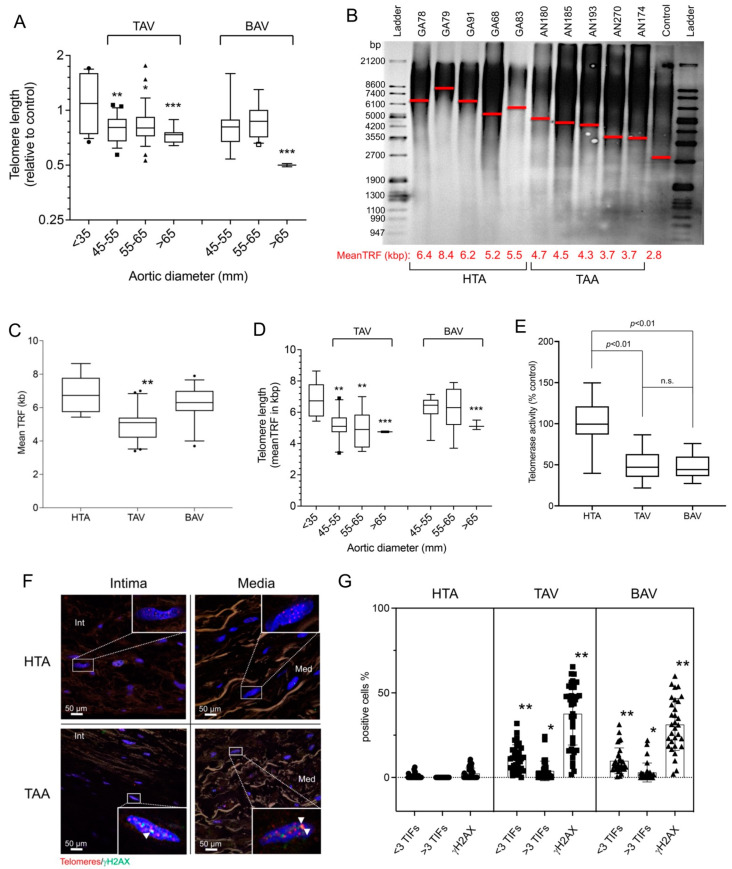
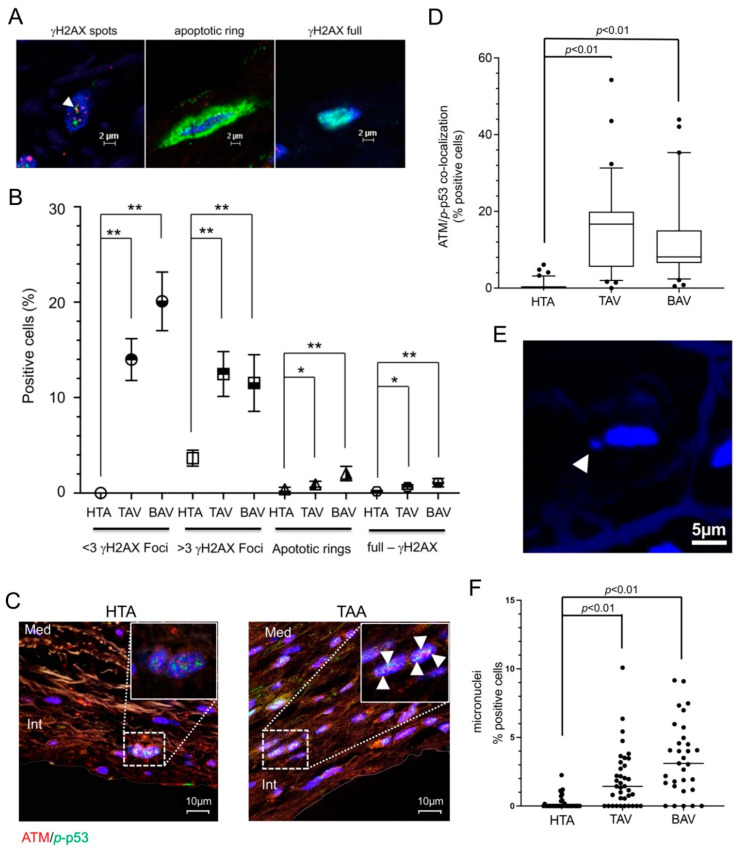
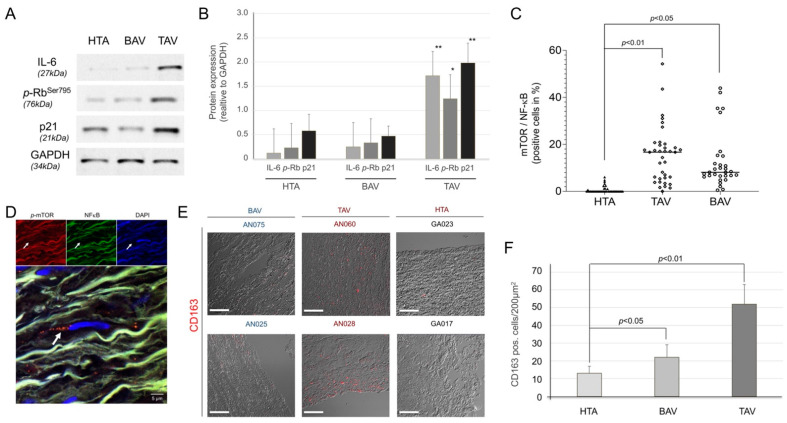
Thoracic aortic aneurysm (TAA) is an age-related and life-threatening vascular disease. Telomere shortening is a predictor of age-related diseases, and its progression is associated with premature vascular disease. The aim of the present work was to investigate the impacts of chronic hypoxia and telomeric DNA damage on cellular homeostasis and vascular degeneration of TAA. We analyzed healthy and aortic aneurysm specimens (215 samples) for telomere length (TL), chronic DNA damage, and resulting changes in cellular homeostasis, focusing on senescence and apoptosis. Compared with healthy thoracic aorta (HTA), patients with tricuspid aortic valve (TAV) showed telomere shortening with increasing TAA size, in contrast to genetically predisposed bicuspid aortic valve (BAV). In addition, TL was associated with chronic hypoxia and telomeric DNA damage and with the induction of senescence-associated secretory phenotype (SASP). TAA-TAV specimens showed a significant difference in SASP-marker expression of IL-6, NF-κB, mTOR, and cell-cycle regulators (γH2AX, Rb, p53, p21), compared to HTA and TAA-BAV. Furthermore, we observed an increase in CD163+ macrophages and a correlation between hypoxic DNA damage and the number of aortic telocytes. We conclude that chronic hypoxia is associated with telomeric DNA damage and the induction of SASP in a diseased aortic wall, promising a new therapeutic target.
Overview
The claims and statistics of this paper haven’t been checked yet.
Free: it reads the open-access text and checks the first 5 claims that cite a source we can check. Create a free account to check every claim.
Integrity signals
Registry
Cites
Statistics
Figures
Verification
Claims the paper makes
The claims and statistics of this paper haven’t been checked yet.
Free: it reads the open-access text and checks the first 5 claims that cite a source we can check. Create a free account to check every claim.
Claims other papers make about this one
Each is checked against this paper’s own text: does it say what the citing paper says it does?
The source backs part of the claim, not all of it — or backs it for a different population, condition or comparison.
In the citing paper
“Senescence-associated markers have also been identified in the context of vascular diseases such as atherosclerosis and abdominal aortic aneurysm and thoracic aortic aneurysm in both human and mouse models69–72.”
From SenNet recommendations for detecting senescent cells in different tissues (2024) · cites this paper as [69]
Experimental — accuracy not yet measured
Self-check
Percentages, sums and reported differences re-computed from the paper’s own numbers.
The self-check needs the paper’s full text.
Citations
Cites
A new mathematical model for relative quantification in real-time RT-PCR
Pfaffl, M. W. (2001) · Nucleic Acids Research · doi:10.1093/nar/29.9.e45 · Cited by 34,610 · cited 1×
“Samples were normalized to single-copy genes as indicated, and fold change was determined by ∆∆Ct method [70].”
MethodTelomeres shorten during ageing of human fibroblasts
Harley, C. B., Futcher, A. B., & Greider, C. W. (1990) · Nature · doi:10.1038/345458a0 · Cited by 5,750 · cited 1×
“Senescence is defined as the irreversible cessation of cell division [15].”
BackgroundInflamm‐aging: An Evolutionary Perspective on Immunosenescence
FRANCESCHI, C., BONAFÈ, M., VALENSIN, S., OLIVIERI, F., DE LUCA, M., OTTAVIANI, E., & DE BENEDICTIS, G. (2000) · Annals of the New York Academy of Sciences · doi:10.1111/j.1749-6632.2000.tb06651.x · Cited by 5,358 · cited 1×
“This chronic, low-grade systemic inflammation is the result of a process called inflamm-aging, a crucial pathogenic mechanism in multiple age-related diseases [53].”
BackgroundCellular senescence: when bad things happen to good cells
Campisi, J., & d'Adda di Fagagna, F. (2007) · Nature Reviews Molecular Cell Biology · doi:10.1038/nrm2233 · Cited by 4,441 · cited 1×
“In summary, compared to TAA-TAV and HTA samples, cells in TAA-BAV samples undergo stable cell cycle arrest, accompanied by morphological and phenotypic changes associated with cellular senescence [66].”
ResultNitric oxide synthases: regulation and function
Forstermann, U., & Sessa, W. C. (2012) · European Heart Journal · doi:10.1093/eurheartj/ehr304 · Cited by 4,409 · cited 1×
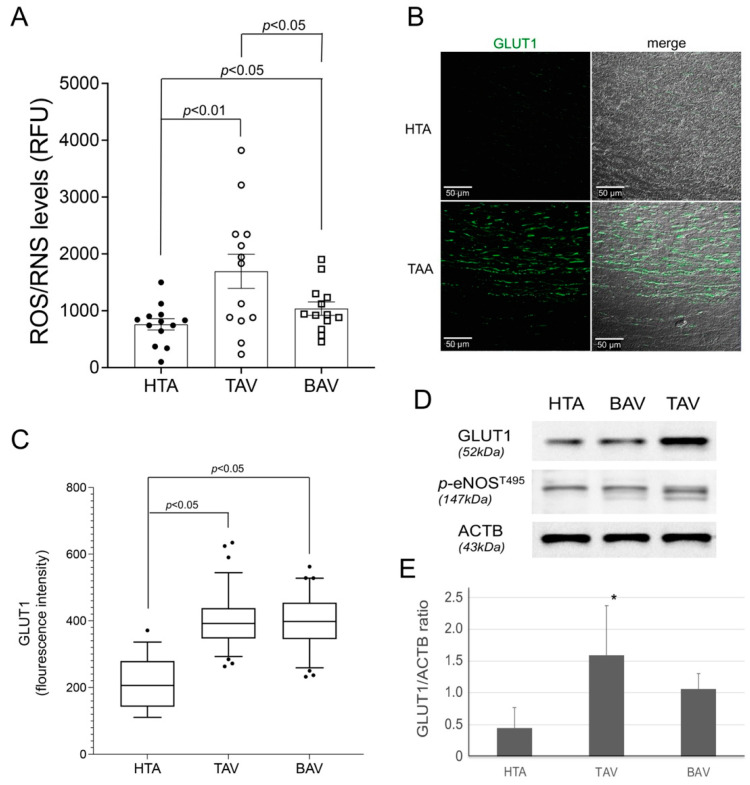
“Next, the expression of activated (phosphorylated) eNOS (p-eNOS), which affects endothelial function [36,37], was analyzed in correlation with ROS/RNS levels.”
BackgroundOxidative stress shortens telomeres
von Zglinicki, T. (2002) · Trends in Biochemical Sciences · doi:10.1016/s0968-0004(02)02110-2 · Cited by 2,524 · cited 2×
“Telomere length is a critical factor for direct DNA damage to telomeres [11,29].”
BackgroundMegabase Chromatin Domains Involved in DNA Double-Strand Breaks in Vivo
Rogakou, E. P., Boon, C., Redon, C., & Bonner, W. M. (1999) · The Journal of Cell Biology · doi:10.1083/jcb.146.5.905 · Cited by 2,422 · cited 1×
“The histone protein 2AX (H2AX) is a central component of numerous signaling pathways in response to double-stranded breaks (DSB), which becomes rapidly phosphorylated to form γH2AX at nascent DSB sites [13].”
BackgroundCellular senescence in aging and age-related disease: from mechanisms to therapy
Childs, B. G., Durik, M., Baker, D. J., & van Deursen, J. M. (2015) · Nature Medicine · doi:10.1038/nm.4000 · Cited by 2,363 · cited 1×
“The permanent senescence of many SASP cells contributes to faster development of age-related diseases, including diabetes and atherosclerosis [16,22,23].”
BackgroundRb-mediated heterochromatin formation and silencing of E2F target genes during cellular senescence
Narita, M., Nuñez, S., Heard, E., Narita, M., Lin, A. W., Hearn, S. A., Spector, D. L., Hannon, G. J., & Lowe, S. W. (2003) · Cell · doi:10.1016/s0092-8674(03)00401-x · Cited by 2,278
A highly conserved repetitive DNA sequence,(TTAGGG) n, present at the telomeres of human chromosomes
Moyzis, R. K., Buckingham, J. M., Cram, L. S., Dani, M., Deaven, L. L., Jones, M. D., Meyne, J., Ratliff, R. L., & Wu, J. R. (1988) · Proceedings of the National Academy of Sciences · doi:10.1073/pnas.85.18.6622 · Cited by 1,820 · cited 2×
“After each cell division, telomeres shorten, and when reaching a critical state, they trigger a DNA damage response (DDR) or senescence [8,9].”
Background
Cited by
SenNet recommendations for detecting senescent cells in different tissues
Suryadevara, V., Hudgins, A. D., Rajesh, A., Pappalardo, A., Karpova, A., Dey, A. K., Hertzel, A., Agudelo, A., Rocha, A., Soygur, B., et al. (2024) · Nature Reviews Molecular Cell Biology · doi:10.1038/s41580-024-00738-8 · Cited by 408
“Senescence-associated markers, including CDKN1A, p53, total γH2AX and γH2AX associated with telomeres (TAF), and SASP factors have also been observed in both human and mouse models of thoracic aortic aneurysm and abdominal aortic aneurysm 69,70 .”
Increased vascular smooth muscle cell senescence in aneurysmal Fibulin-4 mutant mice
Stefens, S. J. M., van Vliet, N., IJpma, A. S., Burger, J. E., Li, Y., van Heijningen, P. M., Lindeman, J. H. N., Majoor‐Krakauer, D. F., Verhagen, H. J. M., Kanaar, R., et al. (2024) · npj Aging · doi:10.1038/s41514-024-00154-4 · Cited by 12
Epigenetic dynamics of cellular senescence: From mechanistic insights to precision senotherapy
Hu, X., Lai, W., Liu, M., & Wang, B. (2026) · Chinese Medical Journal · doi:10.1097/cm9.0000000000004042 · Cited by 2
“[149] This premature senescence is deleterious; it not only promotes features of plaque vulnerability but also drives a pro-inflammatory and glycolytic phenotype, thereby exacerbating atherosclerosis.”
Recent Advances in the Study of Biomarkers of Aging
肖, 夤. (2025) · Advances in Clinical Medicine · doi:10.12677/acm.2025.153869
Zhao, T., Wang, B., Feng, C., Yu, H. N., He, K., Chen, Z., Ma, Q., & Liu, Y. (2025) · Research Square · doi:10.21203/rs.3.rs-7912284/v1
Kumar, R., Abdoul‐Latif, F. M., Ali, M., Gupta, A., Raj, V. S., Thinlas, T., & Vibhuti, A. (2026) · Biophysica · doi:10.3390/biophysica6060105
Metadata
- Authors
- Aschacher, T., Geisler, D., Lenz, V., Aschacher, O., Winkler, B., Schaefer, A.-K., Mitterbauer, A., Wolf, B., Enzmann, F. K., Messner, B., Laufer, G., Ehrlich, M. P., Grabenwöger, M., & Bergmann, M.
- Affiliations
- Medical University of Vienna (AT)
- Department of Cardiovascular Surgery, Clinic Floridsdorf and Karl Landsteiner Institute for Cardio-Vascular Research, 1210 Vienna, Austria
- Sigmund Freud Privatuniversität Wien (AT)
- Innsbruck Medical University (AT)
- Corresponding author
- Aschacher, Thomas
- ORCID
- Venue
- International Journal of Molecular Sciences
- Publisher
- MDPI AG
- Published
- 2022-12-07
- Volume
- 23
- Issue
- 24
- Pages
- 15498
- ISSN
- 1422-0067 (ISSN-L)
- PMC
- PMC9779024
- OpenAlex
- W4311849773
- Cited by
- 6
- References
- 72
- Citations by year
- 2026: 2 · 2025: 2 · 2024: 2
- FWCI
- 0.62
- Type
- journal article
- Language
- en
- Open access
- gold
- doi.org
- Licence
- Locations
- International Journal of Molecular Sciences (publishedVersion, cc-by)
- PubMed Central (publishedVersion, cc-by)
- PubMed (publishedVersion)
- DOAJ (DOAJ: Directory of Open Access Journals) (submittedVersion, cc-by-sa)
- Funders
- Medical-Scientific Fund of the Mayor of Vienna (AP15115)
- Topics
- Life Sciences › Biochemistry, Genetics and Molecular Biology › Cell Biology › Telomeres, Telomerase, and Senescence
- Health Sciences › Medicine › Cardiology and Cardiovascular Medicine › Aortic Disease and Treatment Approaches
- Health Sciences › Medicine › Surgery › Aortic aneurysm repair treatments
- Keywords
- thoracic aortic aneurysm, telomere length, telomere shortening, telomeric DNA damage, chronic hypoxia, cellular senescence, senescence-associated secretory phenotype, tricuspid aortic valve, bicuspid aortic valve, macrophages, apoptosis, NF-κB, mTOR, p53, p21, vascular degeneration
- MeSH terms
- Bicuspid Aortic Valve Disease, Senescence-Associated Secretory Phenotype, Aortic Valve, Heart Valve Diseases, Humans, Aortic Aneurysm, Thoracic
About these checks
Registry, retraction, Cites and statistics results are computed, not judged, with one exception: a printed reference that no index lists is read once by a model before it counts as a citation error. Claims are extracted by a model and kept only when their quote appears verbatim in the text; each cited source is then checked, with a model’s help, for whether it says what the claim relies on. Those verdicts can be wrong — read the claim’s quote and the cited source before relying on one.
Statistics and arithmetic are recomputed, not judged.
Confidence bands are shown only for fields calibrated on our annotated test set. None is calibrated yet, so no band is shown.
What counts as a claim ›How we measure confidence ›How we check this ›
Are you an author, or do you see a problem with this page? Request a review
Data sources
Bibliographic data: Semantic Scholar, OpenAlex, Crossref.
Contains information from the Semantic Scholar Academic Graph Datasets, made available under the ODC Attribution License (ODC-BY 1.0).
Semantic Scholar’s data is described in: Kinney, R., et al. (2023). The Semantic Scholar Open Data Platform. arXiv:2301.10140.
