

The DOI matches its Crossref record; 17 of the 17 references it cites were found in a registry or an index.
Germination and Growth of Plasma-Treated Maize Seeds Planted in Fields and Exposed to Realistic Environmental Conditions
Open accessAbstract
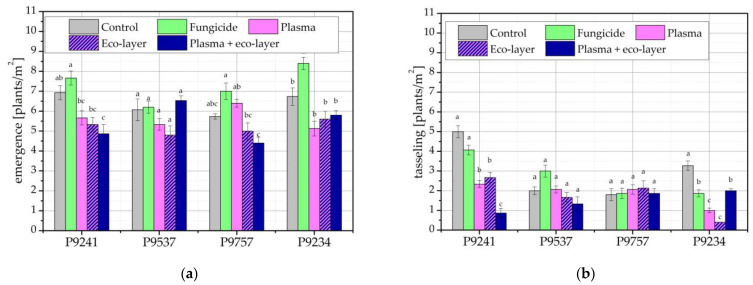
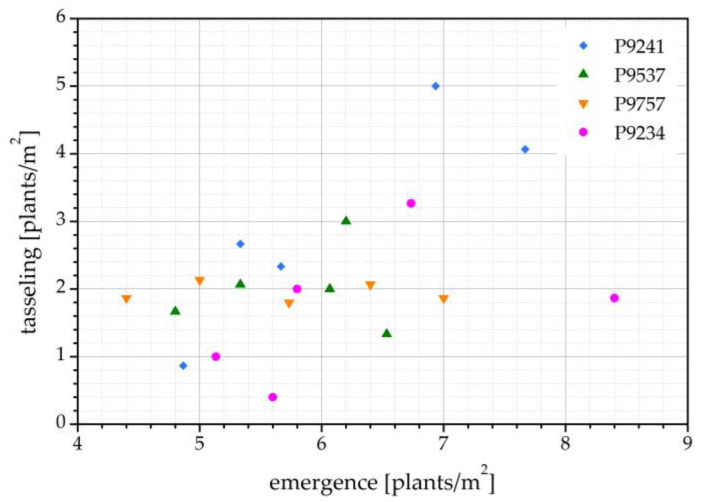
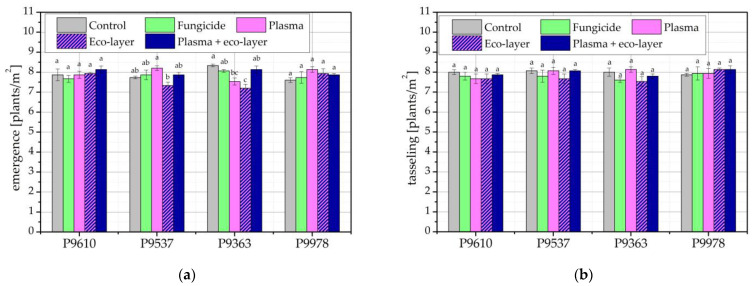
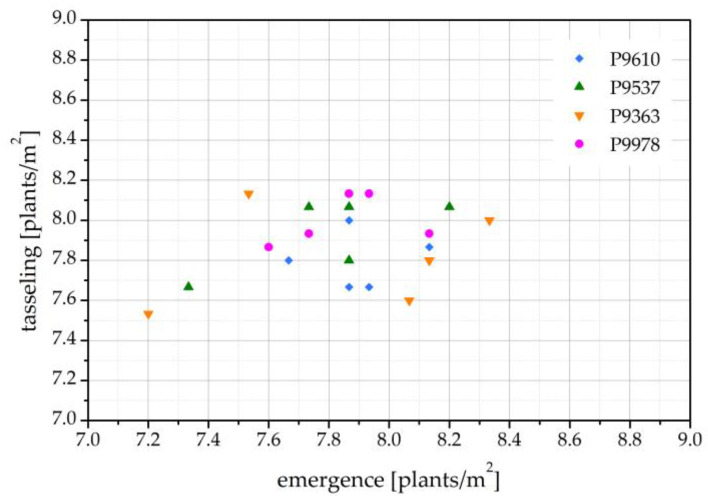
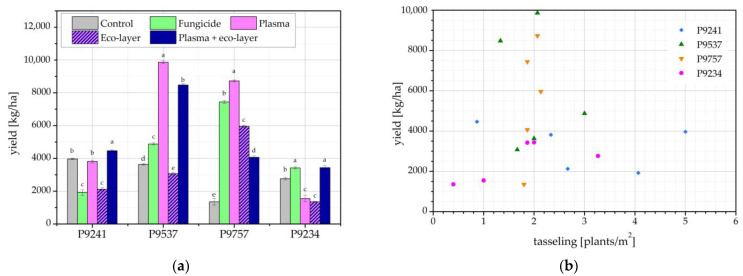
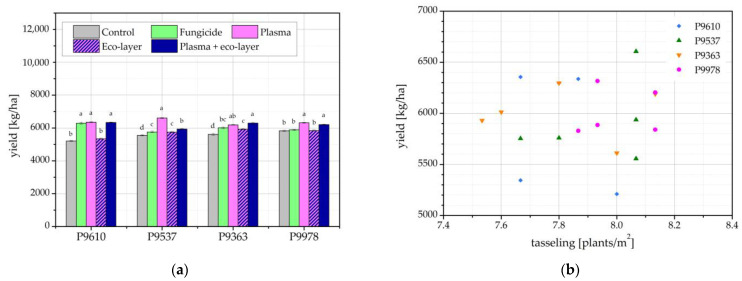
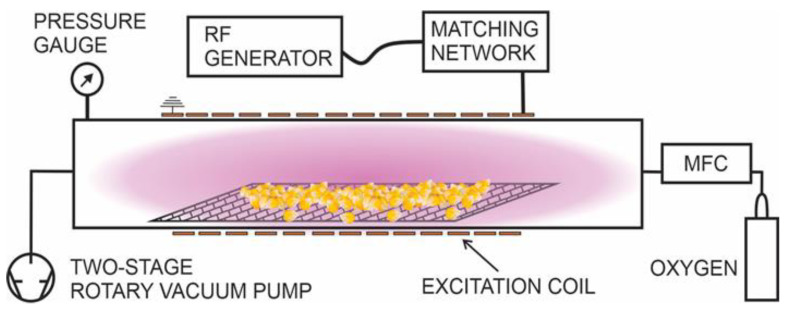
In this study, we applied an inductively coupled, radio frequency oxygen plasma to maize seeds and investigated its effects on seedling emergence, plant number at tasseling, and crop yield of maize in realistic field conditions. Maize seeds of seven different hybrids were treated over two harvest years. In addition to plasma-treated seeds, a control sample, fungicide-treated seeds, an eco-layer, and a plasma and eco-layer combination, were planted. Seedling emergence, plant number at tasseling (plants/m2), and yield (kg/ha), were recorded. In the first harvest year, results were negatively affected by the presence of an insect pest. In the second harvest year, plant number and yield results were more uniform. In both years, for two and three hybrids, respectively, the highest yield arose from plants from plasma-treated seeds, but the differences were only partially significant. Considering our results, plasma treatment of maize seeds appears to have a positive effect on the yield of the plant.
Overview
The claims and statistics of this paper haven’t been checked yet.
Run the check — free, no account needed. It reads the open-access text and checks the sources it cites.
Integrity signals
Registry
Cites
Statistics
Figures
Verification
Claims the paper makes
The claims and statistics of this paper haven’t been checked yet.
Run the check — free, no account needed. It reads the open-access text and checks the sources it cites.
Claims other papers make about this one
Each is checked against this paper’s own text: does it say what the citing paper says it does?
The source backs part of the claim, not all of it — or backs it for a different population, condition or comparison.
In the citing paper
“Studies on other crops, such as rice and maize, indicate that plasma treatments can enhance hormonal balance and improve antioxidant responses, helping plants become more resilient to environmental stressors44,45.”
From Cold plasma technology as a pre-treatment for seed priming enhances germination and reduces salinity stress in Prosopis Koelziana (2025) · cites this paper as [44]
Experimental — accuracy not yet measuredThe check wasn’t confident either way, so it gives no verdict — never disputed.
In the citing paper
“Although the precise mechanism by which plasma priming affects H+-ATPase activity is not yet fully understood, recent studies suggest that plasma treatments may alter the electrochemical properties of cell membranes. This alteration could enhance ion exchange and stabilize the membranes44,62.”
From Cold plasma technology as a pre-treatment for seed priming enhances germination and reduces salinity stress in Prosopis Koelziana (2025) · cites this paper as [44]
Experimental — accuracy not yet measuredThe check wasn’t confident either way, so it gives no verdict — never disputed.
In the citing paper
“Interestingly, this study has shown that pretreating of Prosopis seeds with cold plasma can positively affect carbohydrate metabolism in plants experiencing salt stress, as reported in earlier research on other plants44,55.”
From Cold plasma technology as a pre-treatment for seed priming enhances germination and reduces salinity stress in Prosopis Koelziana (2025) · cites this paper as [44]
Experimental — accuracy not yet measured
Self-check
Percentages, sums and reported differences re-computed from the paper’s own numbers.
The self-check needs the paper’s full text.
Citations
Cites
Freeling, M., & Walbot, V. (1994) · Springer eBooks · doi:10.1007/978-1-4612-2694-9 · Cited by 400
Zahoranová, A., Hoppanová, L., Šimončicová, J., Tučeková, Z. K., Medvecká, V., Hudecová, D., Kaliňáková, B., Kováčik, D., & Černák, M. (2018) · Plasma Chemistry and Plasma Processing · doi:10.1007/s11090-018-9913-3 · Cited by 157
Effects of Nonthermal Plasma on Morphology, Genetics and Physiology of Seeds: A Review
Starič, P., Vogel‐Mikuš, K., Mozetič, M., & Junkar, I. (2020) · Plants · doi:10.3390/plants9121736 · Cited by 120
Self-citationMaking better maize plants for sustainable grain production in a changing climate
Gong, F., Wu, X., Zhang, H., Chen, Y., & Wang, W. (2015) · Frontiers in Plant Science · doi:10.3389/fpls.2015.00835 · Cited by 92
Filatova, I. I., Lyushkevich, V. A., Гончарик, С. В., Zhukovsky, А. G., Krupenko, N. А., & Kalatskaja, J. N. (2020) · Journal of Physics D Applied Physics · doi:10.1088/1361-6463/ab7960 · Cited by 69
Karmakar, S., Billah, M., Hasan, M., Sohan, S. R., Hossain, M. F., Hoque, K. M. F., Kabir, A. H., Rashid, M. M., Talukder, M. R., & Reza, M. A. (2021) · Heliyon · doi:10.1016/j.heliyon.2021.e06458 · Cited by 47
Ivankov, A., Naučienė, Z., Degutytė-Fomins, L., Žūkienė, R., Januškaitienė, I., Malakauskienė, A., Jakštas, V., Іванаускас, Л., Romanovskaja, D., Šlepetienė, A., et al. (2021) · Applied Sciences · doi:10.3390/app11104391 · Cited by 47
Growth of Plasma-Treated Corn Seeds under Realistic Conditions
Ahn, C., Gill, J., & Ruzic, D. N. (2019) · Scientific Reports · doi:10.1038/s41598-019-40700-9 · Cited by 43
EFFECT OF GLOW DISCHARGE PLASMA ON GERMINATION AND FUNGAL LOAD OF SOME CEREAL SEEDS
Braşoveanu, M., Nemţanu, M. R., Surdu-Bob, C., Karaca, G., & Erper, İ. (2015) · Cited by 29
Szőke, C., Nagy, Z., Gierczik, K., Székely, A., Spitkól, T., Zsuboril, Z. T., Galiba, G., Marton, C. L., & Kutasi, K. (2017) · Plasma Processes and Polymers · doi:10.1002/ppap.201700138 · Cited by 18
Cited by
Non-Thermal Plasma as Environmentally-Friendly Technology for Agriculture: A Review and Roadmap
Bilea, F., García‐Vaquero, M., Măgureanu, M., Mihăilă, I., Mildažienė, V., Mozetič, M., Pawłat, J., Primc, G., Puаč, N., Robert, É., et al. (2024) · Critical Reviews in Plant Sciences · doi:10.1080/07352689.2024.2410145 · Cited by 89
Self-citationShahabi, Z. M., Nasibi, F., & Noori, H. (2025) · Scientific Reports · doi:10.1038/s41598-025-11637-z · Cited by 19
Vesel, A., Macovei, A., Balestrazzi, A., Tondepu, S. A. G., Dueñas, C., Locato, V., Tonto, T. C., Zoani, C., Lojen, D., Primc, G., et al. (2025) · Applied Surface Science · doi:10.1016/j.apsusc.2025.162674 · Cited by 14
Self-citationBoosting Seed Performance with Cold Plasma
Benabderrahim, M. A., Bettaieb, I., & Rejili, M. S. (2025) · Applied Sciences · doi:10.3390/app152010996 · Cited by 13
Judickaitė, A., Jankaitytė, E., Ramanciuškas, E., Degutytė-Fomins, L., Naučienė, Z., Kudirka, G., Okumura, T., Koga, K., Shiratani, M., Mildažienė, V., et al. (2025) · Plants · doi:10.3390/plants14020271 · Cited by 11
Metadata
- Authors
- Recek, N., Zaplotnik, R., Vesel, A., Primc, G., Gselman, P., Mozetič, M., & Holc, M.
- Affiliations
- Jožef Stefan Institute (SI)
- Interkorn Ltd., Gančani 94, 9231 Beltinci, Slovenia
- Corresponding author
- Recek, Nina
- Venue
- International Journal of Molecular Sciences
- Publisher
- MDPI AG
- Published
- 2023-04-06
- Volume
- 24
- Issue
- 7
- Pages
- 6868
- ISSN
- 1422-0067 (ISSN-L)
- PMC
- PMC10094815
- OpenAlex
- W4362699339
- Cited by
- 15
- References
- 17
- Citations by year
- 2026: 5 · 2025: 8 · 2024: 2
- FWCI
- 2.48
- Type
- journal article
- Language
- en
- Open access
- gold
- doi.org
- Licence
- Locations
- International Journal of Molecular Sciences (publishedVersion, cc-by)
- PubMed Central (publishedVersion, cc-by)
- PubMed (publishedVersion)
- Funders
- Slovenian Research Agency (L7-4567, P2-0082)
- Topics
- Physical Sciences › Physics and Astronomy › Atomic and Molecular Physics, and Optics › Atmospheric-Pressure Plasma Applications
- Life Sciences › Agricultural and Biological Sciences › Agronomy and Crop Science › Magnetic and Electromagnetic Effects
- Life Sciences › Agricultural and Biological Sciences › Plant Science › Seed Germination and Physiology
- Keywords
- maize, seed germination, seedling emergence, crop yield, maize hybrids, insect damage, fungicide-treated seeds
- MeSH terms
- Zea mays, Insect Control, Oxygen, Seeds, Germination, Seedlings, Plasma Gases
About these checks
Registry, retraction, Cites and statistics results are computed, not judged, with one exception: a printed reference that no index lists is read once by a model before it counts as a citation error. Claims are extracted by a model and kept only when their quote appears verbatim in the text; each cited source is then checked, with a model’s help, for whether it says what the claim relies on. Those verdicts can be wrong — read the claim’s quote and the cited source before relying on one.
Statistics and arithmetic are recomputed, not judged.
Confidence bands are shown only for fields calibrated on our annotated test set. None is calibrated yet, so no band is shown.
What counts as a claim ›How we measure confidence ›How we check this ›
Are you an author, or do you see a problem with this page? Request a review
How to cite
Cite CoChat for the checks on this page, and the paper for its own findings.
- This page
- CoChat. (2026). Citation check: Germination and Growth of Plasma-Treated Maize Seeds Planted in Fields and Exposed to Realistic Environmental Conditions. https://app.cochat.ai/papers/10.3390/ijms24076868
- The paper
- Recek, N., Zaplotnik, R., Vesel, A., Primc, G., Gselman, P., Mozetič, M., & Holc, M. (2023). Germination and Growth of Plasma-Treated Maize Seeds Planted in Fields and Exposed to Realistic Environmental Conditions. International Journal of Molecular Sciences. https://doi.org/10.3390/ijms24076868
Data sources
Bibliographic data: Semantic Scholar, OpenAlex, Crossref.
Contains information from the Semantic Scholar Academic Graph Datasets, made available under the ODC Attribution License (ODC-BY 1.0).
Semantic Scholar’s data is described in: Kinney, R., et al. (2023). The Semantic Scholar Open Data Platform. arXiv:2301.10140.
