

Infrapatellar Fat Pad in Knee Osteoarthritis: A Comprehensive Review of Pathophysiology and Targeted Therapeutic Strategies
Open accessThe DOI matches its Crossref record; 203 of the 204 references it cites were found in a registry or an index.
Abstract
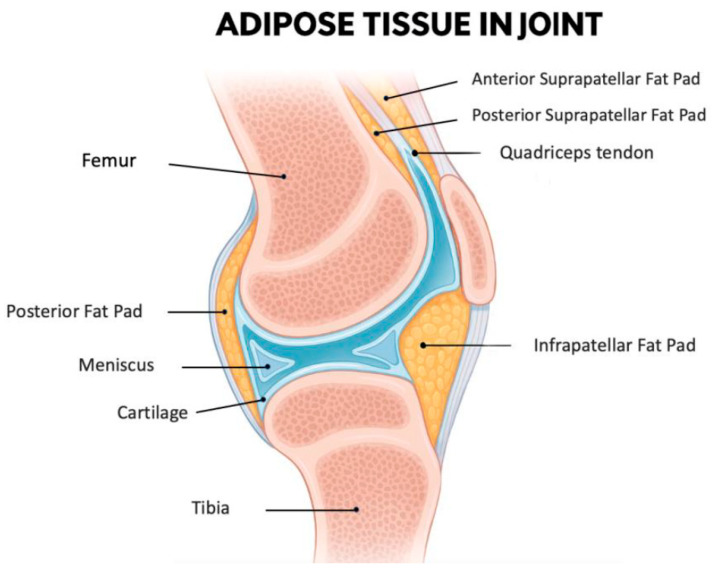
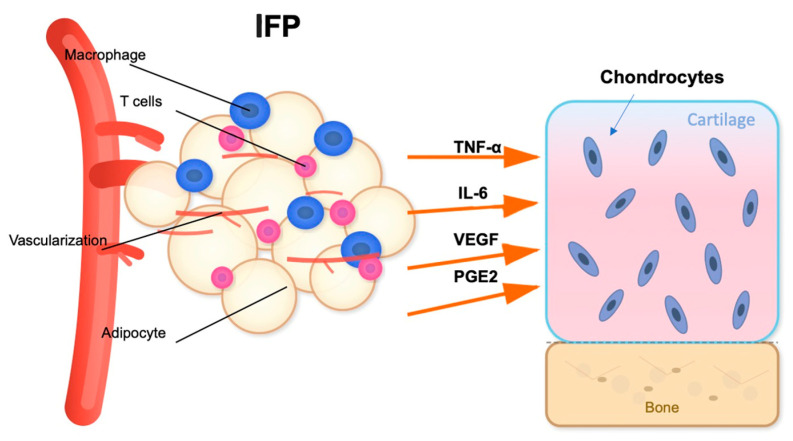
Osteoarthritis (OA) is the most common joint disorder globally, affecting approximately 595 million individuals and representing the first cause of chronic pain and disability. Recently, the infrapatellar fat pad (IFP), an intracapsular adipose tissue in the human knee joint, was recognized as an active and metabolically significant contributor to the pathophysiology of OA through the release of pro-inflammatory cytokines, adipokines, and growth factors that sustain inflammatory response, fibrotic remodeling, and neurogenic pain. The present review provides an overview of the pathophysiological significance of the IFP in OA and current and promising therapeutic strategies targeting this adipose structure. We summarize the available preclinical and translational evidence on conservative therapies, minimally invasive interventions, and surgical options as well as IFP-derived mesenchymal stromal cells as a potential cell source for cartilage repair. Overall, preclinical research indicates that the modulation of IFP inflammation and fibrosis could alleviate pain and delay the progression of the disease. The superficial location and its central role in the pathogenesis of OA make the IFP a promising therapeutic target in knee OA (KOA).
Overview
The claims and statistics of this paper haven’t been checked yet.
Free: it reads the open-access text and checks the first 5 claims that cite a source we can check. Create a free account to check every claim.
Integrity signals
Registry
Cites
Statistics
Figures
Verification
Claims the paper makes
The claims and statistics of this paper haven’t been checked yet.
Free: it reads the open-access text and checks the first 5 claims that cite a source we can check. Create a free account to check every claim.
Self-check
Percentages, sums and reported differences re-computed from the paper’s own numbers.
The self-check needs the paper’s full text.
Citations
Cites
Items 201–204 of 204
Yang, G., Zhang, R., Xu, B., Yang, Y., Wang, Y., Xu, W., Li, P., Yu, A., Ning, S., Fu, Q., et al. (2025) · PLoS ONE · doi:10.1371/journal.pone.0331568 · Cited by 2
Zhang, Y., Ruan, G., Zheng, P., Zhu, Z., Chen, H., Fan, T., Jiang, L., & Ding, C. (2025) · Osteoarthritis and Cartilage · doi:10.1016/j.joca.2025.02.323 · Cited by 1
Exploring the Correlation Between Body Mass Index and Knee Hoffa Fat Pad Size in MRI Sagittal Plane
Davulcu, C. D., & Celayir, A. (2024) · Annals of Medical Research · doi:10.5455/annalsmedres.2024.10.226 · Cited by 1
Kulhari, S., Eghrari, N. B., Chen, M., et al. (2024) · PubMed
Cited by
Yan, M., Zhang, X. R., Liu, H., Kang, Q., Li, J., Zhang, B., Lin, D., & Li, X. (2026) · Frontiers in Immunology · doi:10.3389/fimmu.2026.1833313 · Cited by 8
Zhang, L., Xu, J., Jiang, L., Gao, K., Xue, H., Yulei, L., Liu, A., & Zhang, C. (2026) · Journal of Pain Research · doi:10.2147/jpr.s634945 · Cited by 7
Ma, Y.-X., Lin, M., Nan, Y., Li, N.-N., Liu, B., Wang, H., Ning, S.-Y., & Zhang, Z. (2026) · Frontiers in Immunology · doi:10.3389/fimmu.2026.1889437 · Cited by 3
Epigenetic regulation in osteoarthritis: recent updates and emerging mechanisms
Zhao, Y., & Liu, X. (2026) · Frontiers in Genetics · doi:10.3389/fgene.2026.1862466 · Cited by 2
Gan, D., Qin, L., & Xiao, G. (2026) · Research · doi:10.34133/research.1319 · Cited by 1
“In OA, periarticular adipose deposits, such as the infrapatellar fat pad, function as active neurometa-bolic hubs [ 85 ].”
Metadata
- Authors
- Mallia, I., Fioravanti, A., & Guiducci, S.
- Affiliations
- University of Florence (IT)
- Independent Researcher, 53100 Siena, Italy
- Azienda Ospedaliera Universitaria Senese (IT)
- Corresponding author
- Mallia, Ilenia
- Venue
- International Journal of Molecular Sciences
- Publisher
- MDPI AG
- Published
- 2025-10-26
- Volume
- 26
- Issue
- 21
- Pages
- 10408
- ISSN
- 1422-0067 (ISSN-L)
- PMC
- PMC12609914
- OpenAlex
- W4415560632
- Cited by
- 14
- References
- 192
- Citations by year
- 2026: 14
- FWCI
- 2.18
- Type
- journal article
- Language
- en
- Open access
- gold
- doi.org
- Licence
- Locations
- International Journal of Molecular Sciences (publishedVersion, cc-by)
- Preprints.org (acceptedVersion, cc-by)
- Europe PMC (PubMed Central) (publishedVersion, cc-by)
- PubMed (publishedVersion)
- Florence Research (University of Florence) (submittedVersion)
- Topics
- Health Sciences › Medicine › Rheumatology › Osteoarthritis Treatment and Mechanisms
- Health Sciences › Medicine › Cardiology and Cardiovascular Medicine › Cardiovascular Disease and Adiposity
- Health Sciences › Medicine › Orthopedics and Sports Medicine › Tendon Structure and Treatment
- Keywords
- infrapatellar fat pad, knee osteoarthritis, adipose tissue, inflammatory cytokines, adipokines, fibrosis, neuropathic pain, mesenchymal stem cells, cartilage repair, therapeutic target, minimally invasive interventions, surgical options
- MeSH terms
- Adipose Tissue, Animals, Humans, Knee Joint, Osteoarthritis, Knee
About these checks
Registry, retraction, Cites and statistics results are computed, not judged, with one exception: a printed reference that no index lists is read once by a model before it counts as a citation error. Claims are extracted by a model and kept only when their quote appears verbatim in the text; each cited source is then checked, with a model’s help, for whether it says what the claim relies on. Those verdicts can be wrong — read the claim’s quote and the cited source before relying on one.
Statistics and arithmetic are recomputed, not judged.
Confidence bands are shown only for fields calibrated on our annotated test set. None is calibrated yet, so no band is shown.
What counts as a claim ›How we measure confidence ›How we check this ›
Are you an author, or do you see a problem with this page? Request a review
Data sources
Bibliographic data: Semantic Scholar, OpenAlex, Crossref.
Contains information from the Semantic Scholar Academic Graph Datasets, made available under the ODC Attribution License (ODC-BY 1.0).
Semantic Scholar’s data is described in: Kinney, R., et al. (2023). The Semantic Scholar Open Data Platform. arXiv:2301.10140.
