

The DOI matches its Crossref record; 42 of the 42 references it cites were found in a registry or an index; none of the 4 sources its claims cite is checked for support yet.
A Comparative Analysis of Supervised and Unsupervised Models for Detecting Attacks on the Intrusion Detection Systems
Open accessAbstract
Intrusion Detection Systems are expected to detect and prevent malicious activities in a network, such as a smart grid. However, they are the main systems targeted by cyber-attacks. A number of approaches have been proposed to classify and detect these attacks, including supervised machine learning. However, these models require large labeled datasets for training and testing. Therefore, this paper compares the performance of supervised and unsupervised learning models in detecting cyber-attacks. The benchmark of CICDDOS 2019 was used to train, test, and validate the models. The supervised models are Gaussian Naïve Bayes, Classification and Regression Decision Tree, Logistic Regression, C-Support Vector Machine, Light Gradient Boosting, and Alex Neural Network. The unsupervised models are Principal Component Analysis, K-means, and Variational Autoencoder. The performance comparison is made in terms of accuracy, probability of detection, probability of misdetection, probability of false alarm, processing time, prediction time, training time per sample, and memory size. The results show that the Alex Neural Network model outperforms the other supervised models, while the Variational Autoencoder model has the best results compared to unsupervised models.
Overview
CoChat Summary
TL;DR
This paper compares supervised and unsupervised machine learning models for intrusion detection using the CICDDOS 2019 dataset. It finds that AlexNet performs best overall, while the Variational Autoencoder is the best unsupervised model.
Key findings
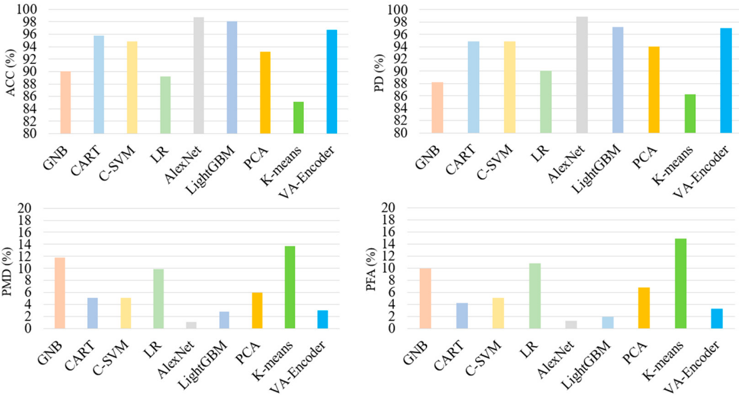
- AlexNet yielded the best results among all supervised and unsupervised models; the ranking reported is AlexNet, LightGBM, VA-Encoder, CART, C-SVM, PCA, GNB and LR, and K-means.
- For DNS attacks, AlexNet achieved ACC 99.13%, PD 99.81%, PMD 0.19%, and PFA 0.93%, while VA-Encoder achieved ACC 96.83%, PD 97.11%, PMD 2.89%, and PFA 3.23%.
- AlexNet had the best processing time, prediction time, training time per sample, and memory size among the compared models, with PRT 1.01 s, PT 1 s, TPS 0.01 s, and M 102 MiB in Table 4; GNB had the worst performance on these metrics (PRT 4.33 s, PT 4.15 s, TPS 0.82 s, M 245 MiB).
- VA-Encoder yielded the highest performance among unsupervised models, while K-means had the lowest ACC and PD and the highest PMD and PFA among unsupervised models.
Methods
- Used the CICDDOS 2019 dataset, containing normal traffic and 10 attack types; the lowest attack sample count (366,461 for UDP-Lag) was used as a threshold for all attacks, and 4,031,071 normal samples were randomly selected, resulting in 8,062,142 samples. The original 88 features were reduced to 21 features using Pearson’s Correlation and tree-based feature selection.
- Supervised models: Gaussian Naïve Bayes, Classification and Regression Tree, C-Support Vector Machine, Logistic Regression, Alex Neural Network, and Light Gradient Boosting. Unsupervised models: Principal Component Analysis, K-means, and Variational Autoencoder. Preprocessing included mean imputation and Yeo-Johnson Power Transformer; supervised models used labeled data, while the label column was removed for unsupervised models.
- Models were optimized with grid search and ADAM optimizer and evaluated with ACC, PD, PMD, PFA, processing time, prediction time, training time per sample, and memory size. A 5-fold cross-validation approach trained on 80% of the data and tested on the remaining 20%.
Limitations
- The paper does not state an explicit limitations section; it only notes future work to investigate supervised and unsupervised deep learning models for detecting attacks on intrusion detection systems.
- Evident from the text: the comparison uses only the CICDDOS 2019 dataset, so generalization to other networks or smart-grid environments is not established.
- Evident from the text: balancing the dataset by limiting every attack class to 366,461 samples and randomly selecting normal samples may discard data and affect representativeness; additionally, some reported table entries are incomplete or unclear in the provided text (e.g., VA-Encoder memory size is blank in Table 4, and Table 6 formatting is garbled), which limits reproducibility.
Model-written summary. Check it against the paper before relying on it.
Integrity signals
Registry
Cites
Statistics
Figures



Verification
Claims the paper makes
0 Valid · 1 Not valid · 2 Not checked · 35 Own results and interpretations
A result the paper states — it cites no source for it, so there is none to check. The quote shows it is in the paper.
In the paper
“GNB and LR models yielded the worst results of the supervised models.”
§ A Comparative Analysis of Supervised and Unsupervised Models for Detecting Attacks on the Intrusion Detection Systems > •
plain- Asserted: passes — The authors put it forward as true.
- Checkable: passes — It can be checked against evidence.
- Load-bearing: passes — The paper’s conclusions depend on it.
- Based: passes — The paper gives a reason why it holds.
A result the paper reports from its own data — it cites no other source for it, so there is none to check. The quote shows it is in the paper.
In the paper
“AlexNet outperformed VA-Encoder in detecting cyber-attacks.”
- Also stated in: § 4. Results and Discussion · hedged
“To summarize, AlexNet could detect LDAP, DNS, SNMP, MSSQL, NetBIOS, NTP, SSDP, TFTP, UDP, UDP-Lag attacks, and Benign traffic better than VA-Encoder.”
- Also stated in: § 5. Conclusions · plain
“In addition, cyber-attacks can be detected better with better performance in comparison with the same attacks using Variational-Encoder.”
§ A Comparative Analysis of Supervised and Unsupervised Models for Detecting Attacks on the Intrusion Detection Systems > 4. Results and Discussion
plainstates a cause- Asserted: passes — The authors put it forward as true.
- Checkable: passes — It can be checked against evidence.
- Load-bearing: passes — The paper’s conclusions depend on it.
- Based: passes — The paper gives a reason why it holds.
- Also stated in: § 4. Results and Discussion · hedged
A result the paper reports from its own data — it cites no other source for it, so there is none to check. The quote shows it is in the paper.
In the paper
“however, this last model detected SSDP, NTP, and TFP with the lowest performance.”
§ A Comparative Analysis of Supervised and Unsupervised Models for Detecting Attacks on the Intrusion Detection Systems > 4. Results and Discussion
plain- Asserted: passes — The authors put it forward as true.
- Checkable: passes — It can be checked against evidence.
- Load-bearing: unclear — It is unclear whether the paper’s conclusions depend on it.
- Based: passes — The paper gives a reason why it holds.
A result the paper states — it cites no source for it, so there is none to check. The quote shows it is in the paper.
In the paper
“The worst performance model among the unsupervised models was K-means.”
§ A Comparative Analysis of Supervised and Unsupervised Models for Detecting Attacks on the Intrusion Detection Systems > •
plain- Asserted: passes — The authors put it forward as true.
- Checkable: passes — It can be checked against evidence.
- Load-bearing: unclear — It is unclear whether the paper’s conclusions depend on it.
- Based: passes — The paper gives a reason why it holds.
A result the paper reports from its own data — it cites no other source for it, so there is none to check. The quote shows it is in the paper.
In the paper
“AlexNet outperformed the VA-Encoder model when detecting cyber-attacks.”
§ A Comparative Analysis of Supervised and Unsupervised Models for Detecting Attacks on the Intrusion Detection Systems > 4. Results and Discussion
plainstates a cause- Asserted: passes — The authors put it forward as true.
- Checkable: passes — It can be checked against evidence.
- Load-bearing: passes — The paper’s conclusions depend on it.
- Based: passes — The paper gives a reason why it holds.
16 more claims
Create a free account to see all 38 claims and to verify the 4 references still open.
- Borderline: one of the tests for a substantial claim is unclear. 1
- It may state two separate claims as one. 11
- The quote only partly states this claim. 1
- Probably not a substantial claim. 5
Self-check
Percentages, sums and reported differences re-computed from the paper’s own numbers.
Each contradiction between two passages listed here was confirmed by an independent check.
Rated major: it would touch a result — a value a result rests on, reported and recomputed p-values on opposite sides of the significance level, two passages that conflict with no sign which is right, or a cited work retracted before this paper was published.
In the paper
§ A Comparative Analysis of Supervised and Unsupervised Models for Detecting Attacks on the Intrusion Detection Systems > 3.1. Dataset
“This dataset includes normal traffic samples and samples from 10 attack types.”
§ A Comparative Analysis of Supervised and Unsupervised Models for Detecting Attacks on the Intrusion Detection Systems > 3.1. Dataset
“To address such an issue, the lowest number of attack samples (366,461) that belongs to the UDP-lag attacks was used as a threshold for all attacks; therefore, each attack category was limited to this number.For the normal samples, we randomly selected 4,031,071, resulting in a dataset with 8,062,142 samples.”
Rated minor: it would not touch a result — a value no result rests on, a p-value that stays on the same side of the significance level, or a conflict that is clerical, resolved elsewhere in the paper, or outside its own findings.
In the paper
§ A Comparative Analysis of Supervised and Unsupervised Models for Detecting Attacks on the Intrusion Detection Systems > 4. Results and Discussion
“AlexNet detected NetBIOS attacks with the highest PRT, PT, TPS, and M compared to those of other attacks”
§ A Comparative Analysis of Supervised and Unsupervised Models for Detecting Attacks on the Intrusion Detection Systems > 5. Conclusions
“| | NetBIOS | 1.9 | 1.4 | 0.9 | 191 | | AlexNet | NTP | 1.2 | 1.7 | 0.6 | 182 |”
Rated minor: it would not touch a result — a value no result rests on, a p-value that stays on the same side of the significance level, or a conflict that is clerical, resolved elsewhere in the paper, or outside its own findings.
In the paper
§ A Comparative Analysis of Supervised and Unsupervised Models for Detecting Attacks on the Intrusion Detection Systems > 4. Results and Discussion
“VA-Encoder detected SSDP attacks with the highest PRT, PT, TPS, and M compared to those other attacks.”
§ A Comparative Analysis of Supervised and Unsupervised Models for Detecting Attacks on the Intrusion Detection Systems > 5. Conclusions
“| | LDAP | 3.5 | 3.1 | 0.4 | 290 | | | DNS | 3.4 | 2.9 | 0.4 | 278 | | | SNMP | 3.2 | 2.3 | 0.9 | 276 | | | MSSQL | 2.9 | 2.3 | 0.3 | 254 | | | NetBIOS | 2.9 | 2.3 | 0.4 | 246 | | VA-Encoder | NTP | 2.9 | 1.3 | 0.6 | 277 | | | SSDP | 3.9 | 2.1 | 0.5 | 297 |”
Rated minor: it would not touch a result — a value no result rests on, a p-value that stays on the same side of the significance level, or a conflict that is clerical, resolved elsewhere in the paper, or outside its own findings.
In the paper
§ A Comparative Analysis of Supervised and Unsupervised Models for Detecting Attacks on the Intrusion Detection Systems > 4. Results and Discussion
“VA-Encoder yielded the best results among the unsupervised models in terms of ACC, PD, PMD, PFA, PRT, PT, TPS, and M.”
§ A Comparative Analysis of Supervised and Unsupervised Models for Detecting Attacks on the Intrusion Detection Systems > 5. Conclusions
“| PCA | 1.9 | 0.91 | 0.89 | 164 | | K-means | 1.9 | 1.4 | 0.81 | 180 | | VA-Encoder | 1.77 | 1.2 | 0.5 | |”
Rated minor: it would not touch a result — a value no result rests on, a p-value that stays on the same side of the significance level, or a conflict that is clerical, resolved elsewhere in the paper, or outside its own findings.
In the paper
§ A Comparative Analysis of Supervised and Unsupervised Models for Detecting Attacks on the Intrusion Detection Systems > 3.5. Evaluation Metrics
“PRT refers to the total time necessary to train, test, and validate the models.”
§ A Comparative Analysis of Supervised and Unsupervised Models for Detecting Attacks on the Intrusion Detection Systems > 5. Conclusions
“| AlexNet | NTP | 1.2 | 1.7 | 0.6 | 182 |”
5 more findings
Create a free account to see every finding of this check.
Citations
Cites
Principal component analysis: A review and recent developments
Jolliffe, I. T., & Cadima, J. (2016) · Philosophical Transactions of the Royal Society A: Mathematical, Physical and Engineering Sciences · doi:10.1098/rsta.2015.0202 · Cited by 10,117
Understanding of a convolutional neural network
Albawi, S., Mohammed, T. A., & Al-Zawi, S. (2017) · 2017 International Conference on Engineering and Technology (ICET) · doi:10.1109/icengtechnol.2017.8308186 · Cited by 3,986
ML-KNN: A lazy learning approach to multi-label learning
Zhang, M.-L., & Zhou, Z.-H. (2007) · Pattern Recognition · doi:10.1016/j.patcog.2006.12.019 · Cited by 3,552
Developing Realistic Distributed Denial of Service (DDoS) Attack Dataset and Taxonomy
Sharafaldin, I., Lashkari, A. H., Hakak, S., & Ghorbani, A. A. (2019) · 2019 International Carnahan Conference on Security Technology (ICCST) · doi:10.1109/ccst.2019.8888419 · Cited by 1,275
Bayesian statistics and modelling
van de Schoot, R., Depaoli, S., King, R., Kramer, B., Märtens, K., Tadesse, M. G., Vannucci, M., Gelman, A., Veen, D., Willemsen, J., et al. (2021) · Nature Reviews Methods Primers · doi:10.1038/s43586-020-00001-2 · Cited by 1,176
Decision tree methods: applications for classification and prediction.
Song, Y. Y., & Lü, Y. (2015) · PubMed · doi:10.11919/j.issn.1002-0829.215044 · Cited by 1,132
Selection of K in K-means clustering
Pham, D. T., Dimov, S. S., & Nguyen, C. D. (2005) · Proceedings of the Institution of Mechanical Engineers, Part C: Journal of Mechanical Engineering Science · doi:10.1243/095440605x8298 · Cited by 597
A Supervised Intrusion Detection System for Smart Home IoT Devices
Anthi, E., Williams, L., Slowinska, M., Theodorakopoulos, G., & Burnap, P. (2019) · IEEE Internet of Things Journal · doi:10.1109/jiot.2019.2926365 · Cited by 597
Wang, S.-C. (2003) · Interdisciplinary Computing in Java Programming · doi:10.1007/978-1-4615-0377-4_5 · Cited by 580
On the training of radial basis function classifiers
Musavi, M. T., Ahmed, W., Chan, K. H., Faris, K. B., & Hummels, D. M. (1992) · Neural Networks · doi:10.1016/s0893-6080(05)80038-3 · Cited by 569
Research works printed but not linked: 4
- Tazi, K., Abdi, F., and Abbou, M.F. (2015). International Renewable and Sustainable Energy Conference (IRSEC), IEEE.
- Mrabet, Z.E., Ghazi, H.E., and Kaabouch, N. (2019). Conference on Electro Information Technology (EIT), IEEE.
- Altwaijry, H. (2013). IAENG Transactions on Engineering Technologies, Springer.
- Singh, 2014, Comparative study ID3, cart and C4. 5 decision tree algorithm: A survey, Int. J. Adv. Inf. Sci. Technol. (IJAIST), 27, 97
Cited by
Machine Learning: Models, Challenges, and Research Directions
Khoei, T. T., & Kaabouch, N. (2023) · Future Internet · doi:10.3390/fi15100332 · Cited by 119
Self-citationElectricity Theft Detection Using Deep Reinforcement Learning in Smart Power Grids
El-Toukhy, A. T., Badr, M. M., Mahmoud, M. M. E. A., Srivastava, G., Fouda, M. M., & Alsabaan, M. (2023) · IEEE Access · doi:10.1109/access.2023.3284681 · Cited by 112
Alnajim, A. M., Habib, S., Islam, M., Thwin, S. M., & Alotaibi, F. (2023) · Technologies · doi:10.3390/technologies11060161 · Cited by 89
Li, S., Zeng, W., Ni, X., Liu, Q., Li, W., Stackpole, M. L., Zhou, Y., Gower, A., Krysan, K., Ahuja, P., et al. (2023) · Proceedings of the National Academy of Sciences · doi:10.1073/pnas.2305236120 · Cited by 87
Muthubalaji, S., Muniyaraj, N. K., Rao, S. P. V. S., Thandapani, K., Mohan, P. R., Somasundaram, T., & Farhaoui, Y. (2024) · Big Data Mining and Analytics · doi:10.26599/bdma.2023.9020022 · Cited by 76
Data reduction in big data: a survey of methods, challenges and future directions
Khoei, T. T., & Singh, A. (2024) · International Journal of Data Science and Analytics · doi:10.1007/s41060-024-00603-z · Cited by 69
Ayad, A. G., El-Gayar, M. M., Hikal, N. A., & Sakr, N. A. (2024) · Electronics · doi:10.3390/electronics14010104 · Cited by 44
Semi-Supervised Anomaly Detection of Dissolved Oxygen Sensor in Wastewater Treatment Plants
Ghinea, L. M., Miron, M., & Barbu, M. (2023) · Sensors · doi:10.3390/s23198022 · Cited by 38
A novel optimization-driven deep learning framework for the detection of DDoS attacks
Batchu, R. K., Bikku, T., Thota, S., Seetha, H., & Ayoade, A. A. (2024) · Scientific Reports · doi:10.1038/s41598-024-77554-9 · Cited by 36
An Unsupervised Anomaly Detection Based on Self-Organizing Map for the Oil and Gas Sector
Concetti, L., Mazzuto, G., Ciarapica, F. E., & Bevilacqua, M. (2023) · Applied Sciences · doi:10.3390/app13063725 · Cited by 29
Countering Evasion Attacks for Smart Grid Reinforcement Learning-Based Detectors
El-Toukhy, A. T., Mahmoud, M. M. E. A., Bondok, A. H., Fouda, M. M., & Alsabaan, M. (2023) · IEEE Access · doi:10.1109/access.2023.3312376 · Cited by 28
Mbaya, E. B., Adetiba, E., Badejo, J. A., Wejin, J. S., Oshin, O. I., Isife, O., Thakur, S. C., Moyo, S., & Adebiyi, E. F. (2023) · IEEE Access · doi:10.1109/access.2023.3325992 · Cited by 26
Alrayes, F. S., Asiri, M. M., Maashi, M. S., Salama, A. S., Hamza, M. A., Ibrahim, S. S., Zamani, A. S., & Alsaid, M. I. (2023) · Sustainability · doi:10.3390/su15086902 · Cited by 25
Gul, S., Arshad, S., Saeed, S. M. U., Akram, A., & Azam, M. A. (2024) · Computers · doi:10.3390/computers14010004 · Cited by 24
AI-DRIVEN THREAT DETECTION AND RESPONSE FRAMEWORK FOR CLOUD INFRASTRUCTURE SECURITY
Cyber Security Analyst, U. C., & Mollah, M. H.-O.-R. (2025) · American Journal of Scholarly Research and Innovation · doi:10.63125/e58hzh78 · Cited by 23
Supervised Deep Learning Models for Detecting GPS Spoofing Attacks on Unmanned Aerial Vehicles
Khoei, T. T., Aissou, G., Shamaileh, K. A. A., Devabhaktuni, V. K., & Kaabouch, N. (2023) · IEEE International Conference on Electro Information Technology · doi:10.1109/eit57321.2023.10187274 · Cited by 19
Self-citationMoses, A., Xie, P., Wang, S., & Chen, D. (2024) · JOM · doi:10.1007/s11837-024-06674-4 · Cited by 16
Kwubeghari, A., & Ezeji, N. G. (2025) · ABUAD Journal of Engineering Research and Development (AJERD) · doi:10.53982/ajerd.2025.0802.32-j · Cited by 15
AI-powered threat detection: Opportunities and limitations in modern cyber defense
Nnaka, K. I., Mbamalu, P. O., Nwaigbo, J. C., Ozo-ogueji, P. C., Njoku, V. I., & Ekechi, C. C. (2025) · World Journal of Advanced Research and Reviews · doi:10.30574/wjarr.2025.27.2.2854 · Cited by 14
f-AnoGAN for Unsupervised Attack Detection in SDN Environment
Ruffo, V. G. D. S., Carvalho, L. F., Lloret, J., & Proença, M. L. (2025) · IEEE Transactions on Network Science and Engineering · doi:10.1109/tnse.2025.3558936 · Cited by 11
Otuka, C. I., Cai, D., Ukwuoma, C. C., Luo, S., Yang, Z., Bamisile, O., Ukwuoma, C. D., Otuka, C. U., Otuka, N. O., & Huang, Q. (2025) · Solar Energy · doi:10.1016/j.solener.2025.114175 · Cited by 10
ACapsule Q-Learning Based Reinforcement Model for Intrusion Detection System on Smart Grid
Khoei, T. T., & Kaabouch, N. (2023) · IEEE International Conference on Electro Information Technology · doi:10.1109/eit57321.2023.10187374 · Cited by 10
Self-citationHarnessing AI and Machine Learning for Intrusion Detection in Cyber Security
Chahal, S. (2023) · International Journal of Science and Research (IJSR) · doi:10.21275/sr231003163943 · Cited by 10
Almoqbil, A. (2024) · International Journal of Information Security · doi:10.1007/s10207-024-00841-z · Cited by 10
Jafari, F., Dorafshan, S., & Kaabouch, N. (2023) · IEEE/ASME International Conference on Advanced Intelligent Mechatronics · doi:10.1109/aim46323.2023.10196113 · Cited by 9
Self-citationBlockage detection in centrifugal pump using semi-supervised machine learning based on SVM and LSTM
Ranawat, N. S., Miglani, A., & Kankar, P. K. (2025) · Measurement Science and Technology · doi:10.1088/1361-6501/adbb08 · Cited by 9
He, Y., Lai, Y., Chen, B., Chen, Y., Xie, Z., Yu, X., & Luo, M. (2024) · Minerals · doi:10.3390/min14121282 · Cited by 8
Securing the Smart Grid: A Comprehensive Analysis of Recent Cyber Attacks
Qureshi, M. S., Khan, I. U., & Kim, K. (2023) · International Conference on Electrical, Control and Instrumentation Engineering (ICECIE) · doi:10.1109/icecie58751.2024.10457427 · Cited by 7
Khalif, A. A., Warsame, A. A., Mohamed, J. I., Mohamoud, H. M., Hirsi, A., Audah, L., Omar, M. O., Abdirahman, A. M., & Ahmed, M. (2025) · International Conference on New Trends in Computing Sciences (ICTCS) · doi:10.1109/ictcs65341.2025.10989362 · Cited by 7
A Review of Outlier Detection Techniques in Cybersecurity: A Machine Learning Perspective
Ododo, F. R., & Sadiq, R. R. (2025) · Journal of Science Innovation and Technology Research · doi:10.70382/ajsitr.v7i9.034 · Cited by 6
Artificial Intelligence-Based Gamification in Cybersecurity Education
Mahmood, D., & Afzaal, R. (2025) · IGI Global eBooks · doi:10.4018/979-8-3373-0477-9.ch007 · Cited by 5
Efficient Utilization of Energy in IoT Devices Using Machine Learning Algorithms
Saurabh, K., Tripathi, M. M., & Mahapatra, S. (2025) · International Journal of experimental research and review · doi:10.52756/ijerr.2025.v47.011 · Cited by 5
Network Attack Detection Using NeuroEvolution of Augmenting Topologies (NEAT) Algorithm
Zhukabayeva, T. K., Adamova, A., Ven–Tsen, K., Nurlan, Z., Mardenov, Y., & Karabayev, N. (2024) · JOIV International Journal on Informatics Visualization · doi:10.62527/joiv.8.1.2220 · Cited by 5
PPT-GNN: a practical pre-trained temporal graph neural network for intrusion detection
Langendonck, L. V. (2024) · UPCommons institutional repository (Universitat Politècnica de Catalunya) · Cited by 5
A Survey of Intrusion Detection Systems Based on Machine Learning for Cloud Security
Mahendar, K., & Shivakanth, G. (2025) · International Journal of Electrical and Electronics Engineering · doi:10.14445/23488379/ijeee-v12i5p119 · Cited by 4
Cyber security challenges and solutions in protective relaying
Thoufeer, K. K., & Jena, M. K. (2024) · Elsevier eBooks · doi:10.1016/b978-0-443-15317-4.00003-8 · Cited by 4
Large Language Model-Based Federated Zero-Shot Learning for Intrusion Detection in Smart Grids
Dasgupta, R., & Mitra, P. (2025) · IFIP advances in information and communication technology · doi:10.1007/978-3-031-96235-6_24 · Cited by 4
Enhanced intrusion detection in smart grids using extended long short-term memory variants
Baalia, S., Boughareb, D., Kouahla, Z., & Séridi, H. (2025) · International Journal of Advances in Intelligent Informatics · doi:10.26555/ijain.v11i4.2169 · Cited by 3
Swetha, T., & Seshaiah, M. (2025) · International Conference on Knowledge Engineering and Communication Systems (ICKECS) · doi:10.1109/ickecs65700.2025.11035332 · Cited by 3
A Comprehensive Review of Intrusion Detection Systems in IoT networks Using ML and DL Techniques
Rahim, F., & Alsaidi, A. P. D. S. A. A. A. (2025) · Alkadhim journal for computer science. · doi:10.61710/kjcs.v3i2.111 · Cited by 3
An Empirical Study of Intrusion Detection by Combining Clustering and Classification Methods
Younisse, R., Alslman, Y., Alnagi, E., & Azzeh, M. (2023) · Communications in computer and information science · doi:10.1007/978-3-031-43838-7_3 · Cited by 3
Multiclassification Analysis of Volumetric, Protocol, and Application Layer DDoS Attacks
Brown, E., Fisher, J., Hudon, A., Colston, E., & Lu, W. (2024) · Lecture notes on data engineering and communications technologies · doi:10.1007/978-3-031-57942-4_39 · Cited by 2
An Effective Unsupervised Cyber Attack Detection on Web Applications Using Gaussian Mixture Model
Tran-Thi, M.-H., Ngo, T.-K., Le, X.-H., Nguyen, D.-T., Nguyen, X.-H., & Le, K.-H. (2024) · Lecture notes in networks and systems · doi:10.1007/978-3-031-74127-2_39 · Cited by 2
Luo, L., & Liu, T. (2024) · Advances in Operation Research and Production Management · doi:10.54254/3029-0880/3/2024019 · Cited by 2
Supervised Vs. Unsupervised Learning: A Comparative Study in Modern AI System
Verma, R. (2025) · Communications on Applied Nonlinear Analysis · doi:10.52783/cana.v32.4022 · Cited by 2
Lawall, A., & Zöller, T. (2025) · Intelligent Cybersecurity Conference (ICSC) · doi:10.1109/icsc65596.2025.11140289 · Cited by 2
Akoul, N., Ahmad, A. A., & Pro, S. (2026) · Journal of Engineering and Applied Science · doi:10.1186/s44147-026-00886-y · Cited by 2
Dastageer, K. B., Chinnasamy, P., & Deepalakshmi, P. (2025) · International Conference on Intelligent Computing, Information and Control Systems (ICOIICS) · doi:10.1109/icoiics67115.2025.11390522 · Cited by 2
Lightweight LSTM-Based Homogeneous Transfer Learning for Efficient On-Device IoT Intrusion Detection
Gamlo, A. H., Sharaf, S. A., & Molla, R. (2026) · Future Internet · doi:10.3390/fi18030133 · Cited by 2
The importance of the clustering model to detect new types of intrusion in data trafficPreprint
Abd, N. S., Khalid, N. W., & Ali, B. H. (2024) · arXiv (Cornell University) · doi:10.48550/arxiv.2411.14550 · Cited by 2
Intrusion Detection Systems Using Quantum-Inspired Density Matrix Encodings
Huynh, L., Hong, J. B., Mian, A. S., Suzuki, H., & Camtepe, S. A. (2024) · International Conference on Dependable Systems and Networks workshops · doi:10.1109/dsn-w60302.2024.00019 · Cited by 1
Jeyasoundari, J., Sridevi, S., & Raja, S. C. (2024) · Students Conference on Engineering and Systems · doi:10.1109/sces61914.2024.10652494 · Cited by 1
Clustering Algorithms for Anomaly Detection in EVCS Infrastructure using OCPP
Tchassem, C. T., Kombate, Y., & Tardif, P.-M. (2025) · Conference on Privacy, Security and Trust · doi:10.1109/pst65910.2025.11268878 · Cited by 1
Implementing Naïve Bayes and Decision Forest Technique to Enhance Intrusion Detection Systems
Durole, P. H., & Agarwal, M. (2025) · International Conference on Applications of Machine Intelligence and Data Analytics (ICAMIDA) · doi:10.1109/icamida64673.2025.11209620 · Cited by 1
Hybrid Behavioral Intrusion Detection for Zigbee Smart Home Networks Using Metadata-Based Learning
Mohamadou, N., Muazu, Z. G., & Alayedi, M. (2026) · IEEE International Conference on Communication Systems and Network Technologies (CSNT) · doi:10.1109/csnt69054.2026.11502291 · Cited by 1
Joumblat, R., Alnaqbi, A. J., Al-Khateeb, G. G., ElKordi, A. A., Youssef, A., Neto, O. D. M. M., Polo-Mendoza, R., & Kassem, H. (2026) · International Journal of Pavement Research and Technology · doi:10.1007/s42947-026-00833-3 · Cited by 1
Ali, M. A. A., El-Badawy, H. M., Bahaa-Eldin, A. M., & Sobh, M. (2025) · Lecture notes in networks and systems · doi:10.1007/978-3-031-82377-0_20 · Cited by 1
Intrusion Detection Systems and its application in latest Networking Technologies – A Survey
Shanthi, K., & Maruthi, R. (2024) · Educational Administration Theory and Practice journal · Cited by 1
Hybrid Intrusion Detection and Prevention Systems: A Comprehensive SurveyPreprint
Asad, M., Otoum, S., & Ouni, B. (2026) · doi:10.22541/au.177376146.68868874/v1 · Cited by 1
Deep learning based intelligent IDS for Large-scale IoT networksPreprint
Andrade, I., Mahadik, S. S., Mukherjee, M., Pawar, P. M., & Muthalagu, R. (2026) · arXiv (Cornell University) · doi:10.48550/arxiv.2603.16342 · Cited by 1
Support analysis method in political news posts on social network
da Silva, R. O. (2023) · UPM Digital Archive (Technical University of Madrid) · doi:10.20868/upm.thesis.79766
Multivariate Long Short-Term Memory with Spark Module for an Intrusion Detection System
(2024) · International journal of intelligent engineering and systems · doi:10.22266/ijies2025.0229.55
A Hierarchical Security Situation Assessment Approach for Train Control System under Cyber Attacks
Li, Q., Bu, B., & Zhao, J. (2025) · Computers, materials & continua/Computers, materials & continua (Print) · doi:10.32604/cmc.2025.061525
Enhanced Malicious Activity Detection In Permissionless-Blockchain Systems: A Comprehensive Review
Deshmukh, C. (2025) · Advances in Nonlinear Variational Inequalities · doi:10.52783/anvi.v28.4143
Autoencoder and Decoder for Efficient Network Intrusion Detection in Internet of Vehicles
Pranav, S. A., Priya, S. S., & Hariharan, B. (2024) · International Conference on Smart Technologies for Sustainable Development Goals (ICSTSDG) · doi:10.1109/icstsdg61998.2024.11026487
Hórus-CDS: O Olho Digital na Segurança das Smart Grids
Paula, A. D. O., Santos, W. F., Gonçalves, V. P., Serrano, A. L. M., Meneguette, R. I., Immich, R., & Filho, G. P. R. (2025) · Simpósio Brasileiro de Redes de Computadores e Sistemas Distribuídos (SBRC) · doi:10.5753/sbrc_estendido.2025.6622
An Emotional Artificial Intelligence Framework for Detecting Criminals
Khoei, T. T., Singh, A., & Yan, P. (2024) · IEEE Annual Information Technology, Electronics and Mobile Communication Conference (IEMCON) · doi:10.1109/iemcon62851.2024.11093505
Machine Learning for Security in Wireless Networks
Thanki, R. M., Borisagar, K. R., & Diwan, A. (2025) · Synthesis lectures on communications · doi:10.1007/978-3-031-94117-7_4
Horus-CDS: The digital eye on smart grid security
Paula, A. D. O., Santos, W. F., Gonçalves, V. P., Serrano, A. L. M., Meneguette, R. I., & Filho, G. R. (2026) · Computer Networks · doi:10.1016/j.comnet.2026.112347
Machine Learning for Attack Detection in IoT Networks
Mliki, H., Ouarda, W., & Fourati, L. C. (2025) · IEEE International Forum on Research and Technology for Society and Industry (RTSI) · doi:10.1109/rtsi64020.2025.11212564
Maximizing Detection Coverage in IDS Through Hybrid Deep Learning Architectures
Dave, J., Shah, C. A., & Patel, P. C. (2025) · Lecture notes in networks and systems · doi:10.1007/978-3-032-06662-6_30
Q-Learning-Based Detection of IPv6 Intrusions: A Behavioral and Performance Study
Daru, A. F., Hirzan, A. M., Bashi, Z. S. M. A., & Fanani, F. (2025) · International Seminar on Application for Technology of Information and Communication (iSemantic) · doi:10.1109/isemantic67418.2025.11291642
Czaplinski, M. (2024) · DiVA (Digitala Vetenskapliga Arkivet)
Nwokedi, U. I. (2023) · NORMA
Detección de anomalías en redes domiciliarias basado en Machine Learning.
Ivars Carbó, M., & Alesanco Iglesias, Á. (2023) · Zaguan (Universidad de Zaragoza)
Koukopoulos, Z., Koukopoulos, D. K., & Fidas, C. A. (2025) · International Conference on Information, Intelligence, Systems & Applications (IISA) · doi:10.1109/iisa66859.2025.11311279
Comparative Evaluation of Machine Learning Methods for Enhanced Intrusion Detection
Ananthi, S. N., & Hemanand, D. (2026) · Communications in computer and information science · doi:10.1007/978-3-032-13026-6_19
Cyber Attack Detection System for Internet of Things Using Machine Learning: A Review
Hadi, Z. H., & Al-Mashhadi, H. M. (2026) · Iraqi Journal of Intelligent Computing and Informatics (IJICI) · doi:10.52940/ijici.v4i2.141
Dave, J., Shah, C., & Patel, P. C. (2026) · Lecture notes in networks and systems · doi:10.1007/978-3-032-13203-1_25
Le, P.-H. P., Thi, H.-N. N., Nhat, T.-H. H., & Xuan, H.-M. D. (2026) · Lecture notes in networks and systems · doi:10.1007/978-3-032-13177-5_6
Comparative Analysis of Machine Learning Models for Intrusion Detection in Cybersecurity
Topcu, A. E., Avci, M., & Uzun, N. B. (2025) · International Conference on Electrical and Computer Engineering Researches (ICECER) · doi:10.1109/icecer65523.2025.11400924
Detección de ciberataques en redes IoT mediante técnicas de clasificación y agrupamiento
Moreno, M. B. (2025) · e_Buah
AI-Driven Cybersecurity for Detecting Anomalous API Access Patterns in Distributed Applications
Rahman, S. S. (2026) · Journal of Information Systems Engineering & Management · doi:10.52783/jisem.v11i2s.14463
Intrusion Response System Using Reinforcement Learning TD3 Algorithm
Roy, D. K., & Kalita, H. (2025) · IEEE International Conference on Emerging Trends in Computing and Communication (ETCOM) · doi:10.1109/etcom66606.2025.11437228
Rajendran, N., Sundharajan, V., Kannan, R., & Shanmugam, M. (2026) · Energy Storage and Saving · doi:10.1016/j.enss.2025.06.008
Cordero-Martínez, R., Sánchez, D., & Melín, P. (2026) · AI & Innovation · doi:10.1002/aiv2.70008
Comparative Analysis of Supervised and Unsupervised Learning in Digital Forensics
Laxmikanthan, M., Murugan, K. S. A. S., Chawla, R., Biswas, P. C., o'g'li, F. S. S., & Chandnani, N. (2026) · Advances in computational intelligence and robotics book series · doi:10.4018/979-8-2600-2278-8.ch007
Hnaif, A. A., Alshawabkah, H., Algafaan, A., & Alia, M. (2026) · Computers, materials & continua/Computers, materials & continua (Print) · doi:10.32604/cmc.2026.082998
Beyond Defensive Reporting: Machine Learning for Active Anti-Money Laundering Control in InsurancePreprint
Goldar, D., Sandve, G. K., & Jullum, M. (2026) · arXiv (Cornell University) · doi:10.48550/arxiv.2606.16663
Real-time Network Traffic Analysis and Visualization for Optimizing Campus Network Performance
Li, X. (2026) · International Conference on Computing, Mathematics and Engineering Technologies (iCoMET) · doi:10.1109/icomet69771.2026.11591721
Babu, K. G., & Jamalpur, B. (2026) · Springer proceedings in mathematics & statistics · doi:10.1007/978-981-95-3841-6_12
Roshna, D., Sritha, K. N., & Namee, K. (2026) · Lecture notes in networks and systems · doi:10.1007/978-3-032-26319-3_36
Vezeteu, P. V., Boboc, N.-D., & Năstac, I. (2026) · Algorithms · doi:10.3390/a19090750
Gondo, R., & Kolawole, O. D. (2026) · Transactions of the Royal Society of South Africa · doi:10.1080/0035919x.2026.2731206
Metadata
- Authors
- Talaei Khoei, T., & Kaabouch, N.
- Affiliations
- School of Electrical Engineering and Computer Science, University of North Dakota, Grand Forks, ND 58202, USA
- University of North Dakota (US)
- Venue
- Information
- Publisher
- MDPI AG
- Published
- 2023-02-07
- Volume
- 14
- Issue
- 2
- Pages
- 103
- ISSN
- 2078-2489 (ISSN-L)
- OpenAlex
- W4319439792
- Cited by
- 95
- References
- 40
- Citations by year
- 2026: 23 · 2025: 32 · 2024: 22 · 2023: 18
- FWCI
- 7.26
- Type
- journal article
- Language
- en
- Open access
- gold
- doi.org
- Licence
- Locations
- Information (publishedVersion, cc-by)
- DOAJ (DOAJ: Directory of Open Access Journals) (submittedVersion, cc-by-sa)
- Topics
- Physical Sciences › Computer Science › Computer Networks and Communications › Network Security and Intrusion Detection
- Physical Sciences › Computer Science › Hardware and Architecture › Network Packet Processing and Optimization
- Physical Sciences › Computer Science › Artificial Intelligence › Artificial Immune Systems Applications
- Keywords
- intrusion detection, cyberattack detection, supervised learning, unsupervised learning, smart grid security, Gaussian naive Bayes, decision tree, support vector machine, LightGBM, AlexNet, variational autoencoder, K-means clustering, principal component analysis, false alarm rate, detection accuracy
About these checks
Registry, retraction, Cites and statistics results are computed, not judged, with one exception: a printed reference that no index lists is read once by a model before it counts as a citation error. Claims are extracted by a model and kept only when their quote appears verbatim in the text; each cited source is then checked, with a model’s help, for whether it says what the claim relies on. Those verdicts can be wrong — read the claim’s quote and the cited source before relying on one.
A language model drew the claims from the paper on 2026-11-16, under version 3 of the claim definition (model deepseek-v4.1-flash, prompt extract-v3).
A second model labelled each claim on 2026-11-16 (model jev-1.13-20260917, definition revision gold-guideline-v0.2).
Statistics and arithmetic are recomputed, not judged.
Confidence bands are shown only for fields calibrated on our annotated test set. None is calibrated yet, so no band is shown.
What counts as a claim ›How we measure confidence ›How we check this ›
Are you an author, or do you see a problem with this page? Request a review
Data sources
Bibliographic data: Semantic Scholar, OpenAlex, Crossref.
Contains information from the Semantic Scholar Academic Graph Datasets, made available under the ODC Attribution License (ODC-BY 1.0).
Semantic Scholar’s data is described in: Kinney, R., et al. (2023). The Semantic Scholar Open Data Platform. arXiv:2301.10140.
