

A Comprehensive Study of Activity Recognition Using Accelerometers
Open accessPublished version of a preprint
The DOI matches its Crossref record; 98 of the 99 references it cites were found in a registry or an index, and 1 are not checked yet.
Abstract
This paper serves as a survey and empirical evaluation of the state-of-the-art in activity recognition methods using accelerometers. The paper is particularly focused on long-term activity recognition in real-world settings. In these environments, data collection is not a trivial matter; thus, there are performance trade-offs between prediction accuracy, which is not the sole system objective, and keeping the maintenance overhead at minimum levels. We examine research that has focused on the selection of activities, the features that are extracted from the accelerometer data, the segmentation of the time-series data, the locations of accelerometers, the selection and configuration trade-offs, the test/retest reliability, and the generalisation performance. Furthermore, we study these questions from an experimental platform and show, somewhat surprisingly, that many disparate experimental configurations yield comparable predictive performance on testing data. Our understanding of these results is that the experimental setup directly and indirectly defines a pathway for context to be delivered to the classifier, and that, in some settings, certain configurations are more optimal than alternatives. We conclude by identifying how the main results of this work can be used in practice, specifically in experimental configurations in challenging experimental conditions.
Overview
The claims and statistics of this paper haven’t been checked yet.
Free: it reads the open-access text and checks the first 5 claims that cite a source we can check. Create a free account to check every claim.
Integrity signals
Registry
Cites
Statistics
Figures

Verification
Claims the paper makes
The claims and statistics of this paper haven’t been checked yet.
Free: it reads the open-access text and checks the first 5 claims that cite a source we can check. Create a free account to check every claim.
Self-check
Percentages, sums and reported differences re-computed from the paper’s own numbers.
The self-check needs the paper’s full text.
Citations
Cites
Breiman, L. (2001) · Machine Learning · doi:10.1023/a:1010933404324 · Cited by 133,538
ImageNet classification with deep convolutional neural networks
Krizhevsky, A., Sutskever, I., & Hinton, G. E. (2017) · Communications of the ACM · doi:10.1145/3065386 · Cited by 112,155 · cited 1×
“Convolutional Neural Networks Convolutional Neural Networks (CNNs), also referred to as ConvNets, are a widely used extension of MLPs which have seen great success in computer vision tasks [80].”
BackgroundHochreiter, S., & Schmidhuber, J. (1997) · Neural Computation · doi:10.1162/neco.1997.9.8.1735 · Cited by 102,318 · cited 13×
“Our experiments use LSTM since they have been shown to perform similarly to other methods (e.g., GRU) in many settings [87].”
MethodInfluentialAdam: A Method for Stochastic Optimization
Kingma, D. P., & Ba, J. (2014) · arXiv · doi:10.48550/arxiv.1412.6980 · Cited by 98,946 · cited 1×
“All networks were trained with the Adam optimiser [88] and parameters are tuned to minimise categorical cross entropy.”
MethodLearning Phrase Representations using RNN Encoder–Decoder for Statistical Machine Translation
Cho, K., van Merrienboer, B., Gulcehre, C., Bahdanau, D., Bougares, F., Schwenk, H., & Bengio, Y. (2014) · Proceedings of the 2014 Conference on Empirical Methods in Natural Language Processing (EMNLP) · doi:10.3115/v1/d14-1179 · Cited by 25,545 · cited 2×
“Our experiments use LSTM since they have been shown to perform similarly to other methods (e.g., GRU) in many settings [87].”
MethodPan, S. J., & Yang, Q. (2010) · IEEE Transactions on Knowledge and Data Engineering · doi:10.1109/tkde.2009.191 · Cited by 23,387 · cited 1×
“The introduction of such methods will reduce the risk of overfitting, but Bayesian models can naturally be adapted to hierarchical models which can naturally lead to transfer learning frameworks [96].”
BackgroundAdvances in neural information processing systems 7
Cios, K., & Shields, M. (1997) · Neurocomputing · doi:10.1016/s0925-2312(97)90018-7 · Cited by 22,059
Multilayer feedforward networks are universal approximators
Hornik, K., Stinchcombe, M., & White, H. (1989) · Neural Networks · doi:10.1016/0893-6080(89)90020-8 · Cited by 21,728 · cited 1×
“However, since these models can model arbitrarily complex functions [46] care must be taken to minimise the risk of overfitting.”
BackgroundQuinlan, J. R. (1986) · Machine Learning · doi:10.1007/bf00116251 · Cited by 21,439 · cited 2×
“We note that whilst research has often focused on which ML algorithm performs best for the given dataset, we will assume instead here that virtually any state-of-the-art ML algorithm (e.g., kernel Support Vector Machines (SVMs) [12], Decision Trees [13], Bayesian classifiers [14]) can be made to perform equivalently g…”
BackgroundConditional Random Fields: Probabilistic Models for Segmenting and Labeling Sequence Data
Lafferty, J., McCallum, A., & Pereira, F. C. N. (2001) · ScholarlyCommons (University of Pennsylvania) · Cited by 12,935
Research works printed but not linked: 3
- Shawe-Taylor, J., and Cristianini, N. (2000). Support Vector Machines, Cambridge University Press.
- Goodfellow, I., Bengio, Y., Courville, A., and Bengio, Y. (2016). Deep Learning, MIT Press.
- Tipping, 2001, Sparse Bayesian Learning and the Relevance Vector Machine, J. Mach. Learn. Res., 1, 211
Cited by
Items 101–143 of 143
Sawandi, H., Jayasinghe, A. B., & Retscher, G. (2024) · Sensors · doi:10.3390/s24123822 · Cited by 6
“As pointed out in the study by [18,22], which investigated several accelerometer placements As pointed out in the study by [18,22], which investigated several accelerometer placements, including at the hip (belt), wrist, upper arm, ankle, and thigh of the test person, using numerous accelerometers…”
BackgroundSirisombat, T., Khuanpet, J., Chancharoen, W., Thanartthanaboon, P., Ngamkajornwiwat, P., Achararit, P., Mahikul, W., & Singkham, P. (2024) · Engineering Journal · doi:10.4186/ej.2024.28.1.13 · Cited by 3
Data labelling in the wild: annotating free-living activities and Parkinson's disease symptoms
Morgan, C., Heidarivincheh, F., Craddock, I. J., McConville, R., Perelló-Nieto, M., Tonkin, E. L., Masullo, A., Vafeas, A., Kim, M. K., McNaney, R., et al. (2021) · IEEE International Conference on Pervasive Computing and Communications Workshops (PerCom Workshops) · doi:10.1109/percomworkshops51409.2021.9431017 · Cited by 6
“Further work comparing the performance of long-term activity recognition using accelerometers concluded that it is more difficult to estimate the performance of these methods in the wild than in a laboratory environment [13].”
Self-citationVideo-based Pose-Estimation Data as Source for Transfer Learning in Human Activity Recognition
Awasthi, S., Rueda, F. M., & Fink, G. A. (2022) · Proceedings - International Conference on Pattern Recognition/Proceedings/International Conference on Pattern Recognition · doi:10.1109/icpr56361.2022.9956405 · Cited by 5
Active Learning with Label Proportions
Poyiadzis, R., Santos‐Rodríguez, R., & Twomey, N. (2019) · IEEE International Conference on Acoustics Speech and Signal Processing · doi:10.1109/icassp.2019.8682748 · Cited by 6
Self-citationImproving Activity Recognition while Reducing Misclassification of Unknown Activities
Fasciglione, A., Leotta, M., & Verri, A. (2021) · IEEE International Conference on Enabling Technologies: Infrastructure for Collaborative Enterprises (WETICE) · doi:10.1109/wetice53228.2021.00039 · Cited by 8
Streaming Processing for ADL Monitoring in Smart Home Environments
Cardinale, Y., Ramírez, J. M. N., Garamendi, I., & de Fez, I. (2024) · IEEE Access · doi:10.1109/access.2024.3430395 · Cited by 5
Gu, X., Liu, Z., Han, J., Qiu, J., Fang, W., Lu, L., Clifton, L., Zhang, Y., & Clifton, D. A. (2025) · Communications Engineering · doi:10.1038/s44172-025-00467-6 · Cited by 9
Sensor positioning for a human activity recognition system using a double layer classifier
Abdelhafiz, M. H., Awad, M. I., Sadek, A., & Tolbah, F. A. (2021) · Proceedings of the Institution of Mechanical Engineers Part H Journal of Engineering in Medicine · doi:10.1177/09544119211040588 · Cited by 4
“12 They indicated that any of the sensor positions; wrist, belt, and chest are good for detecting walking, standing, and running activities.”
BackgroundTjøsvoll, S. O., Seeberg, T. M., Fimland, M. S., Wiggen, Ø. N., & Jahren, S. E. (2022) · Ergonomics · doi:10.1080/00140139.2022.2039410 · Cited by 5
“accelerometers and/or gyroscopes) or video have gained interest in recent years (Afzali Arani, Costa, and Shihab 2021; Duncan et al. 2018; Twomey et al. 2018).”
BackgroundInfluentialMulti-input 1-dimensional deep belief network: action and activity recognition as case study
Nickfarjam, A. M., & Ebrahimpour-Komleh, H. (2019) · Multimedia Tools and Applications · doi:10.1007/s11042-018-7076-0 · Cited by 3
“which are explained in details by [36, 40, 49].”
Duarte, O. D. S., Duarte, O., Jacinto, G., & Véstias, M. (2025) · Sensors · doi:10.3390/s25123808 · Cited by 4
“According to [35], mid-sized time windows (5 to 7 s long) perform best from a range of windows from 1 to 15 s for wrist-placed accelerometers.”
Rigot, S. K., Boninger, M. L., Ding, D., Collinger, J. L., Dicianno, B. E., & Worobey, L. A. (2022) · Journal of NeuroEngineering and Rehabilitation · doi:10.1186/s12984-022-01090-8 · Cited by 2
Hypothesis Testing for Class-Conditional Noise Using Local Maximum Likelihood
Yang, W., Poyiadzi, R., Twomey, N., & Santos‐Rodríguez, R. (2024) · Proceedings of the AAAI Conference on Artificial Intelligence · doi:10.1609/aaai.v38i19.30174 · Cited by 1
Self-citationIntelligent Heart Disease Prediction using Ant Colony Optimization based Machine Learning Algorithms
Shafi, S., Ch, A., Manoj, A., Snehil, B., Nandan, T., & Anusha, M. (2025) · International Conference on Machine Learning and Autonomous Systems (ICMLAS) · doi:10.1109/icmlas64557.2025.10968687 · Cited by 2
“However, the RF model depends greatly on large amounts of labeled data [21].”
Activity Recognition Using Gazed Text and Viewpoint Information for User Support Systems
Chiba, S., Miyazaki, T., Sugaya, Y., & Omachi, S. (2018) · Journal of Sensor and Actuator Networks · doi:10.3390/jsan7030031 · Cited by 2
“Twomey [11] Wearable sensor walking, ascending stairs, descending stairs, sitting, standing, lying down, working at computer, walking and talking, standing and talking, sleeping, etc.”
BackgroundYang, W., Poyiadzi, R., Ben‐Shlomo, Y., Craddock, I. J., Coulthard, E. J., Santos‐Rodríguez, R., Selwood, J., & Twomey, N. (2022) · Internet of things · doi:10.1007/978-3-030-91181-2_3 · Cited by 2
Self-citationA robust classification system for Southern Yellow cow behavior using 3-DoF accelerometers
Tran, D.-N., Khanh, P. C. P., Solanki, V. K., & Tran, D. (2022) · Journal of Intelligent & Fuzzy Systems · doi:10.3233/jifs-219319 · Cited by 3
“3-DoFaccelerometersareprovedthatsuitabletopro-videanon-invasivemethodtoclassifycowbehavior [2, 4, 7, 10, 15, 16, 18, 19, 21, 25, 28].”
Moaveninejad, S., Janes, A., & Porcaro, C. (2024) · Sensors · doi:10.3390/s24144576 · Cited by 1
“Accelerometers have been demonstrated to be effective at identifying a wide range of human activities [21].”
BackgroundReal-time behavior recognition of animal: an IoT-based system design using acceleration data
Tran, D.-N., Manh, D. V., Thanh, P. V., Shankar, A., Joshi, K., & Tran, D. (2024) · Multimedia Tools and Applications · doi:10.1007/s11042-024-20309-5 · Cited by 2
“Therefore, behavior classifications may not correct [13, 45].”
Tran, D.-N., Do, V.-M., Vi, M.-T., & Tran, D. (2025) · Computers, materials & continua/Computers, materials & continua (Print) · doi:10.32604/cmc.2025.062590 · Cited by 3
“Conversely, a window that is too long increases computational complexity and reduces the system’s real-time responsiveness [5,26].”
Balancing Accuracy and Energy: The Impact of Window Size on Sensor-Based Human Activity Recognition
Contoli, C., Peretti, S., & Lattanzi, E. (2025) · IFIP advances in information and communication technology · doi:10.1007/978-3-031-96235-6_4 · Cited by 2
Recognizing User Activity Using a Smartphone's Accelerometer and Deep Neural Network Classifier
Pranata, S., Mantoro, T., Ayu, M. A., Prabuwono, A. S., & Dewi, D. A. (2020) · IEEE International Conference on Computing, Engineering and Design (ICCED) · doi:10.1109/icced51276.2020.9415778 · Cited by 3
“For example, a slight heartbeat triggers the movement of the accelerometer [13][16].”
BackgroundReproducibility in Activity Recognition Based on Wearable Devices: a Focus on Used Datasets
Fasciglione, A., Leotta, M., & Verri, A. (2022) · Conference proceedings/Conference proceedings - IEEE International Conference on Systems, Man, and Cybernetics · doi:10.1109/smc53654.2022.9945344 · Cited by 3
“For this reason, in the last years, many researchers have proposed approaches for the activity recognition task that were ML-based [1], [2].”
BackgroundRoy, A., Bhuyan, A. K., Dutta, H., Lee, M.-H., & Biswas, S. K. (2025) · International Conference on Consumer Electronics · doi:10.1109/icce63647.2025.10929830 · Cited by 1
“Many sensor-based health and wellness monitoring applications such as smart hydration tracking [1] and human activity detection [2] use supervised classification algorithms using a large quantity of pre-labeled data.”
InfluentialIdentification of AR time‐series based on binary data
Auber, R., Pouliquen, M., Pigeon, E., Géhan, O., M’Saad, M., Chapon, P.-A., & Moussay, S. (2019) · IET Signal Processing · doi:10.1049/iet-spr.2019.0152 · Cited by 2
Development of Low-cost Wearable Walking Pattern Recognition System using Inertial Sensors
Setiawan, A. W., & Ananda, A. R. (2019) · International Symposium on Electronics and Smart Devices (ISESD) · doi:10.1109/isesd.2019.8909596 · Cited by 1
“Sampling rate: 50 – 100 Hz [12].”
AI at the Disco: Low Sample Frequency Human Activity Recognition for Night Club Experiences
Gill, A. S., Cabrero, S., Cesar, P. S., & Shamma, D. A. (2020) · International Workshop on Human-centric Multimedia Analysis (HCMA) · doi:10.1145/3422852.3423485 · Cited by 2
“Human Activity Recognition (HAR) is a dominant issue that aims at determining activities, like running, walking, and standing, based on the data acquired from relevant sensors [30, 36].”
BackgroundKojima, R., Legaspi, R., Yoshihara, K., & Wada, S. (2020) · Smart innovation, systems and technologies · doi:10.1007/978-981-15-8269-1_3 · Cited by 2
First Experimental Results on Real-Time Cleaning Activity Monitoring System
Yaegashi, R., Nakayama, Y., Matsuki, M., Yasunaga, R., & Katsurai, M. (2022) · IEEE Consumer Communications and Networking Conference · doi:10.1109/ccnc49033.2022.9700613 · Cited by 2
A Method for Smartphone Theft Prevention When the Owner Dozes Off
NAGATA, K., & Yoshiaki, S. (2019) · IEICE Transactions on Information and Systems · doi:10.1587/transinf.2018ofl0001 · Cited by 1
“Using acceleration data obtained from wristwatches enables high accuracy for the user identification [6] and the wearer’s activity recognition [4].”
MethodAn Efficient Algorithm to Acquire Displacement from Live Streaming Acceleration
Mulindwa, D. B., & Du, S. (2019) · International Conference on Artificial Intelligence, Big Data, Computing and Data Communication Systems (icABCD) · doi:10.1109/icabcd.2019.8851040
Activity Identification using Inertial Measuring Unit Advanced Sensor Network
Kapp, B. C., Hancke, G. P., & Osifeko, M. O. (2019) · Annual Conference of the IEEE Industrial Electronics Society (IECON) · doi:10.1109/iecon.2019.8926614
“In more recent research, it has become the norm to not use gyroscope or accelerometer data on their own, but rather to integrate them to obtain data that provides a more stable and useful data set [8].”
BackgroundPhysical Activity Recognition and Identification System
Twaites, J. (2020) · Figshare · Cited by 1
A comprehensive analysis of nurse care activity recognition using machine learning algorithms
Solimullah, A. S. M. S., Rahman, A. S. M. A., Sadik, M. S., Patwary, N. S., Alam, M. S., & Islam, A. (2023) · AIP conference proceedings · doi:10.1063/5.0149094
Zontone, P., Affanni, A., Pin, D., & Rinaldo, R. (2023) · IEEE International Workshop on Sport, Technology and Research (STAR) · doi:10.1109/star58331.2023.10302440
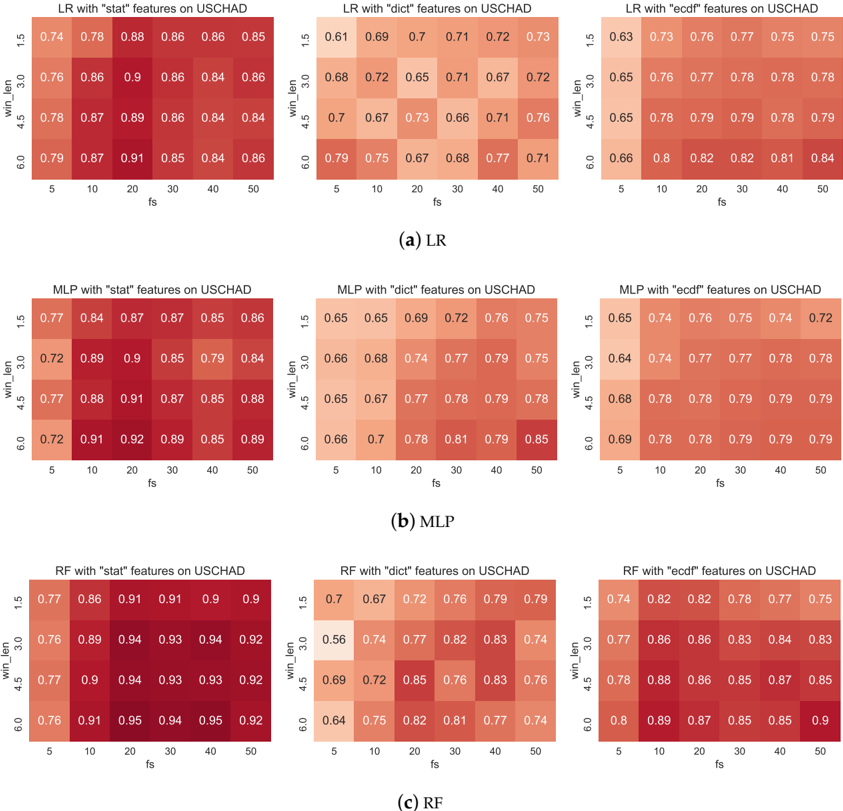
“In [19] the authors address some of the open questions about the accelerometer-based activity recognition, also comparing the classification performance of the logistic regression (LR), random forest (RF), and multi-layer perceptron (MLP) classifiers on three different publicly available datasets.”
Shafi, S., Jeeharshitha, K., Sony, G., Varshitha Reddy, J., Kumar, K., & Kiran Kumar, D. (2025) · International Conference on Machine Learning and Autonomous Systems (ICMLAS) · doi:10.1109/icmlas64557.2025.10968279
Rigot, S. K., Boninger, M. L., Ding, D., Collinger, J. L., Dicianno, B. E., & Worobey, L. A. (2022) · Figshare · doi:10.6084/m9.figshare.21500497
Rigot, S. K., Boninger, M. L., Ding, D., Collinger, J. L., Dicianno, B. E., & Worobey, L. A. (2022) · Figshare · doi:10.6084/m9.figshare.21500506
Rigot, S. K., Boninger, M. L., Ding, D., Collinger, J. L., Dicianno, B. E., & Worobey, L. A. (2022) · Figshare · doi:10.6084/m9.figshare.21500509
Rigot, S. K., Boninger, M. L., Ding, D., Collinger, J. L., Dicianno, B. E., & Worobey, L. A. (2022) · Figshare · doi:10.6084/m9.figshare.21500503
Contribution à la reconnaissance d'activités à partir d'un objet connecté
Auber, R. (2019) · theses.fr (ABES) · doi:10.70675/70621b80z9fc0z4379za036z1c915d879cc9 · Cited by 1
Aadya, Mohan, A., Rikhi, T., Ahlawat, N., Vinod, D. F., & Sharma, J. (2026) · Smart innovation, systems and technologies · doi:10.1007/978-3-032-15996-0_33
Metadata
- Authors
- Twomey, N., Diethe, T., Fafoutis, X., Elsts, A., McConville, R., Flach, P., & Craddock, I.
- Affiliations
- University of Bristol (GB)
- Corresponding author
- Twomey, Niall
- Diethe, Tom
- Venue
- Informatics
- Publisher
- MDPI AG
- Published
- 2018-05-30
- Volume
- 5
- Issue
- 2
- Pages
- 27
- ISSN
- 2227-9709 (ISSN-L)
- OpenAlex
- W2790414609
- Cited by
- 143
- References
- 95
- Citations by year
- 2026: 1 · 2025: 9 · 2024: 20 · 2023: 10 · 2022: 19 · 2021: 30 · 2020: 24 · 2019: 26 · 2018: 4
- FWCI
- 10.50
- Type
- journal article
- Language
- en
- Open access
- gold
- dx.doi.org
- Licence
- Locations
- Informatics (publishedVersion, cc-by)
- Preprints.org (acceptedVersion, cc-by)
- Explore Bristol Research (publishedVersion, cc-by)
- DOAJ (DOAJ: Directory of Open Access Journals) (submittedVersion, cc-by-sa)
- Bristol Research (University of Bristol) (submittedVersion, cc-by)
- Funders
- Horizon 2020 Framework Programme
- Medical Research Council (MC_PC_16029)
- Engineering and Physical Sciences Research Council (EP/K031910/1, H2020)
- Topics
- Physical Sciences › Computer Science › Computer Vision and Pattern Recognition › Context-Aware Activity Recognition Systems
- Health Sciences › Medicine › Public Health, Environmental and Occupational Health › Physical Activity and Health
- Social Sciences › Transportation › Human Mobility and Location-Based Analysis
- Keywords
- activity recognition, accelerometer, wearable sensors, accelerometer placement, time series segmentation, feature extraction, activity selection, test-retest reliability, generalization, field deployment
About these checks
Registry, retraction, Cites and statistics results are computed, not judged, with one exception: a printed reference that no index lists is read once by a model before it counts as a citation error. Claims are extracted by a model and kept only when their quote appears verbatim in the text; each cited source is then checked, with a model’s help, for whether it says what the claim relies on. Those verdicts can be wrong — read the claim’s quote and the cited source before relying on one.
Statistics and arithmetic are recomputed, not judged.
Confidence bands are shown only for fields calibrated on our annotated test set. None is calibrated yet, so no band is shown.
What counts as a claim ›How we measure confidence ›How we check this ›
Are you an author, or do you see a problem with this page? Request a review
Data sources
Bibliographic data: Semantic Scholar, OpenAlex, Crossref.
Contains information from the Semantic Scholar Academic Graph Datasets, made available under the ODC Attribution License (ODC-BY 1.0).
Semantic Scholar’s data is described in: Kinney, R., et al. (2023). The Semantic Scholar Open Data Platform. arXiv:2301.10140.
