

The DOI matches its Crossref record; 168 of the 174 references it cites were found in a registry or an index.
In Vitro and In Vivo Models of Non-Alcoholic Fatty Liver Disease: A Critical Appraisal
Open accessAbstract
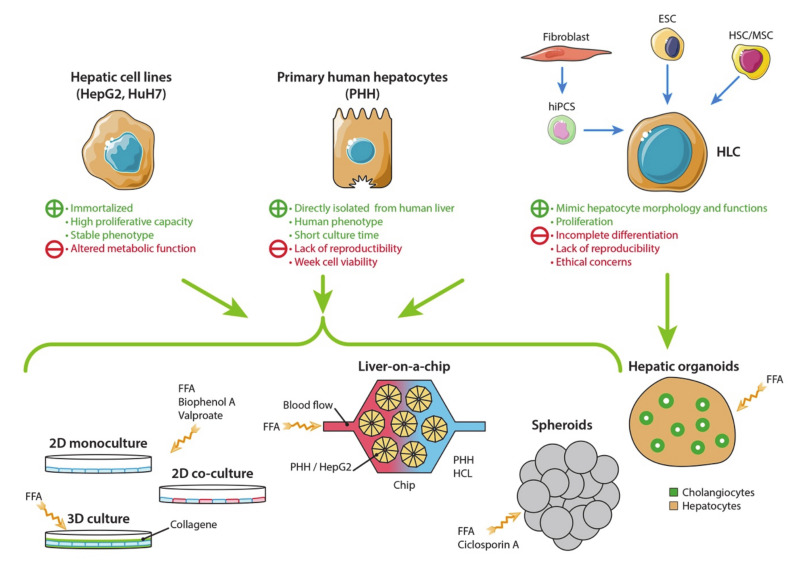
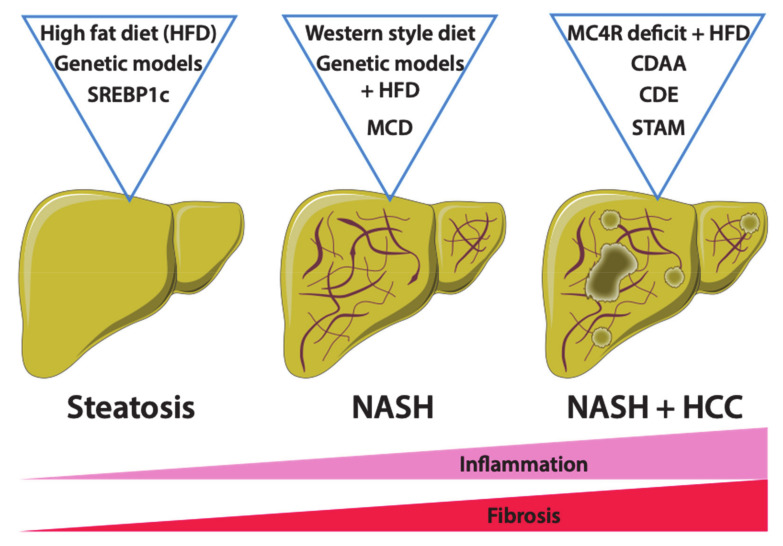
Non-alcoholic fatty liver disease (NAFLD), including non-alcoholic fatty liver (NAFL) and non-alcoholic steatohepatitis (NASH), represents the hepatic manifestation of obesity and metabolic syndrome. Due to the spread of the obesity epidemic, NAFLD is becoming the most common chronic liver disease and one of the principal indications for liver transplantation. However, no pharmacological treatment is currently approved to prevent the outbreak of NASH, which leads to fibrosis and cirrhosis. Preclinical research is required to improve our knowledge of NAFLD physiopathology and to identify new therapeutic targets. In the present review, we summarize advances in NAFLD preclinical models from cellular models, including new bioengineered platforms, to in vivo models, with a particular focus on genetic and dietary mouse models. We aim to discuss the advantages and limits of these different models.
Overview
The claims and statistics of this paper haven’t been checked yet.
Run the check — free, no account needed. It reads the open-access text and checks the sources it cites.
Integrity signals
Registry
Cites
Statistics
Figures
Verification
Claims the paper makes
The claims and statistics of this paper haven’t been checked yet.
Run the check — free, no account needed. It reads the open-access text and checks the sources it cites.
Claims other papers make about this one
Each is checked against this paper’s own text: does it say what the citing paper says it does?
The cited source says what the claim attributes to it.
In the citing paper
“Against the background of the limited translation of preclinical data from animal models due to interspecies differences, the importance of human-oriented in vitro platforms compatible with controlled design and high-throughput screening is increasing.”
From The HepG2 Cell Line as a Model for Studying Metabolic Dysfunction-Associated Steatotic Liver Disease (2026) · cites this paper as [26]
Self-check
Percentages, sums and reported differences re-computed from the paper’s own numbers.
The self-check needs the paper’s full text.
Citations
Cites
Induction of Pluripotent Stem Cells from Adult Human Fibroblasts by Defined Factors
Takahashi, K., Tanabe, K., Ohnuki, M., Narita, M., Ichisaka, T., Tomoda, K., & Yamanaka, S. (2007) · Cell · doi:10.1016/j.cell.2007.11.019 · Cited by 20,221
Global burden of NAFLD and NASH: trends, predictions, risk factors and prevention
Younossi, Z., Anstee, Q. M., Marietti, M., Hardy, T., Henry, L., Eslam, M., George, J., & Bugianesi, E. (2018) · Nature Reviews Gastroenterology & Hepatology · doi:10.1038/nrgastro.2017.109 · Cited by 5,249
EASL–EASD–EASO Clinical Practice Guidelines for the management of non-alcoholic fatty liver disease
(2016) · Journal of Hepatology · doi:10.1016/j.jhep.2015.11.004 · Cited by 4,836
The multiple-hit pathogenesis of non-alcoholic fatty liver disease (NAFLD)
Buzzetti, E., Pinzani, M., & Tsochatzis, E. A. (2016) · Metabolism · doi:10.1016/j.metabol.2015.12.012 · Cited by 3,119
Targeted disruption of the melanocortin-4 receptor results in obesity in mice
Huszar, D., Lynch, C. A., Fairchild-Huntress, V., Dunmore, J. H., Fang, Q., Berkemeier, L. R., Gu, W., Kesterson, R. A., Boston, B. A., Cone, R. D., et al. (1997) · Cell · doi:10.1016/s0092-8674(00)81865-6 · Cited by 3,030
Organogenesis in a dish: Modeling development and disease using organoid technologies
Lancaster, M. A., & Knoblich, J. A. (2014) · Science · doi:10.1126/science.1247125 · Cited by 2,931
Human organoids: model systems for human biology and medicine
Kim, J., Koo, B.-K., & Knoblich, J. A. (2020) · Nature Reviews Molecular Cell Biology · doi:10.1038/s41580-020-0259-3 · Cited by 2,187
Non-alcoholic fatty liver disease - a global public health perspective
Younossi, Z. M. (2019) · Journal of Hepatology · doi:10.1016/j.jhep.2018.10.033 · Cited by 2,149
Regulation of glutathione synthesis
Lu, S. C.-L. (2008) · Molecular Aspects of Medicine · doi:10.1016/j.mam.2008.05.005 · Cited by 2,131
Global perspectives on nonalcoholic fatty liver disease and nonalcoholic steatohepatitis
Younossi, Z., Tacke, F., Arrese, M., Chander Sharma, B., Mostafa, I., Bugianesi, E., Wai‐Sun Wong, V., Yilmaz, Y., George, J., Fan, J., et al. (2019) · Hepatology · doi:10.1002/hep.30251 · Cited by 1,858 · cited 1×
“NAFLD is the hepatic manifestation of obesity and metabolic syndrome, affecting up to one-third of the adult population in the western world [2,3].”
Background
Cited by
Sorted by citations
Harjumäki, R., Pridgeon, C. S., & Ingelman‐Sundberg, M. (2021) · International Journal of Molecular Sciences · doi:10.3390/ijms22158221 · Cited by 248
SGLT-2 Inhibitors in NAFLD: Expanding Their Role beyond Diabetes and Cardioprotection
Ανδρουτσάκος, Θ., Ansari, N. N., Bakasis, A., Kyrou, I., EFSTATHOPOULOS, E. P., Randeva, H. S., & Kassi, E. N. (2022) · International Journal of Molecular Sciences · doi:10.3390/ijms23063107 · Cited by 176
The Influence of Sex Hormones in Liver Function and Disease
Kasarinaite, A., Sinton, M. C., Saunders, P. T. K., & Hay, D. C. (2023) · Cells · doi:10.3390/cells12121604 · Cited by 139
Genetic and Diet-Induced Animal Models for Non-Alcoholic Fatty Liver Disease (NAFLD) Research
Flessa, C., Ansari, N. N., Kyrou, I., Leca, B. M., Lianou, M., Chatzigeorgiou, A., Kaltsas, G., Kassi, E. N., & Randeva, H. S. (2022) · International Journal of Molecular Sciences · doi:10.3390/ijms232415791 · Cited by 141
In Vitro Models for Non-Alcoholic Fatty Liver Disease: Emerging Platforms and Their Applications
Ramos, M. J., Bandiera, L., Menolascina, F., & Fallowfield, J. A. (2022) · iScience · doi:10.1016/j.isci.2021.103549 · Cited by 127
Metadata
- Authors
- Soret, P.-A., Magusto, J., Housset, C., & Gautheron, J.
- Affiliations
- Inserm (FR)
- Corresponding author
- Gautheron, Jérémie
- Venue
- Journal of Clinical Medicine
- Publisher
- MDPI AG
- Published
- 2020-12-24
- Volume
- 10
- Issue
- 1
- Pages
- 36
- ISSN
- 2077-0383 (ISSN-L)
- PMC
- PMC7794936
- OpenAlex
- W3116089396
- Cited by
- 121
- References
- 174
- Citations by year
- 2026: 13 · 2025: 15 · 2024: 25 · 2023: 26 · 2022: 34 · 2021: 8
- FWCI
- 2.48
- Type
- journal article
- Language
- en
- Open access
- gold
- doi.org
- Licence
- Locations
- Journal of Clinical Medicine (publishedVersion, cc-by)
- Europe PMC (PubMed Central) (publishedVersion, other-oa)
- PubMed Central (publishedVersion, cc-by)
- PubMed (publishedVersion)
- HAL (submittedVersion, other-oa)
- DOAJ (DOAJ: Directory of Open Access Journals) (submittedVersion, cc-by-sa)
- Funders
- Fondation pour la Recherche Médicale (EQU2020-03010517, ARF20170938613)
- Société Nationale Française de Gastro-Entérologie
- Société Francophone du Diabète
- Institut de Cardiométabolisme et Nutrition
- Topics
- Health Sciences › Medicine › Hepatology › Liver Disease Diagnosis and Treatment
- Health Sciences › Medicine › Hepatology › Liver physiology and pathology
- Health Sciences › Medicine › Endocrinology, Diabetes and Metabolism › Diet, Metabolism, and Disease
- Keywords
- non-alcoholic fatty liver disease, nonalcoholic steatohepatitis, in vitro model, in vivo models, cell model, mouse model, genetic mouse models, obesity, metabolic syndrome, liver fibrosis, liver cirrhosis, therapeutic target
About these checks
Registry, retraction, Cites and statistics results are computed, not judged, with one exception: a printed reference that no index lists is read once by a model before it counts as a citation error. Claims are extracted by a model and kept only when their quote appears verbatim in the text; each cited source is then checked, with a model’s help, for whether it says what the claim relies on. Those verdicts can be wrong — read the claim’s quote and the cited source before relying on one.
Statistics and arithmetic are recomputed, not judged.
Confidence bands are shown only for fields calibrated on our annotated test set. None is calibrated yet, so no band is shown.
What counts as a claim ›How we measure confidence ›How we check this ›
Are you an author, or do you see a problem with this page? Request a review
