

The DOI matches its Crossref record; the references it cites are not checked yet.
Incidence and Transition of Acute Kidney Injury, Acute Kidney Disease to Chronic Kidney Disease after Acute Type A Aortic Dissection Surgery
Open accessAbstract
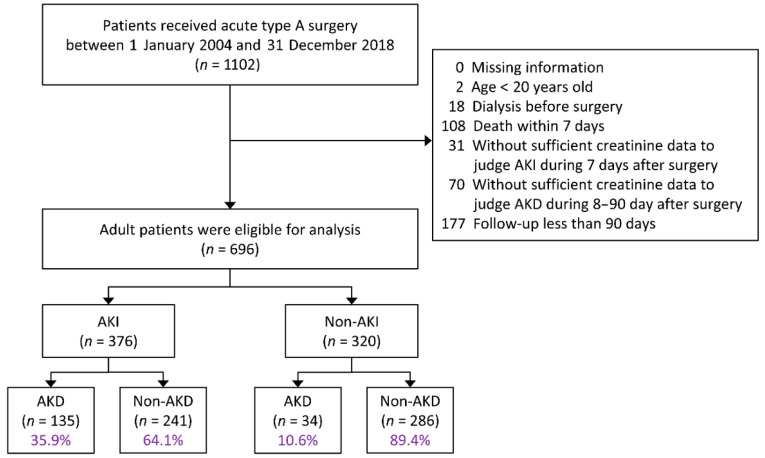
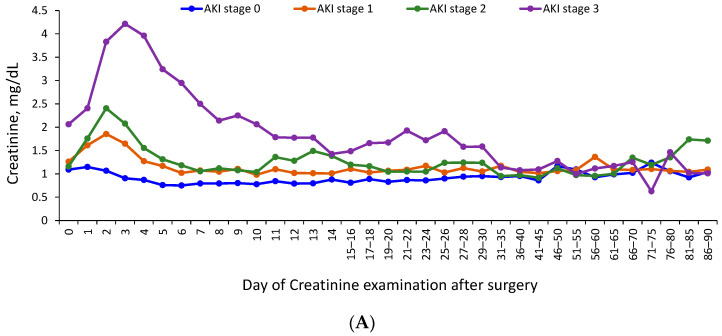
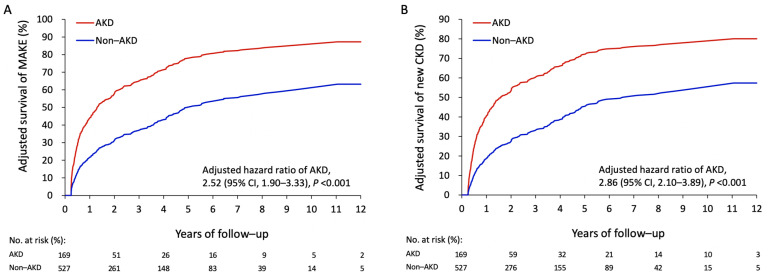
Acute kidney disease (AKD) is the persistence of renal injury between days 8 and 90 after an initial acute kidney injury (AKI). In this study, we aimed to explore the incidence of AKD, the association between AKD, and patient outcomes after acute type A aortic dissection (type A AAD) surgery. We identified 696 participants who underwent type A AAD surgery. Patients were categorized into stages 1 to 3 or 0 (non-AKD) AKD groups. Outcomes included major adverse kidney events (MAKEs), respiratory failure, all-cause readmission, and ischemic stroke from day 91 after operation. A total of 376 (54%) participants developed AKI, and 135/376 (35.9%) developed AKD. Moreover, 34/320 (10.6%) patients without AKI still developed AKD. Overall, 169/696 (24.3%) participants developed AKD. Patients with stages 2 and 3 AKD are associated with persisted declined renal function within 1 year. AKD was associated with a higher risk of MAKEs (hazard ratio (HR): 2.52, 95% confidence interval (CI) 1.90–3.33) and all-cause readmission (HR: 2.86, 95% CI: 2.10–3.89). Development of AKD with or without AKI is associated with a higher risk of MAKEs and hospitalization after acute aortic dissection surgery. Higher-stage AKD is associated with a trend of persistent decline in kidney function.
Overview
The claims and statistics of this paper haven’t been checked yet.
Run the check — free, no account needed. It reads the open-access text and checks the sources it cites.
Integrity signals
Registry
Cites
Statistics
Figures
Verification
Claims the paper makes
The claims and statistics of this paper haven’t been checked yet.
Run the check — free, no account needed. It reads the open-access text and checks the sources it cites.
Self-check
Percentages, sums and reported differences re-computed from the paper’s own numbers.
The self-check needs the paper’s full text.
Citations
The citation lists haven’t been fetched yet
References 26 · Cited by 25
Research works printed but not linked: 26
- Mussa, 2016, Acute Aortic Dissection and Intramural Hematoma: A Systematic Review, JAMA, 316, 754, 10.1001/jama.2016.10026 · DOI
- Pape, 2015, Presentation, Diagnosis, and Outcomes of Acute Aortic Dissection: 17-Year Trends From the International Registry of Acute Aortic Dissection, J. Am. Coll. Cardiol., 66, 350, 10.1016/j.jacc.2015.05.029 · DOI · Paper page
- Jormalainen, M., Raivio, P., Biancari, F., Mustonen, C., Honkanen, H.P., Venermo, M., Vento, A., and Juvonen, T. (2020). Late Outcome after Surgery for Type-A Aortic Dissection. J. Clin. Med., 9. · DOI
- Wang, 2018, Independent risk factors for postoperative AKI and the impact of the AKI on 30-day postoperative outcomes in patients with type A acute aortic dissection: An updated meta-analysis and meta-regression, J. Thorac. Dis., 10, 2590, 10.21037/jtd.2018.05.47 · DOI
- Thakar, 2003, ARF after open-heart surgery: Influence of gender and race, Am. J. Kidney Dis., 41, 742, 10.1016/S0272-6386(03)00021-0 · DOI
- Arora, 2012, Preventable risk factors for acute kidney injury in patients undergoing cardiac surgery, J. Cardiothorac. Vasc. Anesth, 26, 687, 10.1053/j.jvca.2012.03.001 · DOI
- Lagny, M.G., Jouret, F., Koch, J.N., Blaffart, F., Donneau, A.F., Albert, A., Roediger, L., Krzesinski, J.M., and Defraigne, J.O. (2015). Incidence and outcomes of acute kidney injury after cardiac surgery using either criteria of the RIFLE classification. BMC Nephrol., 16. · DOI
- Chen, 2017, Long-term outcomes of extracorporeal membrane oxygenation support for postcardiotomy shock, J. Thorac. Cardiovasc. Surg., 154, 469, 10.1016/j.jtcvs.2017.02.055 · DOI
- Chawla, 2017, Acute kidney disease and renal recovery: Consensus report of the Acute Disease Quality Initiative (ADQI) 16 Workgroup, Nat. Rev. Nephrol., 13, 241, 10.1038/nrneph.2017.2 · DOI · Paper page
- Matsuura, 2020, The Clinical Course of Acute Kidney Disease after Cardiac Surgery: A Retrospective Observational Study, Sci. Rep., 10, 6490, 10.1038/s41598-020-62981-1 · DOI
- Shao, 2019, The Chang Gung Research Database-A multi-institutional electronic medical records database for real-world epidemiological studies in Taiwan, Pharmacoepidemiol. Drug Saf., 28, 593, 10.1002/pds.4713 · DOI
- Tsai, 2017, Chang Gung Research Database: A multi-institutional database consisting of original medical records, Biomed J., 40, 263, 10.1016/j.bj.2017.08.002 · DOI
- (2012). Section 2: AKI Definition. Kidney Int. Suppl., 2, 19–36. · DOI
- Zhang, 2007, A SAS macro for estimation of direct adjusted survival curves based on a stratified Cox regression model, Comput. Methods Programs Biomed., 88, 95, 10.1016/j.cmpb.2007.07.010 · DOI
- Siew, 2020, Timing of Recovery From Moderate to Severe AKI and the Risk for Future Loss of Kidney Function, Am. J. Kidney Dis., 75, 204, 10.1053/j.ajkd.2019.05.031 · DOI
- Moledina, 2018, Kidney Biopsy-Related Complications in Hospitalized Patients with Acute Kidney Disease, Clin. J. Am. Soc. Nephrol., 13, 1633, 10.2215/CJN.04910418 · DOI
- Chu, 2014, Assessment of KDIGO definitions in patients with histopathologic evidence of acute renal disease, Clin. J. Am. Soc. Nephrol., 9, 1175, 10.2215/CJN.06150613 · DOI
- Chen, 2020, Comparison between watchful waiting strategy and early initiation of renal replacement therapy in the critically ill acute kidney injury population: An updated systematic review and meta-analysis, Ann. Intensive Care, 10, 30, 10.1186/s13613-020-0641-5 · DOI
- Molnar, 2012, Association of postoperative proteinuria with AKI after cardiac surgery among patients at high risk, Clin. J. Am. Soc. Nephrol., 7, 1749, 10.2215/CJN.13421211 · DOI
- Gayat, 2018, Impact of angiotensin-converting enzyme inhibitors or receptor blockers on post-ICU discharge outcome in patients with acute kidney injury, Intensive Care Med., 44, 598, 10.1007/s00134-018-5160-6 · DOI
- Chen, 2020, Renin-angiotensin-aldosterone system inhibition decreased contrast-associated acute kidney injury in chronic kidney disease patients, J. Formos. Med. Assoc., 120, 641, 10.1016/j.jfma.2020.07.022 · DOI
- Brar, 2018, Association of Angiotensin-Converting Enzyme Inhibitor or Angiotensin Receptor Blocker Use With Outcomes After Acute Kidney Injury, JAMA Intern. Med., 178, 1681, 10.1001/jamainternmed.2018.4749 · DOI
- Chen, 2020, Effect of beta-blocker therapy on late outcomes after surgical repair of type A aortic dissection, J. Thorac. Cardiovasc. Surg., 159, 1694, 10.1016/j.jtcvs.2019.05.032 · DOI
- Scarton, 2019, Renin-angiotensin-aldosterone system blockers after KDIGO stage 3 acute kidney injury: Use and impact on 2-year mortality in the AKIKI trial, Crit. Care, 23, 148, 10.1186/s13054-019-2447-0 · DOI
- Chen, 2021, The Impact of Angiotensin-Converting Enzyme Inhibitors or Angiotensin II Receptor Blockers on Clinical Outcomes of Acute Kidney Disease Patients: A Systematic Review and Meta-Analysis, Front. Pharmacol., 12, 665250, 10.3389/fphar.2021.665250 · DOI
- Thomas, 2015, The definition of acute kidney injury and its use in practice, Kidney Int., 87, 62, 10.1038/ki.2014.328 · DOI · Paper page
Metadata
- Authors
- Chang, C.-H., Chen, S.-W., Chen, J.-J., Chan, Y.-H., Yen, C.-L., Lee, T. H., & Cheng, Y.-T.
- Affiliations
- Chang Gung Memorial Hospital (TW)
- Corresponding author
- Chen, Shao-Wei
- Chen, Jia-Jin
- ORCID
- Venue
- Journal of Clinical Medicine
- Publisher
- MDPI AG
- Published
- 2021-10-18
- Volume
- 10
- Issue
- 20
- Pages
- 4769
- ISSN
- 2077-0383 (ISSN-L)
- PMC
- PMC8540632
- OpenAlex
- W3205335460
- Cited by
- 25
- References
- 26
- Citations by year
- 2026: 2 · 2025: 2 · 2024: 10 · 2023: 4 · 2022: 7
- FWCI
- 3.59
- Type
- journal article
- Language
- en
- Open access
- gold
- doi.org
- Licence
- Locations
- Journal of Clinical Medicine (publishedVersion, cc-by)
- Europe PMC (PubMed Central) (publishedVersion, other-oa)
- PubMed Central (publishedVersion, cc-by)
- PubMed (publishedVersion)
- DOAJ (DOAJ: Directory of Open Access Journals) (submittedVersion, cc-by-sa)
- Funders
- Chang Gung Memorial Hospital (CMRPG5K0141)
- Ministry of Science and Technology, Taiwan (109-2314-B-182A-124)
- Topics
- Health Sciences › Medicine › Nephrology › Acute Kidney Injury Research
- Health Sciences › Medicine › Cardiology and Cardiovascular Medicine › Aortic Disease and Treatment Approaches
- Health Sciences › Medicine › Nephrology › Chronic Kidney Disease and Diabetes
- Keywords
- acute kidney injury, acute kidney disease, type A aortic dissection, aortic surgery, chronic kidney disease, major adverse kidney events, all-cause readmission, renal function decline, ischemic stroke, respiratory failure
About these checks
Registry, retraction, Cites and statistics results are computed, not judged, with one exception: a printed reference that no index lists is read once by a model before it counts as a citation error. Claims are extracted by a model and kept only when their quote appears verbatim in the text; each cited source is then checked, with a model’s help, for whether it says what the claim relies on. Those verdicts can be wrong — read the claim’s quote and the cited source before relying on one.
Statistics and arithmetic are recomputed, not judged.
Confidence bands are shown only for fields calibrated on our annotated test set. None is calibrated yet, so no band is shown.
What counts as a claim ›How we measure confidence ›How we check this ›
Are you an author, or do you see a problem with this page? Request a review
How to cite
Cite CoChat for the checks on this page, and the paper for its own findings.
- This page
- CoChat. (2026). Citation check: Incidence and Transition of Acute Kidney Injury, Acute Kidney Disease to Chronic Kidney Disease after Acute Type A Aortic Dissection Surgery. https://app.cochat.ai/papers/10.3390/jcm10204769
- The paper
- Chang, C.-H., Chen, S.-W., Chen, J.-J., Chan, Y.-H., Yen, C.-L., Lee, T. H., & Cheng, Y.-T. (2021). Incidence and Transition of Acute Kidney Injury, Acute Kidney Disease to Chronic Kidney Disease after Acute Type A Aortic Dissection Surgery. Journal of Clinical Medicine. https://doi.org/10.3390/jcm10204769
Data sources
Bibliographic data: Semantic Scholar, OpenAlex, Crossref.
Contains information from the Semantic Scholar Academic Graph Datasets, made available under the ODC Attribution License (ODC-BY 1.0).
Semantic Scholar’s data is described in: Kinney, R., et al. (2023). The Semantic Scholar Open Data Platform. arXiv:2301.10140.
