

PEACE: Perception and Expectations toward Artificial Intelligence in Capsule Endoscopy
Open accessThe DOI matches its Crossref record; the references it cites are not checked yet.
Abstract
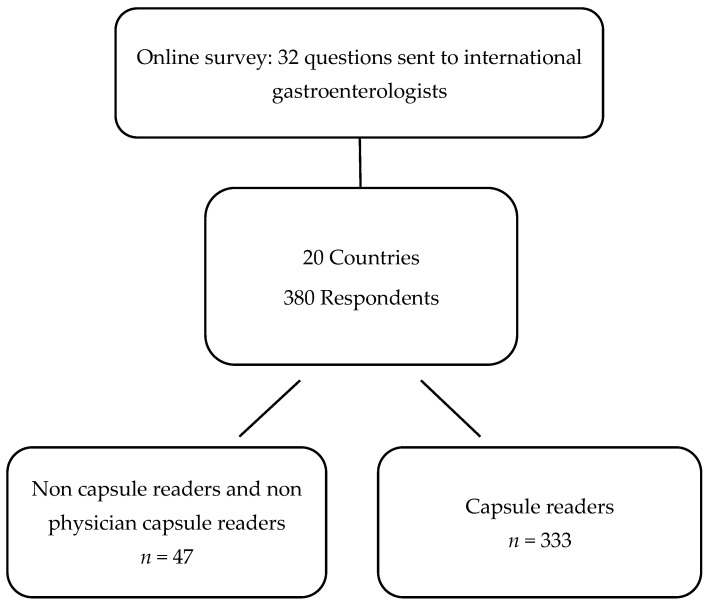
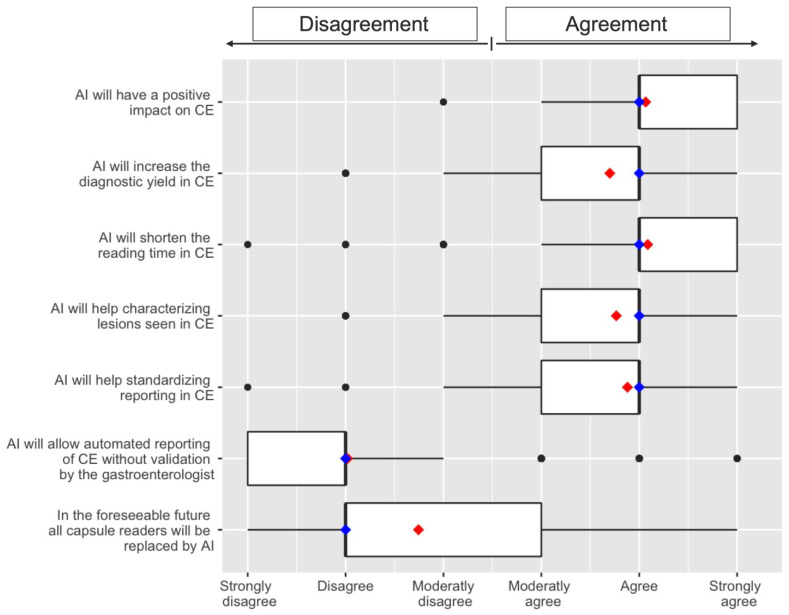
Artificial intelligence (AI) has shown promising results in digestive endoscopy, especially in capsule endoscopy (CE). However, some physicians still have some difficulties and fear the advent of this technology. We aimed to evaluate the perceptions and current sentiments toward the use of AI in CE. An online survey questionnaire was sent to an audience of gastroenterologists. In addition, several European national leaders of the International CApsule endoscopy REsearch (I CARE) Group were asked to disseminate an online survey among their national communities of CE readers (CER). The survey included 32 questions regarding general information, perceptions of AI, and its use in daily life, medicine, endoscopy, and CE. Among 380 European gastroenterologists who answered this survey, 333 (88%) were CERs. The mean average time length of experience in CE reading was 9.9 years (0.5–22). A majority of CERs agreed that AI would positively impact CE, shorten CE reading time, and help standardize reporting in CE and characterize lesions seen in CE. Nevertheless, in the foreseeable future, a majority of CERs disagreed with the complete replacement all CE reading by AI. Most CERs believed in the high potential of AI for becoming a valuable tool for automated diagnosis and for shortening the reading time. Currently, the perception is that AI will not replace CE reading.
Overview
The claims and statistics of this paper haven’t been checked yet.
Free: it reads the open-access text and checks the first 5 claims that cite a source we can check. Create a free account to check every claim.
Integrity signals
Registry
Cites
Statistics
Figures

Verification
Claims the paper makes
The claims and statistics of this paper haven’t been checked yet.
Free: it reads the open-access text and checks the first 5 claims that cite a source we can check. Create a free account to check every claim.
Claims other papers make about this one
Each is checked against this paper’s own text: does it say what the citing paper says it does?
The source backs part of the claim, not all of it — or backs it for a different population, condition or comparison.
In the citing paper
“Eight studies reported on facilitating factors that relate to the professionals’ attitude towards their profession, such as as reducing their fear of job superflousness [41, 42].”
From Healthcare professionals’ perspectives on artificial intelligence in patient care: a systematic review of hindering and facilitating factors on different levels (2025) · cites this paper as [41]
Experimental — accuracy not yet measuredThe cited source says what the claim attributes to it.
In the citing paper
“many studies reported an expected increase in overall efficiency [38, 41, 44, 45, 55, 56, 62, 67, 77–80] as a facilitating factor, a reduction in overall workload [82–84] or improved time management [52, 66].”
Self-check
Percentages, sums and reported differences re-computed from the paper’s own numbers.
The self-check needs the paper’s full text.
Citations
The citation lists are queued
They are fetched later and appear here then.
References 21 · Cited by 30
Metadata
- Authors
- Leenhardt, R., Fernandez-Urien Sainz, I., Rondonotti, E., Toth, E., Van de Bruaene, C., Baltes, P., Rosa, B., Triantafyllou, K., Histace, A., Koulaouzidis, A., Dray, X., & on behalf of the I-CARE Group
- Affiliations
- Centre National de la Recherche Scientifique (FR)
- Gastroenterology, Hospital de Navarra, 31008 Pamplona, Spain
- Ospedale Valduce (IT)
- Department of Gastroenterology, Skane University Hospital, Lund University, 214 28 Malmo, Sweden
- Department of Gastroenterology, Ghent University Hospital, 9000 Ghent, Belgium
- Agaplesion Bethesda Krankenhaus (DE)
- Hospital da Senhora da Oliveira Guimarães (PT)
- Hepatogastroenterology Unit, Second Department of Internal Propaedeutic Medicine, Attikon University General Hospital, Medical School, National and Kapodistrian University of Athens, 10679 Athens, Greece
- Pomeranian Medical University (PL)
- Corresponding author
- Dray, Xavier
- ORCID
- Venue
- Journal of Clinical Medicine
- Publisher
- MDPI AG
- Published
- 2021-12-06
- Volume
- 10
- Issue
- 23
- Pages
- 5708
- ISSN
- 2077-0383 (ISSN-L)
- PMC
- PMC8658716
- OpenAlex
- W4200538247
- Cited by
- 30
- References
- 21
- Citations by year
- 2026: 2 · 2025: 8 · 2024: 8 · 2023: 4 · 2022: 8
- FWCI
- 1.46
- Type
- journal article
- Language
- en
- Open access
- gold
- doi.org
- Licence
- Locations
- Journal of Clinical Medicine (publishedVersion, cc-by)
- PubMed Central (publishedVersion, cc-by)
- PubMed (publishedVersion)
- HAL (submittedVersion)
- DOAJ (DOAJ: Directory of Open Access Journals) (submittedVersion, cc-by-sa)
- Lund University Publications (Lund University) (submittedVersion)
- Topics
- Health Sciences › Medicine › Health Informatics › Artificial Intelligence in Healthcare and Education
- Health Sciences › Medicine › Gastroenterology › Gastrointestinal Bleeding Diagnosis and Treatment
- Physical Sciences › Computer Science › Artificial Intelligence › AI in cancer detection
- Keywords
- artificial intelligence, capsule endoscopy, AI adoption in medicine, automated diagnosis
About these checks
Registry, retraction, Cites and statistics results are computed, not judged, with one exception: a printed reference that no index lists is read once by a model before it counts as a citation error. Claims are extracted by a model and kept only when their quote appears verbatim in the text; each cited source is then checked, with a model’s help, for whether it says what the claim relies on. Those verdicts can be wrong — read the claim’s quote and the cited source before relying on one.
Statistics and arithmetic are recomputed, not judged.
Confidence bands are shown only for fields calibrated on our annotated test set. None is calibrated yet, so no band is shown.
What counts as a claim ›How we measure confidence ›How we check this ›
Are you an author, or do you see a problem with this page? Request a review
How to cite
Cite CoChat for the checks on this page, and the paper for its own findings.
- This page
- CoChat. (2026). Citation check: PEACE: Perception and Expectations toward Artificial Intelligence in Capsule Endoscopy. https://app.cochat.ai/papers/10.3390/jcm10235708
- The paper
- Leenhardt, R., Fernandez-Urien Sainz, I., Rondonotti, E., Toth, E., Van de Bruaene, C., Baltes, P., Rosa, B., Triantafyllou, K., Histace, A., Koulaouzidis, A., Dray, X., & on behalf of the I-CARE Group. (2021). PEACE: Perception and Expectations toward Artificial Intelligence in Capsule Endoscopy. Journal of Clinical Medicine. https://doi.org/10.3390/jcm10235708
Data sources
Bibliographic data: Semantic Scholar, OpenAlex, Crossref.
Contains information from the Semantic Scholar Academic Graph Datasets, made available under the ODC Attribution License (ODC-BY 1.0).
Semantic Scholar’s data is described in: Kinney, R., et al. (2023). The Semantic Scholar Open Data Platform. arXiv:2301.10140.
