

The DOI matches its Crossref record; 35 of the 35 references it cites were found in a registry or an index.
Enhanced Recovery after Pelvic Organ Prolapse Surgery
Open accessAbstract
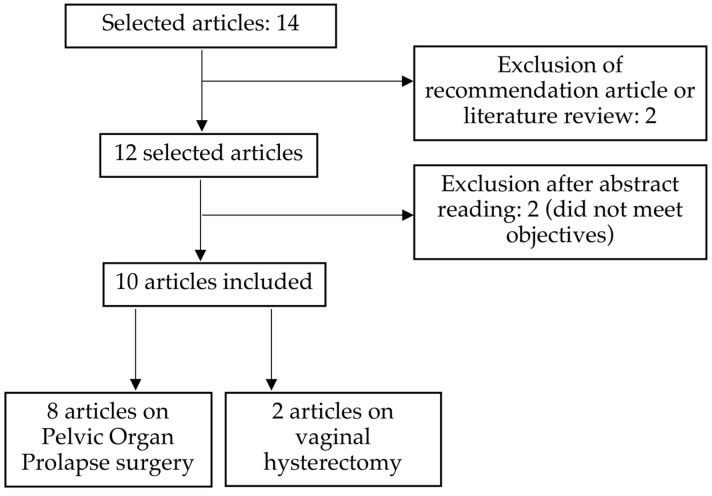
The objective of this study was to review on the influence of enhanced rehabilitation in pelvic organ prolapse surgery outcomes, specifically focusing on length of hospital stay, hospital costs, pain, morbidity, and patient satisfaction. Following the PRISMA model and using PubMed as a source, eight articles pertaining to prolapse surgery and two articles concerning vaginal hysterectomies were selected, all published between 2014 and 2021. These studies revealed no significant difference in terms of operating time, intra- and post-operative complications, intra-operative blood loss and post-operative pain scores before and after the introduction of the ERAS program. Only one study noted a difference in readmission rates. There was, however, a noticeable decrease in intra-operative and post-operative intravenous intakes, opioid administration, length of stay, and overall hospital costs with the adoption of ERAS. Additionally, with ERAS, patients were able to mobilize more rapidly, and overall patient satisfaction significantly improved.
Overview
The claims and statistics of this paper haven’t been checked yet.
Run the check — free, no account needed. It reads the open-access text and checks the sources it cites.
Integrity signals
Registry
Cites
Statistics
Figures
Verification
Claims the paper makes
The claims and statistics of this paper haven’t been checked yet.
Run the check — free, no account needed. It reads the open-access text and checks the sources it cites.
Claims other papers make about this one
Each is checked against this paper’s own text: does it say what the citing paper says it does?
The source backs part of the claim, not all of it — or backs it for a different population, condition or comparison.
In the citing paper
“ERAS protocols primarily focus on optimizing the immediate postoperative phase through measures such as optimized fluid management, multimodal analgesia, early mobilization, reduction in complications, and shortening of hospital stay.”
From Pelvic Floor Muscle Training Following Surgery for Pelvic Organ Prolapse: Recommendation from Scientific Literature (2026) · cites this paper as [26]
Experimental — accuracy not yet measuredThe cited source says what the claim attributes to it.
In the citing paper
“Conceptually, this rehabilitative approach parallels the Enhanced Recovery After Surgery (ERAS) paradigm, which emphasizes early mobilization, multimodal rehabilitation, and optimization of functional recovery [26].”
From Pelvic Floor Muscle Training Following Surgery for Pelvic Organ Prolapse: Recommendation from Scientific Literature (2026) · cites this paper as [26]
Self-check
Percentages, sums and reported differences re-computed from the paper’s own numbers.
The self-check needs the paper’s full text.
Citations
Cites
Nygren, J., Thacker, J., Carli, F., Fearon, K. C. H., Norderval, S., Lobo, D. N., Ljungqvist, O., Soop, M., & Rodríguez, J. M. ́. (2012) · World Journal of Surgery · doi:10.1007/s00268-012-1787-6 · Cited by 2,221
Gustafsson, U. O., Scott, M. J., Schwenk, W., Demartines, N., Roulin, D., Francis, N. K., McNaught, C., Macfie, J. M., Liberman, A. S., Soop, M., et al. (2012) · World Journal of Surgery · doi:10.1007/s00268-012-1772-0 · Cited by 1,146
Adamina, M., Kehlet, H., Tomlinson, G. A., Senagore, A. J., & Delaney, C. P. (2011) · Surgery · doi:10.1016/j.surg.2010.11.003 · Cited by 555 · cited 1×
“In colorectal surgery, the program further yielded notable cost reductions: an average saving of USD 2240 (EUR 1885) per patient, as demonstrated by a Massachusetts study [35].”
BackgroundEnhanced Recovery in Gynecologic Surgery
Kalogera, E., Bakkum-Gamez, J., Jankowski, C. J., Trabuco, E., Lovely, J., Dhanorker, S. R., Grubbs, P. L., Weaver, A., Haas, L. R., Borah, B., et al. (2013) · Obstetrics and Gynecology · doi:10.1097/aog.0b013e31829aa780 · Cited by 282
What does it really mean to “recover” from an operation?
Lee, L., Tran, T. T., Mayo, N. E., Carli, F., & Feldman, L. S. (2013) · Surgery · doi:10.1016/j.surg.2013.10.002 · Cited by 222
Enhanced Recovery Implementation in Major Gynecologic Surgeries
Modesitt, S. C., Sarosiek, B. M., Trowbridge, E. R., Redick, D. L., Shah, P. M., Thiele, R. H., Tiouririne, M., & Hedrick, T. L. (2016) · Obstetrics and Gynecology · doi:10.1097/aog.0000000000001555 · Cited by 188
Bisch, S. P., Wells, T. H., Gramlich, L. M., Faris, P., Wang, X., Tran, D. T.-A., Thành, N. X., Glaze, S., Chu, P., Ghatage, P., et al. (2018) · Gynecologic Oncology · doi:10.1016/j.ygyno.2018.08.007 · Cited by 160
Effect of an Enhanced Recovery After Surgery Program on Opioid Use and Patient-Reported Outcomes
Meyer, L. A., Lasala, J., Iniesta, M. D., Nick, A. M., Munsell, M. F., Shi, Q., Wang, X. S., Cain, K. E., Lu, K. H., & Ramirez, P. T. (2018) · Obstetrics and Gynecology · doi:10.1097/aog.0000000000002735 · Cited by 159
Implementation of an Urogynecology-Specific Enhanced Recovery After Surgery (ERAS) Pathway
Carter-Brooks, C., Du, A. L., Ruppert, K., Romanova, A., & Zyczynski, H. (2018) · American Journal of Obstetrics and Gynecology · doi:10.1016/j.ajog.2018.06.009 · Cited by 128
Wijk, L., Franzén, K., Ljungqvist, O. H., & Nilsson, K. (2014) · Acta Obstetricia Et Gynecologica Scandinavica · doi:10.1111/aogs.12423 · Cited by 123
Cited by
Sorted by citations
Innovative minimally invasive technique for pelvic organ prolapse: V‐Notes lateral suspension
Bulutlar, E., Bulutlar, G. B. U., İzceyhan, G. B., Aktaş, Ö., Denizli, A. B. A., & Kılıççı, Ç. (2025) · Journal of obstetrics and gynaecology research · doi:10.1111/jog.16232 · Cited by 13
Pei, J., Wang, S., Pan, X., Wu, M., Zhan, X., Fang, K., Wang, D., Wang, W. T., Zhu, G., Tang, H., et al. (2024) · Journal of Pediatric Urology · doi:10.1016/j.jpurol.2024.09.019 · Cited by 2
Lamberti, G., Giraudo, D., Ciardi, G., & Levis, J. K. (2026) · Journal of Clinical Medicine · doi:10.3390/jcm15031116 · Cited by 2
“Conceptually, this rehabilitative approach parallels the Enhanced Recovery After Surgery (ERAS) paradigm, which emphasizes early mobilization, multimodal rehabilitation, and optimization of functional recovery [26].”
Deng, S., Gu, Q., Liu, L., Lei, X., Yu, J., & Huang, X. (2026) · International Journal of Surgery · doi:10.1097/js9.0000000000004621 · Cited by 1
Metadata
- Authors
- Tresch, C., Lallemant, M., & Ramanah, R.
- Affiliations
- Centre Hospitalier Universitaire de Besançon (FR)
- Corresponding author
- Tresch, Caroline
- Venue
- Journal of Clinical Medicine
- Publisher
- MDPI AG
- Published
- 2023-09-12
- Volume
- 12
- Issue
- 18
- Pages
- 5911
- ISSN
- 2077-0383 (ISSN-L)
- PMC
- PMC10532386
- OpenAlex
- W4386638810
- Cited by
- 3
- References
- 35
- Citations by year
- 2026: 1 · 2025: 1 · 2024: 1
- FWCI
- 0.19
- Type
- journal article
- Language
- en
- Open access
- gold
- doi.org
- Licence
- Locations
- Journal of Clinical Medicine (publishedVersion, cc-by)
- PubMed Central (publishedVersion, cc-by)
- PubMed (publishedVersion)
- Topics
- Health Sciences › Medicine › Surgery › Enhanced Recovery After Surgery
- Health Sciences › Medicine › Urology › Pelvic floor disorders treatments
- Health Sciences › Medicine › Surgery › Surgical site infection prevention
- Keywords
- enhanced recovery after surgery, pelvic organ prolapse surgery, vaginal hysterectomy, length of hospital stay, hospital costs, postoperative pain, postoperative complications, opioid use, patient satisfaction, early mobilization, hospital readmission
About these checks
Registry, retraction, Cites and statistics results are computed, not judged, with one exception: a printed reference that no index lists is read once by a model before it counts as a citation error. Claims are extracted by a model and kept only when their quote appears verbatim in the text; each cited source is then checked, with a model’s help, for whether it says what the claim relies on. Those verdicts can be wrong — read the claim’s quote and the cited source before relying on one.
Statistics and arithmetic are recomputed, not judged.
Confidence bands are shown only for fields calibrated on our annotated test set. None is calibrated yet, so no band is shown.
What counts as a claim ›How we measure confidence ›How we check this ›
Are you an author, or do you see a problem with this page? Request a review
