

The DOI matches its Crossref record; 25 of the 26 references it cites were found in a registry or an index, and 1 are not checked yet.
In-Advance Prediction of Pressure Ulcers via Deep-Learning-Based Robust Missing Value Imputation on Real-Time Intensive Care Variables
Open accessAbstract
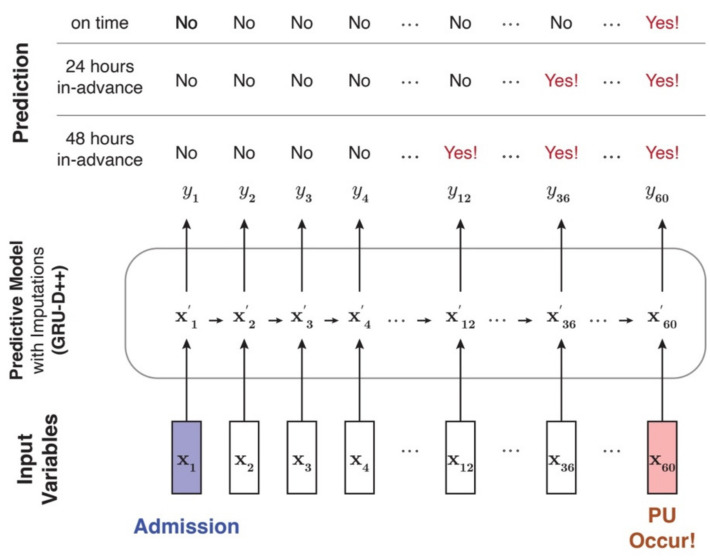
Pressure ulcers (PUs) are a prevalent skin disease affecting patients with impaired mobility and in high-risk groups. These ulcers increase patients’ suffering, medical expenses, and burden on medical staff. This study introduces a clinical decision support system and verifies it for predicting real-time PU occurrences within the intensive care unit (ICU) by using MIMIC-IV and in-house ICU data. We develop various machine learning (ML) and deep learning (DL) models for predicting PU occurrences in real time using the MIMIC-IV and validate using the MIMIC-IV and Kangwon National University Hospital (KNUH) dataset. To address the challenge of missing values in time series, we propose a novel recurrent neural network model, GRU-D++. This model outperformed other experimental models by achieving the area under the receiver operating characteristic curve (AUROC) of 0.945 for the on-time prediction and AUROC of 0.912 for 48h in-advance prediction. Furthermore, in the external validation with the KNUH dataset, the fine-tuned GRU-D++ model demonstrated superior performances, achieving an AUROC of 0.898 for on-time prediction and an AUROC of 0.897 for 48h in-advance prediction. The proposed GRU-D++, designed to consider temporal information and missing values, stands out for its predictive accuracy. Our findings suggest that this model can significantly alleviate the workload of medical staff and prevent the worsening of patient conditions by enabling timely interventions for PUs in the ICU.
Overview
The claims and statistics of this paper haven’t been checked yet.
Run the check — free, no account needed. It reads the open-access text and checks the sources it cites.
Integrity signals
Registry
Cites
Statistics
Figures
Verification
Claims the paper makes
The claims and statistics of this paper haven’t been checked yet.
Run the check — free, no account needed. It reads the open-access text and checks the sources it cites.
Claims other papers make about this one
Each is checked against this paper’s own text: does it say what the citing paper says it does?
The cited source says what the claim attributes to it.
In the citing paper
“The GRU-D++ model demonstrated superior performance in the early prediction of pressure ulcers [18].”
From AI-Driven Predictions of Readmission and Mortality for Improved Discharge Decisions in Critical Care: A Retrospective Study (2026) · cites this paper as [18]
Self-check
Percentages, sums and reported differences re-computed from the paper’s own numbers.
The self-check needs the paper’s full text.
Citations
Cites
Hochreiter, S., & Schmidhuber, J. (1997) · Neural Computation · doi:10.1162/neco.1997.9.8.1735 · Cited by 102,318
On the Properties of Neural Machine Translation: Encoder–Decoder Approaches
Cho, K., van Merriënboer, B., Bahdanau, D., & Bengio, Y. (2014) · SSST@EMNLP · doi:10.3115/v1/w14-4012 · Cited by 7,251
Recurrent Neural Networks for Multivariate Time Series with Missing Values
Che, Z., Purushotham, S., Cho, K., Sontag, D., & Liu, Y. (2018) · Scientific Reports · doi:10.1038/s41598-018-24271-9 · Cited by 2,370
On the Properties of Neural Machine Translation: Encoder-Decoder ApproachesPreprint
Cho, K., van Merriënboer, B., Bahdanau, D., et al. (2014) · arXiv (Cornell University) · doi:10.48550/arxiv.1409.1259 · Cited by 1,112
Multivariate Time Series Imputation with Generative Adversarial Networks
Luo, Y., Cai, X., Zhang, Y., Xu, J., & Yuan, X. (2018) · neural information processing systems · Cited by 361
Current status and applications of Artificial Intelligence (AI) in medical field: An overview
Haleem, A., Javaid, M., & Khan, I. H. (2019) · Current Medicine Research and Practice · doi:10.1016/j.cmrp.2019.11.005 · Cited by 285
E²GAN: End-to-End Generative Adversarial Network for Multivariate Time Series Imputation
Luo, Y., Zhang, Y., Cai, X., & Yuan, X. (2019) · Proceedings of the Twenty-Eighth International Joint Conference on Artificial Intelligence · doi:10.24963/ijcai.2019/429 · Cited by 257
GP-VAE: Deep Probabilistic Time Series ImputationPreprint
Fortuin, V., Baranchuk, D., Rätsch, G., & Mandt, S. (2019) · arXiv (Cornell University) · doi:10.48550/arxiv.1907.04155 · Cited by 161
Qaseem, A., Mir, T. P., Starkey, M., & Denberg, T. D. (2015) · Annals of Internal Medicine · doi:10.7326/m14-1567 · Cited by 148
Missing value imputation in multivariate time series with end-to-end generative adversarial networks
Zhang, Y., Zhou, B., Cai, X., Guo, W., Ding, X., & Yuan, X. (2020) · Information Sciences · doi:10.1016/j.ins.2020.11.035 · Cited by 145
Research works printed but not linked: 1
- PAN Pacific (2014). Prevention and treatment of pressure ulcers: Quick reference guide. Natl. Press. Ulcer Advis. Panel, 75, 1–72.
Cited by
Pressure Injury Prediction in Intensive Care Units Using Artificial Intelligence: A Scoping Review
Alves, J., Azevedo, R., Marques, A., Encarnação, R., & Alves, P. J. P. (2025) · Nursing Reports · doi:10.3390/nursrep15040126 · Cited by 16
External Validation of AI Models for Skin Diseases: A Systematic Review
Fernandes, T. R. S., Teles, A. S., Fernandes, J. R. N., Lima, L. D. B., Sousa, D. L., Soares, R. D. C., & Teixeira, S. S. (2025) · IEEE Access · doi:10.1109/access.2025.3584904 · Cited by 12
Kahveci, M., & Uğur, L. (2025) · Diagnostics · doi:10.3390/diagnostics15101239 · Cited by 11
Digital twin applications in healthcare for people living with disability
Olawade, D. B., Almarzook, S., Ogunbona, M. A., Makanjuola, B. D., Olawuyi, O. F., & Wada, O. Z. (2026) · International Journal of Medical Informatics · doi:10.1016/j.ijmedinf.2026.106359 · Cited by 9
Cho, Y., & Yoo, H.-N. (2025) · Medicine · doi:10.1097/md.0000000000041530 · Cited by 7
Haitjema, S., Nijman, S. W. J., Verkouter, I., Jacobs, J. J. L., Asselbergs, F. W., Moons, K. G. M., Beekers, I., Debray, T. P. A., & Bots, M. L. (2024) · European Heart Journal - Digital Health · doi:10.1093/ehjdh/ztae058 · Cited by 3
Barriga-Gallegos, F., Ríos-Vásquez, G., Figueroa-Torrez, P., de la Fuente‐Mella, H., Garrido, C. A., & Febré, N. (2026) · Journal of Clinical Medicine · doi:10.3390/jcm15124683 · Cited by 2
Wang, Y., Yu, W., Zhi, H., Shang, K., Yin, H., Shan, D., Li, X., Li, W., Zhang, X., & Zhang, B. (2025) · Frontiers in Medicine · doi:10.3389/fmed.2025.1600481 · Cited by 1
Heo, Y., Kim, M., Han, S.-S., Kim, T.-H., Heo, J., Kim, D., Kim, W. J., Lee, S.-J., Kwon, O. B., Kim, Y., et al. (2026) · Diagnostics · doi:10.3390/diagnostics16060874
“The GRU-D++ model demonstrated superior performance in the early prediction of pressure ulcers [18].”
Self-citationRaziee, R., Sadeghi-Naini, M., & Azadmanjir, Z. (2026) · Informatics in Medicine Unlocked · doi:10.1016/j.imu.2026.101742
Li, J., Zhang, B. Z., Cheng, Z., Wei, X., & Zeng, Y. (2026) · doi:10.2196/preprints.94425
Moon, D. H., Kim, M., Han, S., Kim, T.-H., Kim, D., Kim, W. J., Lee, S., Kim, Y. W., Heo, J., Choi, H.-S., et al. (2026) · Journal of Clinical Medicine · doi:10.3390/jcm15103642
Self-citationSAPIF: A Severity-Aware Framework for Pressure Injury Forecasting
Sommerfield, D., Obraczka, K., Casper, J., Chudasama, H., & Engstrom, C. J. (2026) · IEEE International Conference on Digital Health (ICDH) · doi:10.1109/icdh72779.2026.00050
Metadata
- Authors
- Kim, M., Kim, T.-H., Kim, D., Lee, D., Kim, D., Heo, J., Kang, S., Ha, T., Kim, J., Moon, D. H., Heo, Y., Kim, W. J., Lee, S.-J., Kim, Y., Park, S. W., Han, S.-S., & Choi, H.-S.
- Affiliations
- Department of Research & Development, Ziovision Co., Ltd., Chuncheon 24341, Republic of Korea
- Kangwon National University (KR)
- Kangwon National University Hospital (KR)
- Seoul National University of Science and Technology (KR)
- Corresponding author
- Han, Seon-Sook
- Choi, Hyun-Soo
- ORCID
- Venue
- Journal of Clinical Medicine
- Publisher
- MDPI AG
- Published
- 2023-12-20
- Volume
- 13
- Issue
- 1
- Pages
- 36
- ISSN
- 2077-0383 (ISSN-L)
- PMC
- PMC10780209
- OpenAlex
- W4390014060
- Cited by
- 13
- References
- 25
- Citations by year
- 2026: 7 · 2025: 5 · 2024: 1
- FWCI
- 6.48
- Type
- journal article
- Language
- en
- Open access
- gold
- doi.org
- Licence
- Locations
- Journal of Clinical Medicine (publishedVersion, cc-by)
- PubMed Central (publishedVersion, cc-by)
- PubMed (publishedVersion)
- Funders
- Korea Health Industry Development Institute (KHIDI) (HI21C1074)
- Topics
- Health Sciences › Medicine › Dermatology › Pressure Ulcer Prevention and Management
- Physical Sciences › Computer Science › Artificial Intelligence › Machine Learning in Healthcare
- Health Sciences › Health Professions › Health Information Management › Artificial Intelligence in Healthcare
- Keywords
- pressure ulcers, pressure ulcer prediction, intensive care unit, missing data imputation, recurrent neural networks, clinical decision support systems, MIMIC-IV, intensive care monitoring
About these checks
Registry, retraction, Cites and statistics results are computed, not judged, with one exception: a printed reference that no index lists is read once by a model before it counts as a citation error. Claims are extracted by a model and kept only when their quote appears verbatim in the text; each cited source is then checked, with a model’s help, for whether it says what the claim relies on. Those verdicts can be wrong — read the claim’s quote and the cited source before relying on one.
Statistics and arithmetic are recomputed, not judged.
Confidence bands are shown only for fields calibrated on our annotated test set. None is calibrated yet, so no band is shown.
What counts as a claim ›How we measure confidence ›How we check this ›
Are you an author, or do you see a problem with this page? Request a review
