

Development and Initial Testing of an Artificial Intelligence-Based Virtual Reality Companion for People Living with Dementia in Long-Term Care
Open accessThe DOI matches its Crossref record; 52 of the 52 references it cites were found in a registry or an index.
Abstract
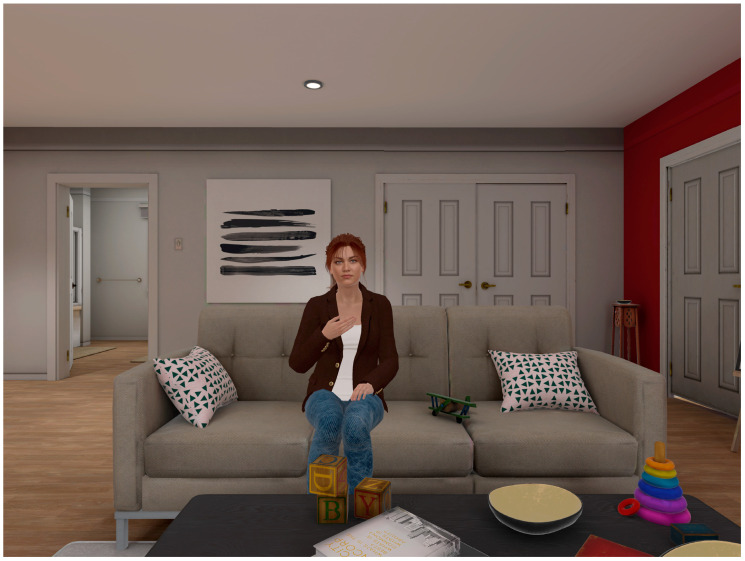
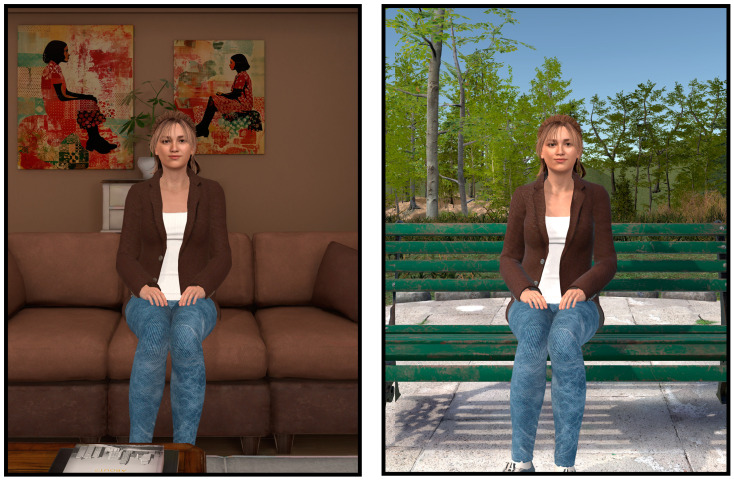
Background/Objectives: Feelings of loneliness are common in people living with dementia (PLWD) in long-term care (LTC). The goals of this study were to describe the development of a novel virtual companion for PLWD living in LTC and assess its feasibility and acceptability. Methods: The computer-generated virtual companion, presented using a head-mounted virtual reality display, was developed in two stages. In Stage 1, the virtual companion asked questions designed to encourage conversation and reminiscence. In Stage 2, more powerful artificial intelligence tools allowed the virtual companion to engage users in nuanced discussions on any topic. PLWD in LTC tested the application at each stage to assess feasibility and acceptability. Results: Ten PLWD living in LTC participated in Stage 1 (4 men and 6 women; average 82 years old) and Stage 2 (2 men and 8 women; average 87 years old). Session lengths ranged from 0:00 to 5:30 min in Stage 1 and 0:00 to 53:50 min in Stage 2. Speech recognition issues and a limited repertoire of questions limited acceptance in Stage 1. Enhanced conversational ability in Stage 2 led to intimate and meaningful conversations with many participants. Many users found the head-mounted display heavy. There were no complaints of simulator sickness. The virtual companion was best suited to PLWD who could engage in reciprocal conversation. After Stage 2, response latency was identified as an opportunity for improvement in future versions. Conclusions: Virtual reality and artificial intelligence can be used to create a virtual companion that is acceptable and enjoyable to some PLWD living in LTC. Ongoing innovations in hardware and software will allow future iterations to provide more natural conversational interaction and an enhanced social experience.
Overview
The claims and statistics of this paper haven’t been checked yet.
Free: it reads the open-access text and checks the first 5 claims that cite a source we can check. Create a free account to check every claim.
Integrity signals
Registry
Cites
Statistics
Figures
Verification
Claims the paper makes
The claims and statistics of this paper haven’t been checked yet.
Free: it reads the open-access text and checks the first 5 claims that cite a source we can check. Create a free account to check every claim.
Claims other papers make about this one
Each is checked against this paper’s own text: does it say what the citing paper says it does?
The check wasn’t confident either way, so it gives no verdict — never disputed.
In the citing paper
“Emerging promising solutions include the adoption of AI confidence scores and secondary AI models that critically evaluate the summaries.41–43”
From Review of Artificial Intelligence for Clinical Use in Alzheimer's Disease and Related Dementias (2026) · cites this paper as [41]
Experimental — accuracy not yet measured
Self-check
Percentages, sums and reported differences re-computed from the paper’s own numbers.
The self-check needs the paper’s full text.
Citations
Cites
Gale, N. K., Heath, G., Cameron, E., Rashid, S., & Redwood, S. (2013) · BMC Medical Research Methodology · doi:10.1186/1471-2288-13-117 · Cited by 10,865
Nichols, E., Steinmetz, J. D., Vollset, S. E., Fukutaki, K., Chalek, J., Abd-Allah, F., Abdoli, A., Abualhasan, A., Abu-Gharbieh, E., Akram, T. T., et al. (2022) · The Lancet Public Health · doi:10.1016/s2468-2667(21)00249-8 · Cited by 5,575
How we design feasibility studies
Bowen, D. J., Kreuter, M., Spring, B., Cofta-Woerpel, L., Linnan, L., Weiner, D., Bakken, S., Kaplan, C. P., Squiers, L., Fabrizio, C., et al. (2009) · American Journal of Preventive Medicine · doi:10.1016/j.amepre.2009.02.002 · Cited by 4,021 · cited 2×
“…in PLWD living in LTC. Feasibility and acceptability assessments included the determination of the ease of use of the hardware and software for PLWD, the enjoyment and acceptability of the virtual companion, and the duration and quality of interactions between PLWD and the virtual companion [32].”
BackgroundMethodPlace illusion and plausibility can lead to realistic behaviour in immersive virtual environments
Slater, M. (2009) · Philosophical Transactions of the Royal Society B: Biological Sciences · doi:10.1098/rstb.2009.0138 · Cited by 2,691 · cited 1×
“Being immersed in VR and interacting with a conversational agent may also allow PLWD living in LTC to feel as though they are no longer in their LTC facility, a phenomenon called presence [30,31].”
BackgroundMDS Cognitive Performance Scale(C)
Morris, J. N., Fries, B. E., Mehr, D. R., Hawes, C., Phillips, C., Mor, V., & Lipsitz, L. A. (1994) · Journal of Gerontology · doi:10.1093/geronj/49.4.m174 · Cited by 1,810
Sex differences in self-disclosure: A meta-analysis.
Dindia, K., & Allen, M. (1992) · Psychological Bulletin · doi:10.1037//0033-2909.112.1.106 · Cited by 919
Mushtaq, R. (2014) · JOURNAL OF CLINICAL AND DIAGNOSTIC RESEARCH · doi:10.7860/jcdr/2014/10077.4828 · Cited by 622
Hicks, M. T., Humphries, J., & Slater, J. (2024) · Ethics and Information Technology · doi:10.1007/s10676-024-09775-5 · Cited by 456
Principles of Health Care Ethics
(2006) · Wiley eBooks · doi:10.1002/9780470510544 · Cited by 453
Haque, M. D. R., & Rubya, S. (2023) · JMIR mHealth and uHealth · doi:10.2196/44838 · Cited by 404 · cited 1×
“[22]), clinical benefits may be achieved.”
Research works printed but not linked: 2
- Leaver, C., and Moroz, A. (2022). There’s Still Time: Paving a Path for Value-Based Dementia Care in Canada, The Conference Board of Canada.
- Lhoest, J. (2022). Développement d’un Agent Conversationnel Dans un Environnement de Réalité Virtuelle au Service des Personnes Atteintes de la Maladie d’Alzheime. [Master’s Thesis, École de Gestion de l’Université de Liège].
Cited by
Review of Artificial Intelligence for Clinical Use in Alzheimer's Disease and Related Dementias
Breithaupt, A. G., Tang, A., Paolillo, E. W., Bibars, M., Johnson, E. C. B., Saloner, R., Possin, K. L., Windon, C. C., Hill-Jarrett, T. G., Giorgio, J., et al. (2026) · Seminars in Neurology · doi:10.1055/a-2744-9871 · Cited by 6
The role of LLM-powered chatbots in assisting elderly people: systematic review
Tahir, H., Özdemir, M. K., & Alhajj, R. (2025) · Network Modeling Analysis in Health Informatics and Bioinformatics · doi:10.1007/s13721-025-00698-9 · Cited by 5
Johnson, J. T., Duin, J. J., Kuiper, T., Drewes, Y. M., Gussekloo, J., van den Bos, F., Lefebvre, A., Spruit, M. R., van Dijk, B., & Mooijaart, S. P. (2026) · European Geriatric Medicine · doi:10.1007/s41999-026-01454-6 · Cited by 4
Artificial Intelligence in Public Health: Bridging Today’s Trends with Tomorrow’s Possibilities
Giansanti, D., & Costantini, G. (2025) · Bioengineering · doi:10.3390/bioengineering12060559 · Cited by 6
Wu, F., Wu, Y., Xing, Y., Cai, W., & Zhang, R. (2025) · Journal of Medical Internet Research · doi:10.2196/81865 · Cited by 3
Metadata
- Authors
- Sheehy, L., Bouchard, S., Kakkar, A., El Hakim, R., Lhoest, J., & Frank, A.
- Affiliations
- Bruyère (CA)
- Université du Québec en Outaouais (CA)
- Bruyère Research Institute, 43 Bruyère St., Ottawa, ON K1N 5C8, Canada
- University of Liège (BE)
- Corresponding author
- Bouchard, Stéphane
- Venue
- Journal of Clinical Medicine
- Publisher
- MDPI AG
- Published
- 2024-09-20
- Volume
- 13
- Issue
- 18
- Pages
- 5574
- ISSN
- 2077-0383 (ISSN-L)
- PMC
- PMC11432461
- OpenAlex
- W4402686717
- Cited by
- 16
- References
- 50
- Citations by year
- 2026: 9 · 2025: 7
- FWCI
- 7.57
- Type
- journal article
- Language
- en
- Open access
- gold
- doi.org
- Licence
- Locations
- Journal of Clinical Medicine (publishedVersion, cc-by)
- PubMed Central (publishedVersion, cc-by)
- PubMed (publishedVersion)
- Funders
- Bruyère Academic Medical Organization (SPARK-6-00449, 18750, 81450, 231039)
- Centre for Aging + Brain Health Innovation (SPARK-6-00449, 18750, 81450, 231039)
- BioTalent Canada (SPARK-6-00449, 18750, 81450, 231039)
- Canada Research Chairs (SPARK-6-00449, 18750, 81450, 231039)
- Burnside family (SPARK-6-00449, 18750, 81450, 231039)
- Topics
- Social Sciences › Psychology › Social Psychology › Social Robot Interaction and HRI
- Health Sciences › Medicine › Psychiatry and Mental health › Dementia and Cognitive Impairment Research
- Physical Sciences › Computer Science › Human-Computer Interaction › Virtual Reality Applications and Impacts
- Keywords
- dementia, long-term care, loneliness, artificial intelligence, chatbots, reminiscence, speech recognition, head-mounted displays, feasibility, acceptability, social interaction, response latency
About these checks
Registry, retraction, Cites and statistics results are computed, not judged, with one exception: a printed reference that no index lists is read once by a model before it counts as a citation error. Claims are extracted by a model and kept only when their quote appears verbatim in the text; each cited source is then checked, with a model’s help, for whether it says what the claim relies on. Those verdicts can be wrong — read the claim’s quote and the cited source before relying on one.
Statistics and arithmetic are recomputed, not judged.
Confidence bands are shown only for fields calibrated on our annotated test set. None is calibrated yet, so no band is shown.
What counts as a claim ›How we measure confidence ›How we check this ›
Are you an author, or do you see a problem with this page? Request a review
How to cite
Cite CoChat for the checks on this page, and the paper for its own findings.
- This page
- CoChat. (2026). Citation check: Development and Initial Testing of an Artificial Intelligence-Based Virtual Reality Companion for People Living with Dementia in Long-Term Care. https://app.cochat.ai/papers/10.3390/jcm13185574
- The paper
- Sheehy, L., Bouchard, S., Kakkar, A., El Hakim, R., Lhoest, J., & Frank, A. (2024). Development and Initial Testing of an Artificial Intelligence-Based Virtual Reality Companion for People Living with Dementia in Long-Term Care. Journal of Clinical Medicine. https://doi.org/10.3390/jcm13185574
Data sources
Bibliographic data: Semantic Scholar, OpenAlex, Crossref.
Contains information from the Semantic Scholar Academic Graph Datasets, made available under the ODC Attribution License (ODC-BY 1.0).
Semantic Scholar’s data is described in: Kinney, R., et al. (2023). The Semantic Scholar Open Data Platform. arXiv:2301.10140.
