

The DOI matches its Crossref record; 40 of the 40 references it cites were found in a registry or an index.
Non-Immersive Virtual Reality for Rehabilitation of the Older People: A Systematic Review into Efficacy and Effectiveness
Open accessAbstract
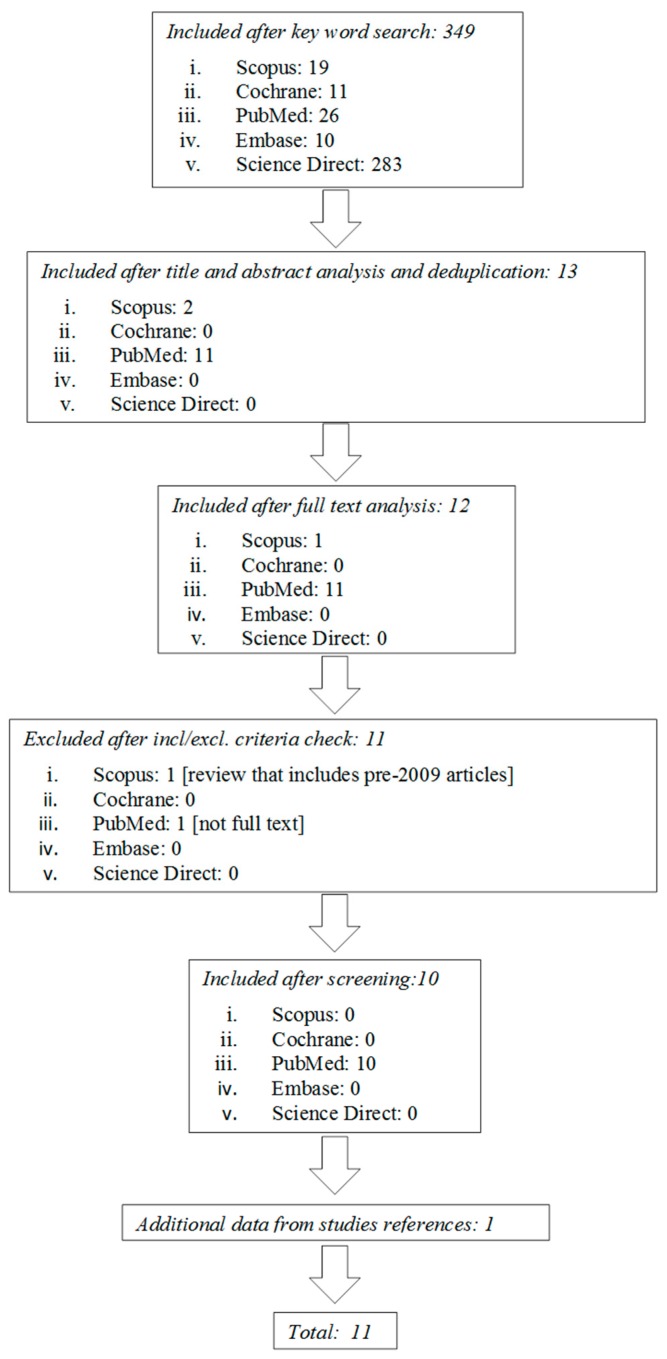
Objective: the objective of this review is to analyze the advances in the field of rehabilitation through virtual reality, while taking into account non-immersive systems, as evidence have them shown to be highly accepted by older people, due to the lowest “cibersikness” symptomatology. Data sources: a systematic review of the literature was conducted in June 2019. The data were collected from Cochrane, Embase, Scopus, and PubMed databases, analyzing manuscripts and articles of the last 10 years. Study selection: we only included randomized controlled trials written in English aimed to study the use of the virtual reality in rehabilitation. We selected 10 studies, which were characterized by clinical heterogeneity. Data extraction: quality evaluation was performed based on the Physioterapy Evidence Database (PEDro) scale, suggested for evidence based review of stroke rehabilitation. Of 10 studies considered, eight were randomized controlled trials and the PEDro score ranged from four to a maximum of nine. Data synthesis: VR (Virtual Reality) creates artificial environments with the possibility of a patient interaction. This kind of experience leads to the development of cognitive and motor abilities, which usually positively affect the emotional state of the patient, increasing collaboration and compliance. Some recent studies have suggested that rehabilitation treatment interventions might be useful and effective in treating motor and cognitive symptoms in different neurological disorders, including traumatic brain injury, multiple sclerosis, and progressive supranuclear palsy. Conclusions: as it is shown by the numerous studies in the field, the application of VR has a positive impact on the rehabilitation of the most predominant geriatric syndromes. The level of realism of the virtual stimuli seems to have a crucial role in the training of cognitive abilities. Future research needs to improve study design by including larger samples, longitudinal designs, long term follow-ups, and different outcome measures, including functional and quality of life indexes, to better evaluate the clinical impact of this promising technology in healthy old subjects and in neurological patients.
Overview
The claims and statistics of this paper haven’t been checked yet.
Run the check — free, no account needed. It reads the open-access text and checks the sources it cites.
Integrity signals
Registry
Cites
Statistics
Figures
Verification
Claims the paper makes
The claims and statistics of this paper haven’t been checked yet.
Run the check — free, no account needed. It reads the open-access text and checks the sources it cites.
Claims other papers make about this one
Each is checked against this paper’s own text: does it say what the citing paper says it does?
The cited source says what the claim attributes to it.
In the citing paper
“Thus, this modality may be more accepted by the users [13,14].”
From A Pilot Study to Assess Visual Vertigo in People with Persistent Postural–Perceptual Dizziness with a New Computer-Based Tool (2023) · cites this paper as [13]
Self-check
Percentages, sums and reported differences re-computed from the paper’s own numbers.
The self-check needs the paper’s full text.
Citations
Cites
Reliability of the PEDro Scale for Rating Quality of Randomized Controlled Trials
Maher, C. G., Sherrington, C., Herbert, R. D., Moseley, A. M., & Elkins, M. (2003) · Physical Therapy · doi:10.1093/ptj/83.8.713 · Cited by 4,808
Virtual Reality in the Assessment, Understanding, and Treatment of Mental Health Disorders
Freeman, D., Reeve, S., Robinson, A., Ehlers, A., Clark, D., Spanlang, B., & Slater, M. (2017) · Psychological Medicine · doi:10.1017/s003329171700040x · Cited by 1,428
Motor rehabilitation using virtual reality
Sveistrup, H. (2004) · Journal of NeuroEngineering and Rehabilitation · doi:10.1186/1743-0003-1-10 · Cited by 746
Falls in individuals with stroke.
Weerdesteyn, V., de Niet, M., van Duijnhoven, H. J. R., & Geurts, A. C. H. (2008) · The Journal of Rehabilitation Research and Development · doi:10.1682/jrrd.2007.09.0145 · Cited by 612
Falls in individuals with stroke.
Weerdesteyn, V., de Niet, M., van Duijnhoven, H. J. R., & Geurts, A. C. H. (2008) · PubMed · Cited by 546
Henderson, A., Korner-Bitensky, N. A., & Levin, M. F. (2007) · Topics in Stroke Rehabilitation · doi:10.1310/tsr1402-52 · Cited by 543
Mirelman, A., Rochester, L., Maidan, I., Din, S. D., Alcock, L., Nieuwhof, F., Rikkert, M. G. M. O., Bloem, B. R., Pelosin, E., Avanzino, L., et al. (2016) · The Lancet · doi:10.1016/s0140-6736(16)31325-3 · Cited by 517
Saposnik, G., Cohen, L. G., Mamdani, M., Pooyania, S., Ploughman, M., Cheung, D., Shaw, J., Hall, J., Nord, P., Dukelow, S. P., et al. (2016) · The Lancet Neurology · doi:10.1016/s1474-4422(16)30121-1 · Cited by 430
Savović, J., Weeks, L., Sterne, J. A., Turner, L., Altman, D. G., Moher, D., & Higgins, J. P. (2014) · Systematic Reviews · doi:10.1186/2046-4053-3-37 · Cited by 340
Botner, E. M., Miller, W. C., & Eng, J. J. (2005) · Disability and Rehabilitation · doi:10.1080/09638280400008982 · Cited by 332
Cited by
Sorted by citations
Virtual Reality in Neurorehabilitation: An Umbrella Review of Meta-Analyses
Voinescu, A., Sui, J., & Fraser, D. S. (2021) · Journal of Clinical Medicine · doi:10.3390/jcm10071478 · Cited by 121
Baragash, R. S., Aldowah, H. A., & Ghazal, S. (2022) · Digital Health · doi:10.1177/20552076221132099 · Cited by 116
Virtual reality in the assessment, understanding, and treatment of mental health disorders
Riva, G., & Serino, S. (2020) · Journal of Clinical Medicine · doi:10.3390/jcm9113434 · Cited by 109
Soleimani, M., Ghazisaeedi, M., & Heydari, S. (2024) · BMC Medical Informatics and Decision Making · doi:10.1186/s12911-024-02534-y · Cited by 105
Serious Game Design and Clinical Improvement in Physical Rehabilitation: Systematic Review
Vieira, C., Pais-Vieira, C., Novais, J., & Perrotta, A. (2021) · JMIR Serious Games · doi:10.2196/20066 · Cited by 103
Metadata
- Authors
- Bevilacqua, R., Maranesi, E., Riccardi, G. R., Di Donna, V., Pelliccioni, P., Luzi, R., Lattanzio, F., & Pelliccioni, G.
- Affiliations
- Istituto Nazionale di Riposo e Cura per Anziani (IT)
- Clinical Unit of Physical Rehabilitation, IRCCS INRCA, 60100 Ancona, Italy
- Marche Polytechnic University (IT)
- Corresponding author
- Maranesi, Elvira
- ORCID
- Venue
- Journal of Clinical Medicine
- Publisher
- MDPI AG
- Published
- 2019-11-05
- Volume
- 8
- Issue
- 11
- Pages
- 1882
- ISSN
- 2077-0383 (ISSN-L)
- PMC
- PMC6912349
- OpenAlex
- W2989062418
- Cited by
- 125
- References
- 40
- Citations by year
- 2026: 9 · 2025: 21 · 2024: 25 · 2023: 21 · 2022: 20 · 2021: 17 · 2020: 10 · 2019: 2
- FWCI
- 1.71
- Type
- journal article
- Language
- en
- Open access
- gold
- doi.org
- Licence
- Locations
- Journal of Clinical Medicine (publishedVersion, cc-by)
- Europe PMC (PubMed Central) (publishedVersion, cc-by)
- PubMed Central (publishedVersion, cc-by)
- PubMed (publishedVersion)
- DOAJ (DOAJ: Directory of Open Access Journals) (submittedVersion)
- Topics
- Health Sciences › Medicine › Rehabilitation › Stroke Rehabilitation and Recovery
- Physical Sciences › Computer Science › Human-Computer Interaction › Virtual Reality Applications and Impacts
- Social Sciences › Psychology › Experimental and Cognitive Psychology › Cognitive Functions and Memory
- Keywords
- non-immersive virtual reality, virtual reality rehabilitation, older adults, geriatric syndromes, motor rehabilitation, cognitive rehabilitation, stroke rehabilitation, traumatic brain injury, multiple sclerosis, progressive supranuclear palsy, medication adherence, cybersickness, neurological disorders
About these checks
Registry, retraction, Cites and statistics results are computed, not judged, with one exception: a printed reference that no index lists is read once by a model before it counts as a citation error. Claims are extracted by a model and kept only when their quote appears verbatim in the text; each cited source is then checked, with a model’s help, for whether it says what the claim relies on. Those verdicts can be wrong — read the claim’s quote and the cited source before relying on one.
Statistics and arithmetic are recomputed, not judged.
Confidence bands are shown only for fields calibrated on our annotated test set. None is calibrated yet, so no band is shown.
What counts as a claim ›How we measure confidence ›How we check this ›
Are you an author, or do you see a problem with this page? Request a review
