

The DOI matches its Crossref record; 52 of the 52 references it cites were found in a registry or an index; none of the 45 sources its claims cite is checked for support yet.
Food Administration and Not Genetic Variants Causes Pharmacokinetic Variability of Tadalafil and Finasteride
Open accessAbstract
Tadalafil and finasteride are used in combination for the management of benign prostatic hyperplasia (BPH). Genetic variations in genes involved in the metabolism and transport of tadalafil or finasteride (i.e., pharmacogenes) could affect their pharmacokinetic processes altering their drug exposure, efficacy, and toxicity. The main objective of this study was to investigate the effects of variants in pharmacogenes on the pharmacokinetics of tadalafil and finasteride. An exploratory candidate gene study involving 120 variants in 33 genes was performed with 66 male healthy volunteers from two bioequivalence clinical trials after administration of tadalafil/finasteride 5 mg/5 mg under fed or fasting conditions. Afterwards, a confirmatory study was conducted with 189 male and female volunteers receiving tadalafil 20 mg formulations in seven additional bioequivalence clinical trials. Regarding tadalafil, fed volunteers showed higher area in the time-concentration curve (AUC∞), maximum plasma concentration (Cmax), and time to reach Cmax (tmax) compared to fasting volunteers; male volunteers also showed higher AUC∞ and Cmax compared to female volunteers. Furthermore, fed volunteers presented higher finasteride AUC∞, Cmax and tmax compared to fasting individuals. Variants in ABCC3, CYP1A2, CES1, NUDT15, SLC22A1/A2 and UGT2B10 were nominally associated with pharmacokinetic variation in tadalafil and/or finasteride but did not remain significant after correction for multiple comparisons. Genetic variation did not demonstrate to clinically impact on the pharmacokinetics of finasteride and tadalafil; however, additional studies with larger sample sizes are needed to assess the effect of rare variants, such as CYP3A4*20 or *22, on tadalafil and finasteride pharmacokinetics.
Overview
CoChat Summary
TL;DR
In healthy volunteers, food intake increased tadalafil and finasteride exposure and delayed tmax, while sex affected tadalafil pharmacokinetics. Genetic variants in candidate pharmacogenes showed only nominal associations that did not survive multiple-testing correction.
Key findings
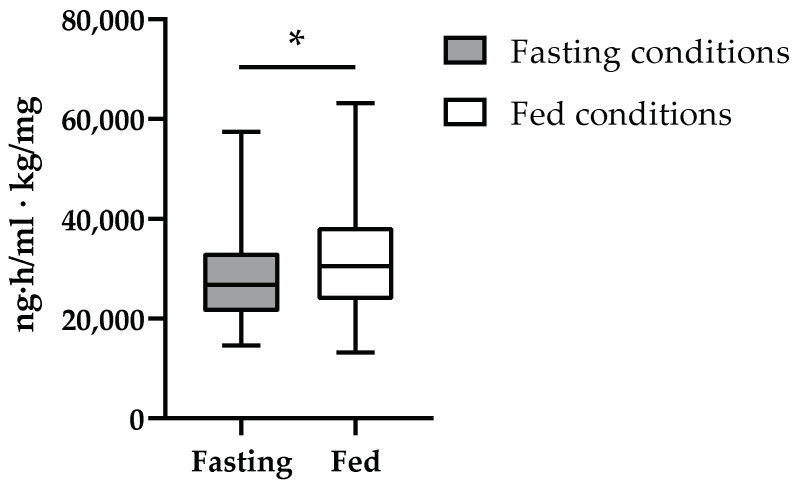
- Fed volunteers had higher tadalafil AUC∞/DW, Cmax/DW, and tmax than fasting volunteers: exploratory 1.4-fold AUC∞/DW (p = 0.004), Cmax/DW β = 0.122, R² = 0.162, pMV = 0.043, and 1.8-fold tmax (p < 0.001); confirmatory 1.2-fold AUC∞/DW (pMV = 0.001), 1.2-fold Cmax/DW (pMV < 0.001), and 1.5-fold tmax (pMV < 0.001).
- Fed volunteers also had higher finasteride AUC∞/DW and tmax: 1.2-fold AUC∞/DW (p = 0.032) and 1.8-fold tmax (p < 0.001), but not higher Cmax/DW.
- In the confirmatory tadalafil study, males had 1.2-fold higher AUC∞/DW (pMV = 0.009) and 1.2-fold higher Cmax/DW (pMV < 0.001) than females.
- Variants in ABCC3, CYP1A2, CES1, NUDT15, SLC22A1/A2, and UGT2B10 were nominally associated with tadalafil and/or finasteride pharmacokinetic variation but did not remain significant after Bonferroni correction.
Methods
- Exploratory candidate-gene study: 120 variants in 33 genes in 66 male healthy volunteers from two bioequivalence clinical trials of tadalafil/finasteride 5 mg/5 mg under fed or fasting conditions.
- Confirmatory study: 189 male and female volunteers receiving tadalafil 20 mg formulations in seven additional bioequivalence clinical trials.
- Pharmacokinetic parameters were calculated by non-compartmental analysis; drug levels were measured by HPLC-MS/MS with LLOQ 1 ng/mL; univariate tests were followed by multivariate linear regression with Bonferroni correction.
Limitations
- The paper states the sample size was small, arbitrary, and not calculated to demonstrate associations; the population mixed biogeographical groups and trials, potentially introducing confounders; the study was descriptive and lacked efficacy/pharmacodynamic assessment in healthy volunteers.
- The paper states candidate-gene design misses other genomic variants, and genotyping individual variants cannot identify rare alleles; larger studies and NGS/GWAS were suggested, including for rare CYP3A4 variants such as *20 or *22.
- Evident from the text: CYP3A4 had insufficient variability for analysis, with only one CYP3A4 *1/*3 intermediate metabolizer among 66 volunteers; sex could not be analyzed in the exploratory finasteride study because of finasteride’s indications.
Model-written summary. Check it against the paper before relying on it.
Integrity signals
Registry
Cites
Statistics
Figures
Verification
Claims the paper makes
0 Valid · 0 Not valid · 32 Not checked · 64 Own results and interpretations
A result the paper reports from its own data — it cites no other source for it, so there is none to check. The quote shows it is in the paper.
In the paper
“male volunteers also showed higher AUC∞ and Cmax compared to female volunteers.”
§ Food Administration and Not Genetic Variants Causes Pharmacokinetic Variability of Tadalafil and Finasteride > Abstract
plainstates an associationn = 189- Asserted: passes — The authors put it forward as true.
- Checkable: passes — It can be checked against evidence.
- Load-bearing: unclear — It is unclear whether the paper’s conclusions depend on it.
- Based: passes — The paper gives a reason why it holds.
A result the paper reports from its own data — it cites no other source for it, so there is none to check. The quote shows it is in the paper.
In the paper
“Regarding tadalafil, fed volunteers showed higher area in the time-concentration curve (AUC∞), maximum plasma concentration (Cmax), and time to reach Cmax (tmax) compared to fasting volunteers”
- Also stated in: § 3.1. Exploratory Study · plain
“Fed volunteers presented a 1.4-, 1.1, and 1.8-fold higher AUC∞/DW (p = 0.004), Cmax/DW (β = 0.122, R2 = 0.162, pMV = 0.043), and tmax (p < 0.001), respectively, compared to fasting volunteers (Table 4).”
§ Food Administration and Not Genetic Variants Causes Pharmacokinetic Variability of Tadalafil and Finasteride > Abstract
plainstates an associationn = 66- Asserted: passes — The authors put it forward as true.
- Checkable: passes — It can be checked against evidence.
- Load-bearing: passes — The paper’s conclusions depend on it.
- Based: passes — The paper gives a reason why it holds.
- Also stated in: § 3.1. Exploratory Study · plain
A result the paper reports from its own data — it cites no other source for it, so there is none to check. The quote shows it is in the paper.
In the paper
“No significant associations were found between genotypes or phenotypes and variability in tadalafil pharmacokinetics, although variants in some genes (ABCC3, CYP1A2, CES1, NUDT15, SLC22A1, UGT2B10) were nominally associated with tadalafil pharmacokinetic variation.”
§ Food Administration and Not Genetic Variants Causes Pharmacokinetic Variability of Tadalafil and Finasteride > 4. Discussion
plainn = 66- Asserted: passes — The authors put it forward as true.
- Checkable: passes — It can be checked against evidence.
- Load-bearing: passes — The paper’s conclusions depend on it.
- Based: passes — The paper gives a reason why it holds.
A result the paper reports from its own data — it cites no other source for it, so there is none to check. The quote shows it is in the paper.
In the paper
“No significant associations were found between genotypes or phenotypes and variability in tadalafil pharmacokinetics, although variants in some genes (ABCC3, CYP1A2, CES1, NUDT15, SLC22A1, UGT2B10) were nominally associated with tadalafil pharmacokinetic variation.”
§ Food Administration and Not Genetic Variants Causes Pharmacokinetic Variability of Tadalafil and Finasteride > 4. Discussion
hedgedstates an association- Asserted: passes — The authors put it forward as true.
- Checkable: passes — It can be checked against evidence.
- Load-bearing: unclear — It is unclear whether the paper’s conclusions depend on it.
- Based: passes — The paper gives a reason why it holds.
A result the paper reports from its own data — it cites no other source for it, so there is none to check. The quote shows it is in the paper.
In the paper
“Fed volunteers presented 1.2-, 1.2-, and 1.5-fold higher AUC∞/DW (β = 0.175, R2 = 0.113, pMV = 0.001), Cmax/DW (β = 0.168, R2 = 0.170, pMV < 0.001) and tmax (β = −0.132, pMV < 0.001), respectively, compared to fasting volunteers (Table 7).”
§ Food Administration and Not Genetic Variants Causes Pharmacokinetic Variability of Tadalafil and Finasteride > 3. Results > 3.2. Confirmatory Study
plainstates an association- Asserted: passes — The authors put it forward as true.
- Checkable: passes — It can be checked against evidence.
- Load-bearing: passes — The paper’s conclusions depend on it.
- Based: passes — The paper gives a reason why it holds.
32 more claims
Create a free account to see all 96 claims and to verify the 42 references still open.
- It may state two separate claims as one. 31
- Probably not a substantial claim. 43
Self-check
Percentages, sums and reported differences re-computed from the paper’s own numbers.
Each contradiction between two passages listed here was confirmed by an independent check.
Rated minor: it would not touch a result — a value no result rests on, a p-value that stays on the same side of the significance level, or a conflict that is clerical, resolved elsewhere in the paper, or outside its own findings.
In the paper
§ Food Administration and Not Genetic Variants Causes Pharmacokinetic Variability of Tadalafil and Finasteride > 3. Results > 3.2. Confirmatory Study
“mean height of 70.45 ± 12.78 m”
§ Food Administration and Not Genetic Variants Causes Pharmacokinetic Variability of Tadalafil and Finasteride > 3. Results > 3.2. Confirmatory Study
“mean weight of 70.45 ± 12.78 kg, and body max index (BMI) of 24.18 ± 3.06 m/kg2.”
Rated minor: it would not touch a result — a value no result rests on, a p-value that stays on the same side of the significance level, or a conflict that is clerical, resolved elsewhere in the paper, or outside its own findings.
In the paper
§ Food Administration and Not Genetic Variants Causes Pharmacokinetic Variability of Tadalafil and Finasteride > 2. Material and Methods > 2.5. Feeding Conditions
“In this way, it was ensured that each volunteer received each formulation twice.”
§ Food Administration and Not Genetic Variants Causes Pharmacokinetic Variability of Tadalafil and Finasteride > 2. Material and Methods > 2.5. Feeding Conditions
“Both had two periods and two sequences (TR and RT). In the first period, the volunteers were randomly administered the T or R formulations and, in the following period, after a 7-day washout period, the opposite formulation.”
Rated minor: it would not touch a result — a value no result rests on, a p-value that stays on the same side of the significance level, or a conflict that is clerical, resolved elsewhere in the paper, or outside its own findings.
In the paper
§ Food Administration and Not Genetic Variants Causes Pharmacokinetic Variability of Tadalafil and Finasteride > 3. Results > 3.1. Exploratory Study
“body max index (BMI) of 25.62 ± 2.67 m/kg2.”
§ Food Administration and Not Genetic Variants Causes Pharmacokinetic Variability of Tadalafil and Finasteride > 2. Material and Methods > 2.3. Criteria and Conditions
“body mass index (BMI) outside of the 18.5–30 kg/m2 range”
Citations
Cites
O'Leary, N. A., Wright, M. W., Brister, J. R., Ciufo, S., Haddad, D., McVeigh, R., Rajput, B., Robbertse, B., Smith-White, B., Ako-Adjei, D., et al. (2016) · Nucleic Acids Research · doi:10.1093/nar/gkv1189 · Cited by 6,357
The Effect of Finasteride in Men with Benign Prostatic Hyperplasia
Gormley, G. J., Stoner, E., Bruskewitz, R. C., Imperato‐McGinley, J., Walsh, P. C., McConnell, J. D., Andriole, G. L., Geller, J., Bracken, B. R., Tenover, J. L., et al. (1992) · New England Journal of Medicine · doi:10.1056/nejm199210223271701 · Cited by 1,110
An Evidence‐Based Framework for Evaluating Pharmacogenomics Knowledge for Personalized Medicine
Whirl‐Carrillo, M., Huddart, R., Gong, L., Sangkuhl, K., Thorn, C. F., Whaley, R., & Klein, T. E. (2021) · Clinical Pharmacology & Therapeutics · doi:10.1002/cpt.2350 · Cited by 810
Roehrborn, C. G., Siami, P., Barkin, J., Damião, R., Major-Walker, K., Nandy, I., Morrill, B. B., Gagnier, R. P., & Montorsi, F. (2010) · European Urology · doi:10.1016/j.eururo.2009.09.035 · Cited by 788
Birdwell, K., Decker, B., Barbarino, J., Peterson, J., Stein, C., Sadee, W., Wang, D., Vinks, A., He, Y., Swen, J., et al. (2015) · Clinical Pharmacology & Therapeutics · doi:10.1002/cpt.113 · Cited by 730
Amstutz, U., Henricks, L. M., Offer, S. M., Barbarino, J. M., Schellens, J. H. M., Swen, J. J., Klein, T. E., McLeod, H. L., Caudle, K. E., Diasio, R. B., et al. (2017) · Clinical Pharmacology & Therapeutics · doi:10.1002/cpt.911 · Cited by 728
Relling, M. V., Schwab, M. G., Whirl‐Carrillo, M., Suarez‐Kurtz, G., Pui, C., Stein, C. M., Moyer, A. M., Evans, W. E., Klein, T. E., Antillón‐Klussmann, F., et al. (2018) · Clinical Pharmacology & Therapeutics · doi:10.1002/cpt.1304 · Cited by 716
Diagnosis and Treatment of Pulmonary Arterial Hypertension: A Review
Ruopp, N. F., & Cockrill, B. A. (2022) · JAMA · doi:10.1001/jama.2022.4402 · Cited by 643
Lee, C. R., Luzum, J. A., Sangkuhl, K., Gammal, R. S., Sabatine, M. S., Stein, C. M., Kisor, D. F., Limdi, N. A., Lee, Y. M., Scott, S. A., et al. (2022) · Clinical Pharmacology & Therapeutics · doi:10.1002/cpt.2526 · Cited by 539
Benign prostatic hyperplasia: an overview
Ziada, A., Rosenblum, M., & Crawford, E. D. (1999) · Urology · doi:10.1016/s0090-4295(98)00532-9 · Cited by 431
Cited by
What do we really know about the external urethral sphincter?
McCloskey, K. D., Kanai, A., Panicker, J. N., Hashitani, H., & Fry, C. H. (2024) · Continence · doi:10.1016/j.cont.2024.101223 · Cited by 15
Perezcano, C. (2026) · Frontiers in Public Health · doi:10.3389/fpubh.2026.1748704 · Cited by 2
Finasteride, pharmacogenomics, and suicide risk: a public health concern
Perezcano, C., Pérez-Coria, M., & Borrayo-LóPez, F. J. (2026) · The Pharmacogenomics Journal · doi:10.1038/s41397-026-00420-6 · Cited by 1
Role of 5α-reductase inhibitors in Parkinson's disease: Gambling or not?
Hussein, N. R., Al‐kuraishy, H. M., Fahad, E. H., Sulaiman, G. M., Mohammed, H. A., Al-Gareeb, A. I., & Albuhadily, A. K. (2026) · The Journal of Steroid Biochemistry and Molecular Biology · doi:10.1016/j.jsbmb.2026.107056
Metadata
- Authors
- Villapalos-García, G., Zubiaur, P., Marián-Revilla, C., Soria-Chacartegui, P., Navares-Gómez, M., Mejía-Abril, G., Rodríguez-Lopez, A., González-Iglesias, E., Martín-Vílchez, S., Román, M., Ochoa, D., & Abad-Santos, F.
- Affiliations
- Clinical Pharmacology Department, School of Medicine, Hospital Universitario de La Princesa, Instituto Teófilo Hernando, Instituto de Investigación Sanitaria La Princesa (IP), Universidad Autónoma de Madrid, 28006 Madrid, Spain
- Hospital Universitario de La Princesa (ES)
- Corresponding author
- Zubiaur, Pablo
- ORCID
- Venue
- Journal of Personalized Medicine
- Publisher
- MDPI AG
- Published
- 2023-10-31
- Volume
- 13
- Issue
- 11
- Pages
- 1566
- ISSN
- 2075-4426 (ISSN-L)
- PMC
- PMC10672114
- OpenAlex
- W4388048650
- Cited by
- 4
- References
- 52
- Citations by year
- 2026: 3 · 2024: 1
- FWCI
- 0.60
- Type
- journal article
- Language
- en
- Open access
- gold
- doi.org
- Licence
- Locations
- Journal of Personalized Medicine (publishedVersion, cc-by)
- PubMed Central (publishedVersion, cc-by)
- PubMed (publishedVersion)
- Hispana (submittedVersion, cc-by)
- Biblos-e Archivo (Universidad Autónoma de Madrid) (submittedVersion, public-domain)
- Funders
- Instituto de Salud Carlos III (ISCIII) and the European Social Fund (FI20/00090, ICI20/00131, FPI-UAM, 2021, 2022-C23.I01.P03.S0020-0000031, 09-PIN1-00015.6/2022)
- Acción Estratégica en Salud 2017–2020, ISCIII (FI20/00090, ICI20/00131, FPI-UAM, 2021, 2022-C23.I01.P03.S0020-0000031, 09-PIN1-00015.6/2022)
- Universidad Autónoma de Madrid, Margarita Salas contract (FI20/00090, ICI20/00131, FPI-UAM, 2021, 2022-C23.I01.P03.S0020-0000031, 09-PIN1-00015.6/2022)
- Universidad Autónoma de Madrid (FI20/00090, ICI20/00131, FPI-UAM, 2021, 2022-C23.I01.P03.S0020-0000031, 09-PIN1-00015.6/2022)
- Programa Investigo (NextGenerationEU funds of the Recovery and Resilience Facility) (FI20/00090, ICI20/00131, FPI-UAM, 2021, 2022-C23.I01.P03.S0020-0000031, 09-PIN1-00015.6/2022)
- Topics
- Life Sciences › Pharmacology, Toxicology and Pharmaceutics › Pharmacology › Pharmacogenetics and Drug Metabolism
- Life Sciences › Biochemistry, Genetics and Molecular Biology › Genetics › Genetic Associations and Epidemiology
- Life Sciences › Biochemistry, Genetics and Molecular Biology › Genetics › Nutrition, Genetics, and Disease
- Keywords
- tadalafil, finasteride, pharmacokinetic variability, drug metabolism genes, genetic variants, benign prostatic hyperplasia, food effect, sex differences, ABCC3, CYP1A2, CES1, NUDT15, UGT2B10, drug metabolism, drug transport
About these checks
Registry, retraction, Cites and statistics results are computed, not judged, with one exception: a printed reference that no index lists is read once by a model before it counts as a citation error. Claims are extracted by a model and kept only when their quote appears verbatim in the text; each cited source is then checked, with a model’s help, for whether it says what the claim relies on. Those verdicts can be wrong — read the claim’s quote and the cited source before relying on one.
A language model drew the claims from the paper on 2026-11-14, under version 3 of the claim definition (model deepseek-v4.1-flash, prompt extract-v3).
A second model labelled each claim on 2026-11-14 (model jev-1.13-20260917, definition revision gold-guideline-v0.2).
Statistics and arithmetic are recomputed, not judged.
Confidence bands are shown only for fields calibrated on our annotated test set. None is calibrated yet, so no band is shown.
What counts as a claim ›How we measure confidence ›How we check this ›
Are you an author, or do you see a problem with this page? Request a review
Data sources
Bibliographic data: Semantic Scholar, OpenAlex, Crossref.
Contains information from the Semantic Scholar Academic Graph Datasets, made available under the ODC Attribution License (ODC-BY 1.0).
Semantic Scholar’s data is described in: Kinney, R., et al. (2023). The Semantic Scholar Open Data Platform. arXiv:2301.10140.
