

The DOI matches its Crossref record; 37 of the 37 references it cites were found in a registry or an index; 10 of the 45 sources its claims cite were checked for support.
Challenges and Stakeholder Perspectives on Implementing Ecological Designs in Green Public Spaces: A Case Study of Hue City, Vietnam
Open accessAbstract
In recent years, ecological design has emerged as an innovative approach for landscape designs to address urban environmental issues such as biodiversity protection and the promotion of ecosystem services. However, in developing countries like Vietnam, an ecological approach is still in its early stages and requires more research and practical application. This study aims to explore stakeholder perspectives and identify suitable ecological landscape approaches through semi-structured interviews based on designed images. The findings reveal various challenges to implementing ecological designs in the public green spaces of Hue City, such as the prioritisation of short-term goals over ecosystem services, solely focusing on increasing green per capita, the lack of market interest, and the lack of motivation among different departments responsible for the design and management of public green spaces. In addition, the study also finds that stakeholders are willing to accept a hybrid ecological landscape approach in combination with ‘cues to care’ landscapes, such as buffer zones of well-managed vegetation or regularly cut lawns. Results highlight the necessity of prioritising ecosystem services in decision-making, policy, and planning development concerning urban green spaces in Vietnamese cities. In addition, education and awareness campaigns are needed for the public and stakeholders to increase acceptance of ecological design.
Overview
CoChat Summary
TL;DR
This case study of three public parks in Hue City, Vietnam, uses image-assisted semi-structured interviews with 15 stakeholders to identify barriers to implementing ecological landscape design in Vietnamese urban green spaces. Stakeholders favoured a hybrid "medium" ecological approach combining native planting with "cues to care" such as mown lawns and clear buffer zones, rather than a wilder intensive approach.
Key findings
- Four main barriers emerged: prioritisation of short-term goals over ecosystem services; a sole focus on increasing green per capita (respondents cited a national standard of 12 m² per capita and Hue's target of 15 m² per capita); lack of market interest (e.g., suppliers not stocking native plants, investors fearing wild-looking landscapes will not attract customers); and low motivation and siloed collaboration among departments, compounded by limited budgets ("just enough to maintain the parks").
- Knowledge gaps were explicit: one interviewee said "we have heard about ecosystem services before but we don't really understand… ecological designs just make the landscape more crowded and untidy" (P7), and another "I can't see the differences in benefits of conventional designs and ecological designs except for the appearances" (P8).
- The majority of stakeholders preferred the medium ecological approach (alternative 1) over the intensive approach (alternative 2), citing maintenance burden, safety/security concerns (dense vegetation as hiding places or breeding grounds for rats, snakes, mosquitoes), rubbish trapping in dense riverbank vegetation, and aesthetics.
- Stakeholders agreed on a hybrid model balancing ecological and conventional features — clear pathway buffers, layered native planting, controlled shrub heights, rain gardens and bioswales, and low-maintenance design — consistent with the "cues to care" approach.
Methods
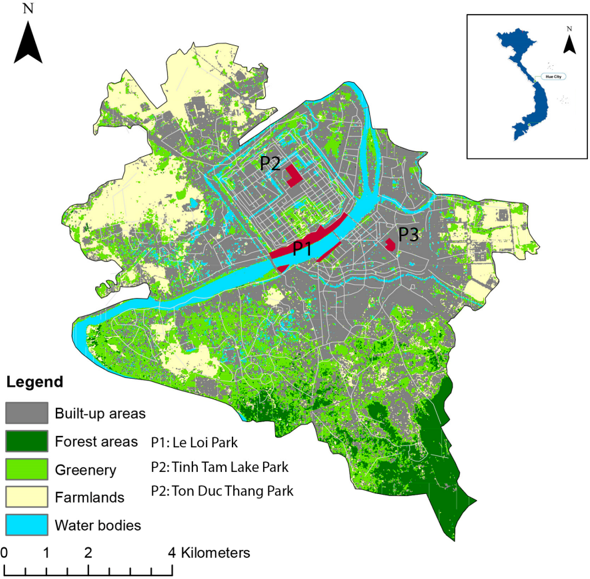
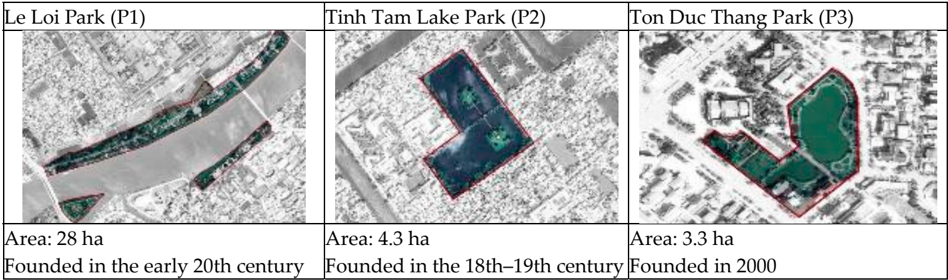
- Qualitative case study of three of Hue City's largest public parks: Le Loi Park (P1, 28 ha, founded early 20th century), Tinh Tam Lake (P2, 4.3 ha, founded 18th–19th century), and Ton Duc Thang Park (P3, 3.3 ha, founded 2000).
- 15 semi-structured interviews (40 min–1 h) with stakeholders responsible for planning, design, and management: senior park managers, park site supervisors, ground staff, landscape architects, and academic scholars; participants included two architects, three landscape architects, two university lecturers, and four agricultural/horticultural engineers.
- Photo-based questioning using purpose-designed images of two ecological implementation levels (alternative 1 = medium, alternative 2 = intensive) across five green space typologies (lawns, shrubs, semi-woodlands, water edges, river/lake margins); interviews were recorded, transcribed, translated from Vietnamese to English, and coded in NVivo using a case study approach.
Limitations
- Stated by the authors: due to COVID-19, public opinions could not be collected, which they describe as a limitation; they recommend further research on public attitudes and on comparative benefits, costs, and public reactions of ecological versus conventional landscapes.
- Evident from the text: the sample is small (15 stakeholders) and drawn entirely from professional/managerial roles, so the "public" perspective is inferred through stakeholders' perceptions rather than measured directly; the authors themselves note that stakeholders' reading of public opinion is "subjective" and that community participation in Vietnamese public landscape design is limited. Data cannot be made publicly available.
Model-written summary. Check it against the paper before relying on it.
Integrity signals
Registry
Cites
Statistics
Figures


Verification
Claims the paper makes
8 Valid · 0 Not valid · 20 Not checked · 85 Own results and interpretations
Every source the paper cites for this claim was checked and supports it.
In the paper
“For example, Nassauer [34] found evidence supporting the notion that societies have a common expectation for landscapes to be well-maintained, managed, and cared for to a certain standard.”
§ Challenges and Stakeholder Perspectives on Implementing Ecological Designs in Green Public Spaces: A Case Study of Hue City, Vietnam > 1. Introduction
What the sources say
- Supportedcites [34] Nassauer, 1988, The aesthetics of horticulture: Neatness as a Form of Care, HortScience source
In “Care in Local Landscape Perceptions,” Nassauer calls neatness a nearly universal language of care and says people expect others to notice signs of poor upkeep, such as weeds and brown lawn patches. Her local landscape investigations also found that well-maintained homes and yards were associated with attractiveness. The paper notes that people can differ in what they recognize as care, but supports the citing sentence’s broad paraphrase. (LLM, conf=0.90)
plain- Asserted: passes — The authors put it forward as true.
- Checkable: passes — It can be checked against evidence.
- Load-bearing: passes — The paper’s conclusions depend on it.
- Based: passes — The paper gives a reason why it holds.
- Supported
Every source the paper cites for this claim was checked and supports it.
In the paper
“Firstly, in the urban development process, ecosystem services are not always a top priority for stakeholders, even in developed countries.For instance, Hagemann et al. [32] demonstrated that some cities in Sweden do not adequately prioritise urban ecosystem services in their municipal planning.”
§ Challenges and Stakeholder Perspectives on Implementing Ecological Designs in Green Public Spaces: A Case Study of Hue City, Vietnam > 4. Discussion
What the sources say
- Supportedcites Hagemann et al. [32] Hagemann, 2020, Challenges to implementing the urban ecosystem service concept in green infrastructure planning: A view from practitioners in Swedish municipalities, Socio-Ecol. Pract. Res. source
Section 5.1 (‘UES is not prioritized’) reports that urban ecosystem services were under-prioritized relative to housing and infrastructure in the Swedish municipalities studied. It also describes limited recognition of their value among local politicians and private developers. This supports the citing sentence’s example that some Swedish cities do not adequately prioritize these services in municipal planning. (LLM, conf=0.93)
boosted- Asserted: passes — The authors put it forward as true.
- Checkable: passes — It can be checked against evidence.
- Load-bearing: unclear — It is unclear whether the paper’s conclusions depend on it.
- Based: passes — The paper gives a reason why it holds.
- Rests on an assumption not shown here.
- Supported
The cited sources support only part of this claim — read each source’s verdict below.
In the paper
“For example, native plants often require less water and fertiliser once established [10].”
§ Challenges and Stakeholder Perspectives on Implementing Ecological Designs in Green Public Spaces: A Case Study of Hue City, Vietnam > 4.1. Appropriate Ecological Landscape in the Eye of Stakeholders
What the sources say
- Partly supportedcites [10] Berthon, 2021, The role of ‘nativeness’ in urban greening to support animal biodiversity, Landsc. Urban Plan. sourceExperimental — accuracy not yet measured
The Introduction (page unavailable) says native species are considered better adapted to local environments and to require less maintenance. It does not specify lower water or fertiliser needs, or say that this applies once plants are established. (LLM, conf=0.80)
plainstates a cause- Asserted: passes — The authors put it forward as true.
- Checkable: passes — It can be checked against evidence.
- Load-bearing: unclear — It is unclear whether the paper’s conclusions depend on it.
- Based: passes — The paper gives a reason why it holds.
- Partly supported
A result the paper reports from its own data — it cites no other source for it, so there is none to check. The quote shows it is in the paper.
In the paper
“The interview highlighted a key issue where park managers tend to overlook the ecosystem services offered by ecological approaches compared with temporary goals.”
- Also stated in: § 3.1.1. Insufficient Understanding and Priority Are Given to Ecosystem Services · plain
“Our park aims to create a beautiful, clean, tidy, and safe landscape for local people to come and relax and enjoy.Promoting ecosystem services, such as providing biodiversity or water runoff treatments are not part of our plans.”
§ Challenges and Stakeholder Perspectives on Implementing Ecological Designs in Green Public Spaces: A Case Study of Hue City, Vietnam > 3.1.1. Insufficient Understanding and Priority Are Given to Ecosystem Services
plainSingle case- Asserted: passes — The authors put it forward as true.
- Checkable: passes — It can be checked against evidence.
- Load-bearing: passes — The paper’s conclusions depend on it.
- Based: passes — The paper gives a reason why it holds.
- Rests on an assumption not shown here.
- Also stated in: § 3.1.1. Insufficient Understanding and Priority Are Given to Ecosystem Services · plain
A result the paper reports from its own data — it cites no other source for it, so there is none to check. The quote shows it is in the paper.
In the paper
“In addition, the study also finds that stakeholders are willing to accept a hybrid ecological landscape approach in combination with 'cues to care' landscapes, such as buffer zones of well-managed vegetation or regularly cut lawns.”
§ Challenges and Stakeholder Perspectives on Implementing Ecological Designs in Green Public Spaces: A Case Study of Hue City, Vietnam > Abstract
plain- Asserted: passes — The authors put it forward as true.
- Checkable: passes — It can be checked against evidence.
- Load-bearing: passes — The paper’s conclusions depend on it.
- Based: passes — The paper gives a reason why it holds.
41 more claims
Create a free account to see all 113 claims and to verify the 14 references still open.
- Probably not a substantial claim. 52
- It may state two separate claims as one. 33
Self-check
Percentages, sums and reported differences re-computed from the paper’s own numbers.
Each contradiction between two passages listed here was confirmed by an independent check.
Rated minor: it would not touch a result — a value no result rests on, a p-value that stays on the same side of the significance level, or a conflict that is clerical, resolved elsewhere in the paper, or outside its own findings.
In the paper
§ Challenges and Stakeholder Perspectives on Implementing Ecological Designs in Green Public Spaces: A Case Study of Hue City, Vietnam > 2.1. Case Study
“In 2016, Hue City (Figure 1) was recognised as the first national green city in Vietnam by the World Wide Fund for Nature [42].”
§ Challenges and Stakeholder Perspectives on Implementing Ecological Designs in Green Public Spaces: A Case Study of Hue City, Vietnam > References
“42. Söderström, O.; Geertman, S. Loose threads: The translocal making of public space policy in Hanoi. Singap. J. Trop. Geogr. 2013, 34, 244-267. [CrossRef]”
Rated minor: it would not touch a result — a value no result rests on, a p-value that stays on the same side of the significance level, or a conflict that is clerical, resolved elsewhere in the paper, or outside its own findings.
In the paper
§ Challenges and Stakeholder Perspectives on Implementing Ecological Designs in Green Public Spaces: A Case Study of Hue City, Vietnam > 3.2.3. Visual Appearance
“GS5 stated: 'If the ecological landscape is kept orderly, beautiful and wellmaintained, I think the public can accept it.”
§ Challenges and Stakeholder Perspectives on Implementing Ecological Designs in Green Public Spaces: A Case Study of Hue City, Vietnam > 5. Conclusions
“| Ground staff | P8 | Horticultural worker | | Ground staff | P9 | Horticultural worker | | Ground staff | P10 | Horticultural worker |”
Rated minor: it would not touch a result — a value no result rests on, a p-value that stays on the same side of the significance level, or a conflict that is clerical, resolved elsewhere in the paper, or outside its own findings.
In the paper
§ Challenges and Stakeholder Perspectives on Implementing Ecological Designs in Green Public Spaces: A Case Study of Hue City, Vietnam > 4. Discussion
“For instance, Hagemann et al. [32] demonstrated that some cities in Sweden do not adequately prioritise urban ecosystem services in their municipal planning.”
§ Challenges and Stakeholder Perspectives on Implementing Ecological Designs in Green Public Spaces: A Case Study of Hue City, Vietnam > References
“32. Calkins, M. Strategy use and challenges of ecological design in landscape architecture. Landsc. Urban Plan. 2005, 73, 29-48. [CrossRef]”
Citations
Cites
Ecosystem services in urban areas
Bolund, P., & Hunhammar, S. (1999) · Ecological Economics · doi:10.1016/s0921-8009(99)00013-0 · Cited by 2,942
Ecological Resilience—In Theory and Application
Gunderson, L. H. (2000) · Annual Review of Ecology and Systematics · doi:10.1146/annurev.ecolsys.31.1.425 · Cited by 2,751
Crowe, S., Cresswell, K., Robertson, A., Huby, G., Avery, A., & Sheikh, A. (2011) · BMC Medical Research Methodology · doi:10.1186/1471-2288-11-100 · Cited by 2,697
The role of urban parks for the sustainable city
Chiesura, A. (2004) · Landscape and Urban Planning · doi:10.1016/j.landurbplan.2003.08.003 · Cited by 2,555
Fletcher, T. D., Shuster, W., Hunt, W. F., Ashley, R., Butler, D., Arthur, S., Trowsdale, S., Barraud, S., Semadeni-Davies, A., Bertrand-Krajewski, J.-L., et al. (2015) · Urban Water Journal · doi:10.1080/1573062x.2014.916314 · Cited by 1,938
Messy Ecosystems, Orderly Frames
Nassauer, J. I. (1995) · Landscape Journal · doi:10.3368/lj.14.2.161 · Cited by 891
Ahern, J. (2013) · Landscape Ecology · doi:10.1007/s10980-012-9799-z · Cited by 754
Nature, Role and Value of Green Space in Towns and Cities: An Overview
Swanwick, C., Dunnett, N., & Woolley, H. (2003) · Built Environment · doi:10.2148/benv.29.2.94.54467 · Cited by 413
What will the neighbors think? Cultural norms and ecological design
Nassauer, J. I., Wang, Z., & Dayrell, E. (2009) · Landscape and Urban Planning · doi:10.1016/j.landurbplan.2009.05.010 · Cited by 390
Larondelle, N., & Haase, D. (2013) · Ecological Indicators · doi:10.1016/j.ecolind.2012.12.022 · Cited by 336
Research works printed but not linked: 9
- Tymieniecka, A.-T. (2009). Memory in the Ontopoiesis of Life: Book One. Memory in the Generation and Unfolding of Life, Springer.
- Melchionni, B. (2021). Integrating Ecological and Human Health: Restorative Environmental Design in Therapeutic Landscapes. [Ph.D Thesis, University of Georgia].
- Konijnendijk, C.C., Annerstedt, M., Nielsen, A.B., and Maruthaveeran, S. (2013). Benefits of Urban Parks—A systematic review. Int. Fed. Park. Recreat. Adm., 1–68.
- Vargas-Hernández, J.G., Pallagst, K., and Zdunek-Wielgołaska, J. (2018). Handbook of Engaged Sustainability, Springer.
- Molla, 2015, The Value of Urban Green Infrastructure and Its Environmental Response in Urban Ecosystem: A Literature Review, Int. J. Environ. Sci., 4, 89
- Nassauer, J.I. (1997). Placing Nature: Culture and Landscape Ecology, Island Press.
- Shih, W.Y., and Mabon, L. (2020). Routledge Handbook Urban Ecology, Taylor & Francis Group. [2nd ed.].
- 2011, Vietnam: Traditional cultural concepts of human relations with the nature, Asian Geogr., 5706, 67
- Labbé, D., Herbelin, C., and Vinh, D.Q. (2014). Harbin to Hanoi: Architectural Production and Exchanges in Hanoi during the Late French Colonial Era, Hong Kong University Press. Chapter 10.
Cited by
Rethinking Urban Lawns: Rewilding and Other Nature-Based Alternatives
Dushkova, D., & Ignatieva, M. E. (2025) · Diversity · doi:10.3390/d17120830 · Cited by 10
“Our studies in various cities in Europe and outside [4,20,21,41,42,59,60,62] demonstrate that all lawns rely on intensive inputs such as modified soil compositions or soil replacement, regular applications of fertilizers, irrigation, herbicides, and frequent mowing to maintain the uniform turf-sod…”
InfluentialSelf-citationZhuang, X., & Xie, Y. (2023) · Systems · doi:10.3390/systems11120565 · Cited by 1
Nguyen, M.-H., Tran, T. M. A., Sari, N. P. W. P., Trần, T. B., & Vuong, Q. (2026) · Urban forestry & urban greening · doi:10.1016/j.ufug.2026.129485
Metadata
- Authors
- Ignatieva, M., Tran, D. K., & Tenorio, R.
- Affiliations
- The University of Western Australia (AU)
- School of Design, The University of Western Australia, 35 Stirling Highway, Crawley, WA 6009, Australia
- Corresponding author
- Ignatieva, Maria
- Tran, Duy Khiem
- Venue
- Land
- Publisher
- MDPI AG
- Published
- 2023-09-13
- Volume
- 12
- Issue
- 9
- Pages
- 1772
- ISSN
- 2073-445X (ISSN-L)
- OpenAlex
- W4386712943
- Semantic Scholar
- d6475e072a414bdcfddef466d0f1fc1c300365b3
- Cited by
- 4
- References
- 36
- Citations by year
- 2026: 1 · 2025: 2 · 2023: 1
- FWCI
- 1.06
- Type
- journal article
- Language
- en
- Open access
- gold
- doi.org
- Licence
- Locations
- Land (publishedVersion, cc-by)
- UWA Profiles and Research Repository (UWA) (submittedVersion, cc-by)
- RePEc: Research Papers in Economics (submittedVersion)
- DOAJ (DOAJ: Directory of Open Access Journals) (submittedVersion, cc-by-sa)
- Funders
- This paper is invited with a 100% discount for the special issue "Research in Urban Ecology: Application into Landscape Design and Green Infrastructure" (n/a)
- Topics
- Physical Sciences › Environmental Science › Management, Monitoring, Policy and Law › Urban Planning and Landscape Design
- Social Sciences › Urban Studies › Urban Green Space and Health
- Physical Sciences › Environmental Science › Management, Monitoring, Policy and Law › Urban Arborization and Environmental Studies
- Keywords
- sustainable design, public green spaces, urban green space, ecosystem services, biodiversity conservation, stakeholder perspectives, buffer zones, landscape planning, urban environmental policy, public awareness, Hue City
About these checks
Registry, retraction, Cites and statistics results are computed, not judged, with one exception: a printed reference that no index lists is read once by a model before it counts as a citation error. Claims are extracted by a model and kept only when their quote appears verbatim in the text; each cited source is then checked, with a model’s help, for whether it says what the claim relies on. Those verdicts can be wrong — read the claim’s quote and the cited source before relying on one.
The claim verdicts this report counts are experimental: their accuracy is not yet measured.
A language model drew the claims from the paper on 2026-09-28, under version 3 of the claim definition (prompt extract-v3).
A second model labelled each claim on 2026-09-28 (model jev-1.13-20260917, definition revision gold-guideline-v0.2).
Cited sources are checked with a language model’s help (gpt-6-sol).
Statistics and arithmetic are recomputed, not judged.
Confidence bands are shown only for fields calibrated on our annotated test set. None is calibrated yet, so no band is shown.
What counts as a claim ›How we measure confidence ›How we check this ›
Are you an author, or do you see a problem with this page? Request a review
How to cite
Cite CoChat for the checks on this page, and the paper for its own findings.
- This page
- CoChat. (2026). Citation check: Challenges and Stakeholder Perspectives on Implementing Ecological Designs in Green Public Spaces: A Case Study of Hue City, Vietnam. https://app.cochat.ai/papers/10.3390/land12091772
- The paper
- Ignatieva, M., Tran, D. K., & Tenorio, R. (2023). Challenges and Stakeholder Perspectives on Implementing Ecological Designs in Green Public Spaces: A Case Study of Hue City, Vietnam. Land. https://doi.org/10.3390/land12091772
Data sources
Bibliographic data: Semantic Scholar, OpenAlex, Crossref.
Contains information from the Semantic Scholar Academic Graph Datasets, made available under the ODC Attribution License (ODC-BY 1.0).
Semantic Scholar’s data is described in: Kinney, R., et al. (2023). The Semantic Scholar Open Data Platform. arXiv:2301.10140.
