

The Sociodemographic Biases in Machine Learning Algorithms: A Biomedical Informatics Perspective
Open accessThe DOI matches its Crossref record; 98 of the 98 references it cites were found in a registry or an index.
Abstract
Artificial intelligence models represented in machine learning algorithms are promising tools for risk assessment used to guide clinical and other health care decisions. Machine learning algorithms, however, may house biases that propagate stereotypes, inequities, and discrimination that contribute to socioeconomic health care disparities. The biases include those related to some sociodemographic characteristics such as race, ethnicity, gender, age, insurance, and socioeconomic status from the use of erroneous electronic health record data. Additionally, there is concern that training data and algorithmic biases in large language models pose potential drawbacks. These biases affect the lives and livelihoods of a significant percentage of the population in the United States and globally. The social and economic consequences of the associated backlash cannot be underestimated. Here, we outline some of the sociodemographic, training data, and algorithmic biases that undermine sound health care risk assessment and medical decision-making that should be addressed in the health care system. We present a perspective and overview of these biases by gender, race, ethnicity, age, historically marginalized communities, algorithmic bias, biased evaluations, implicit bias, selection/sampling bias, socioeconomic status biases, biased data distributions, cultural biases and insurance status bias, conformation bias, information bias and anchoring biases and make recommendations to improve large language model training data, including de-biasing techniques such as counterfactual role-reversed sentences during knowledge distillation, fine-tuning, prefix attachment at training time, the use of toxicity classifiers, retrieval augmented generation and algorithmic modification to mitigate the biases moving forward.
Overview
The claims and statistics of this paper haven’t been checked yet.
Free: it reads the open-access text and checks the first 5 claims that cite a source we can check. Create a free account to check every claim.
Integrity signals
Registry
Cites
Statistics
Figures
Verification
Claims the paper makes
The claims and statistics of this paper haven’t been checked yet.
Free: it reads the open-access text and checks the first 5 claims that cite a source we can check. Create a free account to check every claim.
Self-check
Percentages, sums and reported differences re-computed from the paper’s own numbers.
The self-check needs the paper’s full text.
Citations
Cites
(2003) · Journal of Machine Learning Research · doi:10.5555/944919.944937 · Cited by 32,337
Blei, D. M., Ng, A. Y., & Jordan, M. I. (2002) · Advances in Neural Information Processing Systems 14 · doi:10.7551/mitpress/1120.003.0082 · Cited by 12,223
Dissecting racial bias in an algorithm used to manage the health of populations
Obermeyer, Z., Powers, B., Vogeli, C., & Mullainathan, S. (2019) · Science · doi:10.1126/science.aax2342 · Cited by 7,137 · cited 4×
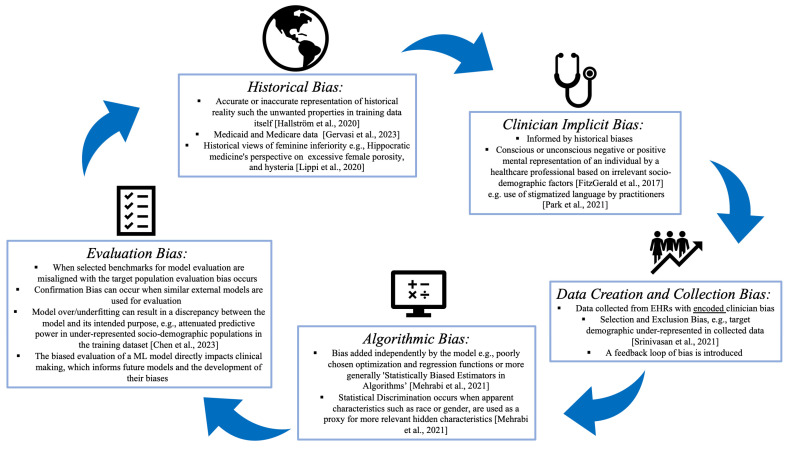
“With the advent of big data analytics, EHRs are often the source of training data for AIMs and, subsequently, MLAGs, thus creating a feedback loop of bias (Figure 1) where existing inequities and disparities can be exacerbated through positive reinforcement methods [12,50].”
BackgroundInfluentialOn the Dangers of Stochastic Parrots: Can Language Models Be Too Big? 🦜
Bender, E. M., Gebru, T., McMillan-Major, A., & Shmitchell, S. (2021) · Proceedings of the 2021 ACM Conference on Fairness, Accountability, and Transparency · doi:10.1145/3442188.3445922 · Cited by 6,988
A Survey on Bias and Fairness in Machine Learning
Mehrabi, N., Morstatter, F., Saxena, N., Lerman, K., & Galstyan, A. (2022) · ACM Computing Surveys · doi:10.1145/3457607 · Cited by 5,812 · cited 2×
“The fact is that MLAGs born of AIMs may not perform as well on women as on men when they are under-represented in the training data [16,74].”
BackgroundA Survey on Bias and Fairness in Machine Learning
Mehrabi, N., Morstatter, F., Saxena, N., Lerman, K., & Galstyan, A. (2019) · arXiv · doi:10.48550/arxiv.1908.09635 · Cited by 5,812
Explanation in Artificial Intelligence: Insights from the Social Sciences
Miller, T. (2017) · arXiv · doi:10.48550/arxiv.1706.07269 · Cited by 5,338
Explanation in artificial intelligence: Insights from the social sciences
Miller, T. (2019) · Artificial Intelligence · doi:10.1016/j.artint.2018.07.007 · Cited by 5,302
Implicit bias in healthcare professionals: a systematic review
FitzGerald, C., & Hurst, S. (2017) · BMC Medical Ethics · doi:10.1186/s12910-017-0179-8 · Cited by 2,556 · cited 2×
“Implicit bias imposed by clinicians has an impact on the overall quality of patients’ health and health care and can lead to unequal treatment based on certain demographics [17,23,48].”
BackgroundHidden in Plain Sight — Reconsidering the Use of Race Correction in Clinical Algorithms
Vyas, D. A., Eisenstein, L. G., & Jones, D. S. (2020) · New England Journal of Medicine · doi:10.1056/nejmms2004740 · Cited by 1,731 · cited 3×
“While recommendations of race-based adjustment have been considered to mitigate these issues, these algorithms can also be negatively biased toward Black individuals, further perpetuating racial bias in health care [40].”
Background
Research works printed but not linked: 2
- Hellström T. Dignum V. Bensch S. Bias in Machine Learning—What Is It Good For? arXiv 2020 2004.00686
- Liyanage U.P. Ranaweera N.D. Ethical considerations and potential risks in the deployment of large Language Models in diverse societal contexts J. Comput. Soc. Dyn. 2023 8 15 25
Cited by
Mohammed, S. A. A. Q., Osman, Y. M. M., Ibrahim, A. M., & Shaban, M. (2025) · International Nursing Review · doi:10.1111/inr.70010 · Cited by 105
Alhumaidi, N. H., Dermawan, D., Kamaruzaman, H. F., & Alotaiq, N. (2025) · JMIR Medical Informatics · doi:10.2196/68898 · Cited by 109
“By incorporating fairness-aware ML models and building representative datasets, health care practitioners can ensure that ML applications benefit all patient groups, regardless of demographics [20].”
Diet Quality and Caloric Accuracy in AI-Generated Diet Plans: A Comparative Study Across Chatbots
Kaçar, H. K., Kaçar, Ö. F., & Avery, A. (2025) · Nutrients · doi:10.3390/nu17020206 · Cited by 60
“This disparity could arise from algorithmic biases informed by societal norms or training datasets that emphasise greater dietary diversity for women [56,57], possibly due to their unique nutritional requirements during reproductive years or broader dietary trends [58].”
Advancing clinical biochemistry: addressing gaps and driving future innovations
Cao, H., Oghenemaro, E. F., latypova, A., Abosaoda, M. K., Zaman, G. S., & Devi, A. (2025) · Frontiers in Medicine · doi:10.3389/fmed.2025.1521126 · Cited by 62
“Explainability holds great importance in the context of clinical responsibility (192, 193).”
Data Quality in the Age of AI: A Review of Governance, Ethics, and the FAIR Principles
Guillen-Aguinaga, M., Aguinaga-Ontoso, E., Guillen-Aguinaga, L., Guillen-Grima, F., & Aguinaga-Ontoso, I. (2025) · Data · doi:10.3390/data10120201 · Cited by 37
Traylor, D., Kern, K. V., Anderson, E. E., & Henderson, R. (2025) · Cureus · doi:10.7759/cureus.76825 · Cited by 48
Artificial Intelligence in Health Promotion and Disease Reduction: Rapid Review
Yousefi, F., Naye, F., Ouellet, S., Yameogo, A. R., Sasseville, M., Bergeron, F., Ozkan, M., Cousineau, M., Amil, S., Rhéaume, C., et al. (2025) · Journal of Medical Internet Research · doi:10.2196/70381 · Cited by 33
“These biases can disproportionately affect certain demographic groups based on factors such as gender, age, socioeconomic status, and cultural background [99,100].”
Artificial Intelligence and Cancer Health Equity: Bridging the Divide or Widening the Gap
Dankwa‐Mullan, I., Ndoh, K., Akogo, D., Rocha, H. A. L., & Juaçaba, S. F. (2025) · Current Oncology Reports · doi:10.1007/s11912-024-01627-1 · Cited by 25
“Moreover, there is a lack of diversity among the developers and researchers working on AI, which may contribute to blind spots in the development process [11, 20].”
InfluentialTemsah, M.-H. A., Nazer, R. I., Altamimi, I., Aldekhyyel, R. N., Jamal, A. A., Almansour, M., Aljamaan, F., Alhasan, K. A., Temsah, A. A., Al-Eyadhy, A. A., et al. (2025) · Cureus · doi:10.7759/cureus.77593 · Cited by 32
Multimodal large language models for medical image diagnosis: Challenges and opportunities
Zhang, A., Zhao, E., Wang, R., Zhang, X., Wang, J., & Chen, E. (2025) · Journal of Biomedical Informatics · doi:10.1016/j.jbi.2025.104895 · Cited by 21
Predictive analytics in bronchopulmonary dysplasia: past, present, and future
McOmber, B. G., Moreira, A. G., Kirkman, K., Acosta, S. I., Rusin, C. G., & Shivanna, B. (2024) · Frontiers in Pediatrics · doi:10.3389/fped.2024.1483940 · Cited by 17
Robots as Managers? Organizational Justice, Power Asymmetries, and the Future of AI Supervision
Monod, E. (2025) · Management Research Quarterly · doi:10.63029/rqg5z883 · Cited by 13
Digital twin applications in healthcare for people living with disability
Olawade, D. B., Almarzook, S., Ogunbona, M. A., Makanjuola, B. D., Olawuyi, O. F., & Wada, O. Z. (2026) · International Journal of Medical Informatics · doi:10.1016/j.ijmedinf.2026.106359 · Cited by 12
Dwiyanti, L., Nambo, H., & Hamid, N. (2024) · AI · doi:10.3390/ai5040100 · Cited by 10
Exploring AI's Role in Supporting Diversity and Inclusion Initiatives in Multicultural Marketplaces
Mariyono, D., & Hidayatullah, A. N. A. (2024) · International Journal of Religion · doi:10.61707/apmwg008 · Cited by 17
“Addressing AI bias is a complex but essential task, requiring fairness metrics, de-biasing techniques, and ethical considerations in AI development and deployment (Broder & Berton, 2021; Franklin et al., 2024; Hindin, 2021; I. Sharma & Rathodiya, 2019; Williams, 2024).”
BackgroundTapias, B. A. H., Guzmán, D. H., Zambam, N. J., Turatti, L., Rodríguez, F. A., Fröhlich, S., Staffen, M. R., Muñoz, P. M. C., Reyes, A. G., Soto, G., et al. (2025) · Procedia Computer Science · doi:10.1016/j.procs.2025.03.164 · Cited by 12
Mathes, S., Ferber, D., Dreyer, T. F., Borm, K. J., Modersohn, L., Willem, T., Dirven, R. J., Vibert, J., Kreutzfeldt, S., Pérez-López, R., et al. (2025) · npj Precision Oncology · doi:10.1038/s41698-025-01180-5 · Cited by 12
“…subconscious discrimination in training data for models can lead to algorithmicbias, necessitating critical interpretation, evaluation, and monitoring, including limiting use to suitable application contexts and implementing regular, sample-based human reviews of AI suggestions 49 .”
Disentangle Heart Rate Signals for Improved Stress Detection
Chen, P.-J., Chien, W.-S., & Lee, C.-C. (2025) · IEEE International Conference on Acoustics Speech and Signal Processing · doi:10.1109/icassp49660.2025.10888319 · Cited by 6
“When datasets include multiple samples from the same subject, these signals typically carry individual physiological characteristics, making it difficult for models to distinguish between individual traits and task-related characteristics [4].”
Artificial intelligence in nutrition science: Balancing innovation and ethical responsibility
Capocasa, M., & Venier, D. (2025) · Nutrition and Health · doi:10.1177/02601060251375834 · Cited by 6
“This bias can stem from various sources, including sociodemographic characteristics like ethnicity, gender, age, and socioeconomic status (Franklin et al., 2024).”
The role of large language models (LLMs) in enhancing intelligent transportation systems: A survey
Hassija, V., Majumder, T., Roy, D., Piyush, R., & Chamola, V. (2025) · Vehicular Communications · doi:10.1016/j.vehcom.2025.100996 · Cited by 14
Gupta, P., Chaudhary, R., & Goel, F. (2026) · Journal of Holistic Integrative Pharmacy · doi:10.1016/j.jhip.2026.02.007 · Cited by 6
Yang, C. P., Malarvizhi, A. S., Yu, M., Huang, Q., Liu, L., Wang, Z., Duffy, D. Q., Wang, S., Smith, S., Bao, S., et al. (2026) · Encyclopedia · doi:10.3390/encyclopedia6040084 · Cited by 5
“Risk reduction and trust research , focusing on exploring algorithmic bias [64], protecting ethics and privacy [65]), disparate spatial impacts [66], quantifying uncertainty [67], and filling accountability gaps.”
Baizer, L., Bures, R. M., Nadkarni, G. N., Reyes-Guzman, C. M., Ladwa, S. A., Cade, B. E., Westover, M. B., Durmer, J. S., de Zambotti, M., Desai, M., et al. (2025) · SLEEP · doi:10.1093/sleep/zsaf035 · Cited by 5
Algorithmic Bias and Fairness in Biomedical and Health Research
Jones, R. K. (2025) · Advances in computational intelligence and robotics book series · doi:10.4018/979-8-3373-4252-8.ch008 · Cited by 5
Bias-Mitigated AI as a Foundation for Resilient and Effective Health Systems
Júnior, J. B. D. S., Birminghamm, M., Rivière-Cinnamond, A., Boisson, E., Valdez, M. L., García-Saisó, S., Souza, J. P., Martí, M., Richards, L.-M. L.-M., Guzman, J., et al. (2026) · JMIR Public Health and Surveillance · doi:10.2196/88457 · Cited by 5
“The sources of bias are varied and can emerge at any stage of the AI lifecycle [1, 2].”
AI-Enhanced Neurophysiological Assessment
Kumar, D., Kumar, P., Pal, S., & Singh, S. (2025) · Advances in psychology, mental health, and behavioral studies (APMHBS) book series · doi:10.4018/979-8-3693-9341-3.ch002 · Cited by 4
Pasupuleti, S. P., Kola, J., Kodete, S. P. M., & Palli, S. H. (2025) · Analytics · doi:10.3390/analytics4040026 · Cited by 3
“Audits of real-world ML systems have demonstrated how predictive models can inherit or amplify existing social inequities, especially when variables like age, education, or occupation act as proxies for protected characteristics [25,26].”
Rosa, B. J. F., Mascarenhas, M., Afonso, J. P. L., Gonçalves, T. C., Mendes, F., Moreira, M. J., Martins, M., de Castro, F. D., Ribeiro, T., Cardoso, P., et al. (2025) · BMJ Open Gastroenterology · doi:10.1136/bmjgast-2025-001906 · Cited by 5
Spatial and Machine Learning Analysis of District-Level Health Insurance Inequities in Ghana
Ghanem, V. G. (2026) · Cureus · doi:10.7759/cureus.101984 · Cited by 3
“That said, the implementation of these models should be situated within a strong policy and governance structure so that algorithmic logic does not exacerbate existing sociodemographic disparities related to gender, ethnicity, and age [17].”
Ajisafe, O. M., Ogebule, L. A., Egbon, E., Olawuyi, O. F., Olasilola, R., & Olawade, D. B. (2026) · Toxicology Letters · doi:10.1016/j.toxlet.2026.111924 · Cited by 5
Saleem, N. H., Amaranathan, J., Dandoush, A., Rye, S., King, P. T., & Chin, M. H. (2026) · Medical Teacher · doi:10.1080/0142159x.2026.2691072 · Cited by 3
NAVIGATING ETHICAL DILEMMAS IN ALGORITHMIC DECISION-MAKING: A CASE-BASED STUDY OF FINTECH PLATFORMS
Wardi, A., & Aditya, G. (2025) · Jurnal Akuntansi dan Bisnis · doi:10.51903/jiab.v5i1.1044 · Cited by 6
“…bias bukan sekadar fenomena teknis, melainkan produk dari sistem sosial yang terinternalisasi dalam algoritma, sebagaimana ditegaskan oleh (Franklin et al., 2024) bahwa bias dalam machine learning bersumber dari ketimpangan yang tertanam dalam data dan praktik pengambilan keputusan…”
Kakish, D. R. K., AlSamhori, J. F., Qaqish, L. N., Aburumman, L., Sarsur, R., Salkhadi, A. A., Nassif, Z. B., Akmal, M. A., & Nashwan, A. J. (2025) · Dermatological Reviews · doi:10.1002/der2.70022 · Cited by 5
Zhuang, D., Xu, H., Guo, X., Zheng, Y., Wang, S., & Zhao, J. (2025) · International World Wide Web Conference (WWW) · doi:10.1145/3701716.3717368 · Cited by 9
Parra, J. P. D., & Ortega, A. (2025) · Psicoperspectivas Individuo y Sociedad · doi:10.5027/psicoperspectivas-vol24-issue2-fulltext-3437 · Cited by 3
Fatima, S., Faisal, S., Batool, S. V., Faisal, M., Aamir, T., Shahid, Z. U. A., & Mahato, R. K. (2025) · Frontiers in Oncology · doi:10.3389/fonc.2025.1673586 · Cited by 2
Latt, P. M., Ray, A., Lu, H., Soe, N. N., Xu, X., Bao, Y., Ong, J. J., Chow, E. P. F., Varma, R., Zhang, L., et al. (2025) · BMC Infectious Diseases · doi:10.1186/s12879-025-12087-8 · Cited by 2
“These demographic disparities in predictive performance align with findings from Franklin et al. [32], which demonstrated that demographic characteristics can introduce bias in machine learning models, affecting their generalisability across diverse populations.”
Zhang, X., Wang, A., Xu, R., & Liu, D. (2025) · Frontiers in Pediatrics · doi:10.3389/fped.2025.1629795 · Cited by 2
“Moreover, the training data has insufficient representativeness for some populations, all of which affect the generalization performance of the model (50).”
Nejadshamsi, S., Chu, C. H., McGilton, K. S., Li, X., Ronquillo, C., & Rahimi, S. A. (2025) · JAMIA Open · doi:10.1093/jamiaopen/ooaf171 · Cited by 3
Alshehri, F. A., Alamri, A., Alqahtani, S., AlMoslemany, M. A., Temsah, A. A., Temsah, M.-H., & Alshehri, M. (2026) · BMC Oral Health · doi:10.1186/s12903-026-07807-8 · Cited by 2
“…are developed with diverse datasets and are continuously audited for fairness to ensure they provide equitable care for all patients, regardless of background [83, 84]. d) Regulatory and Policy Gaps: The pace of technological innovation has outstripped the development of corresponding regulations.”
Beyond Feature Selection: Interpretable Machine Learning for Mechanistic Insights in Metabolomics
Bai, H., Ren, Y., Wang, J., Wang, Y., & Yang, Y. (2026) · Biology · doi:10.3390/biology15070572 · Cited by 3
“In many datasets, putative disease biomarkers function merely as proxies for these demographic variances [72], precipitating the “Right for the Wrong Reasons” phenomenon [73].”
Wang, X., Bian, Y., & Chen, W.-G. (2024) · Frontiers in Immunology · doi:10.3389/fimmu.2024.1504629 · Cited by 1
Grooms, E., Biesack, K., Abban, B., & Kramer, J. (2025) · Journal for Healthcare Quality · doi:10.1097/jhq.0000000000000493 · Cited by 1
AI, Machine Learning, and IoT in Higher Education: Transforming Teaching, Learning, and Research
Kayyali, M. (2025) · Advances in computational intelligence and robotics book series · doi:10.4018/979-8-3373-2372-5.ch005 · Cited by 1
Fardella, C., & Schöngut‐Grollmus, N. (2025) · Psicoperspectivas Individuo y Sociedad · doi:10.5027/psicoperspectivas-vol24-issue2-fulltext-3450 · Cited by 3
Putri, V. C. C. (2026) · Frontiers in Human Dynamics · doi:10.3389/fhumd.2026.1791655 · Cited by 1
Antonsen, A., Cadili, L., Webb, M., Connolly, S., Tam, R., & Segedi, M. (2026) · The American Journal of Surgery · doi:10.1016/j.amjsurg.2026.117029 · Cited by 1
Forde‐Johnston, C., Butcher, D., Mounce, G., & Aveyard, H. (2026) · Journal of Advanced Nursing · doi:10.1111/jan.70668 · Cited by 1
Ardila, C. M., & Yadalam, P. K. (2025) · International Journal of Oral and Maxillofacial Surgery · doi:10.1016/j.ijom.2025.01.020
Ethical Considerations and Challenges of Leveraging IoT and Machine Learning in Smart Urban Planning
Mohtashim, M. (2025) · IGI Global eBooks · doi:10.4018/979-8-3693-9030-6.ch007 · Cited by 1
Implementing Generative AI into Health Systems, Hospitals and Your Practice: Preparing for Change
Urban, H. (2025) · Springer eBooks · doi:10.1007/978-3-031-83526-1_15
Shap-Enhanced Machine Learning for Explainable Stroke Risk Prediction in Hypertensive PatientsPreprint
AKINWALE, D. O., Bosede, O. A., & Awe, O. O. (2025) · SSRN Electronic Journal · doi:10.2139/ssrn.5256190
Shap-Enhanced Machine Learning for Explainable Stroke Risk Prediction in Hypertensive PatientsPreprint
AKINWALE, D. O., Bosede, O. A., & Awe, O. O. (2025) · SSRN Electronic Journal · doi:10.2139/ssrn.5358813
AI in targeted drug discovery for TNBC
Kothawade, S. N., Bhosale, S., Jedhe, R., Mhaske, P., & Makhare, S. (2025) · Elsevier eBooks · doi:10.1016/b978-0-443-33565-5.00020-7
Halder, A. N., Sultana, S., Hasan, R., & Ahmed, S. (2025) · Indian Journal of Marketing · doi:10.17010/ijom/2025/v55/i10/175611
Amjad, A. I. (2025) · Advances in computational intelligence and robotics book series · doi:10.4018/979-8-3373-4217-7.ch006 · Cited by 3
Effects of machine learning biases in digital tools–A case of the Nigerian construction industry
Tunji-Olayeni, P. F., & Adejola, F. O. (2025) · Technological Sustainability · doi:10.1108/techs-08-2025-0177 · Cited by 2
Recalibrating Responsible AI: Non-Western Ethics, Sustainable Machine Learning, and Human Oversight
Wasiu, L. (2025) · Journal of information engineering and applications · doi:10.7176/jiea/15-2-09
Bioinformatics Meets AI: Transforming Big Data into Breakthroughs in Biotechnology
Eskandar, K. (2025) · Annales Universitatis Paedagogicae Cracoviensis Studia Naturae · doi:10.24917/25438832.10.11
“Data bias is particularly problematic, with underrepresented populations in datasets leading to systemic inequalities in algorithm performance, as seen in the healthcare domain where racial, gender, and age -related biases are prevalent (Franklin et al., 2024).”
Anca, S., Gallegos-Serrano, S. P., Sánchez-Bocanegra, C. L., Piraino, P., & Sevillano, J. L. (2026) · Journal of Medical Internet Research · doi:10.2196/95273
“While LLMs provide scalability for analyzing vast datasets, they may reflect inherent training biases, potentially affecting the interpretation of culturally nuanced narratives or sarcasm [62-64].”
Mishra, T., Raj, M. M., Sarangi, P. K., Panda, S., & Sasanka, K. S. B. S. K. (2026) · Indian Journal of Otolaryngology and Head & Neck Surgery · doi:10.1007/s12070-026-06558-w
Applications and Challenges of Generative AI in the Medical Field
Tao, Z., & Li, L. (2026) · Advances in computational intelligence and robotics book series · doi:10.4018/407369
Rajalakshmi, A., Ananthi, S., Padmashini, R. K., Jayashree, N., Boomija, M. D., & Prasannambiga, G. (2026) · International Conference on Innovative Computing, Intelligent Communication and Smart Electrical Systems (ICSES) · doi:10.1109/icses66558.2026.11478826
“Biomedical imaging has now become an essential part of contemporary diagnostics providing the ability to detect different conditions without invasions, including not only lung diseases but also tumors and cardiovascular abnormalities [2].”
A systematic review and thematic analysis of gender bias in AIPreprint
Liu, J. (2026) · Research Square · doi:10.21203/rs.3.rs-9240627/v1
Artificial Intelligence in Social Work: Bridging Technology and Humanity
An, R., & Lindsey, M. A. (2026) · Springer eBooks · doi:10.1007/978-3-032-18443-6 · Cited by 1
Yang, Y., & Traube, D. E. (2026) · Springer eBooks · doi:10.1007/978-3-032-18443-6_9
Abdulwahab, L. O., Halabi, K. A., & Kazonda, H. T. (2026) · Advances in computational intelligence and robotics book series · doi:10.4018/979-8-3373-8944-8.ch005
AI-enhanced ECG for acute coronary syndrome triage: A state-of-the-art review
Garg, K., Bhanushali, V., Gautam, N., Sawalha, K., Rana, A., Agrawal, A., Spraggins, R., Bruich, L., Alhwarat, B., Almasri, M., et al. (2026) · Cardiovascular revascularization medicine · doi:10.1016/j.carrev.2026.06.015 · Cited by 3
Just Don’t Make It Worse: A custom GPT to develop Generative AI literacy in specialized translation
Herget, K., Yeung, J.-E., & Rufrano, M. (2026) · International Conference on Higher Education Advances (HEAd) · doi:10.4995/head26.2026.21626
Impartial Intelligence? Evidence of Country-Label Sensitivity in AI Financial Analysis
Motoki, F. Y. S., & Pinto, J. P. (2026) · Journal of Business Ethics · doi:10.1007/s10551-026-06385-7 · Cited by 2
Kurpicz-Briki, M., Ikae, C., Puttick, A. R., Rafnsdóttir, G. L., Haraldsdóttir, R. K., Rigotti, C., Fosch‐Villaronga, E., Sangiuliano, M., Kharas, M. W., & Søraa, R. A. (2026) · Frontiers in Artificial Intelligence · doi:10.3389/frai.2026.1795293
“Current approaches to bias detection remain disproportionately focused on English, leaving other linguistic and sociocultural contexts underexamined (Franklin et al., 2024; Raj et al., 2024).”
Lakshmi, D. S. K. (2026) · International Journal of Nursing Information · doi:10.58418/ijni.v5i1.186
“…algorithms and clinical decision support models are trained on highly homogenous datasets derived from Western populations, they inherently reflect the specific demographic, genetic, epidemiological, and cultural characteristics of those regions (Fletcher et al., 2021; Franklin et al., 2024).”
Development of an Ensemble Deep Learning Model for Breast Cancer DiagnosisPreprint
Ibrahim, M. A., Abidakun, T., & Ozoh, P. (2026) · Research Square · doi:10.21203/rs.3.rs-10349400/v1
Recent trends of retrieval-augmented generation in healthcare: A systematic review
Landolsi, M. Y., Fadhli, I., Boufaied, A., & Romdhane, L. B. (2026) · Engineering Applications of Artificial Intelligence · doi:10.1016/j.engappai.2026.115912
Bao, H., Yu, T., Wang, J., Yin, H., Gao, Y., & Mao, Y. (2026) · Frontiers in Public Health · doi:10.3389/fpubh.2026.1844470
“Studies in medical decision support and biomedical informatics show that language models can reproduce or amplify sociodemographic patterns in diagnostic reasoning, triage, and recommendation behavior (7–9).”
Generative artificial intelligence technologies in pathology
Ullah, E. (2026) · Elsevier eBooks · doi:10.1016/b978-0-443-40383-5.00013-3
Exploring security and privacy challenges in intelligent semantic healthcare
Ali, A. (2026) · Elsevier eBooks · doi:10.1016/b978-0-443-33512-9.00008-1
Yapay Zekânın Bireyselleştirilmiş Hemşirelik Bakımı Üzerine Etkileri: Tehdit Mi Güç Mü?
ARIKAN, E. N., & Şendir, M. (2026) · Samsun Sağlık Bilimleri Dergisi · doi:10.47115/jshs.1968428
Prakash, P., & Reddy, K. J. (2026) · Advances in computational intelligence and robotics book series · doi:10.4018/979-8-3373-9109-0.ch011
Tayyab, A., & Shah, S. M. A. (2025) · Journal of Social Science Perspectives · doi:10.65761/jssp.2025.21
“Since machine learning models are trained using historical data, they may inherit and perpetuate discriminatory patterns already present in society (Franklin et al., 2024).”
InfluentialAI Sovereignty, Data Bias, and Ethical Challenges in International Law
Lo, N. (2026) · Asian Journal of Law and Society · doi:10.1017/als.2026.10053
Parra-Vilchis, M. A., Garibaldi-Ríos, A. F., Gallegos‐Arreola, M. P., Alonzo-Rojo, A., Sanchez‐Ante, G., & García‐Ortíz, J. E. (2026) · Archives of Medical Research · doi:10.1016/j.arcmed.2026.103518
Metadata
- Authors
- Franklin, G., Stephens, R., Piracha, M., Tiosano, S., Lehouillier, F., Koppel, R., & Elkin, P.
- Affiliations
- United States Department of Veterans Affairs (US)
- University at Buffalo, State University of New York (US)
- Corresponding author
- Elkin, Peter
- Venue
- Life
- Publisher
- MDPI AG
- Published
- 2024-05-21
- Volume
- 14
- Issue
- 6
- Pages
- 652
- ISSN
- 2075-1729 (ISSN-L)
- PMC
- PMC11204917
- OpenAlex
- W4398169659
- Cited by
- 76
- References
- 95
- Citations by year
- 2026: 29 · 2025: 43 · 2024: 4
- FWCI
- 31.39
- Type
- journal article
- Language
- en
- Open access
- gold
- doi.org
- Licence
- Locations
- Life (publishedVersion, cc-by)
- PubMed Central (publishedVersion, cc-by)
- PubMed (publishedVersion)
- DOAJ (DOAJ: Directory of Open Access Journals) (submittedVersion, cc-by-sa)
- Funders
- NIH NLM (T15LM012495, R25LM014213, NIAAA R21AA026954, R33AA0226954, NCATS UL1TR001412)
- Topics
- Physical Sciences › Computer Science › Artificial Intelligence › Ethics and Social Impacts of AI
- Health Sciences › Medicine › Health Informatics › Artificial Intelligence in Healthcare and Education
- Physical Sciences › Computer Science › Artificial Intelligence › Machine Learning in Healthcare
- Keywords
- algorithmic bias, sociodemographic bias, health care disparities, large language models, training data bias, gender bias, racial and ethnic bias, socioeconomic status, insurance status, implicit bias, sampling bias, anchoring effect, clinical decision-making, knowledge distillation, retrieval-augmented generation
About these checks
Registry, retraction, Cites and statistics results are computed, not judged, with one exception: a printed reference that no index lists is read once by a model before it counts as a citation error. Claims are extracted by a model and kept only when their quote appears verbatim in the text; each cited source is then checked, with a model’s help, for whether it says what the claim relies on. Those verdicts can be wrong — read the claim’s quote and the cited source before relying on one.
Statistics and arithmetic are recomputed, not judged.
Confidence bands are shown only for fields calibrated on our annotated test set. None is calibrated yet, so no band is shown.
What counts as a claim ›How we measure confidence ›How we check this ›
Are you an author, or do you see a problem with this page? Request a review
Data sources
Bibliographic data: Semantic Scholar, OpenAlex, Crossref.
Contains information from the Semantic Scholar Academic Graph Datasets, made available under the ODC Attribution License (ODC-BY 1.0).
Semantic Scholar’s data is described in: Kinney, R., et al. (2023). The Semantic Scholar Open Data Platform. arXiv:2301.10140.
