

Evolutionary Steps in the Emergence of Life Deduced from the Bottom-Up Approach and GADV Hypothesis (Top-Down Approach)
Open accessThe DOI matches its Crossref record; 61 of the 61 references it cites were found in a registry or an index.
Abstract
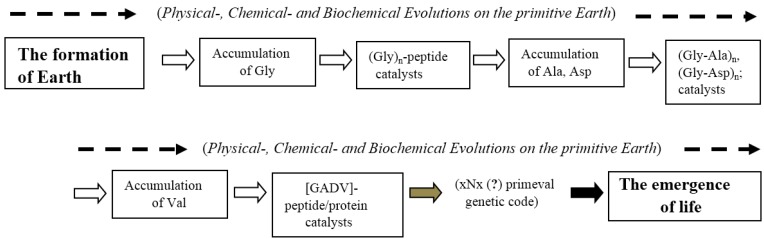
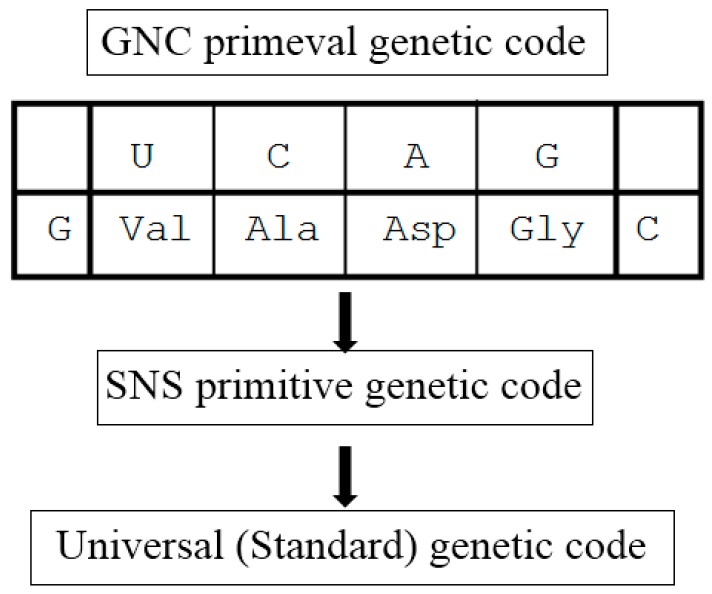
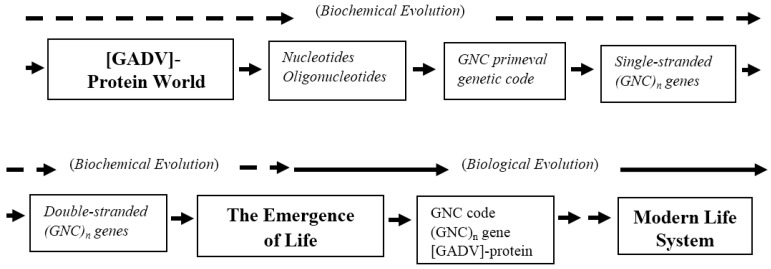
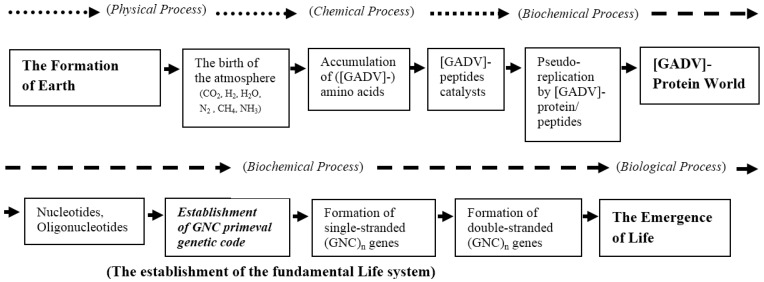
It is no doubt quite difficult to solve the riddle of the origin of life. So, firstly, I would like to point out the kinds of obstacles there are in solving this riddle and how we should tackle these difficult problems, reviewing the studies that have been conducted so far. After that, I will propose that the consecutive evolutionary steps in a timeline can be rationally deduced by using a common event as a juncture, which is obtained by two counter-directional approaches: one is the bottom-up approach through which many researchers have studied the origin of life, and the other is the top-down approach, through which I established the [GADV]-protein world hypothesis or GADV hypothesis on the origin of life starting from a study on the formation of entirely new genes in extant microorganisms. Last, I will describe the probable evolutionary process from the formation of Earth to the emergence of life, which was deduced by using a common event—the establishment of the first genetic code encoding [GADV]-amino acids—as a juncture for the results obtained from the two approaches.
Overview
The claims and statistics of this paper haven’t been checked yet.
Free: it reads the open-access text and checks the first 5 claims that cite a source we can check. Create a free account to check every claim.
Integrity signals
Registry
Cites
Statistics
Figures



Verification
Claims the paper makes
The claims and statistics of this paper haven’t been checked yet.
Free: it reads the open-access text and checks the first 5 claims that cite a source we can check. Create a free account to check every claim.
Claims other papers make about this one
Each is checked against this paper’s own text: does it say what the citing paper says it does?
In the citing paper
“The bridging of all the critical advances made by chemistry’s bottom-up and biology’s top-down approaches seems to be an indelible requirement for the advancement of the OoL field [38,39,40].”
From The Future of Origin of Life Research: Bridging Decades-Old Divisions (2020) · cites this paper as [39]
Self-check
Percentages, sums and reported differences re-computed from the paper’s own numbers.
The self-check needs the paper’s full text.
Citations
Cites
A Production of Amino Acids Under Possible Primitive Earth Conditions
Miller, S. L. (1953) · Science · doi:10.1126/science.117.3046.528 · Cited by 3,522
Gilbert, W. (1986) · Nature · doi:10.1038/319618a0 · Cited by 2,721
The RNA moiety of ribonuclease P is the catalytic subunit of the enzyme
Guerrier-Takada, C., Gardiner, K., Marsh, T., Pace, N., & Altman, S. (1983) · Cell · doi:10.1016/0092-8674(83)90117-4 · Cited by 2,684
Kruger, K., Grabowski, P. J., Zaug, A. J., Sands, J., Gottschling, D. E., & Cech, T. R. (1982) · Cell · doi:10.1016/0092-8674(82)90414-7 · Cited by 2,331
Gilbert, W. (1986) · Nature · Cited by 1,941
Submarine Thermal Springs on the Galápagos Rift
Corliss, J. B., Dymond, J., Gordon, L. I., Edmond, J. M., von Herzen, R. P., Ballard, R. D., Green, K., Williams, D., Bainbridge, A., Crane, K., et al. (1979) · Science · doi:10.1126/science.203.4385.1073 · Cited by 1,898 · cited 1×
“It is supposed that deep-sea hydrothermal environments were important sites for the synthesis of bioorganic molecules, leading to the emergence of life [29].”
BackgroundMiller, S. L., & Urey, H. C. (1959) · Science · doi:10.1126/science.130.3370.245 · Cited by 1,405 · cited 1×
“About 60 years ago, Miller published results showing that amino acids and nucleobases were synthesized by repeated electrical discharging into a reducing gas mixture containing CH4, NH3, H2, and H2O, which imitates lightning in the primitive atmosphere [4,23–25].”
BackgroundKasting, J. F. (1993) · Science · doi:10.1126/science.11536547 · Cited by 1,374
Chyba, C., & Sagan, C. (1992) · Nature · doi:10.1038/355125a0 · Cited by 1,321 · cited 1×
“Although, of course, which organic compounds were synthesized with prebiotic means at quantitatively high amounts depends on primitive Earth’s conditions, such as the composition of the early terrestrial atmosphere [22].”
BackgroundProduction of Some Organic Compounds under Possible Primitive Earth Conditions1
Miller, S. L. (1955) · Journal of the American Chemical Society · doi:10.1021/ja01614a001 · Cited by 827
Research works printed but not linked: 1
- Ikehara K. Simulation of gene evolution: Evidence for GC-NSF(a) hypothesis on the origin of genes Viva Origin. 2003 31 201 215
Cited by
Nonenzymatic Metabolic Reactions and Life’s Origins
Muchowska, K. B., Varma, S. J., & Moran, J. (2020) · Chemical Reviews · doi:10.1021/acs.chemrev.0c00191 · Cited by 317
The Future of Origin of Life Research: Bridging Decades-Old Divisions
Preiner, M., Asche, S., Becker, S., Betts, H. C., Boniface, A., Camprubi, E., Chandru, K., Erastova, V., Garg, S. G., Khawaja, N., et al. (2020) · Life · doi:10.3390/life10030020 · Cited by 140
“, the protein (or peptide) [39,55,56], lipid [57,58], coenzyme [59], and even virus [60] worlds are some of the most popular theories for the order and/or relevance of appearance of biomolecules on Earth.”
BackgroundMaury, C. P. J. (2018) · Cellular and Molecular Life Sciences · doi:10.1007/s00018-018-2797-9 · Cited by 130
Coenzyme world model of the origin of life
Sharov, A. A. (2016) · Biosystems · doi:10.1016/j.biosystems.2016.03.003 · Cited by 55
“Despite of the large number of publications on the origin of life (sf. reviews Ikehara, 2016; Sponer et al., 2016; Weber, 2007), the problem is rarely addressed from the systems theory perspective.”
BackgroundThe evolution of the genetic code: Impasses and challenges
Kun, Á., & Radványi, Á. (2017) · Biosystems · doi:10.1016/j.biosystems.2017.10.006 · Cited by 59
“Ikehara (Ikehara, 2016), for example, proposed that oligomers of the VADG amino acids were the first to appear.”
BackgroundSelf-Referential Encoding on Modules of Anticodon Pairs—Roots of the Biological Flow System
Guimarães, R. C. (2017) · Life · doi:10.3390/life7020016 · Cited by 29
Lei, L., & Burton, Z. F. (2021) · Transcription · doi:10.1080/21541264.2021.1927652 · Cited by 23
van der Gulik, P. T. S., & Hoff, W. D. (2016) · PLoS ONE · doi:10.1371/journal.pone.0158342 · Cited by 23
Origin of Life: The Point of No Return
Kunnev, D. (2020) · Life · doi:10.3390/life10110269 · Cited by 25
The 3 31 Nucleotide Minihelix tRNA Evolution Theorem and the Origin of Life
Lei, L., & Burton, Z. F. (2023) · Life · doi:10.3390/life13112224 · Cited by 13
“Consistent with a GADV–tRNA world [36,49–52,58], GADV occupies the most favored The closest homology of tRNA Pri and tRNA Gly is consistent with life evolving from a tRNA–polyglycine world [23]. row of the code, row 4 (BNC).”
The Origin of tRNA Deduced from Pseudomonas aeruginosa 5′ Anticodon-Stem Sequence
Ikehara, K. (2019) · Origins of Life and Evolution of Biospheres · doi:10.1007/s11084-019-09573-w · Cited by 12
“(1) There is a serious problem to elucidate the processes by which the first genetic system was formed on the primitive Earth, only with usual bottom-up approaches (Ikehara 2016).”
BackgroundSelf-citationNahálka, J. (2021) · Frontiers in Genetics · doi:10.3389/fgene.2021.763995 · Cited by 9
“It seems that glycine, alanine, aspartic acid, and valine (G, A, D, and V, respectively), which are coded with GNC codons, were the first amino acids in the first peptides/proteins (Ikehara, 2009, 2016).”
BackgroundHow Did Life Emerge in Chemically Complex Messy Environments?
Ikehara, K. (2022) · Life · doi:10.3390/life12091319 · Cited by 8
“Therefore, I consider that a parallel use of both bottom-up approaches, which have been carried out thus far, and top-down approaches, for example, using database analyses of modern genes and proteins, could hold one of the keys to solving the mystery of the origin of life [13].”
BackgroundSelf-citationKato, K., Nakayoshi, T., Sato, M., Kurimoto, E., & Oda, A. (2020) · ACS Omega · doi:10.1021/acsomega.0c01012 · Cited by 7
Lubell, W. D. (2016) · Topics in heterocyclic chemistry · doi:10.1007/978-3-319-49124-0 · Cited by 8
Colombet, J., Fuster, M., Billard, H., & Sime‐Ngando, T. (2020) · Viruses · doi:10.3390/v12080881 · Cited by 11
Prebiotic Peptides Based on the Glycocodon Theory Analyzed with FRET
Nahálka, J., & Hrabárová, E. (2021) · Life · doi:10.3390/life11050380 · Cited by 6
“Ikehara proposed a prebiotic protein world enriched with peptides/proteins composed of glycine, alanine, aspartic acid, and valine (G, A, D, and V, respectively; also abbreviated as Gly, Ala, Asp, and Val) [4,5].”
BackgroundCoenzyme World Model of the Origin of Life
Sharov, A. A. (2018) · Elsevier eBooks · doi:10.1016/b978-0-12-811940-2.00017-4 · Cited by 3
Lei, L., & Burton, Z. F. (2024) · DNA · doi:10.3390/dna4030017 · Cited by 3
Pollack, J. D., Gerard, D., Makhatadze, G. I., & Pearl, D. K. (2019) · Journal of Biomolecular Structure and Dynamics · doi:10.1080/07391102.2019.1679666 · Cited by 3
Chemical Evolution of Life on Earth
Lei, L., & Burton, Z. F. (2025) · Genes · doi:10.3390/genes16020220 · Cited by 2
Life Emerged as the “Protein/Metabolism-First” Theory ExpectsPreprint
Ikehara, K. (2018) · Preprints.org · doi:10.20944/preprints201811.0620.v1 · Cited by 1
Self-citationChemical Origins of Life, Agency, and Meaning
Sharov, A. A. (2024) · Wiley eBooks · doi:10.1002/9781119865667.ch9 · Cited by 4
A Recipe to Evolve Complex Life Chemically on Earth
Lei, L., & Burton, Z. F. (2025) · Genes · doi:10.3390/genes16101136 · Cited by 1
“A bottom-up approach would be to reproduce pre-life chemistry in a laboratory [59].”
Chaos, Order and Systematics in Evolution of the Genetic CodePreprint
Lei, L., & Burton, Z. F. (2020) · Preprints.org · doi:10.20944/preprints202009.0162.v2 · Cited by 2
Under what kind of life system could space life emerge?
Ikehara, K. (2019) · Elsevier eBooks · doi:10.1016/b978-0-12-812742-1.00009-x
Self-citationSharov, A. A., & Tønnessen, M. (2021) · Biosemiotics/Biosemiotics. Bookseries · doi:10.1007/978-3-030-89484-9_5
Towards Revealing the Origin of Life: Introduction
Ikehara, K. (2021) · Towards Revealing the Origin of Life · doi:10.1007/978-3-030-71087-3_1
Self-citationIkehara, K. (2021) · Springer eBooks · doi:10.1007/978-3-030-71087-3_10
Self-citationChaos, Order and Systematics in Evolution of The Genetic CodePreprint
Lei, L., & Burton, Z. F. (2020) · Preprints.org · doi:10.20944/preprints202009.0162.v1
“Class I aaRS enzymes were generated by refolding an ancient GlyRS-IIA probably to ValRS-IA (Figure 7).”
BackgroundResultInfluentialThe Evolution of the First Code
Lei, L., de Farías, S. T., & Burton, Z. F. (2026) · Genes · doi:10.3390/genes17050544
Metadata
- Authors
- Ikehara, K.
- Affiliations
- International Institute for Advanced Studies (JP)
- Corresponding author
- Ikehara, Kenji
- ORCID
- Ikehara, Kenji
- Venue
- Life
- Publisher
- MDPI AG
- Published
- 2016-01-26
- Volume
- 6
- Issue
- 1
- Pages
- 6
- ISSN
- 2075-1729 (ISSN-L)
- PMC
- PMC4810237
- OpenAlex
- W2253269306
- Cited by
- 32
- References
- 61
- Citations by year
- 2026: 1 · 2025: 3 · 2024: 2 · 2023: 1 · 2022: 1 · 2021: 6 · 2020: 7 · 2019: 3 · 2018: 3 · 2017: 2 · 2016: 3
- FWCI
- 0.26
- Type
- journal article
- Language
- en
- Open access
- gold
- doi.org
- Licence
- Locations
- Life (publishedVersion, cc-by)
- PubMed Central (publishedVersion, cc-by)
- PubMed (publishedVersion)
- DOAJ (DOAJ: Directory of Open Access Journals) (submittedVersion, cc-by-sa)
- Topics
- Physical Sciences › Physics and Astronomy › Astronomy and Astrophysics › Origins and Evolution of Life
- Life Sciences › Biochemistry, Genetics and Molecular Biology › Molecular Biology › RNA and protein synthesis mechanisms
- Life Sciences › Biochemistry, Genetics and Molecular Biology › Genetics › Evolution and Genetic Dynamics
- Keywords
- origin of life, bottom-up approach, top-down approach, prebiotic evolution
About these checks
Registry, retraction, Cites and statistics results are computed, not judged, with one exception: a printed reference that no index lists is read once by a model before it counts as a citation error. Claims are extracted by a model and kept only when their quote appears verbatim in the text; each cited source is then checked, with a model’s help, for whether it says what the claim relies on. Those verdicts can be wrong — read the claim’s quote and the cited source before relying on one.
Statistics and arithmetic are recomputed, not judged.
Confidence bands are shown only for fields calibrated on our annotated test set. None is calibrated yet, so no band is shown.
What counts as a claim ›How we measure confidence ›How we check this ›
Are you an author, or do you see a problem with this page? Request a review
Data sources
Bibliographic data: Semantic Scholar, OpenAlex, Crossref.
Contains information from the Semantic Scholar Academic Graph Datasets, made available under the ODC Attribution License (ODC-BY 1.0).
Semantic Scholar’s data is described in: Kinney, R., et al. (2023). The Semantic Scholar Open Data Platform. arXiv:2301.10140.
